This week’s news in charts.
🚨 US Tariffs
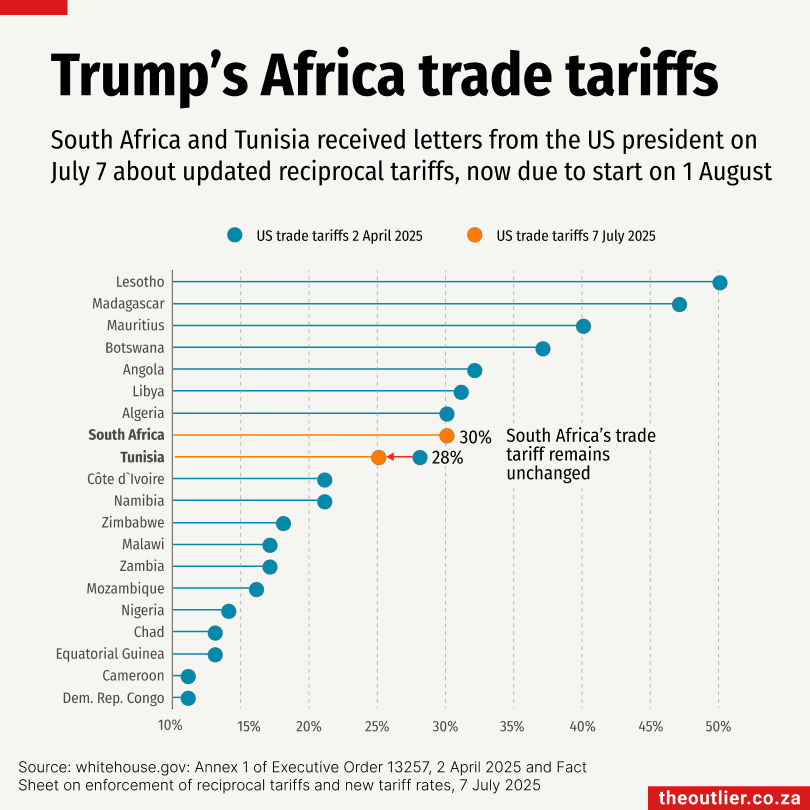
United States President Donald Trump’s reciprocal trade tariffs announced on 2 April were due to come into effect this week, but instead he extended the 90-day moratorium to 1 August. He also sent letters to 14 countries, informing them of their ‘new’ tariffs. South Africa and Tunisia were the only two African countries that got one.
South Africa’s ‘new’ tariff is the same 30% as the old one from April. Tunisia’s tariff was reduced from 28% to 25%.
A fact sheet on the White House website which states that ‘President Trump is the best trade negotiator in history’, also suggests he may be open to more trade discussions and deals. It’s anyone’s guess whether the 30% tariff will be implemented on 1 August.
President Cyril Ramaphosa said that South Africa will continue with its ‘diplomatic efforts towards a more balanced and mutually beneficial trade relationship’.
South Africa’s platinum, gold, coal, manganese and chrome are among products have been excluded from the US tariffs.
Uncertainty has reportedly already had a serious impact on Lesotho, which faces 50% tariffs, the highest in the world.
💡 Elsewhere: One of the most interesting ways we’ve seen of visualising the impact of these tariffs on African countries is the Tariff Turbulence Simulator from the ONE Campaign. Take a moment to check it out, and while you’re there check out some of their other excellent data work.
🔋 Battery storage costs drop
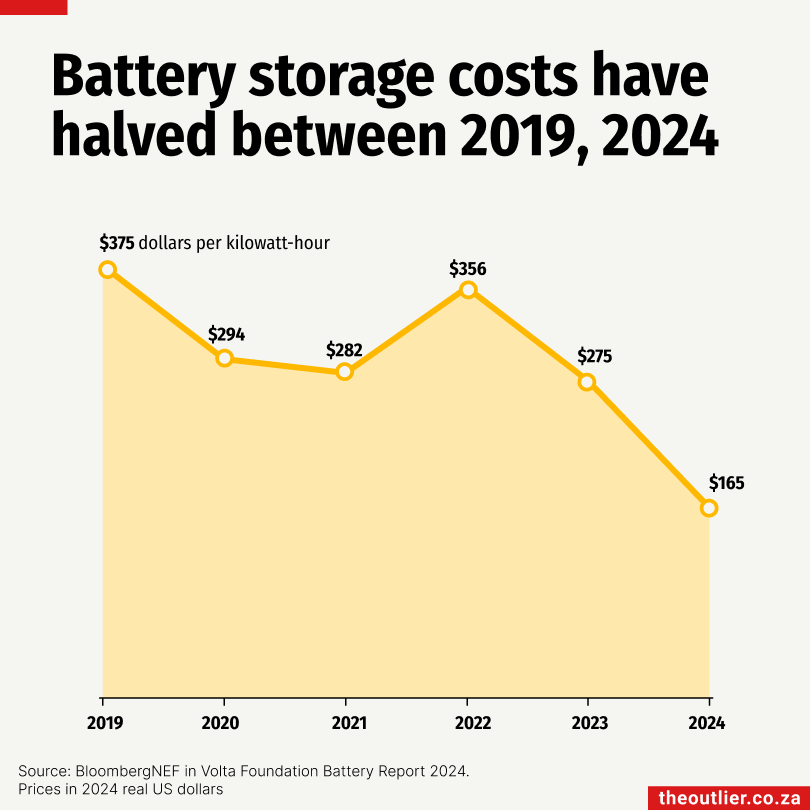
The global average cost of battery storage fell by 40% between 2023 and 2024, according to the Volta Foundation Battery Report 2024. Battery energy storage systems are a bit like giant rechargeable batteries storing excess electricity generated by sources, like solar or wind, so they can be used when needed. In 2024 there was 69GW of battery storage deployed around the world, just over half of it in China, followed by the United States.
In 2019, battery storage cost $375 per kilowatt-hour (kWh). By 2024 that price had dropped to $165/kWh. The price decrease has driven a surge in the number of new battery storage projects being built around the world.
South Africa is no exception. In the last year and a half, 18 preferred bidders have been appointed to build grid-linked battery storage capacity under the government’s Battery Energy Storage Independent Power Producer Procurement Programme (BESIPPPP).
One of them, the 153MW Red Sands Battery Energy Storage System, the largest standalone system in the country, reached financial close this month. The project, which is near Upington in the Northern Cape, has a 15-year purchase agreement with Eskom and is expected to be completed in 2027.
☀️ Sun power
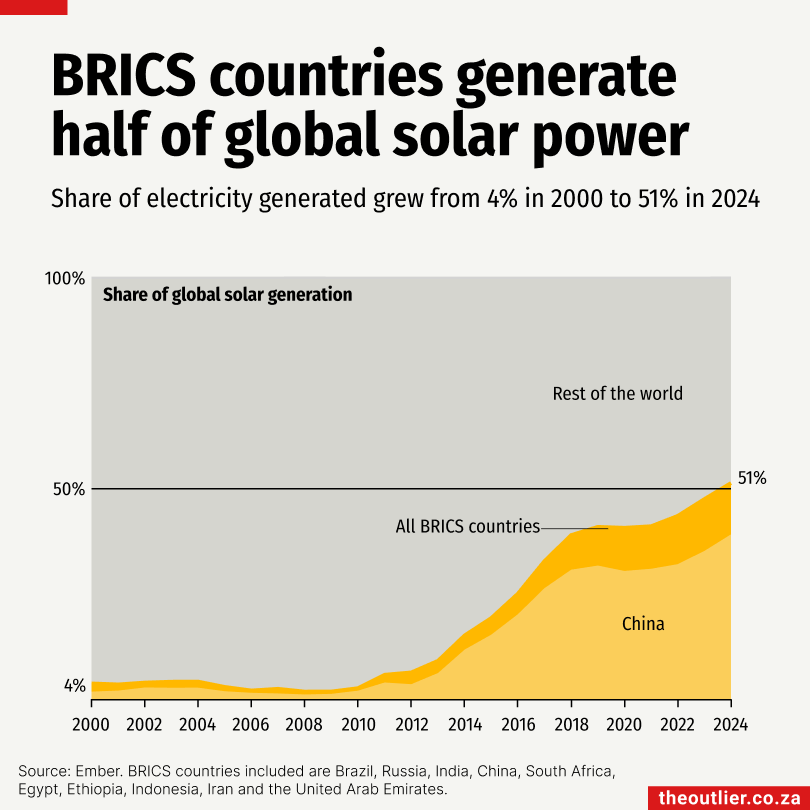
A report by energy think tank Ember shows that the BRICS countries – Brazil, Russia, India, China and South Africa, plus Egypt, Ethiopia, Indonesia, Iran and the United Arab Emirates – together accounted for half (51%) of global solar electricity generation in 2024.
China is the driving force. It generated 39% of the world’s solar electricity in 2024, up from 12% in 2014, according to the Ember report “Solar BRICS: Emerging economies now lead the world’s clean energy race.”
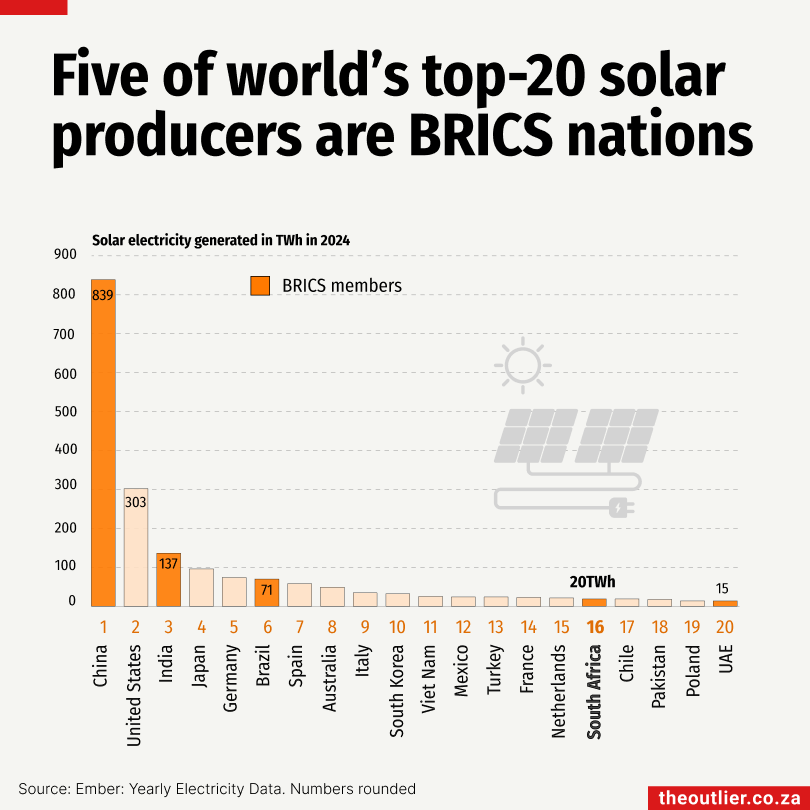
South Africa contributed 0.9% of the world’s solar generation and ranked 16th out of the top 20 solar producers in the world in 2024.
But China leads by a huge margin, generating 839 terawatt hours (TWh) of solar electricity in 2024. The United States was second, generating 303TWh.
Three other BRICS countries were in the top 20, namely India, Brazil and the United Arab Emirates.
📱 Internet disconnect
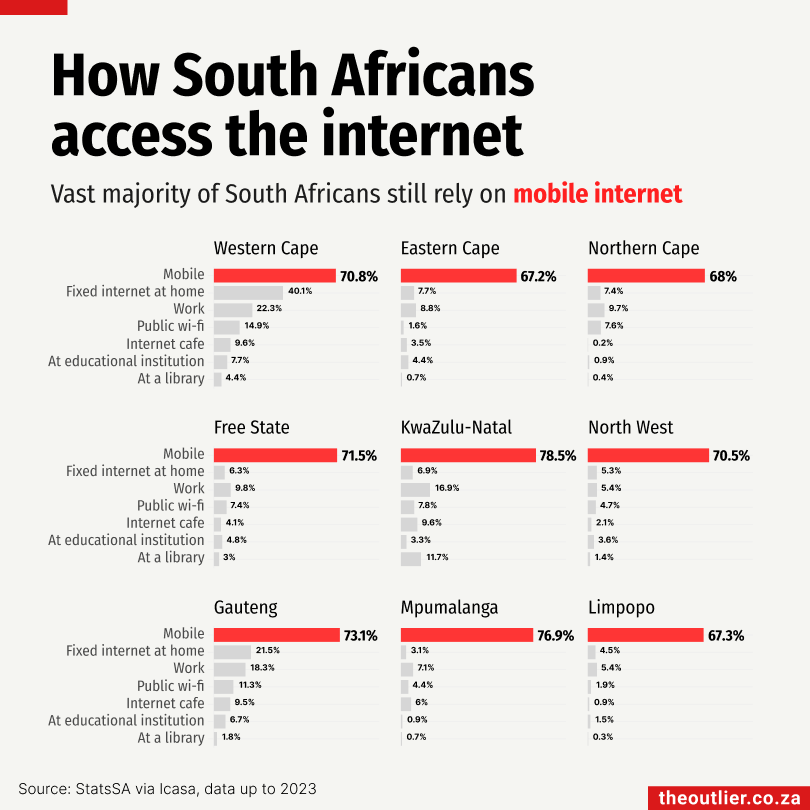
Almost three quarters of South Africans have access to the internet using a mobile phone. Only 14.5% of them have a fixed home internet connection. The home internet numbers are largely skewed by the higher numbers in the Western Cape and Gauteng. In most other provinces the percentage of people with fixed home internet is well under 10% according to the March 2025 State of the ICT Sector in South Africa report by Icasa.
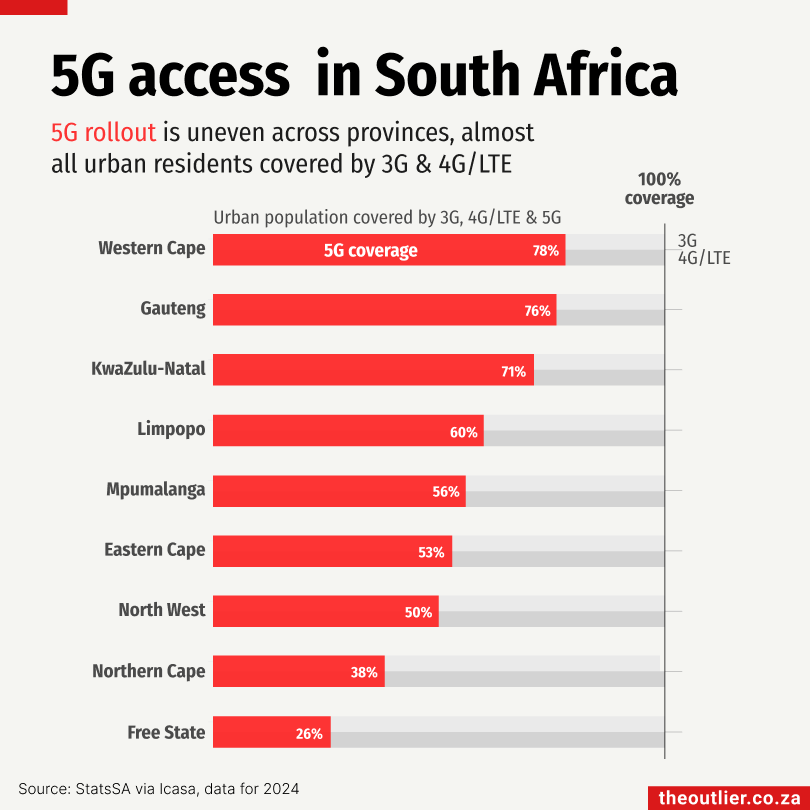
In amongst the many tables in the report is a 2024 summary of the percentage of urban residents covered by newer mobile data technologies like 5G. Almost all of South Africa’s urban residents are currently covered by 3G and 4G.
5G coverage is highest in the Western Cape and Gauteng, and significantly lower in the Northern Cape and Free State.
3G networks are being phased out in South Africa and all 2G and 3G networks should be shut down by December 2027. Networks have been prohibited from introducing new 3G devices since December 2024.
4G offer download speeds of around 100Mbps (depending on conditions) while 5G networks are capable of speeds around 10 times that.
🤔 Chart quiz
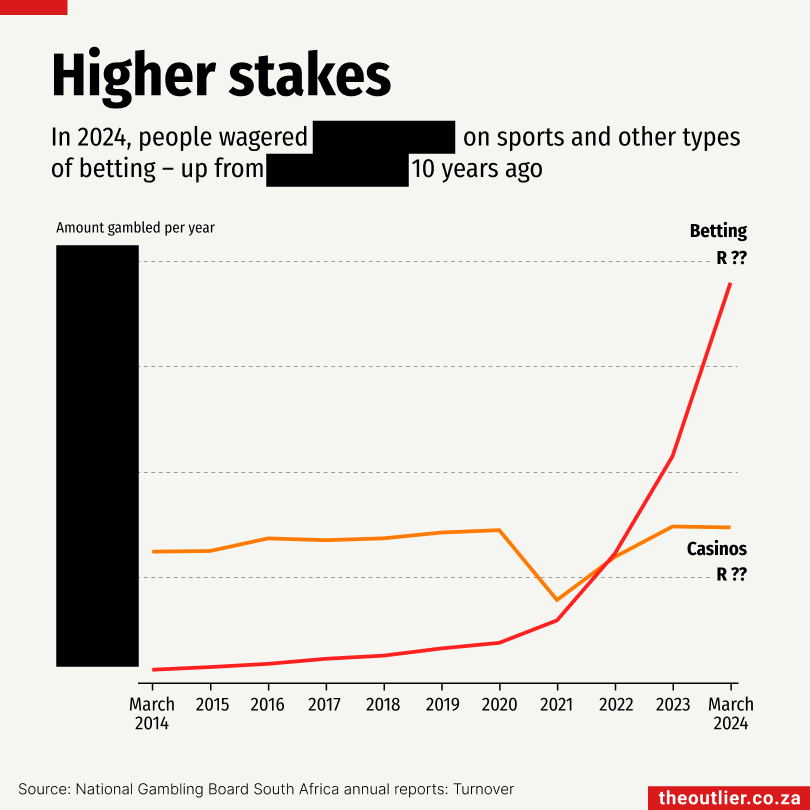
Can you fill in these numbers?
Gambling is booming in South Africa. Do you know how much was wagered by South Africans on betting and casinos?