The week that was in cahrts.
🔋 Backup power
In last week’s newsletter we looked at how the global cost of battery energy storage has plummeted since 2022. That got us wondering what South Africa is doing about adding battery storage to the energy mix.
Things are moving, it would seem. The government launched what it calls its Battery Energy Storage Independent Power Producer Procurement Programme in March 2023. Since then, it has opened three bid windows and announced 18 preferred bidders. The map below shows the locations of the 18 projects those preferred bidders are working on.

Five of those projects have reached the ‘financial close’ stage, which means that they should be built and ready to operate by the end of 2026. Together they will add 513MW/2,023MWh capacity to the grid.
Why is this kind of grid-connected battery storage important? There are a few reasons, three of which are:
- It supports the expansion of renewable energy on the national grid. Battery storage can store the electricity generated by wind and solar when their electricity output is high and release it when it is low.
- Batteries increase the available grid capacity.
- Batteries can be charged from the grid and can store a substantial amount of electricity. This can be used to boost the electricity network during peak hours, reducing the strain on the network.
Connecting battery energy storage to the grid is also a way to alleviate loadshedding, says Eskom.
Eskom started its own battery energy storage project around 2018. Twelve grid-connected battery storage systems were planned, and, according to Eskom’s 2024 annual report, three have been commissioned, one in Worcester in the Western Cape and two in KwaZulu-Natal, with a combined capacity of 68MW/292MWh.
Eskom’s Elandskraal battery storage system, in KwaZulu-Natal, which is the smallest of the three and was commissioned in October 2024, has 8MW of capacity. That’s equivalent to 32MWh of distributed electricity, enough to power a town such as Howick for four hours, says Eskom.
A fourth Eskom battery storage system, Skaapvlei (80MW/320MWh), near the Sere wind farm in the Western Cape, may have been commissioned in January this year, but we are trying to verify that.
All told, three (maybe four) grid-connected battery storage systems have been commissioned so far, with another five due towards the end of 2026.
These massive battery storage systems use lithium-ion technology. So do the much smaller batteries used to store electricity generated by the solar systems installed across the country by homeowners as well as commercial, industrial and agricultural enterprises.
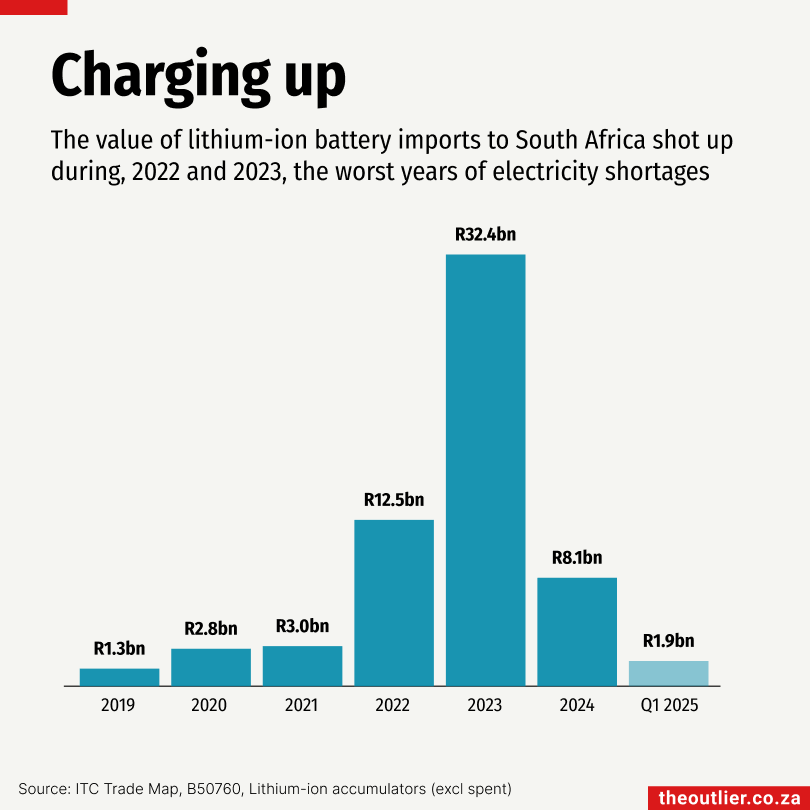
The chart below shows the value of lithium-ion batteries imported to South Africa since 2019. It has dropped since the peak of electricity outages in 2022 and 2023, but the R1.9-billion in imports in the first quarter of 2025 is slightly higher than Q1 2024, so it looks like South Africa is on track to spend about the same amount on battery imports this year. Most of them are imported from China.
▼Brought to you by our partner Electrum
📱 VAS market worth almost R500bn annually
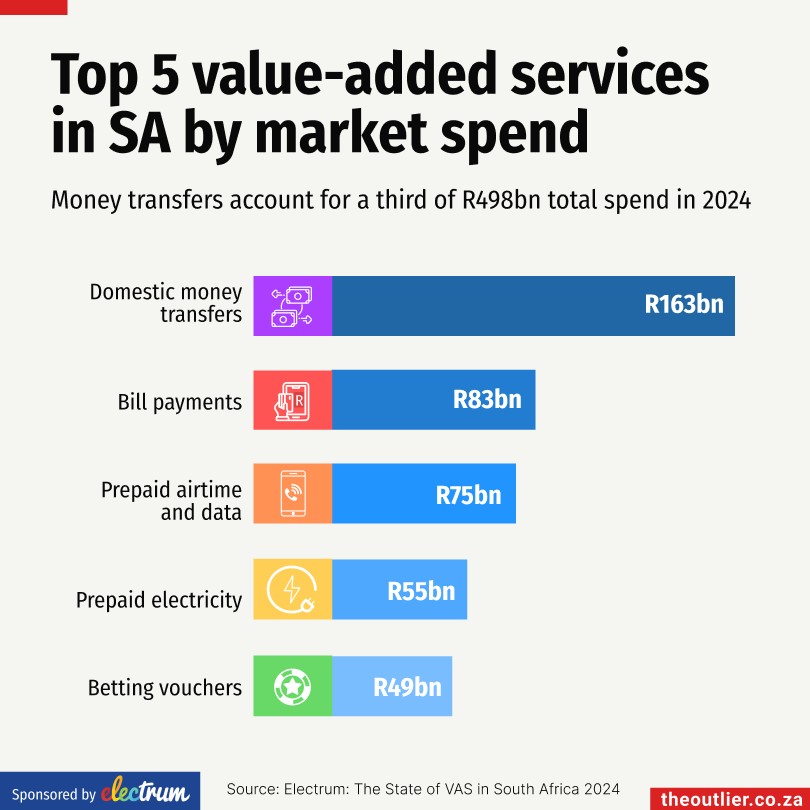
Long seen as a nice-to-have, value-added services (VAS) are now a vital part of South Africa’s payments ecosystem. New research by payments software company Electrum estimates the VAS market to be worth almost R500-billion per year.
In a November 2024 survey of economically active South Africans who manage personal or household payments, the company found that domestic money transfers made up a third of the annual R498-billion spend. This was followed by bill payments, prepaid airtime and data, prepaid electricity and betting vouchers.
The survey was conducted across all nine provinces, with fieldwork in both urban and peri-urban areas. Respondents were selected using quotas based on province, race, age and gender.
Electrum says the findings highlight the growing importance of VAS in everyday financial behaviours.
- Electrum is a next-generation payments software company and trusted partner to leading banks and retailers.
🚢 AGO again?
US President Donald Trump’s 30% tariff on South Africa has dealt a blow to the African Growth and Opportunity Act (AGOA), which is due to expire in September 2025. AGOA provides duty-free access to eligible sub-Saharan African countries for thousands of products, aimed at promoting economic growth through exports.
Thirty-two countries are eligible for AGOA.
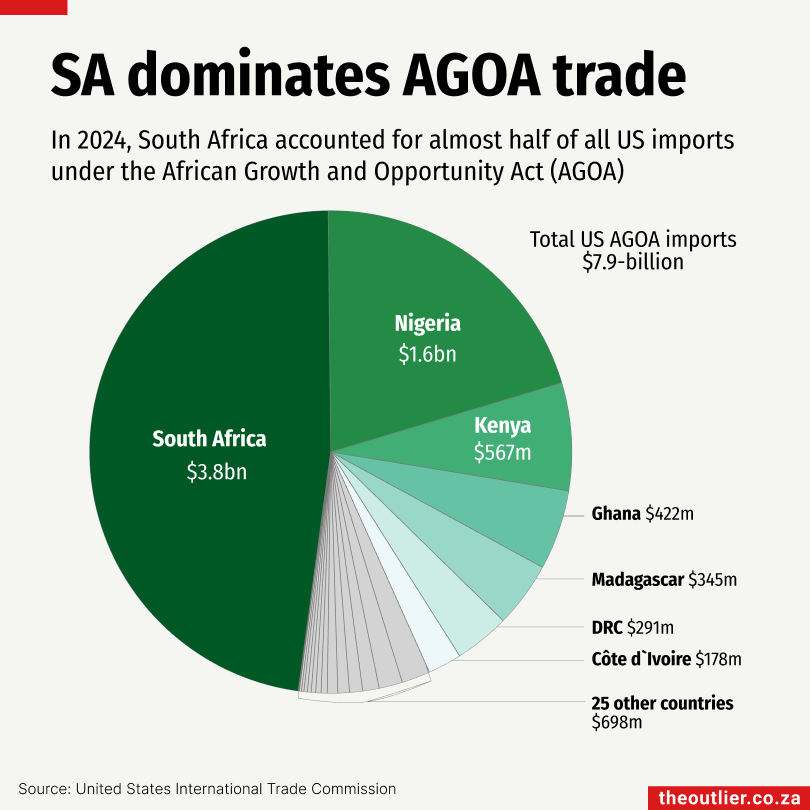
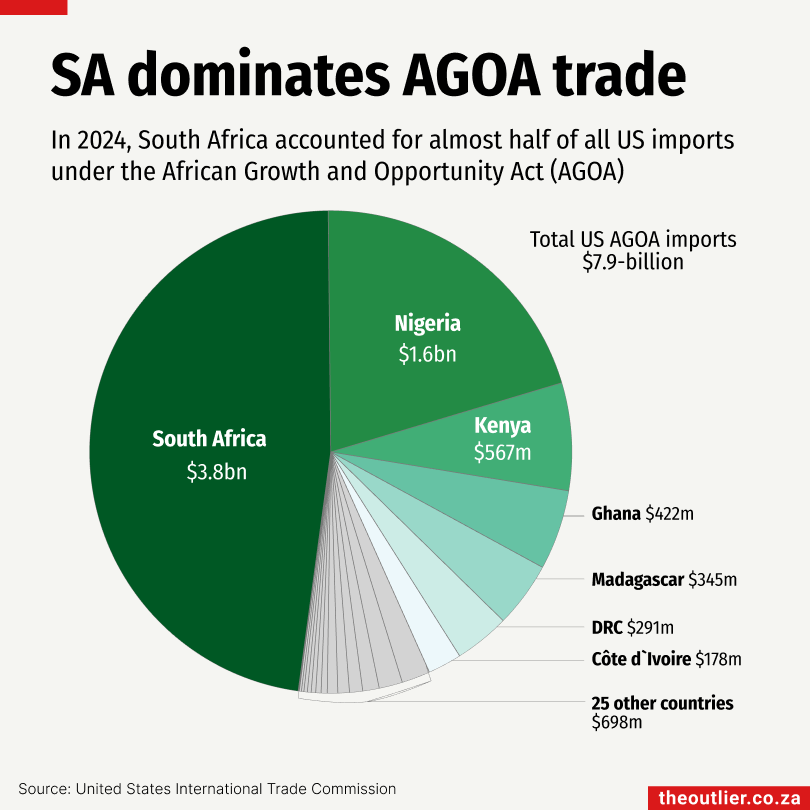
In 2024, South Africa accounted for almost half ($3.8-billion) of the $7.9-billion in US imports under AGOA, followed by Nigeria ($1.6-billion) and Kenya ($567-million), according to US International Trade Commission data.
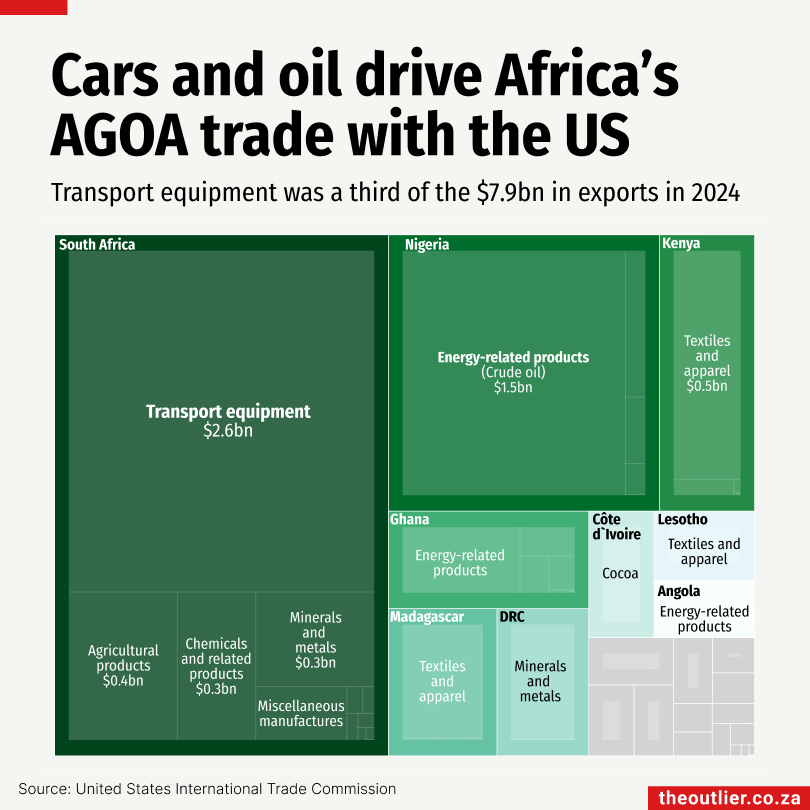
Nigeria mainly exports crude oil, while Kenya’s key exports are textiles.
Roughly 25% of South Africa’s total exports to the US fall under AGOA, according to a 2025 Parliamentary Budget Office report.
South Africa’s top AGOA export is transport equipment. In 2024, the country exported 24,681 vehicles to the United States under this agreement, according to Naamsa, the Automotive Business Council.
“This is not just a trade issue – it’s a socio-economic crisis in the making,” said Naamsa CEO Mikel Mabasa.
“The US tariffs directly threaten thousands of jobs in our sector, disrupt hard-won industrial capabilities, and risk devastating communities such as East London, where the auto sector forms the economic heartbeat of the town. If we cannot retain export markets like the US, we risk turning vibrant industrial hubs into ghost towns.”
South Africa’s automotive industry directly supports over 110,000 formal sector jobs, according to Naamsa.
Is there a solution?
Naamsa has welcomed an early proposal for a quota of 40,000 duty-free vehicle units a year. It is also exploring new markets. “Export diversification and finding new markets is not something that can be achieved overnight. Our global competitors are already redirecting their exports into markets we traditionally serve,” said Mabasa.
Another potential buffer is the African Continental Free Trade Area (AfCFTA), a free trade agreement that includes all 55 members of the African Union. While it may not be able to fully shield South Africa from protectionist policies like the US tariffs, it can help cushion the impact, says Dr Refilwe Lepelle, a senior lecturer in the School of Economics at the University of Cape Town.
“This means going beyond tariff cuts – it requires harmonisation of non-tariff barriers, boosting infrastructure, and building regional value chains,” she explained.
🚔 Losing trust
South Africans don’t trust the police. About one in five people surveyed by the Human Sciences Research Council (HSRC) earlier this year said they ‘trust’ or ‘strongly trust’ the police, but three in five said they ‘distrust’ the police.
Trust in the police has almost halved, from 41% of the people surveyed in 1998 to just 22% in 2024/25, according to an HSRC report, National and provincial trends: Trust in the police, 1998-2025.
Recent allegations by KwaZulu-Natal Police Commissioner Nhlanhla Mkhwanazi that a criminal syndicate has infiltrated South Africa’s law enforcement structures are not going to help. And President Cyril Ramaphosa’s call for a judicial commission to investigate the allegations is also unlikely to restore South Africans’ fading trust in the police.
The most recent survey results are the lowest recorded levels of trust in 27 years, said the HSRC.

Trust has dropped in all nine provinces. There was a time when over 60% of the people in the Northern Cape, Free State and the Eastern Cape said they trusted the police, but, in the survey conducted in early 2025, no province recorded a trust level above 30%.

“While provincial levels and trajectories have varied, the trend points to a deepening legitimacy crisis for SAPS across the country, with historically higher-trust provinces converging downward towards the levels of deep scepticism observed in Gauteng and KwaZulu-Natal,” notes the HSRC.
The survey also found that trust eroded when people felt they were treated unfairly or disrespected, or believed the police lacked impartiality, transparency, or effectiveness.
Why does this matter? The HSRC says, “The risk is that low and diminishing confidence in the police, if left unchecked, will also continue to negatively shape views of key elements of police legitimacy, such as a sense of shared moral values and the duty to obey the police.”
🤔 Chart quiz
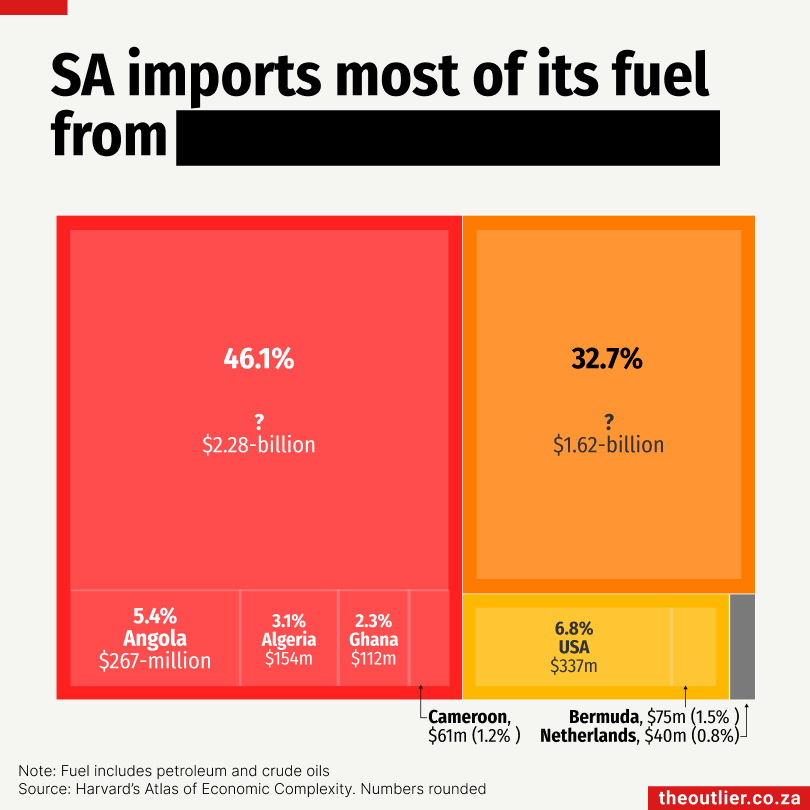
Can you complete this chart?
Where does South Africa import most of its oil from?