The week that was in charts, 1 August 2025.
💰 Tariff troubles
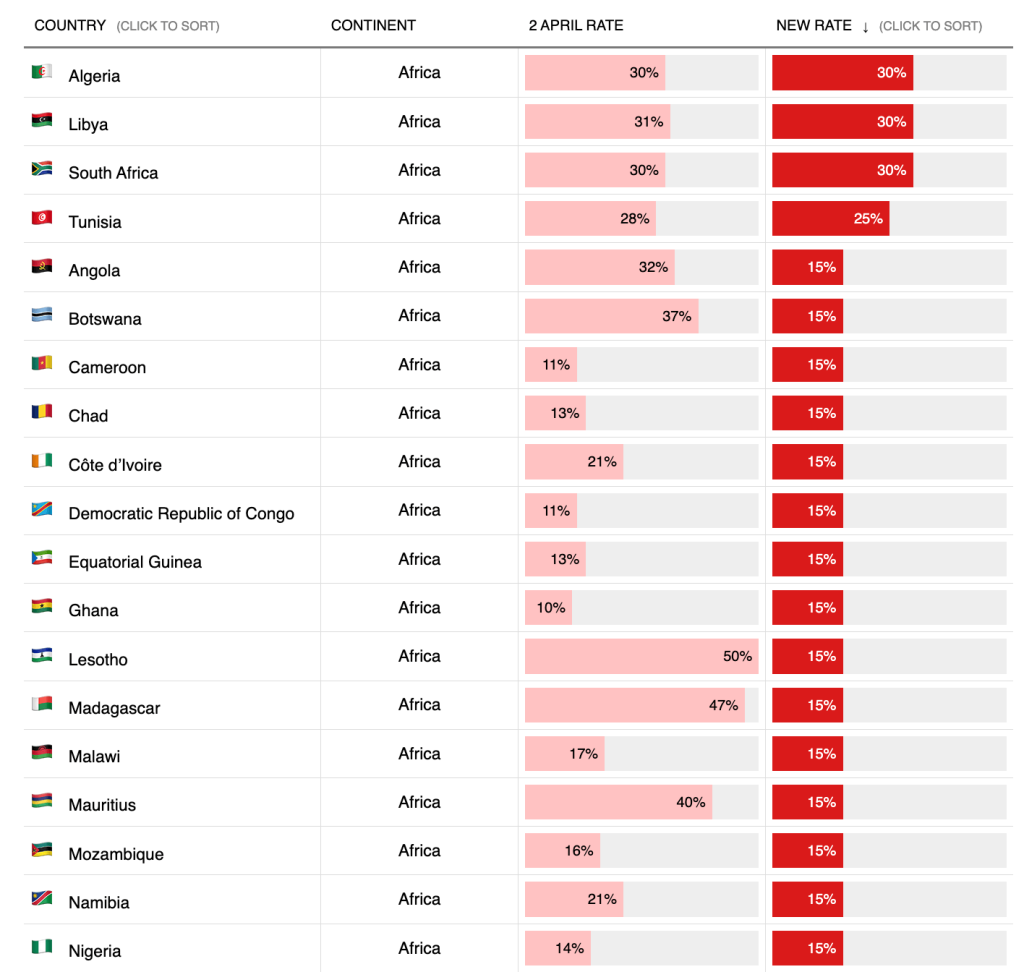
South Africa didn’t manage to broker a last-minute deal to reduce the 30% trade tariff imposed by United States President Donald Trump in April. The tariff was due to come into effect today, but a new executive order issued by Trump yesterday has moved the start date to 7 August.
Lesotho, Madagascar, Mauritius and Botswana, which had higher tariffs than South Africa on 2 April, all had their tariffs reduced to 15% yesterday. Lesotho’s dropped from 50%, the highest in the world.
South Africa’s tariffs are now the highest in Africa.
We’ve collected all the tariff data and created an explorable table comparing the 2 April tariffs with the August 2025 updates. You can find the table here.
The 30% tariff is a source of “great anxiety” for citrus growers in the Western Cape and Northern Cape who are reliant on trade with the US, says the Citrus Growers’ Association of Southern Africa (CGA). These two provinces export about 7-million 15kg cartons to the US a year.
Hundreds of thousands of cartons of citrus are currently in packhouses ready to be shipped to the US. But the implementation of a 30% tariff will mean much of this fruit will be unsold, says the CGA.
The tariff is not the only problem growers face. “Citrus is grown for designated markets, each with their own precise market and plant health specifications. It is not easy to simply divert citrus from the US and find a new market,” the CGA wrote in a letter to President Cyril Ramaphosa.
Diverting fruit to other markets could depress the price in those markets through oversupply, which would negatively impact the entire Southern African citrus industry, the CGA added.
There are a few days left to get the fruit onto ships before 7 August, when the 30% tariff will kick in.
South Africa is the world’s second-largest exporter of citrus. In the 2024 season more than 2-million tonnes of oranges, mandarins, grapefruits and lemons were shipped overseas. The two biggest markets are Europe (36%) and the Middle East (19%). North America, which includes the United States and Canada, takes 9% of the exports.

💰 Pay perks
Given the state of municipal services (or lack of them) in Johannesburg, we thought it would be interesting to look at what the chief executives of the companies in charge of delivering them earn.
The biggest annual package of R4.84-million goes to the chief executive of City Power – that’s without a bonus. The CEO of Pikitup’s R4.36-million package, does include a ‘performance bonus’ of R536,000.
Looking for the funny side can help keep us sane. For example, in July the Democratic Alliance held a first birthday party for one of the city’s biggest potholes, with party hats and cake. They named the hole ‘Kenny se gat’ after Kenny Kunene, the city councillor responsible for transport, who has since resigned from the council. He has been replaced by 24-year-old Liam Jacobs, who has no local government experience, recently defected to the Patriotic Alliance and has a big following on TikTok.
Kunene, whose resignation had nothing to do with potholes, blamed Johannesburg Water for not fixing the pothole, which blamed the Johannesburg Road Agency, which blamed Johannesburg Water.
The CEO’s of both Joburg Water and the Joburg Road Agency both got ‘performance bonuses’ of R218,000 and R191,000 respectively.
As the bucks get passed around, the hole just gets deeper.

High earners prefer banks over retailers to pay bills
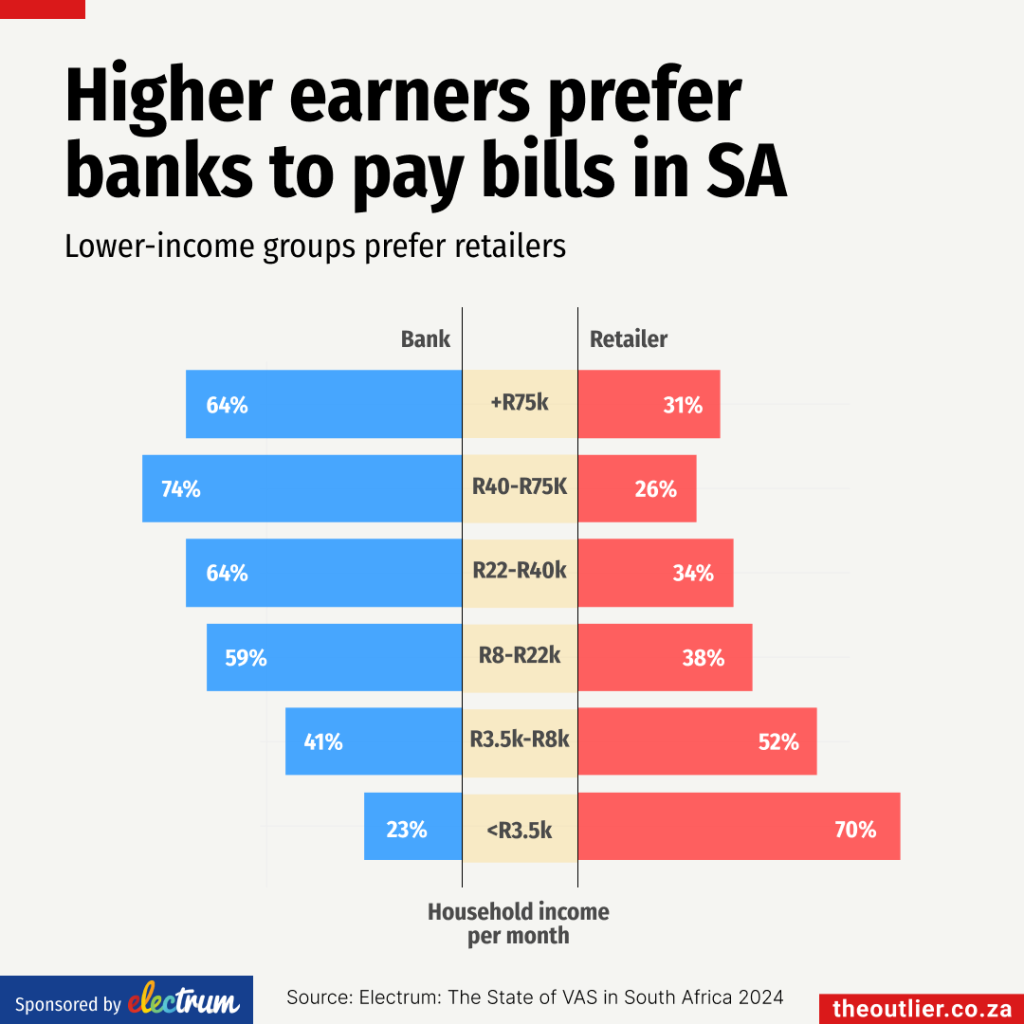
How much you earn can determine where you will pay your bills. Banks are a popular choice for households earning above R8,000 a month, according to recent survey research by Electrum Software. But if your household earns less than R8,000 a month, you’re more likely to pay your bills at a retailer.
Electrum found that different consumers pay their bills in ways that fit into their day-to-day lifestyles and budgets.
Their survey, conducted in November 2024, examined how South Africans purchase value-added services (VAS) such as prepaid airtime and data, prepaid electricity, and betting vouchers. With fieldwork taking place across all nine provinces, in both urban and peri-urban areas, Electrum says the findings highlight how VAS purchasing has become ingrained in everyday behaviour, with growth potential remaining for all businesses selling these services.
- Electrum is the next-generation payments software company, powering payments for banks and retailers.
🖥️ Surf & software
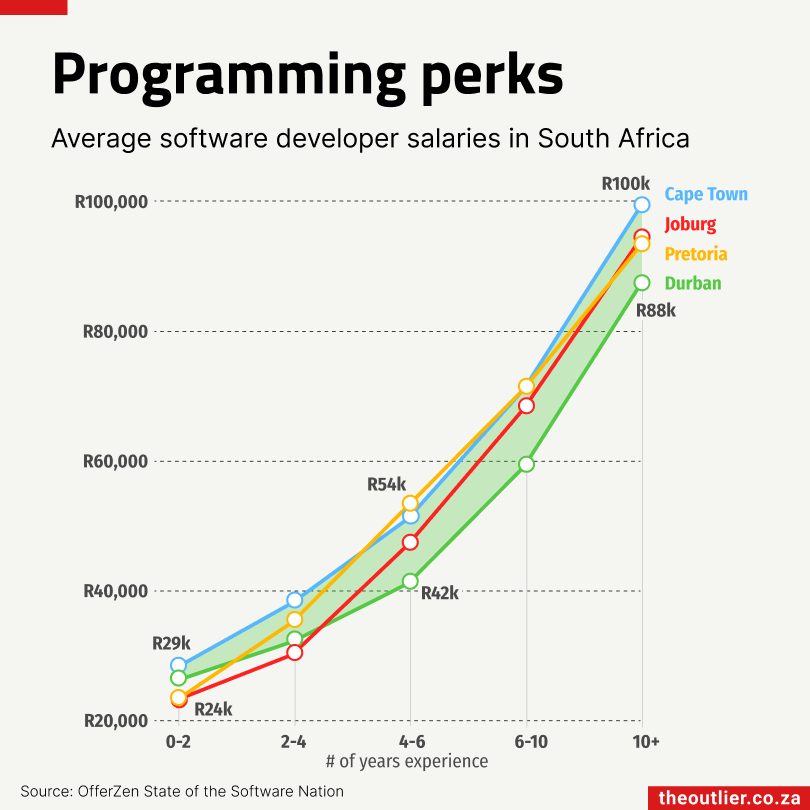
Cape Town developers continue to earn more on average than developers in other parts of the country. In the most recent OfferZen State of the Software Nation report, experienced developers in Cape Town earn around R100k/month, roughly R12,000 more than their coastal compatriots in Durban.
Interestingly, Durban developers seem to start off strong in the first years of their career but tend to fall behind over the following decade.
#TIL (Today I learned)
In a new occasional section in this newsletter I’m sharing some of the data, AI and visualisation things I’ve been experimenting with. This week it’s a quick video on how I made an SA dam dashboard with no coding. You can see the video here. And the demo dashboard is here. If this is your kind of thing, you can also find me on TikTok talking about charts and data viz.