The week that was in charts.
💰 It’s criminal
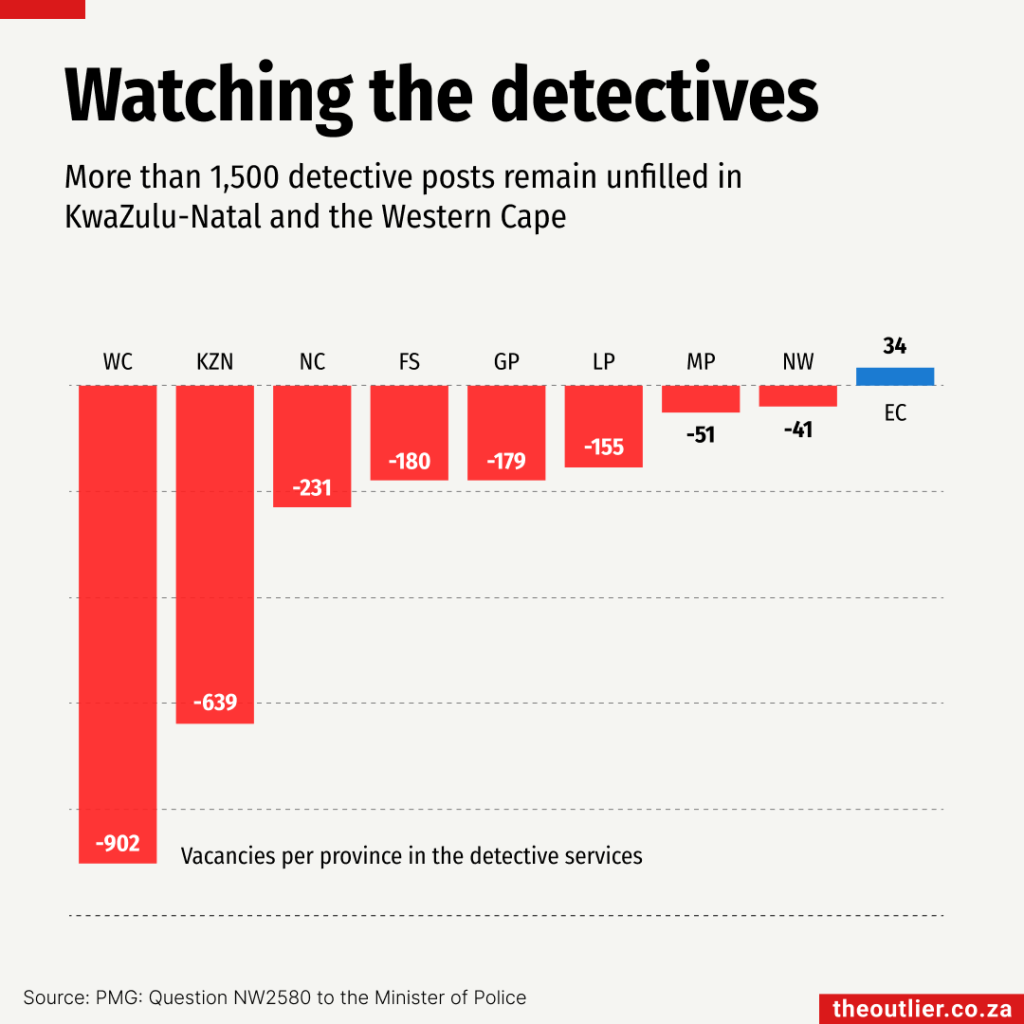
South Africa’s police service has more than 2,000 unfilled detective positions.
In a written response to Build One South Africa’s Mmusi Maimane, the minister of police, said that the Western Cape and KwaZulu-Natal were the worst off, reporting 902 and 639 vacancies, respectively.
The Eastern Cape was the only province where the number of filled detective posts exceeded the number funded, a rare surplus.
Without enough detectives, investigations stall, and justice is delayed. In March 2025, nearly half a million case dockets (499,873) were more than two years old, including 79,401 murder cases, according to a parliamentary response.
Adding to the problem is the fact that even when cases make it to court, only 12% result in a guilty verdict, according to criminologist Guy Lamb.
✈️ Flights of fancy
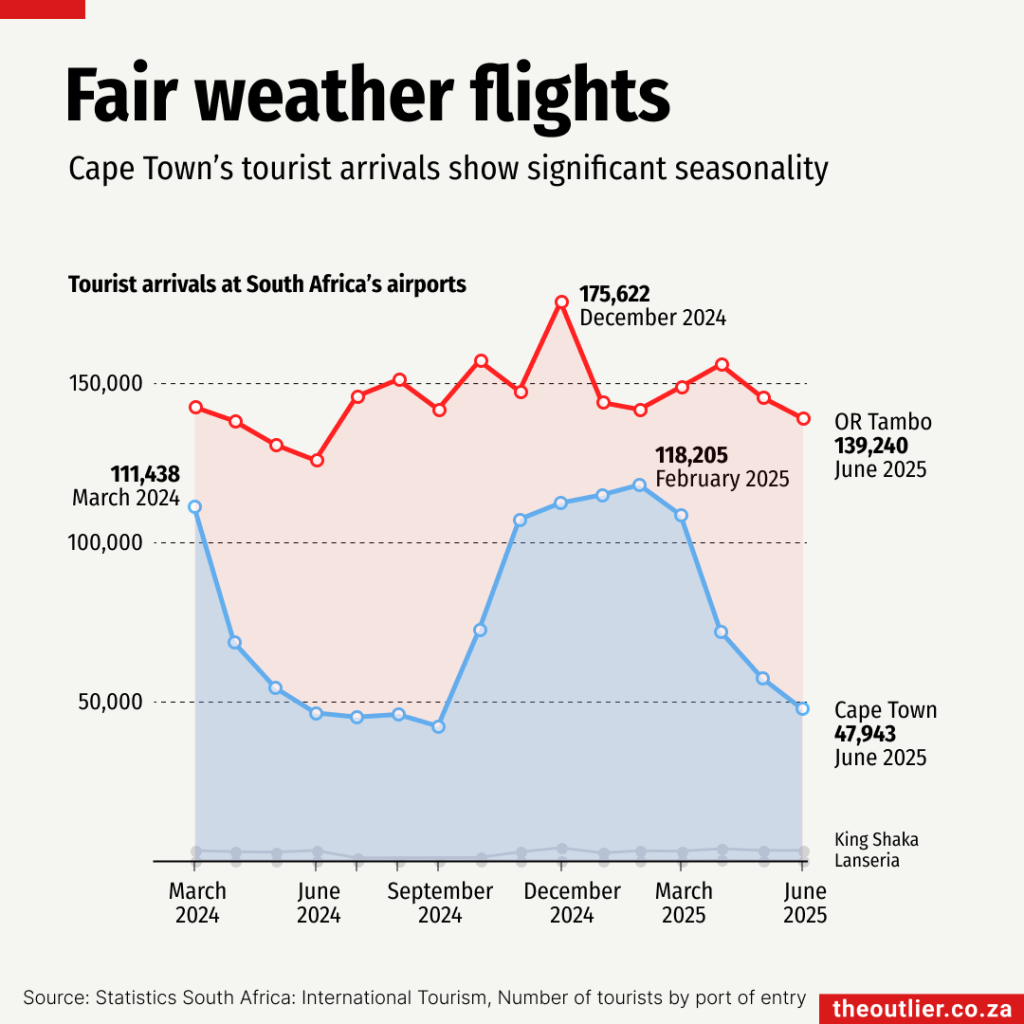
Tourist arrivals at Cape Town International Airport show clear seasonal swings, peaking at 118,205 international visitors in February 2025 before dropping to 47,943 in June, according to Statistics South Africa. This trend reflects the city’s strong appeal during the southern hemisphere summer, from November to March, when warm weather and scenic coastlines draw tourists and airlines ramp up flight frequencies. Carriers like Qatar Airways, Norse Atlantic and Air France have announced additional seasonal routes for the 2025/26 summer to meet growing demand.
Unlike Cape Town, Johannesburg’s OR Tambo International Airport maintains a steady flow of tourist arrivals throughout the year.
🔇 On mute

In Africa only one in five of the sources quoted in the news is a woman, according to the most recent Who Makes the News?, Global Media Monitoring Project, a study done every five years.
South African media is better at quoting women than those in Kenya and Nigeria, but still 75% of those quoted are men.
Quote This Woman+ is working to change this.
QW+ connects journalists from around the world with African women experts. This August, they’re running an #EachOneReachOne campaign to add 100 new experts to their database, which already contains more than 700 woman+ experts in fields ranging from gender rights, politics, economics and crime to AI, tech, education and climate change.
Help them reach that goal by nominating yourself or a woman+ whose expertise you know deserves to be heard.
🔌 Plugging in

There are about 13-million vehicles on South Africa’s roads and less than 1% of them are plug-in electric vehicles, said Hiten Parmar of non-profit Electric Mission in a webinar hosted by EE Publishers earlier this week (see the references section for the link). That doesn’t sound particularly positive, but car sales data shows that South Africa is on the right track.
Sales of battery electric vehicles are definitely starting to rev up, with 1,200 sold in 2024 alone. It’s closer to 2,000 when you add plug-in hybrid vehicles. But that pales in significance when you compare it to the 11-million electric vehicles sold in China last year. Nevertheless, we’re headed in the right direction.

Last year about one in every five cars sold globally was an electric vehicle. Norway stands apart with 92% of new cars sold being electric. China is close to 50% and the United States was 10%.
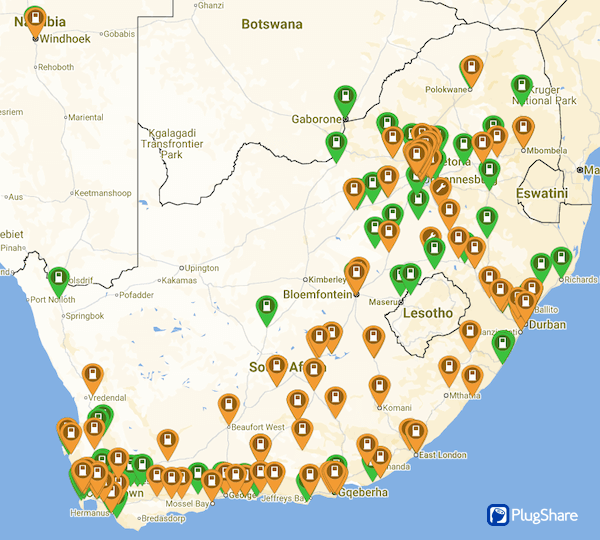
For South Africans the cost of electric vehicles is a factor. That and anxiety about there being enough charging stations. Eighty to ninety percent of charging takes place at home, says Parmar. With loadshedding mostly behind us and increasing amounts of private renewable energy available, that allays one concern. Plus there are 385 charging stations in South Africa at present, according to Plugshare (see map) – roughly 190 standard-charge points and 190 fast-charge points, says the International Energy Agency – so that road trip from Joburg to Durbs is doable, our highways are covered.
Parmar also offered hope for our 100-year-old local vehicle manufacturing sector, which has been knocked by the new US tariffs. He said the manufacturing chain is technology agnostic, so converting to building electric vehicles is possible.