On the road, again
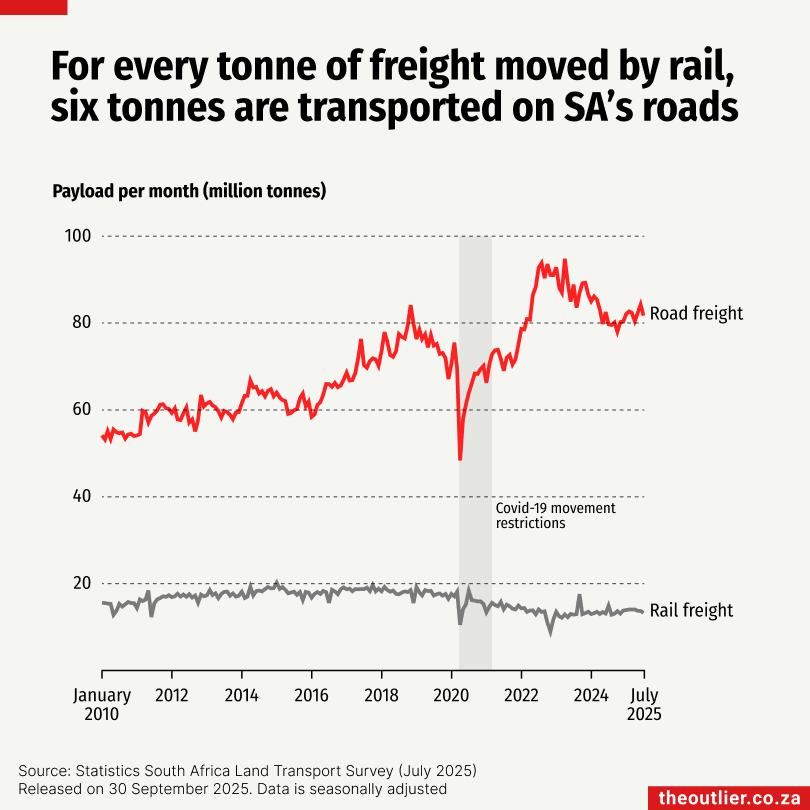
In July 2025, over 85% of South Africa’s land freight was carried by road. For every tonne moved by rail, more than six were hauled by road.
Over the past 15 years, the amount of road freight per month has increased by over 50% to 82-million tonnes. Rail freight has dropped by 15% to 13.3-million tonnes a month, according to Statistics South Africa’s latest land transport survey.
Vandalism and poor maintenance are at the root of the drop in rail freight, according to a 2024 research report on the state of rail infrastructure. As a result, there are more heavy trucks on the country’s roads, worsening congestion. A report published in 2023 stated that 3,546 trucks were involved in fatal crashes over a five-year period, an average of two crashes a day.
Transnet has opened its rail network to private operators. The reform aims to shift road freight back to rail, which will ease pressure on roads.
 Going digital
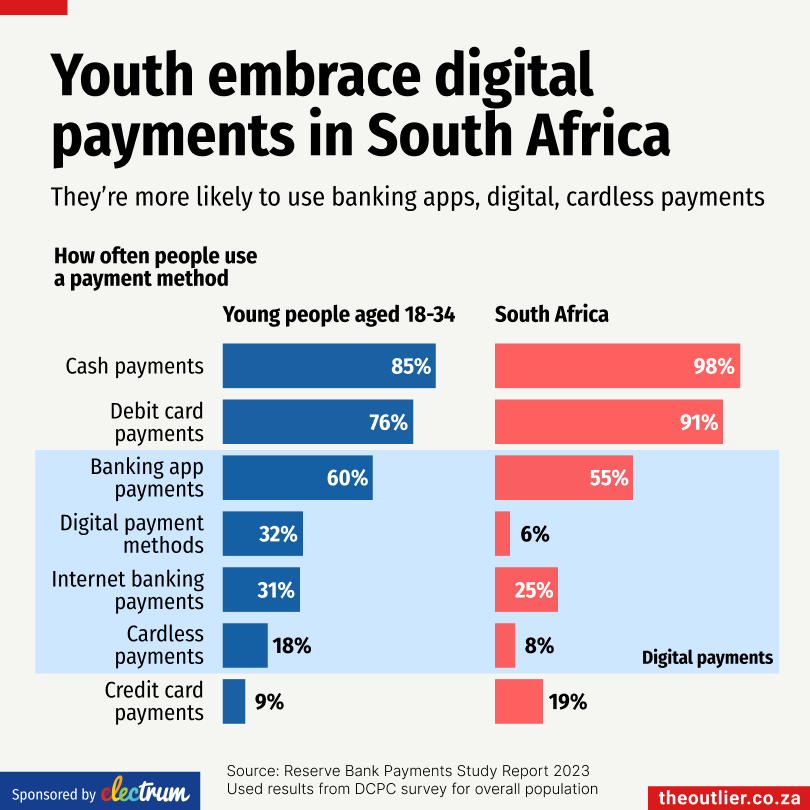
South Africa’s young adults are leading the shift towards digital payments. Among people aged 18–34, who are either working or students, 60% use banking apps and nearly a third use digital payment options such as mobile wallets like Nedbank MobiMoney, QR codes, or apps like SnapScan, PayFast, Masterpass, Apple Pay, and Samsung Pay. In comparison, just 6% of the overall population use these methods. This is according to the latest South African Reserve Bank Payments Study, based on a survey of 4,600 people between June and December 2023.
The report notes that digital payments are still relatively niche, used mostly by people with higher incomes or education levels.
As a result, cash remains South Africa’s dominant payment method. It is used by 85% of young adults and 98% of the overall population.
However, the Reserve Bank finds that debit cards are steadily replacing cash, signalling a slow but steady shift in how South Africans pay for everyday goods and services, one shaped by both technology access and financial literacy.
- Produced by The Outlier in partnership with Electrum, the next-generation payments software company, powering payments for banks and retailers.
💰 Following the money
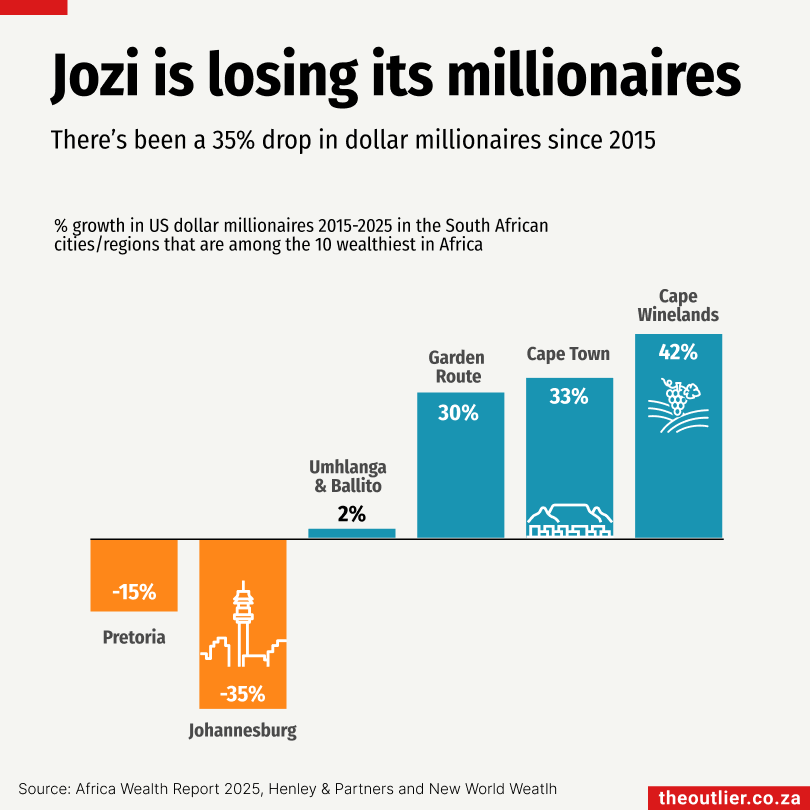
Six of the top-10 wealthiest cities in Africa are in South Africa, according to the latest Africa Wealth Report 2025 published by Henley & Partners and New World Wealth.
That’s not surprising given that South Africa is the continent’s wealthiest country. What is surprising (or maybe not, given the parlous state it’s in) is that Johannesburg – the continent’s wealthiest city – seems to be shedding millionaires. Between 2015 and 2025 the growth rate in dollar millionaires living in the city decreased by 35%, the report says.
It still has the most millionaires by quite a margin: 11,700 compared with Cape Town’s 8,500. But Cape Town has more centi-millionaires (people with more than $100-million) – 35 versus 24 – and billionaires (3 versus 2).
This, and the fact that it has the dubious honour of having the most expensive property prices, explains why Cape Town is on track to replace Johannesburg as Africa’s wealthiest city by 2030, according to the report.
The Cape Winelands – the Paarl, Franschhoek, Stellenbosch area – is increasingly popular with wealthy retirees, the report says. It’s estimated to have 3,800 millionaires, 18 centi-millionaires and three billionaires.
The Umhlanga and Ballito areas on the KwaZulu-Natal coast are home to around 3,700 millionaires and 11 centi-millionaires (no billionaires, yet). The Cape Garden Route – which includes Plettenberg Bay, George, Knysna, Wilderness Mossel Bay and “up-and-coming” millionaire hotspots Nature’s Valley and Keurboomstrand – has 3,200 millionaires and five centi-millionaires.
The Whale Coast, which includes Hermanus, Rooi Els, and Betty’s Bay, is South Africa’s fastest growing region for high-net-worth individuals, according to the report.
 Police perspective
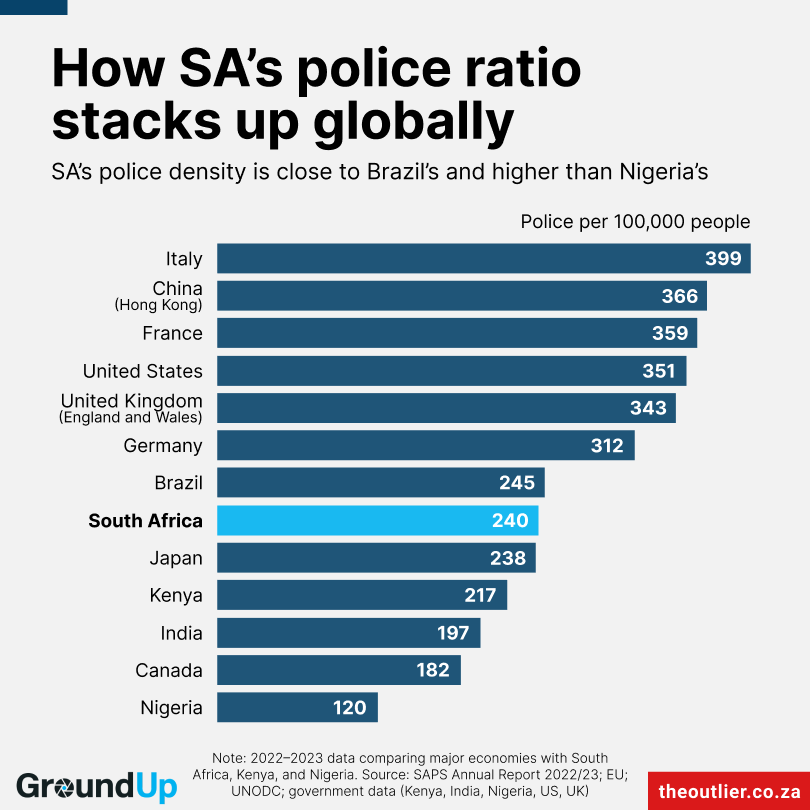
Despite a much higher violent crime rate, South Africa has fewer police per 100,000 people than the United States, the UK, France, Italy and China. But we do have a higher police per person ratio than developing countries like Kenya, India and Nigeria. We also have more police per population than Canada and Japan, though they have extremely low violent crime rates.
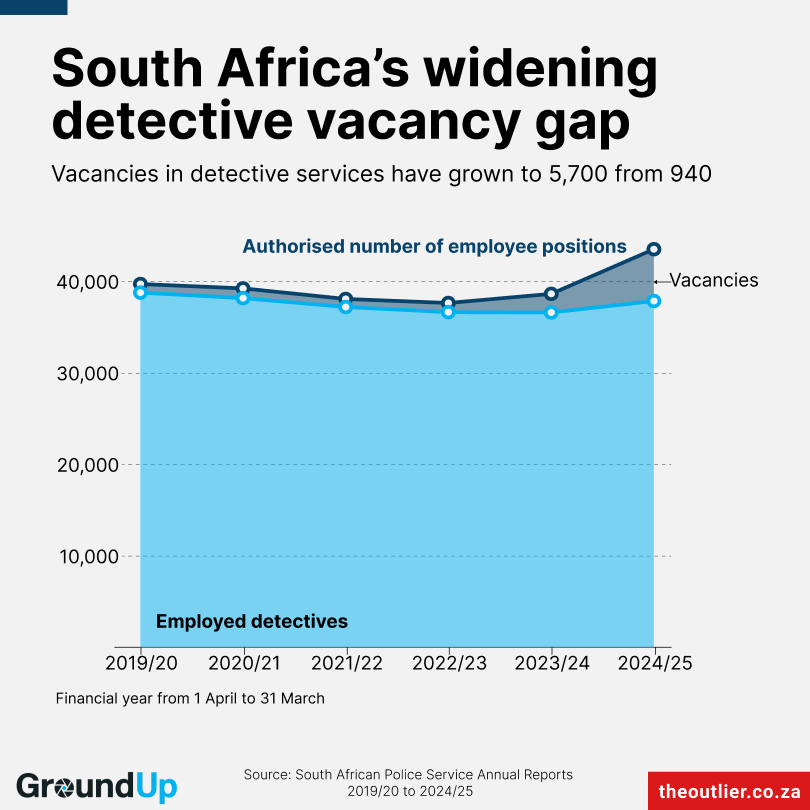
The number of police is a factor in reducing crime but perhaps much more important are the quality and qualifications of the police. A measure, albeit very imperfect, for the number of well-qualified, expert police officers is the number of detectives. The data we have shows that there is a growing shortage of detectives.
The number of budgeted detective posts in 2019/20 was just shy of 40,000. Just under 39,000 of these posts were filled, leaving a gap of about 940 unfilled posts. By 2024/25 the number of posts had grown to over 43,500 but the number of detectives had dropped to under 38,000 — a shortfall of about 5,700.
These charts done in collaboration with GroundUp.