📱 Mobile cash

The world of payments and money transactions is changing. Rapidly. We’ve done many charts on digital payments, cash supply and mobile money. In Kenya remittances (money sent home by Kenyan’s working abroad) is as big a contributor to the local economy as more established sectors.
In the world of mobile money, M-Pesa is one of the most established systems for people to transfer money outside of the traditional banking system. And earlier this month Safaricom, which launched M-Pesa together with Vodafone in 2007, dropped this amazing statistic: there are more M-Pesa users each month than there are people using Safaricom’s connectivity services.
In the first half of the 2026 financial year Safaricom reported 37.9-million M-Pesa users per month, almost 6% up on the second half of FY2025. This is the first time M-Pesa users have exceeded connectivity users for Safaricom.
👷🏾♀️Not desk-bound
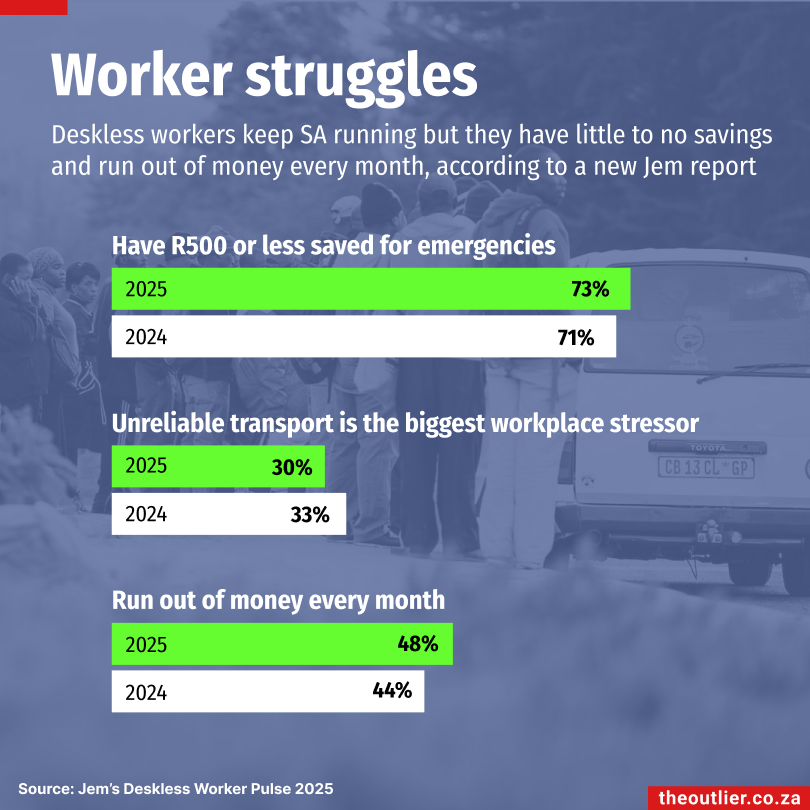
Most of us live in a world where going to work means an office with a desk and a computer. But there are millions of South Africans – ‘deskless’ workers – who live in another world. They are the refuse workers, the security guards, the till operators. They don’t spend the day surfing the internet but they do keep the world moving.
In the second edition of its Deskless Worker Pulse survey, Jem offers some insight into the lives and struggles of these workers: They may keep the world ticking over but they aren’t thriving. “Despite high self-reported rates of job satisfaction and vocational purpose, half of the country’s deskless workforce runs out of money before their next payday, and 1 in 2 people have absolutely zero savings,” says Jem CEO Simon Ellis.
The full report delves into the challenges these workers face daily, the most startling of which is the financial pressure they are under: almost three-quarters have less than R500 saved for emergencies and almost half run out of money before month end.
Perhaps unsurprisingly, transport to and from work is a major cause of stress for these workers and the vast majority of the more than 4,500 workers surveyed said that they often need to borrow money to cover the cost of transport.
💰 Cash plateau
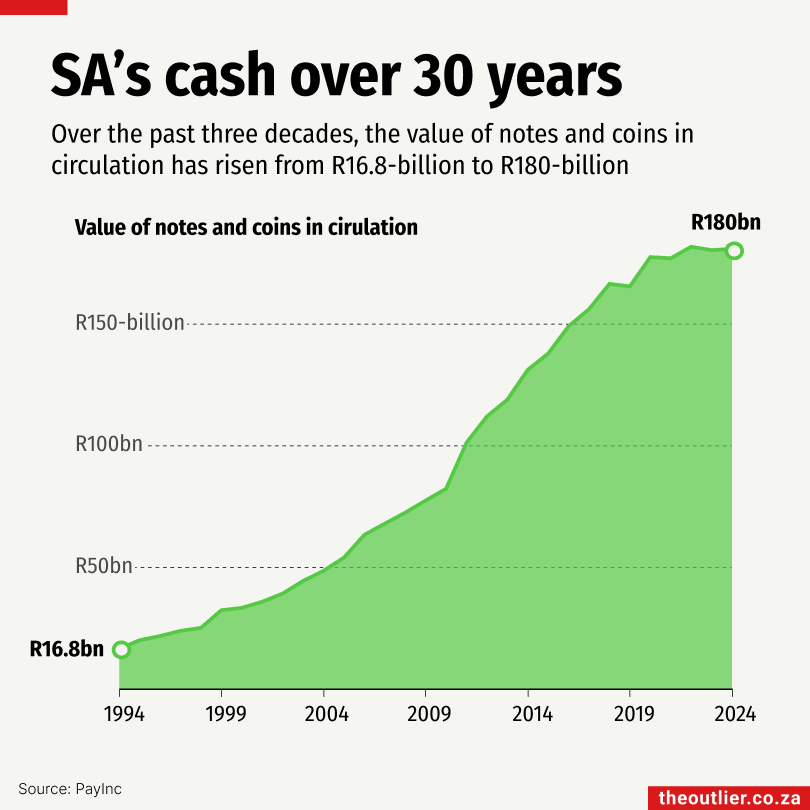
Despite the rise of digital payments, South Africans still held R180-billion in notes and coins in circulation in 2024, according to PayInc (formerly BanservAfrica).
The South African Reserve Bank says the value of notes and coins in circulation has levelled off since 2020. In a speech last year, Reserve Bank Governor Lesetja Kganyago noted that “for several years now we have seen little or no growth in the total demand for banknotes and coin… Historically, cash growth has broadly followed growth in nominal gross domestic product, but this trend broke down after COVID-19.”
☀️ Chinese solar spike
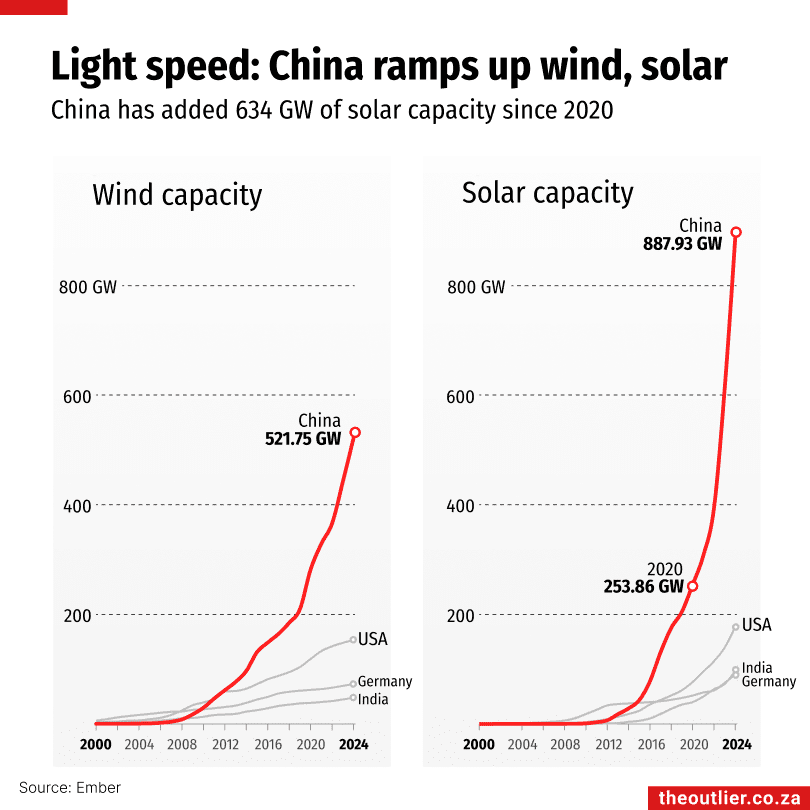
At the end of 2024 China had 1,409 GW of wind and solar capacity installed. By itself that’s an amazing number. Even more eye-opening is that China has installed more than 650 GW of wind and solar in the past two years alone.
The Chinese solar boom in particular is a fascinating story not just for China but for the rest of the world as well, because the country is the main supplier of solar panels. In 2024 it is estimated that Chinese factories produced solar panels with a capacity of 680 GW and could have the ability to produce as much as 1,200 GW per year.
🧳 Work shifts

There are 2.6-million more jobs in 2025 than in 2008, but 10.4-million more people who need them.
248,000 new jobs were created in the third quarter (Q3) of the year, according to the latest employment data released by StatsSA on Tuesday. Our chart this week shows how employment has changed since 2008.
The official unemployment rate at the end of Q3 is 31.9%, down from 33.2% at the end of the Q2. If people who have stopped looking for work are included (the expanded definition of unemployment), the unemployment rate is 42.4%, down from 43.0%.
But the increase in jobs is also linked to a new method StatsSA used to estimate employment in the informal sector, so it should probably be treated with caution. And taking the first two quarters of the year into account, the economy has still lost about 24,000 jobs so far this year.
Long-term trends
StatsSA’s quarterly labour force data goes back to 2008. At the start of that year, South Africa had an unemployment rate of 23.2%, with 14.4-million people employed. At the end of the third quarter of 2025, there were 17-million people with jobs in the country. But because of population growth, the unemployment rate is still higher than in 2008, at 31.9%. The working-age population was 31.5-million in 2008 and is now approximately 41.9-million.
The number of jobs in the manufacturing industry has decreased significantly since 2008 – from 2.1-million to 1.6-million.
Private household jobs – like domestic workers, gardeners, and other paid jobs that take place within households – are also down, from 1.2-million in 2008 to 1.1-million in Q3 of this year.
But steady increases in employment, above the rate of population growth, have been seen in the finance, transport and community and social services sectors. Collectively, these sectors have added 2.7-million jobs since 2008.
Chart produced by The Outlier in partnership with GroundUp.
Click here for a link to all references for this newsletter.