It’s that time of year again, when thousands gather at the United Nations climate conference. This one (COP30), which started in Brazil on Monday, is the tenth anniversary of the Paris Agreement adopted at COP21 in Paris in 2015.
The Paris Agreement is a legally binding treaty aimed at limiting global warming to below 2°C above pre-industrial levels, and ideally to 1.5°C. To do this, countries must set emissions reduction targets and report on their progress. These targets are submitted in Nationally Determined Contributions (NDCs), which are supposed to be updated every five years with progressively more ambitious targets.
South Africa’s emissions target for 2030 is 350-420 MtCO2e (megatonnes of carbon dioxide equivalent). The latest available estimate of the country’s emissions, which is for 2022, was 436 MtCO2e. So we were 16 megatonnes over.
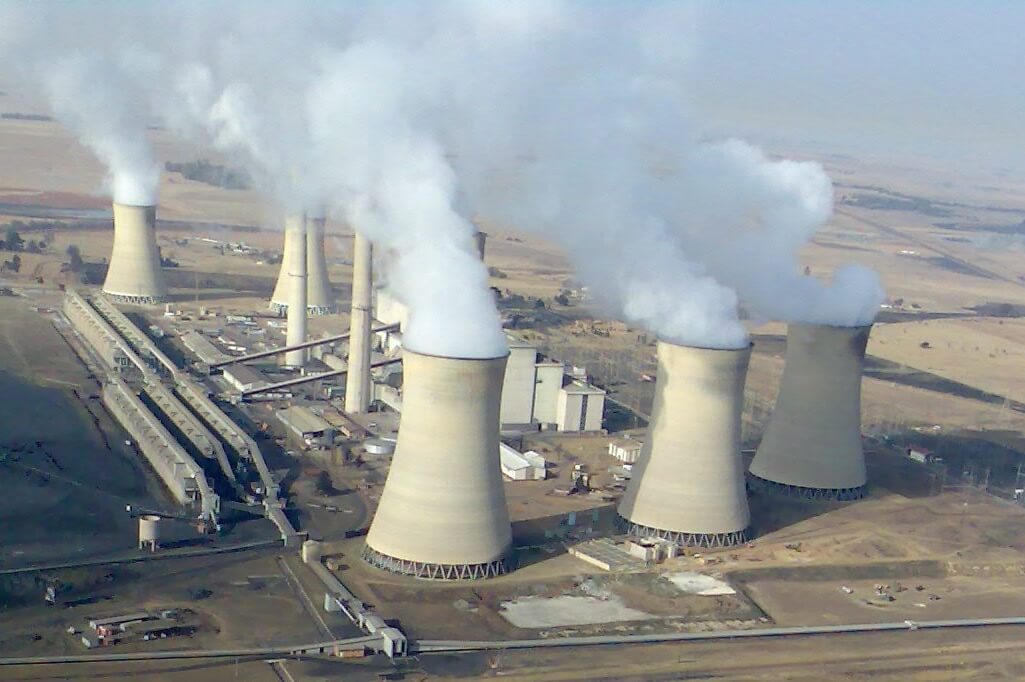
Burning less coal to produce electricity is the most obvious way to cut emissions.
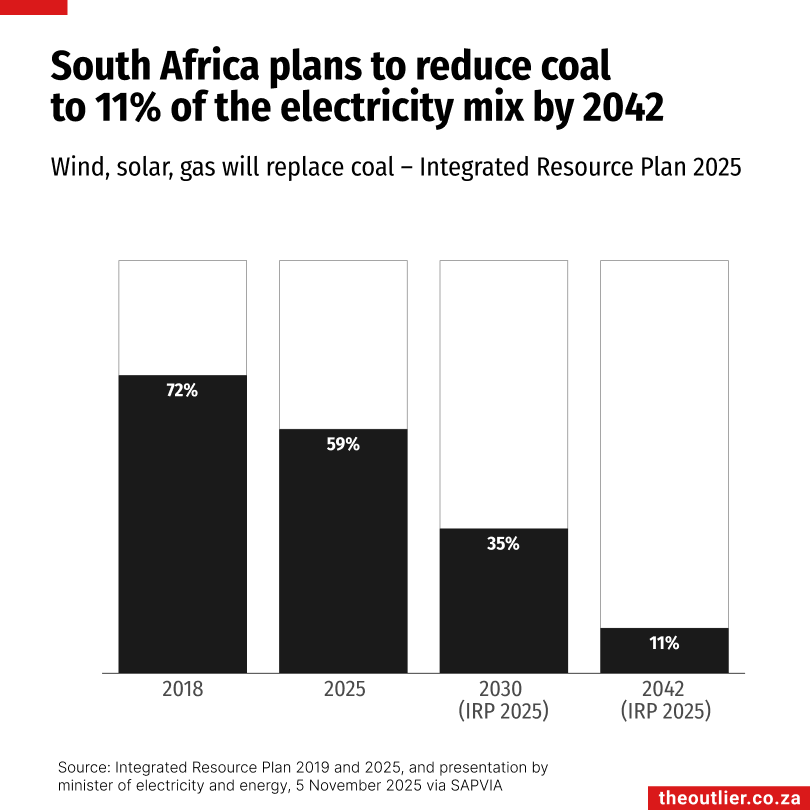
The government’s plan for the country’s future energy mix, the Integrated Resource Plan 2025, proposes a reduction in coal capacity from 41 GW to around 33 GW (35% of the electricity mix) in the next five years (ie, by 2030) and then to 18 GW by 2042 (11% of the mix).
Can South Africa meet its energy needs without coal? The prevailing narrative seems to be that we need to keep our elderly coal power stations going for as long as possible to avoid descending back into loadshedding. Plus, we need to add nuclear.
But maybe we don’t. Researchers modelled three possible scenarios that “illuminate the trade-offs and opportunities inherent in our energy transition”. Their findings are published in a report entitled South Africa’s Energy Transition Scenarios Between 2024 and 2050.
Turns out that the scenario that is most aligned with our missions targets is the lowest-cost solution that will meet the country’s energy needs. It includes renewable energy technologies, supported by battery storage and flexible gas capacity. Plus we don’t need new coal or nuclear investments. Good to know.
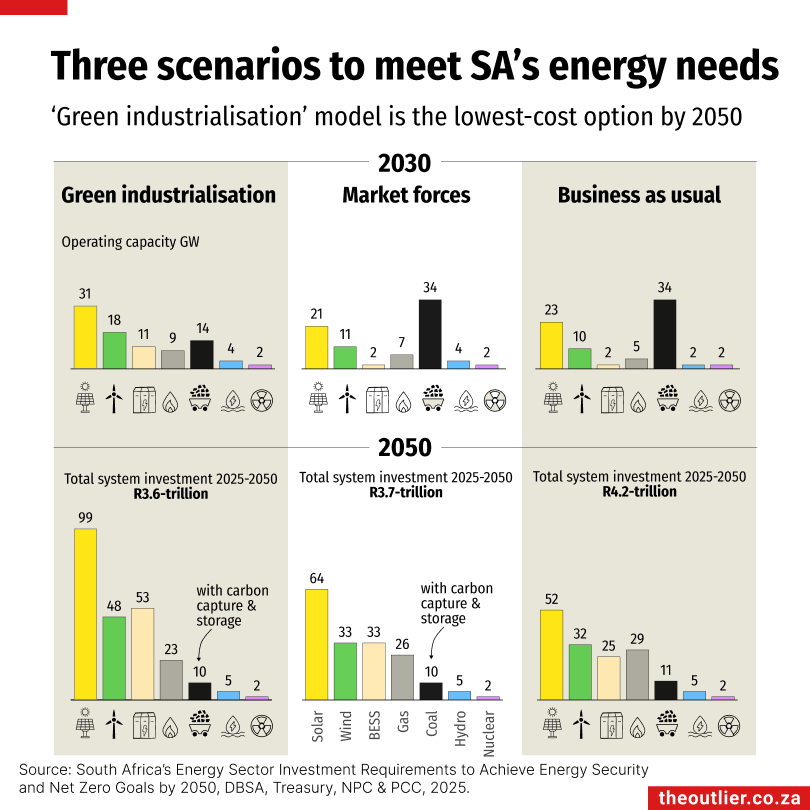
The three scenarios are:
- Green industrialisation, an environmentally conscious and low-emissions development strategy, aligned to Paris Agreement commitments
- Market forces, a middle-of-the-road scenario where the country is generally aligned to its climate commitments, but cost and other economic factors influence decisions
- Business-as-usual, a path where climate commitments are abandoned
The green industrialisation scenario needs the highest upfront spend, but ends up being cheaper in the longer run. Interestingly, it also cuts coal capacity to 14GW by 2030, compared with the IRP 2025’s 33GW by 2030. You can read the 282-page report here, or Chris Yelland’s summary here.
The three scenarios are visualised in the chart below using data from the report.
Battery energy storage report
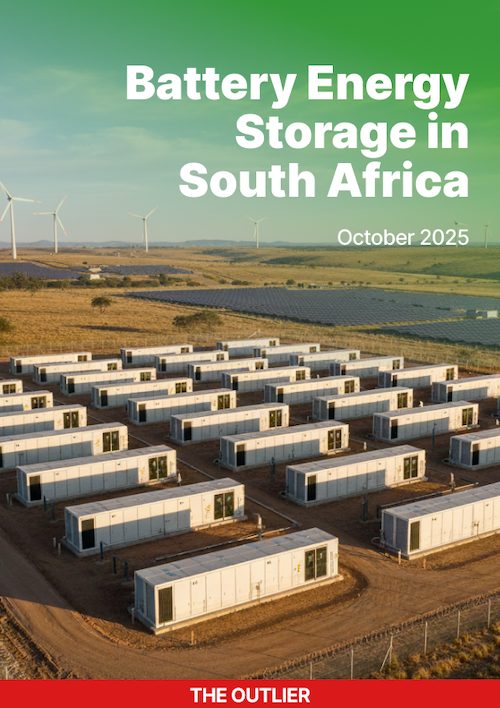
Battery Energy Storage in South Africa 2025 report is the first of a planned series of reports on the renewable energy sector.
The report is a review of the state of battery energy storage in the country and includes data on 35 major battery storage projects in the country with information on progress, developers, timelines and more.
NEWS WRAP
Office offsets
GrowthPoint Properties reports that it is offering renewable energy certificates (RECs) to its tenants as a way to offset their electricity emissions.
Growthpoint has 80 rooftop solar systems with 61.2 MW of capacity and plans to commission another 7 MW by mid-2026. Half of its solar fleet is registered on the international Renewable Energy Certificate registry with Fuel Switch, an REC exchange.
The company also launched a wheeled renewable energy initiative in October with a 195 GWh power purchase agreement with Etana Energy, an electricity trader.
Growthpoint has a 30% stake in the Boston Hydroelectric Plant near Clarens in the Free State and says it has exclusive access to the 30 GWh it generates a year. Twenty buildings on Eskom’s grid and three on Cape Town’s grid are being supplied with this electricity, says the company. Read more here.
Financing solar
The South African Photovoltaic Association (Sapvia) called on the Treasury to provide clear pathways for financing the massive solar PV build outlined in the IRP 2025 in the mini budget. Sapvia wants transmission funding to be ring-fenced, investment incentives for private generation, and the deployment of financial instruments that de-risk projects for local and international capital. It also notes the importance of policy certainty and streamlined regulatory timelines.
“The multi-gigawatt pipeline of projects demands immediate, targeted fiscal support and a transparent funding model for the next three years. We need to see how the government will strategically allocate resources to support this aspiration, particularly for the grid upgrades that are currently the single largest bottleneck to connecting new capacity,” says Sim Khuluse, technical and policy manager of Sapvia. Read more here.
In his mini budget speech this week, Finance Minister Enoch Godongwana said the government will contribute R2-billion to capitalise a new credit guarantee vehicle (CGV) to de-risk investment in critical infrastructure. The CGV will initially support investment to expand the electricity grid. Read the speech here and more about the CGV here.
Solar backup for waste water treatment works
Mossel Bay municipality’s Hartenbos waste water treatment works now has its own solar PV plant and microgrid to ensure it has an uninterrupted power supply. If the power supply stops, a battery energy storage system kicks in supported by solar power during the day. Excess solar energy is fed into the municipal grid. Read more here.
Learn more
Energy performance certificates
Certain buildings in South Africa will have to submit and display an energy performance certificate by 7 December. EE Business Intelligence is hosting a free webinar on the legal duties, risks and opportunities for building owners and tenants on 17 November. Register here.
Municipalities and electricity wheeling
How can municipalities deliver cleaner, more affordable power to their customers? Token wheeling is a solution. To learn more, you can attend a webinar hosted by Future Cities Africa and Meridian Economics on 27 November. Register here.
Big numbers
1,409 GW
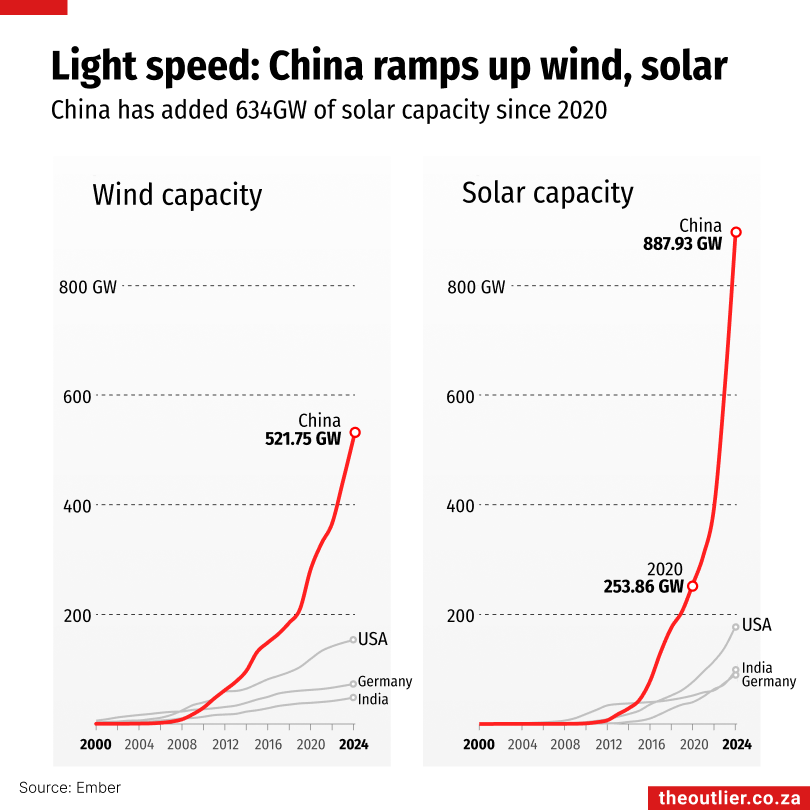
At the end of 2024 China had 1,409 GW of wind and solar capacity installed. By itself that’s an amazing number. Even more eye-opening is that China has installed more than 650 GW of wind and solar in the past two years alone.
The Chinese solar boom in particular is a fascinating story not just for China but for the rest of the world as well, because the country is the main supplier of solar panels. In 2024 it is estimated that Chinese factories produced solar panels with a capacity of 680 GW and could have the ability to produce as much as 1,200 GW per year. (Solar in China has become too big to fail – Economist)