👷🏾♀️ Joburg jobs
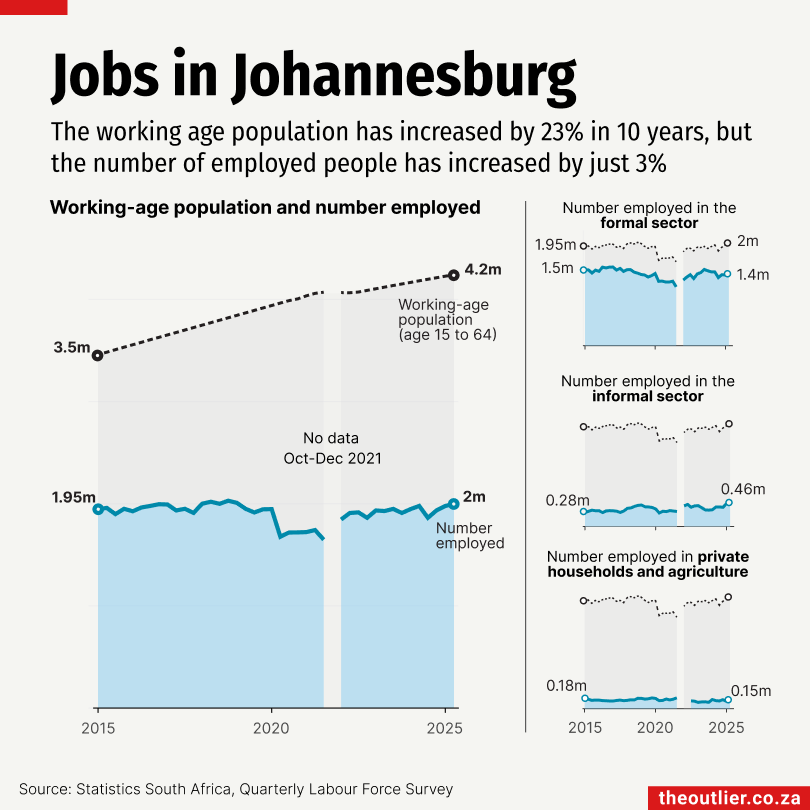
Ten percent of South Africa’s working-age population lives in the City of Johannesburg, according to Statistics South Africa’s Quarterly Labour Force Survey. With 4.24-million people between the ages of 15 and 64 years, the city has the highest working-age population of all the metro municipalities and a million more than Cape Town, the second highest.
As the country’s economic hub, people come to the city looking for work. As a result, the working-age population in the city has increased by 23% over the past decade, but jobs haven’t kept up. The number of people who are employed has increased by only 3% over the past decade. The number of unemployed people has increased by 39%, StatSA’s numbers show.
The informal sector appears to have been taking up some of the slack, with jobs increasing from 277,000 to 457,000 over 10 years. But there are fewer people employed in the formal sector now than there were 10 years ago. The number is down from 1.5-million to 1.4-million.
- For more Johannesburg charts and stories check out Our City News.
🌍 Remittances

In 2024, people living in South Africa sent R19.4-billion in remittances to 15 countries across southern Africa, with 84% going to Zimbabwe, Lesotho and Malawi, according to the Reserve Bank. While South Africa doesn’t have the highest value of remittances sent from its borders to other countries – that goes the United States and Saudi Arabia – this is a significant rise from R5.9-billion in 2016, especially as South Africa is one of the costliest G20 countries to send remittances from, according to a World Bank report. The average cost of sending $200 from South Africa is 15%, compared with the average across the G20 countries of 6.8%.
According to next-generation payments software company Electrum’s research, banks were long considered “the only viable option for international remittances”. “With limited competition, they had little incentive to innovate or reduce fees,” Electrum found. “That complacency created space for digital money transfer providers such as WorldRemit, Remitly, and Flutterwave to disrupt the market with faster, more affordable alternatives.”
- Produced by The Outlier in partnership with Electrum, the next-generation payments software company, powering payments for banks and retailers.
☀️ Rooftop solar
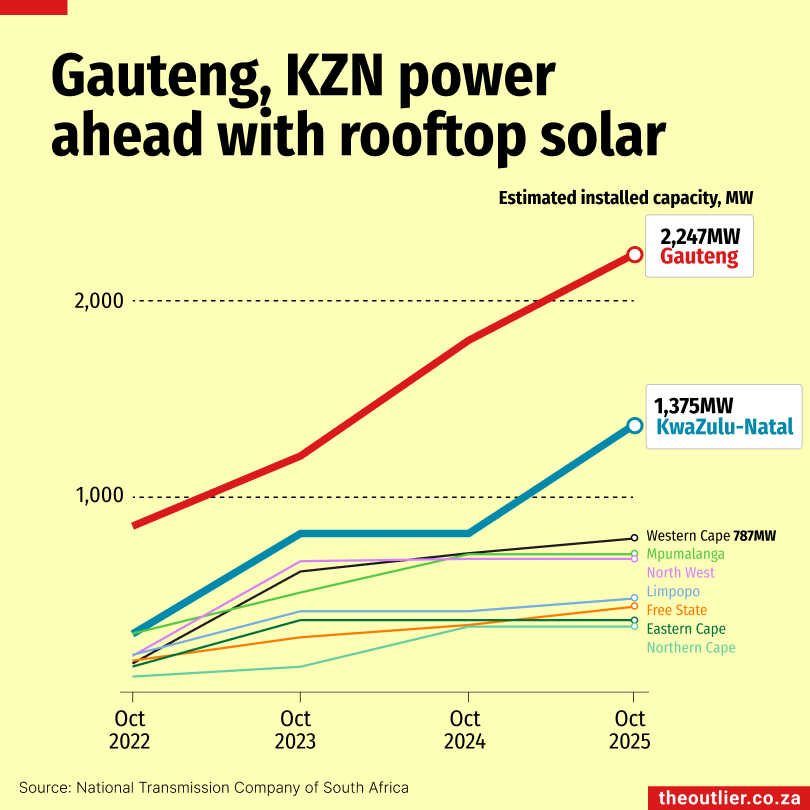
Eskom estimates that there is 2.25 GW worth of rooftop solar installed in Gauteng. KwaZulu-Natal is next with close to 1.4 GW.
There has been a sharp increase in that province since last year. In total South Africa has 7.4 GW of rooftop solar. In three years this has increased by 218% from 2.33 GW in 2022.
🚨 Domestic violence
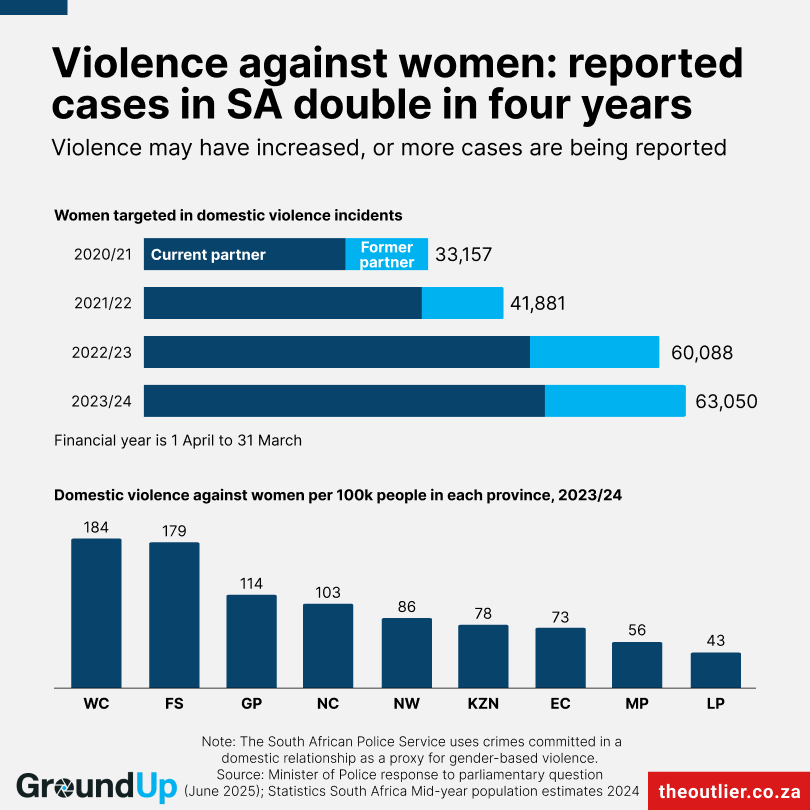
Over the past four years, the number of domestic violence incidents against women reported to police in South Africa has almost doubled, from 33,000 in 2020/23 to 63,000 in 2023/24.
It could be that violence has increased, or that more women are reporting cases to the police.
The South African Police Service defines domestic violence as “crime committed in a domestic relationship”. This includes when the perpetrator is a current or past spouse, life partner, boyfriend, fiancé, partner, or sexual partner.
Physical assault is by far the most common form of domestic violence. Other crimes include murders, attempted murders, rapes, sexual assaults, robberies, arson, damage to property, and burglaries.
Lisa Vetten, a researcher specialising in gender-based violence, told GroundUp that there are three possible reasons why reported domestic violence cases have increased:
- Fewer cases were reported during the 2020/21 covid lockdowns. A 2022 HSRC report suggests that domestic violence may have decreased during the covid lockdown.
- More women may be willing to open criminal cases for incidents that have previously been addressed in other ways, for example, through family discussions or protection orders. Increased awareness of gender-based violence may have contributed to this.
- There may be an actual increase in domestic violence. “The country’s poor economic situation, doubt about the future, fraying social bonds, weakened policing, the rise in organised crime and its knock-on effects might all be creating the conditions that support violence,” says Vetten.
The accuracy of SAPS statistics is also questionable. In response to a question in Parliament, the police minister said SAPS had decided to stop publishing crime stats disaggregated by age and sex after finding serious inaccuracies in past data.
- Chart produced by The Outlier in partnership with GroundUp.
Click here for a link to all references for this newsletter.