I was struck this week by just how much money is flowing into South Africa’s electricity sector, and particularly renewable energy projects.
Part of that comes from something Rudi Dicks said in a webinar: 90% of the R500-billion in investments unlocked during phase one of Operation Vulindlela went into new electricity generation. Alongside that the Presidential Climate Commission released a report showing that most of our climate finance is heading straight into renewable energy projects.
Operation Vulindlela, a joint initiative of the Presidency and the National Treasury, aims to boost economic growth by fast-tracking structural reforms. The electricity sector was obviously in need of a kick because, well, loadshedding.
On the one hand, it’s great news that renewables are attracting serious investment. But both the webinar and the report make the same point: even with all this money, it’s still not enough to jump-start the economy or deliver a truly just transition.
R500-billion sounds encouraging but the aim is to grow the economy by 3%. Dicks said that will need investments of R1-trillion or more.
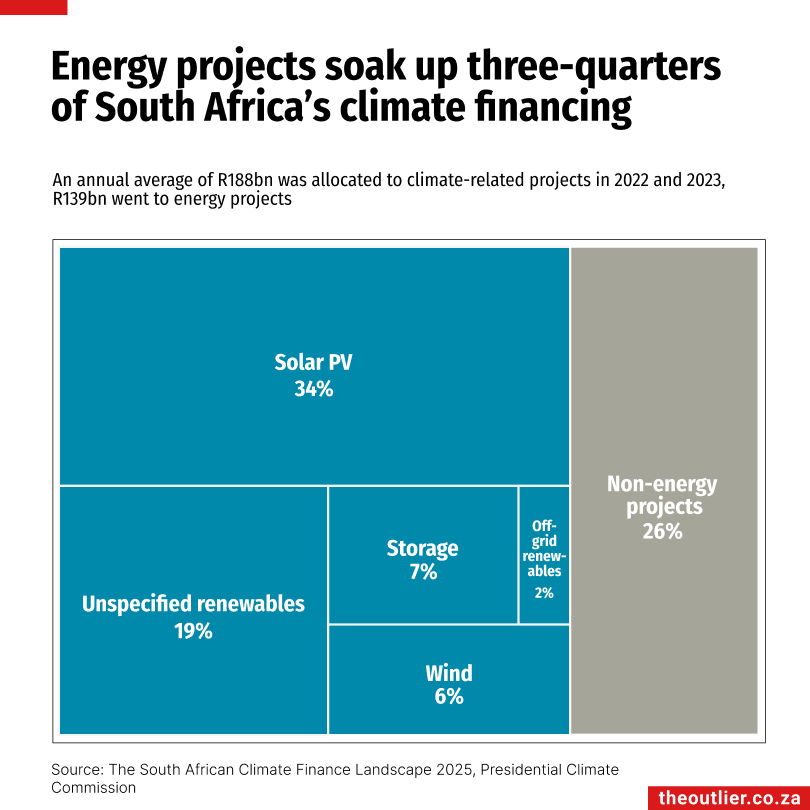
Then there was the report by the Presidential Climate Commission which analysed where South Africa’s climate financing went in 2022 and 2023. Average annual climate finance was calculated at R188.3-billion, 74% of which went to the energy sector, mainly clean energy projects, particularly renewable electricity.
Unlike most African countries, which rely heavily on international funding, 60% of South Africa’s climate finance came from domestic sources. In Africa (excluding South Africa) only 7% of climate funding is domestic, according to the report.
South Africa’s domestic funding came from:
- Commercial banks (33%)
- Corporations (19%)
- Households (14%)
This is a good thing. We have a string of renewable energy projects lining up to take the strain off our elderly coal plants. There’s obviously money, we need to find the best ways to deploy it.
🔋 South Africa’s battery boom is here and we’ve got it covered.
Our 2025 Outlier Renew Battery Energy Storage Report is a review of this fast-growing, often overlooked part of the energy transition.
Across 60+ pages, we unpack 30+ storage projects in detail, showing where capacity is coming online, who’s building it, and what it means for the grid. If you want to understand the real state of battery energy storage in South Africa this is your essential guide.

News Wrap
💰Clean energy jobs pay better in SA
Researchers from Oxford University analysed 12 months of job ads in South Africa and found that clean energy jobs paid 16% more on average than other advertised roles. In a report titled The Economic benefits of renewable energy and how to share them, the researchers note that nearly half of clean energy jobs are likely to be construction related. Once built, the operation and maintenance of facilities need less workers, plus clean energy jobs tend to be highly skilled. “Ramping up efforts to anticipate skill gaps and adapt education and occupational policies accordingly is therefore central to preparing workers for the global energy transition,” says the report.
I was struck this week by just how much money is flowing into South Africa’s electricity sector, and particularly renewable energy projects.
Part of that comes from something Rudi Dicks said in a webinar: 90% of the R500-billion in investments unlocked during phase one of Operation Vulindlela went into new electricity generation. Alongside that the Presidential Climate Commission released a report showing that most of our climate finance is heading straight into renewable energy projects.
Operation Vulindlela, a joint initiative of the Presidency and the National Treasury, aims to boost economic growth by fast-tracking structural reforms. The electricity sector was obviously in need of a kick because, well, loadshedding.
On the one hand, it’s great news that renewables are attracting serious investment. But both the webinar and the report make the same point: even with all this money, it’s still not enough to jump-start the economy or deliver a truly just transition.
R500-billion sounds encouraging but the aim is to grow the economy by 3%. Dicks said that will need investments of R1-trillion or more.
Then there was the report by the Presidential Climate Commission which analysed where South Africa’s climate financing went in 2022 and 2023. Average annual climate finance was calculated at R188.3-billion, 74% of which went to the energy sector, mainly clean energy projects, particularly renewable electricity.
Unlike most African countries, which rely heavily on international funding, 60% of South Africa’s climate finance came from domestic sources. In Africa (excluding South Africa) only 7% of climate funding is domestic, according to the report.
South Africa’s domestic funding came from:
- Commercial banks (33%)
- Corporations (19%)
- Households (14%)
This is a good thing. We have a string of renewable energy projects lining up to take the strain off our elderly coal plants. There’s obviously money, we need to find the best ways to deploy it.
🔋 South Africa’s battery boom is here and we’ve got it covered.
Our 2025 Outlier Renew Battery Energy Storage Report is a review of this fast-growing, often overlooked part of the energy transition.
Across 60+ pages, we unpack 30+ storage projects in detail, showing where capacity is coming online, who’s building it, and what it means for the grid. If you want to understand the real state of battery energy storage in South Africa this is your essential guide.
NEWS WRAP
💰Clean energy jobs pay better in SA
Researchers from Oxford University analysed 12 months of job ads in South Africa and found that clean energy jobs paid 16% more on average than other advertised roles. In a report titled The Economic benefits of renewable energy and how to share them, the researchers note that nearly half of clean energy jobs are likely to be construction related. Once built, the operation and maintenance of facilities need less workers, plus clean energy jobs tend to be highly skilled. “Ramping up efforts to anticipate skill gaps and adapt education and occupational policies accordingly is therefore central to preparing workers for the global energy transition,” says the report.
🌻 Solar farming
Broccoli, grapes, grass, potatoes and tomatoes are among a range of crops that apparently love growing under solar panels. This sounds counterintuitive, but the shade cast by the panels helps to conserve water and protect plants from excess sun, wind, hail and soil erosion. As a result, crop yields improve, which is a bonus for farmers, who can also generate their own electricity. Read more here.
🌚 Powerless data centres
The demand for data centres is increasing, but in the United States data centres are reported to be standing idle because they lack power. Access to electricity is an issue because of ageing power infrastructure, the need for new transmission lines and bureaucratic hurdles, Bloomberg reports. Sounds familiar.
Equipment backlogs are adding to the problem, according to a report in The Conversation. The US has more than 60-million high-voltage distribution transformers in service, of which more than half are over 33 years old. These will need to be replaced, but transformer prices are four to six times more expensive than they were before 2022 and orders can take more than two years to be delivered, the report says.
🚘 Porsche’s speedy electric rise
36% of the 146,391 vehicles Porsche sold in the first half of 2025 were either fully hybrid or plug-in hybrids. And now Porsche has announced the Porsche Cayenne Electric and the Porsche Cayenne Electric Turbo. Both boast a range of more than 600km and DC charging times as low as 16 minutes (10%-80%). Naturally they’re quick off the mark with the Electric Turbo taking around 2.5 seconds from start to 100km/h. Brace yourself. Read more.
Learning & opportunities
Global lessons in grid expansion
The first in a series of webinars on grid expansion is being held on 25 November. It will explore how countries around the world have accelerated transmission development to meet growing energy demand. The series is an initiative of Energise Mzansi in collaboration with World Energy Council South Africa and the Africa Sustainable Energy Centre. Register here.
Grants for new African energy research hubs
African Energy Futures, with support from the Rockefeller Foundation, will open its first call for proposals on 3 December 2025 for African institutions to host a new in-country energy research hub. The US$1-million grant aims to establish hubs that can lead locally grounded energy research, develop the next generation of experts, and coordinate multi-disciplinary collaboration with policymakers and industry. Find out more at the launch event.

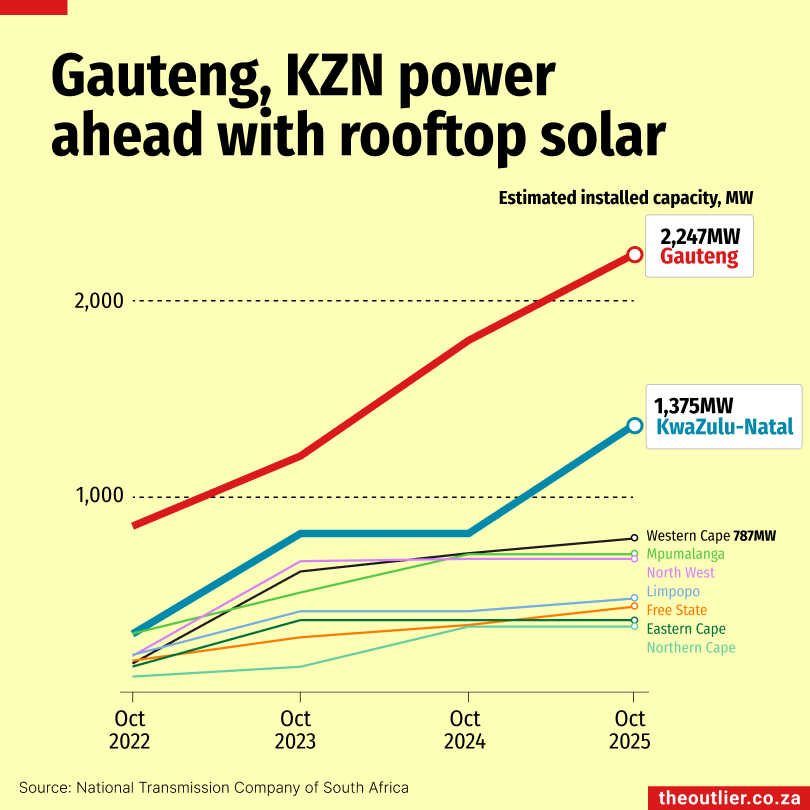
Eskom estimates that there is 2.25 GW worth of rooftop solar installed in Gauteng. KwaZulu-Natal is next with close to 1.4 GW. There’s been a sharp increase in that province since last year.
In total South Africa has 7.4 GW of rooftop solar. In three years this has increased by 218% from 2.33 GW in 2022.
