💸 Outflows
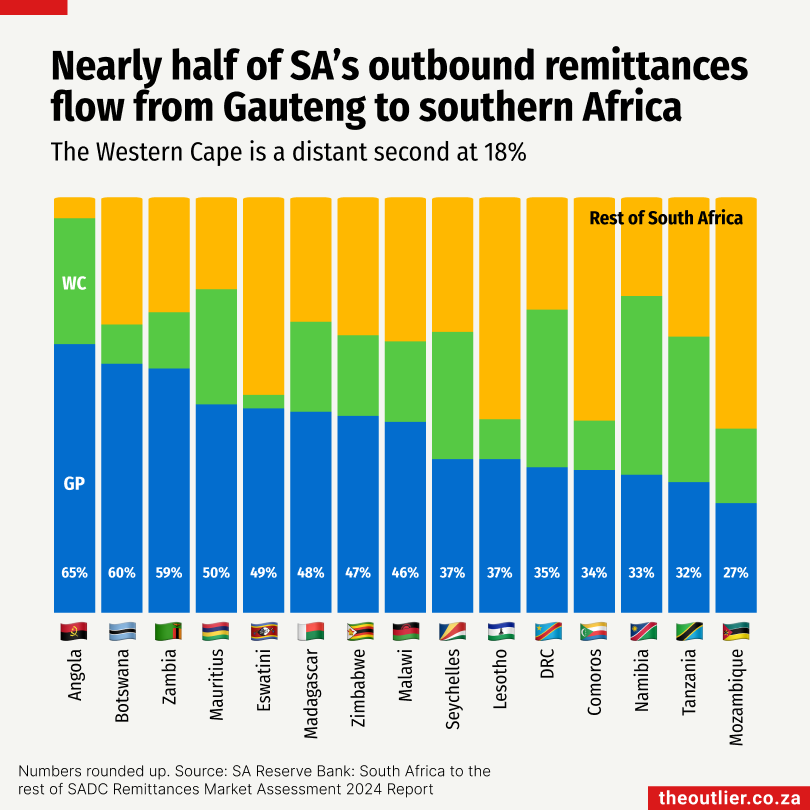
Last year people living in South Africa sent R19.4-billion in formal, digital remittances to 15 southern African countries. It is up from R5.9-billion in 2016. Gauteng was the largest source of these remittances, accounting for 45% of the total, followed by the Western Cape at 18%. Almost two-thirds of remittances to Angola and 47% of remittances to Zimbabwe came from Gauteng. Zimbabwe remains the largest recipient of remittances from South Africa, receiving R11.8-billion.
For other countries, different provinces dominate as origin points. The Western Cape is the leading source of remittances to the DRC, Namibia and Tanzania, while KwaZulu-Natal sends the most to Comoros. These flows underline South Africa’s continuing role as a financial lifeline for households across the southern African region.
💰 Overdue chaos
Good cash flow is a critical element for any business. Invoices being paid within 30 days is largely common practice. But the reality is often very different when dealing with municipalities.
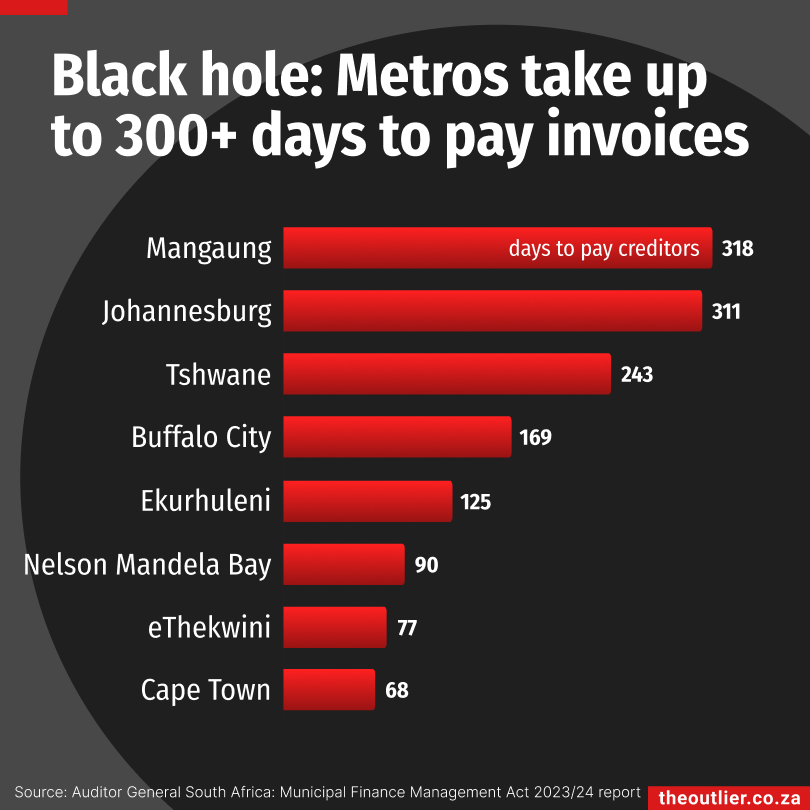
In theory at least when a service provider invoices a municipality they should be paid within 30 days. In practice, that rarely happens, even in South Africa’s eight metro municipalities. In fact none of them pay invoices within 30 days on average, according to data from the Auditor General of South Africa.
Cape Town and eThekwini are relatively good performers while the City of Johannesburg and Mangaung take well over 300 days on average to settle invoices. That’s around a 10 month wait service providers have to put up with.
- For more charts and data about Johannesburg visit the Joburg by Numbers collection on Our City News.
⚽️ Bad sport

Limpopo municipalities have poured more than R200-million into sports complexes and stadiums that were never completed, never used, or left to decay, leaving communities without the facilities they were promised. Over the past year, reporting by GroundUp and the Limpopo Mirror has revealed a growing list of failed projects, from the R22-million Makhuvha Sports Complex with its unused swimming pools and overgrown pitch, to the long-delayed R37-million Vhuilafuri Stadium, where construction is years behind schedule and the field remains unplayable.
Across the province, the pattern repeats: multimillion-rand builds that stall, crumble, or are abandoned altogether. Municipalities have spent tens of millions of rands on projects like Vuwani’s Dhavana Stadium, the Waterval sports facility near Elim, Giyani’s long-overdue Section E stadium, and the Tshivhuyuni sports stadium, none of which are complete or usable. Together, the reports show a systemic failure in planning, oversight, and accountability for public infrastructure.
🏎️ Fast money

Formula 1 isn’t just burning rubber on the track; it’s doing it on the balance sheet too. Every one of F1’s ten teams is now worth at least $1.5-billion (~R25.7bn). Two years ago, only four teams were even close to that number, according to Forbes. The average valuation has rocketed to $3.6-billion, an 89% jump since 2023.
It’s not hard to see why. Revenue across the grid continues to accelerate, with teams averaging roughly $430-million last year and clocking in multi-year, double-digit growth. Mercedes leads the pack with $799-million in 2024.
Click here for a link to all references for this newsletter.