In our last newsletter we had a chart showing that Gauteng had 2.2 GW of installed rooftop solar capacity. We wondered if this massive off-grid capacity has had an effect on the City of Johannesburg’s electricity sales.
The city makes 30% of its revenue from electricity sales, so when it sells less electricity through its power utility, City Power, it will presumably affect the city’s bottom line.
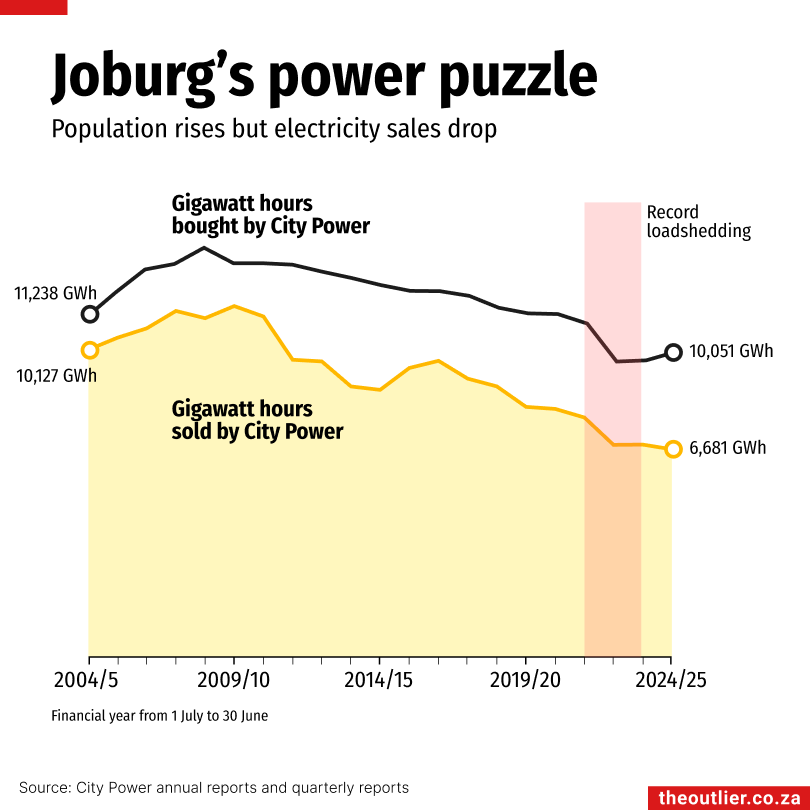
We collected data from City Power’s annual and quarterly reports on the amount of electricity it buys from Eskom in gigawatt hours and the amount it sells to its customers. Sure enough, there has been a decrease in the amount of electricity sold, but the decrease started around 2010 – long before the surge in rooftop solar installations.
The extent of the drop off in sales is strange given that the city’s population has grown from 4.2-million in 2010 to 5.9-million in 2025, according to StatsSA’s 2025 mid-year estimates.
The gap between the amount of electricity bought from Eskom and the amount sold has also increased. We asked City Power why. Their answers were not what we expected.
Firstly, on the extent of the gap between the amount of electricity bought and sold, City Power says it loses nearly 30% (29.87% to be precise) of the electricity it buys from Eskom.
The utility pays Eskom a fixed amount of about R1.5-billion a month for electricity and says it is owed more than R10.6-billion by defaulting customers.
The biggest driver of the long-term decline in electricity sales are “non-technical losses”. That’s electricity theft, meter bypassing, illegal connections and unmetered consumption. These losses have risen sharply since 2011, peaked between 2013 and 2015, and have remained high, says City Power.
Technical losses, caused by ageing infrastructure, overloaded feeders and unbalanced loads are also a problem. But it’s non-technical losses that are the main cause of revenue loss and underlie why population growth doesn’t bring proportional electricity sales, says City Power.
“There are approximately 380 informal settlements, along with numerous hijacked buildings illegally connecting to the City Power network… The demand for electricity has far outpaced the provision of formal housing. As a result, many residents are turning to unauthorised and unsafe connections to access electricity.”
The majority of residents in informal settlements are illegally connected to the grid.
Unauthorised technicians target streetlights, stripping luminaire components that are essential for establishing illegal connections, says the utility.
Criminal networks establish parallel electricity networks and charge residents monthly fees. Syndicates and insiders supply arial bundle conductor cables and conduct illegal reconnections at various network points, which can lead to substation overloads, explosions and outages.
Loadshedding compounded the drop in sales: City Power cannot charge customers for electricity they did not receive, which contributed to the sharp dip in sales between 2022 and 2023, when South Africa faced record blackouts.
When we asked if rooftop solar had anything to do with the drop-off in the amount of electricity it buys from Eskom, City Power didn’t answer directly but referred to its Sustainable Energy Strategy, which involves diversifying its energy sources.
Our research shows that City Power still buys around 90% of its bulk electricity from Eskom and 10% from Kelvin Power Station in Kempton Park. It also has short-term contracts with four independent power producers (92 MW of capacity in total) and has approved 26 MW of small-scale embedded generation, according to its latest available annual report (2023/2024). You can find the full City Power response to our questions here.
🔋 South Africa’s battery boom is here and we’ve got it covered

Our 2025 Outlier Renew Battery Energy Storage Report is a review of this fast-growing, often overlooked part of the energy transition.
Across 60+ pages, we unpack 30+ storage projects in detail, showing where capacity is coming online, who’s building it, and what it means for the grid. If you want to understand the real state of battery energy storage in South Africa this is your essential guide.
NEWS WRAP
🚗 Volkswagen Group Africa has completed the second phase of its solar-photovoltaic project at the Kariega manufacturing plant in the Eastern Cape. The expansion lifts the facility’s total onsite renewable-energy capacity to 5.2 MWp.
👍 The National Energy Regulator of South Africa (Nersa) announced three landmark decisions last week paving the way towards a competitive electricity market: 1) Granting the National Transmission Company South Africa (NTCSA) a market operator licence 2) Adopting new grid capacity allocation rules 3) Establishing the Electricity Market Advisory Forum, a 14-member advisory body that will guide the regulator on market rules.
⚡️ New data from a survey of more than 2,000 businesses and home owners shows that the strongest force behind solar adoption is no longer load shedding but the need to curb rising electricity costs.
☀️ Solar power company Candi Solar has secured $58.5-million in funding from the International Finance Corporation (IFC), which will enable solar installations in South Africa and India.
😎 NCP Chlorchem has announced one of South Africa’s biggest private industrial solar installations to deploy 27 MWp of solar capacity at its main production site. The project is set for completion by the end of 2026.
🚙 Electric Ubers have arrived in Johannesburg. Uber Go Electric four-seater cars are being piloted in Sandton and Rosebank to test the charging infrastructure and demand. Clean energy company Valternative is reportedly sourcing the vehicles from China and leasing them to drivers.
🔌 Zero Carbon Charge (CHARGE) is building two off-grid, solar-powered ultra-fast EV charging stations along the N3 between Joburg and Durban. CHARGE N3 Roadside is in the Free State, 180km from Johannesburg, and CHARGE N3 Tugela, in KwaZulu-Natal, is around 200km from Durban.
😎 Sun City, the holiday resort in North West province, has reportedly saved R8-million on its electricity bill after installing R17-million in solar panels
💶 Transnet has secured a €300-million (about R6-billion) loan from Agence Française de Développement (AFD) to accelerate the decarbonisation of its port, rail and pipeline operations. The loan will enable the group to source approximately 300 GWh of renewable electricity per year.
☀️ Independent power producer Sturdee Energy has reached financial close on the 91.2 MW Bela Bela Solar Park in Limpopo.
🔌 Seriti Green’s R1-billion Vunumoya Main Transmission Station in Mpumalanga went live this week. The station will allow 155 MW of wind energy from the Ummbila Emoyeni One Wind Energy Facility to enter the national grid.
🌍 Enpower Trading has been granted conditional membership to the Southern African Power Pool, allowing it to trade electricity across the region. The final step in the process is the completion of a systems operation agreement with the National Transmission Company South Africa.
🏥 Standard Bank has provided the funding for Midvaal Private Hospital’s R34-million solar PV and battery energy storage system. The 1.2 MW solar and 2.5 MW battery storage facility is expected to produce 1,426 MWh of electricity a year.
LEARNING & RESOURCES
Renewables from space
Global Renewables Watch maps and measures the world’s utility-scale renewable energy installations using satellite imagery and artificial intelligence. It also provides spatial data on land use trends to monitor the growing land footprint of renewables and the potential for land-use conflicts that could harm ecosystems that are important for people and nature.


The G20 summit has come and gone, as have the teams of people cleaning the roadsides and fixing the potholes on the route from Johannesburg’s OR Tambo airport to Sandton, where the summit was held. The burning question is, will we ever see those people again?
Let’s not be pessimistic, but rather focus on something positive, like the €15.5-billion pledged for clean energy investment in Africa at a G20 side event. European Commission President Ursula von der Leyen and President Cyril Ramaphosa led the ‘Scaling up Renewables in Africa’ initiative in collaboration with advocacy group Global Citizen.
Who pledged what?
€57-million, Sweden
€250-million, Netherlands and FMO, the Dutch Entrepreneurial Development Bank. Plus it committed to mobilising $100-million from the private sector
€2-billion, European Investment Bank, over the next two years
€100-million, Portugal
€2-billion, Germany, in low-interest loans, guarantees, guidance and grants
€2.5-billion, Italy
€1.3-billion, European Bank for Reconstruction and Development
€5-million, Austria
€80-million, Denmark
€5-million , Ireland
€10-billion, Team Europe
Some private companies stepped up
Harith General Partners, which owns and operates fossil and renewable power plants in nine African countries, said it will scale up its capacity from 1.5 GW to 5 GW in the next five years, 25% of which will be ‘clean renewable power projects’.
Enertrag pledged to introduce 1.2 GW of renewable energy worth R32-billion. It is the equivalent of electrifying 800,000 homes. The investment will protect critical jobs in Mpumalanga and serve as a leading catalyst in South Africa’s green hydrogen economy, said Enos Banda, the company’s South Africa CEO.
British companyOctopus Energy Generation committed to unlock up to $450-million in clean energy investment, enough to power 1.1-million people
Genesis Energy Holdings pledged to deploy 10 GW of clean energy over the next 10 years, which is an investment of $8.5-billion to $10-billion, reaching 33-million people.
Crossboundary Energy announced that it has secured $200-million towards a goal of building a $1-billion pipeline of renewable projects by 2030, spanning solar, wind, and battery storage.
Sun King committed to deliver 50-million off-grid solar systems by 2030, which is the equivalent of 3.8 GW of electricity to 200-million people.
Why all these pledges for Africa?
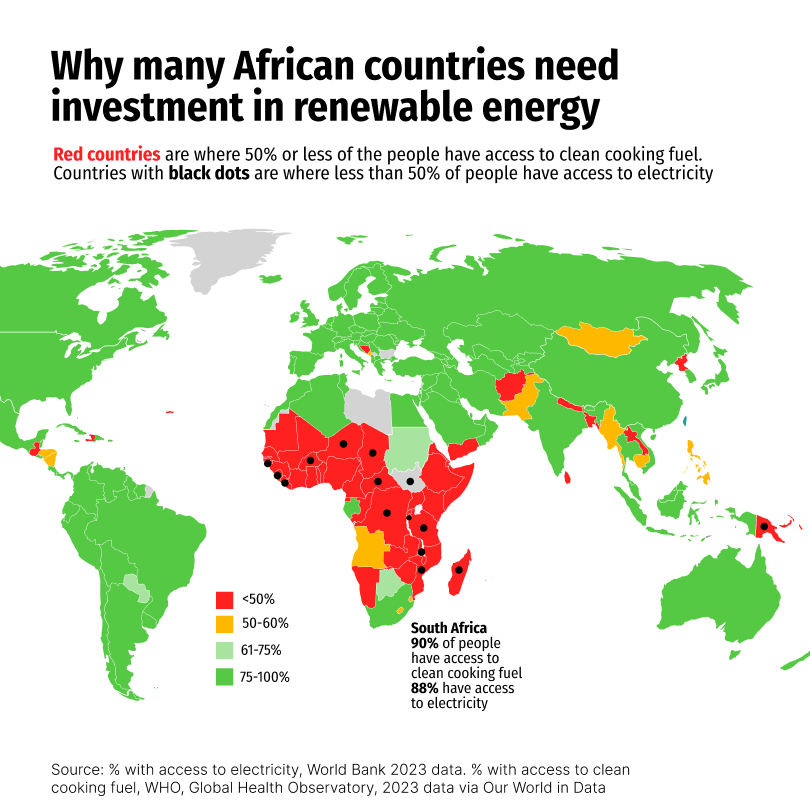
$2-trillion was invested in clean energy last year, but only 2% went to Africa, said Van der Leyen. Meanwhile, in 13 countries less than half the population have access to electricity and in many countries people do not have access to clean cooking fuels. South Africa isn’t one of those countries.