
This week I’m focusing on clean energy beyond South Africa, inspired by a dataset on Chinese loans to Africa. I was looking at the loans for energy projects and it reminded me of something we did last year that showed the proportion of electricity generated from hydro in African countries.
At the time it surprised me. My world is shaped by living in a water-scarce country where most of our electricity is generated from coal.
The chart below doesn’t account for electricity imports; it’s just what’s locally generated and doesn’t necessarily mean that hydro meets 100% of a country’s energy demand. Namibia, for example – which you’ll probably be surprised to see on the top row of the chart because so much of it is desert – imported 60% of its electricity in 2023.
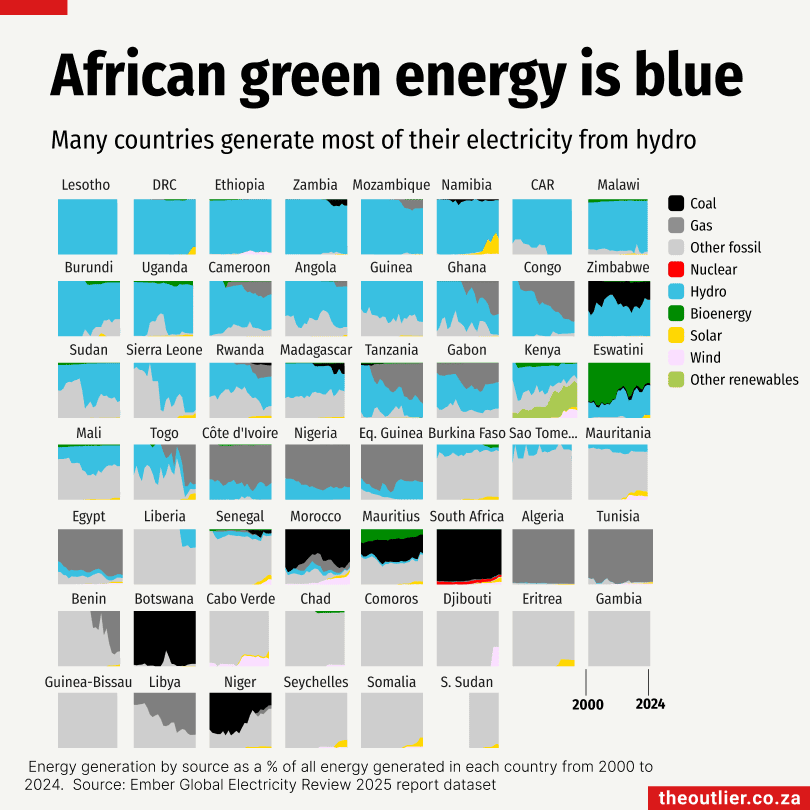
Africa has 43 GW of installed hydro capacity, according to the International Hydropower Association. That’s 20% of the total electricity generated on the continent but only a “small fraction” of its potential, it says.
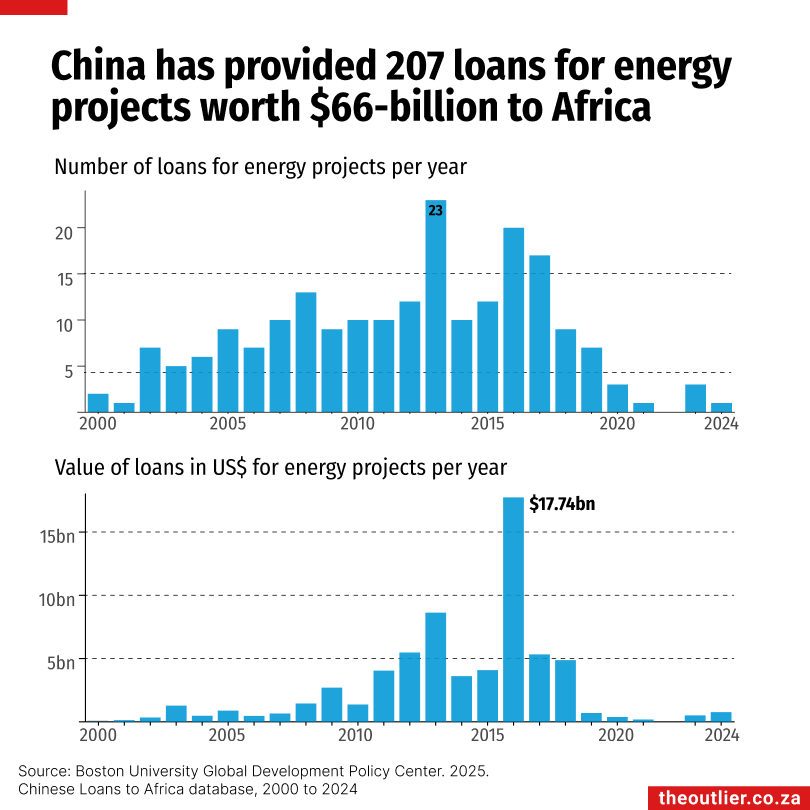
This is where Chinese loans to Africa come in. African countries have received more than $66-billion in loans from China for energy projects and most of the power generation loans were for hydroelectric projects.
In all, 207 energy-related loans were recorded in the Chinese Loans to Africa database maintained by Boston University’s Global Development Policy Centre. The database covers 2000 to 2024.
Which countries got loans?
China has committed loans for energy in 35 African countries. The projects ranged from gas, oil and coal to clean energy and transmission and distribution. There’s even a nuclear project: a $100-million loan in 2011 for Niger’s Azelik uranium mine.
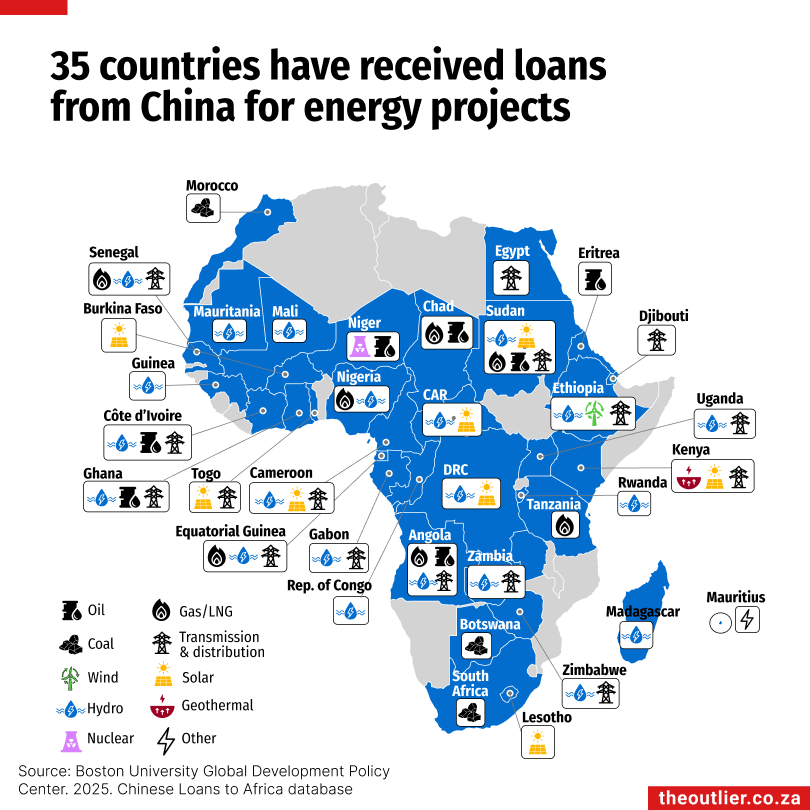
About half the loans were for transmission and distribution projects, the infrastructure that moves electricity from the facilities that generate it to the places that use it. In terms of power generation, the database lists more than 30 hydro projects. (see table here).
There were a few other clean energy projects:
- Domain Solar Plant (25MW) in Burkina Faso
- Sakai Solar Plant (15MW) in the Central African Republic
- Djoum Solar Plant (0.5MW) in Cameroon
- Garissa Solar Plant (50MW) in Kenya
- Ramarothole Solar Plant (70MW) in Lesotho
- Adama Wind Farm Array 1 (51MW) and Array 2 (153MW) in Ethiopia
- Aysha Wind Farm (120MW) in Ethiopia
- Olkaria IV Geothermal Power Station in Kenya
Belt and road
China’s belt and road initiative, launched in 2013, aimed to invest in infrastructure and development projects in countries around the world to promote trade ties with China. Eighty percent of the $66-billion worth of loans were issued between 2011 and 2019.
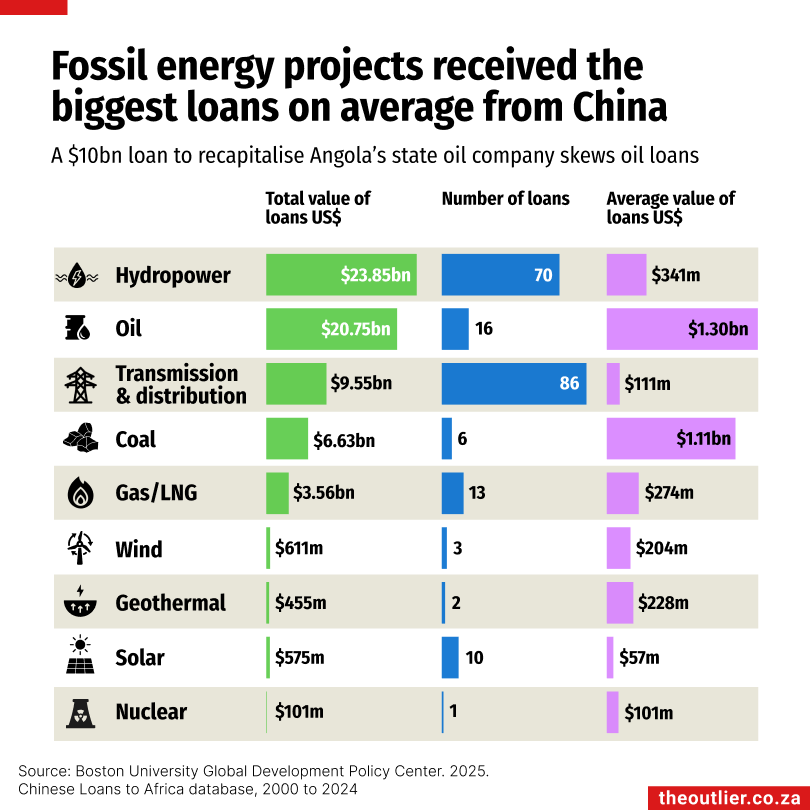
Energy loans peaked in 2016, with $17-billion worth of loans recorded that year. Most of the money ($10-billion) went towards recapitalising Angola’s state oil company, Sonangol. But South Africa’s Eskom also got a $4.5-billion loan for Medupi and Kusile coal power stations that year, and Zimbabwe got close to $1-billion to expand its Hwange coal power station.
One big clean energy project featured in 2016: Angola’s Caculo Cabaca Hydroelectric power station, which got $4-billion.
Even though only 17% of the loans were for fossil energy projects, on average those projects got more money. Close to 60% of the total value of loans over the years were for fossil fuel projects.
African countries with the most loans
Angola got by far the line’s share of the energy loans, $27.3-billion dollars worth, or 40% of the total. South Africa got the second highest amount, with three loans totalling $4.5-billion for Medupi and Kusile, but at 7% of the total it was a long way behind Angola.
Sudan, Ethiopia, Zambia and Uganda make up the top six countries that together got 68% of the value of the loans.
Since 2020 the number and value of energy loans in the database have dropped significantly and no new fossil fuel projects have been funded since 2019.
China is moving away from traditional development finance towards alternative channels, writes the Global China Initiative in a policy report. The database tracks loan commitments from Chinese development finance institutions, commercial banks, government entities and companies to African governments, state-owned enterprises and regional institutions.
Only six loans have been listed since 2020. Three are generation projects: Lesotho’s Ramarothole Solar Plant, the Ranomafana Hydropower plant in Madagascar and the Nyabarongo 2 Hydropower plant in Rwanda. The other three loans were for transmission and distribution projects in Uganda and Ghana.
But Chinese firms are increasingly involved in renewable energy supply chains, says the China-Global South Project. Chinese solar panels, wind turbines, inverters and batteries are now commonly used in African projects, even where China is not the financier, it states.
In South Africa, for example, Chinese company Longyuan Power Group operates two wind farms in De Aar, and PowerChina is involved in the Oya Energy Hybrid Facility.
The China-Global South Project has built an interactive power tracker of Chinese energy projects in Africa that illustrates the extent of China’s involvement in the energy sector in Africa.
NEWS WRAP
💨 Nine European countries this week committed to build 300 GW of offshore wind in the North Sea by 2050 at a rate of 15 GW per year between 2031 and 2040.
🚚 Zero Carbon Charge this month charged an electric truck using its off-grid solar charging station in Wolmaransstad. It shows electric long-haul freight powered by renewable energy and independent of the national grid is possible, the company says.
💰 British International Investment and Alexforbes Investments have committed R1-billion to the Revego Africa Energy Fund to support the expansion of its renewable energy projects.
☀️ 💨 Scatec has been awarded 25-year power purchase agreements with Tunisian state Société Tunisienne de l’Electricité et du Gaz (STEG) for the 120 MW Tataouine solar power plant and a 75 MW El Fahs wind power plant.
🚗 Tesla has reported the first ever annual revenue decline as it faces competition from Chinese electric vehicle manufacturers such as BYD.
EVENTS
🎤 EE Business Intelligence is hosting a webinar on renewable energy, battery storage and microgrid solutions for the mining industry in Southern Africa on 5 February. Register here.
🎤 Engineering News’ two-part series on SA’s energy outlook for 2026 kicked off on 28 January with a look at sustaining reform momentum in the sector. If you missed part one you can watch the recording on YouTube. Part two will be held on 3 February and will discuss investment in SA’s electricity transmission grid.
🔋 Solar & Storage Live Africa returns to the Gallagher Convention Centre from 25 to 27 March. The exhibition will feature more than 650 solution providers showcasing technologies across solar generation, energy storage, power electronics and smart energy systems. Alongside the exhibition will be a three-day conference. Outlier Renew is a media partner for the event. To register to attend the exhibition and conference for free you can register here.
⚡️ The Africa Energy Indaba will be happening at the Cape Town Convention Centre on 3 – 5 March.