
I went to the Africa Energy Indaba in Cape Town this week. The theme was African Energy Pathways to Prosperity and multiple speakers made the case that Africa’s energy deficit is the single greatest constraint on economic development, industrialisation and equity on the continent.
There were a few recurring themes:
Energy is a development imperative, not a luxury
Electricity is not optional infrastructure on a continent where 600-million people don’t have access to it. About 90-million people a year need to be able to get access to electricity if universal access is to be achieved by 2025. In South Africa: 93% of households have access to electricity, up from 53% in 1994, President Cyril Ramaphosa said in a speech.
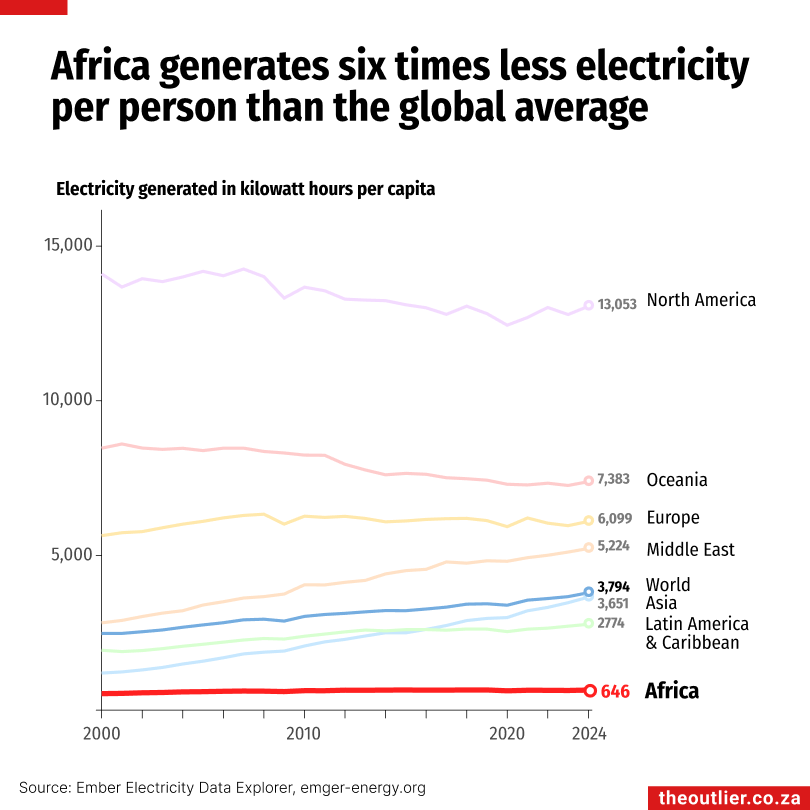
Ember data for 2024 (the latest available year) shows that the amount of electricity generated per capita in Africa is six times lower than the global average. The continent has a long way to go to catch up to the electricity generated per capita in North America, Europe and Oceania.
The paradox of abundance and poverty
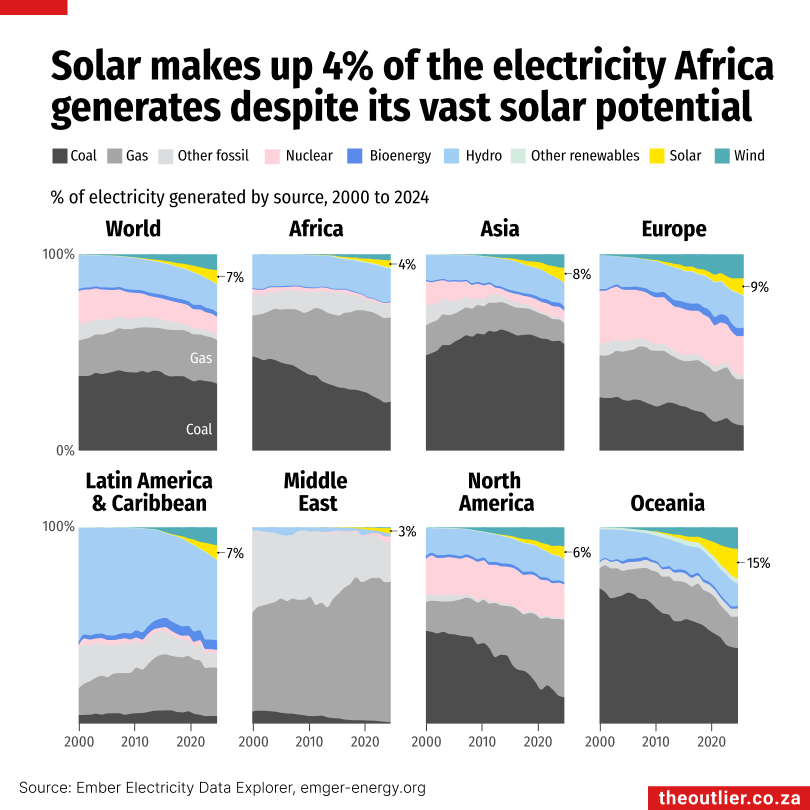
Africa holds 60% of the world’s best solar resources, vast hydropower potential, significant gas and oil reserves, and critical minerals yet it remains the most energy-deficient continent.
Continental integration over fragmented national markets
Regional power pools for southern, eastern, central, western and northern Africa, as well as and cross-border interconnectors are seen as the building blocks of a connected continental grid. Integration benefits efficiency (balancing supply and demand across geography) and resilience (spreading risk so that failure in one part of the grid is compensated elsewhere).
The financing gap and domestic capital mobilisation
Africa’s own $4.6-trillion in domestic capital across pension funds, sovereign wealth funds, insurance assets, and commercial banks could be mobilised through better financial instruments and stronger regulatory frameworks to help bridge the financing gap, which is estimated at about $150-billion a year, said Lerato Mataboge, Commissioner for Infrastructure and Energy at the African Union. Attracting foreign capital is another solution.
From ambition to delivery
There is a need to move beyond policy frameworks and talking-shops to actual project execution.
Beneficiation and value addition
President Cyril Ramaphosa returned to the argument that Africa must stop exporting raw minerals (‘stone, dust, and soil’) and start processing them locally.
Geopolitical wake-up calls
The Russia-Ukraine conflict, the Middle East supply disruptions and US tariffs announced on ‘Liberation Day’ were all cited as evidence that import-dependent economies are vulnerable to external shocks and as arguments for African energy self-sufficiency and market diversification.
RENEWABLE PIN-UP
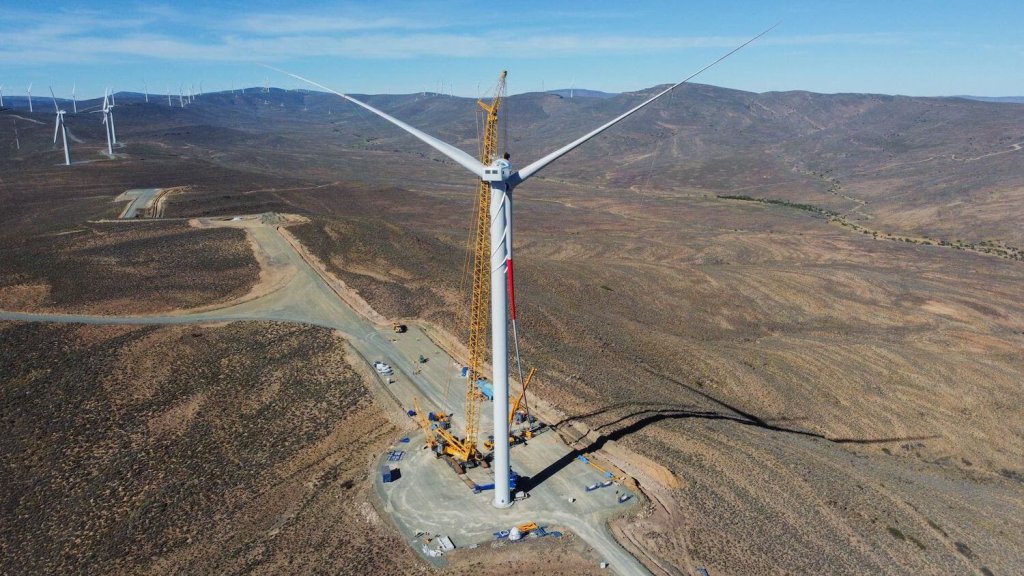
G7 Renewable Energies announces the completion of the first star lift at the 140MW Karreebosch wind farm in the Karoo. A wind turbine ‘star lift’ refers to the mounting of the rotor blades, hub and nacelle on the tower, typically using massive cranes.
Turbine specifications
Rated capacity: 6.0MW per turbine
Tower height: 100m
Rotor diameter: 165m
Generator: 117 tonnes
Nacelle: 43 tonnes
Hub: 57 tonnes
NEWS WRAP
☀️ Etana Energy and developer Mulilo have reached financial close on a 219MW solar project near Orkney in the North West, with Etana as the sole offtaker under a private power purchase agreement, buying electricity delivered via the national grid. The project has equity backing from Copenhagen Infrastructure Partners and Norfund, with financing from Standard Bank and Absa. Once operating, it will generate about 478GWh of electricity annually and displace over 500,000 tonnes of CO2 per year. It is the second project between Etana and Mulilo to reach financial close in the past 12 months.
💰 Vantage Capital has invested R635-million (about $39.5-million) into Commercial Energy South Africa (CESA), a subsidiary of SolarAfrica Energy, alongside co-investor Greenpoint Capital. The mezzanine facility was used to buy out Inspired Evolution‘s stake, making SolarAfrica the 100% owner of CESA‘s roughly 90MW portfolio spread across 134 commercial and industrial sites.
☀️ Lyra Energy, a joint venture between Norwegian developer Scatec (50%), Standard Bank, and Stanlib, has signed power purchase agreements with three commercial and industrial customers for a significant share of its 255MW Thakadu solar project in South Africa. Financial close on Phase 1 was anticipated for the first quarter of 2026, with construction to follow and Phase 2 later in the year. Scatec will handle engineering, procurement, construction, operations and maintenance.
📋 Finance Minister Enoch Godongwana tabled the 2026 budget on 25 February, placing energy infrastructure at the centre of the fiscal plan. Key measures include R3.8-billion for electrification programmes, R2-billion for a smart meter rollout, and a new Credit Guarantee Vehicle being developed with the World Bank to attract private investment into transmission. The government will this year launch the first round of Independent Transmission Projects, inviting private companies to finance, build and operate new grid infrastructure.
📋 President Cyril Ramaphosa used his 12 February State of the Nation Address to commit South Africa to sourcing more than 40% of its electricity from renewables by 2030, framing cheap, clean power as the backbone of future economic growth. He also confirmed that the National Transmission Company South Africa (NTCSA) will become a fully independent state-owned entity with outright ownership and control of the country’s transmission assets, settling a question that had hung over the sector about whether transmission would genuinely separate from Eskom.
⚡️ The National Transmission Company South Africa (NTCSA) is targeting 1 April 2026 to launch the South African Wholesale Electricity Market (SAWEM), which will replace Eskom‘s single-buyer model with a multi-buyer, multi-seller trading platform. NERSA granted NTCSA its market operator licence in November 2025. The market will open in phases, starting with Eskom power stations and publicly procured independent power producers, before bringing in private generators. Key components include a day-ahead market, an intraday market, and a balancing market. NTCSA has flagged that the April timeline carries risks, and readiness remains a live concern across the sector.
☀️ German-led Kahre Renewable Energy Group unveiled a plan at the Cape Town Mining Indaba in February for a 20 GW solar and wind corridor running 450km from an 85,000-hectare site in the Northern Cape to Saldanha Bay on the west coast. Rather than plugging into Eskom‘s congested grid, the project would build its own private transmission and pipeline route alongside the existing Sishen-Saldanha railway.
☀️ The African Development Bank has approved $14.54-million in financing for the Garneton North solar plant in Zambia’s Copperbelt Province, a $24.5-million project developed under Zambia’s Global Energy Transfer Feed-in Tariffs (GETFiT) programme. The 20MW plant will connect to the national grid via a 10km transmission line and sell power to the Zambia Electricity Supply Corporation under a 25-year take-or-pay agreement.
☀️ Mauritania has signed a $300-million agreement with Iwa Green Energy to develop a 60MW hybrid solar and wind power plant under the African Development Bank‘s Desert to Power initiative, which aims to bring electricity to 250-million people across the Sahel using the region’s solar resources. The plant is scheduled to start generating by September 2026. The Desert to Power programme is targeting 10GW of solar capacity across 11 Sahel countries and has been a vehicle for coordinating concessional finance and private investment in one of Africa’s least-electrified regions.
EVENTS and RESOURCES
🔋 Solar & Storage Live Africa returns to the Gallagher Convention Centre from 25 to 27 March. The exhibition will feature more than 650 solution providers showcasing technologies across solar generation, energy storage, power electronics and smart energy systems. Alongside the exhibition will be a three-day conference. Outlier Renew is a media partner for the event. To register to attend the exhibition and conference for free, you can register here.
💻 Webinar recording: Tokenised energy settlement: affordable green electricity for municipal customers, hosted by Future Cities Africa.