 Slow growth
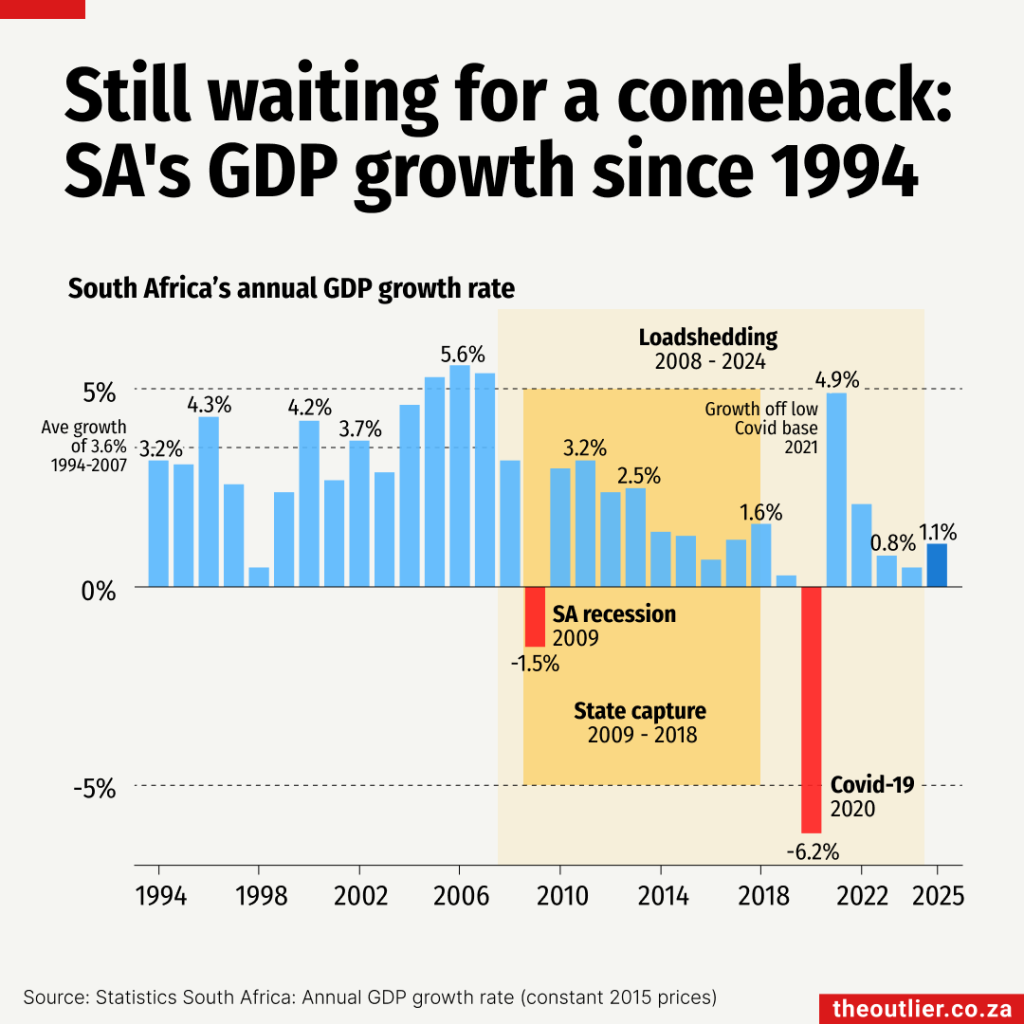
South Africa reported its best economic growth in three years in 2025, but 1.1% is not nearly good enough. It falls short of the National Treasury’s predictions of 1.4%. It also lags well behind the IMF’s global estimate of 3.3% and Nigeria’s 4.2%.
GDP, the total value of goods and services produced, is a measure of economic health. When it grows, jobs are created and investment follows. When it contracts, jobs are lost and investors look elsewhere.
Between 1994 and 2007, South Africa averaged 3.6% growth thanks to a commodities boom, an expanding middle-class and a surplus budget in 2007/08. But loadshedding, the 2008 global recession and state capture dragged the 2008–2019 average down to 1.6%. Post-Covid recovery has yet to restore those early highs.
2025 was South Africa’s Government of National Unity’s first year. The coalition of rival political parties has a target of 3.5% growth by 2030. Economist Sanisha Packirisamy said several structural reforms could push economic growth towards 2% in the coming years. These include shifting electricity generation from Eskom to private sector players adding renewables to the grid; expanding the transmission network, bringing private sector operators into Transnet’s railways and Durban’s Pier 2 terminal, ringfencing water revenue so that it is directed towards infrastructure, making it easier for tourist operators from China and India to enter South Africa, streamlining work visa approvals, digitising the economy, and overhauling municipal governance.
 Stolen and vandalised
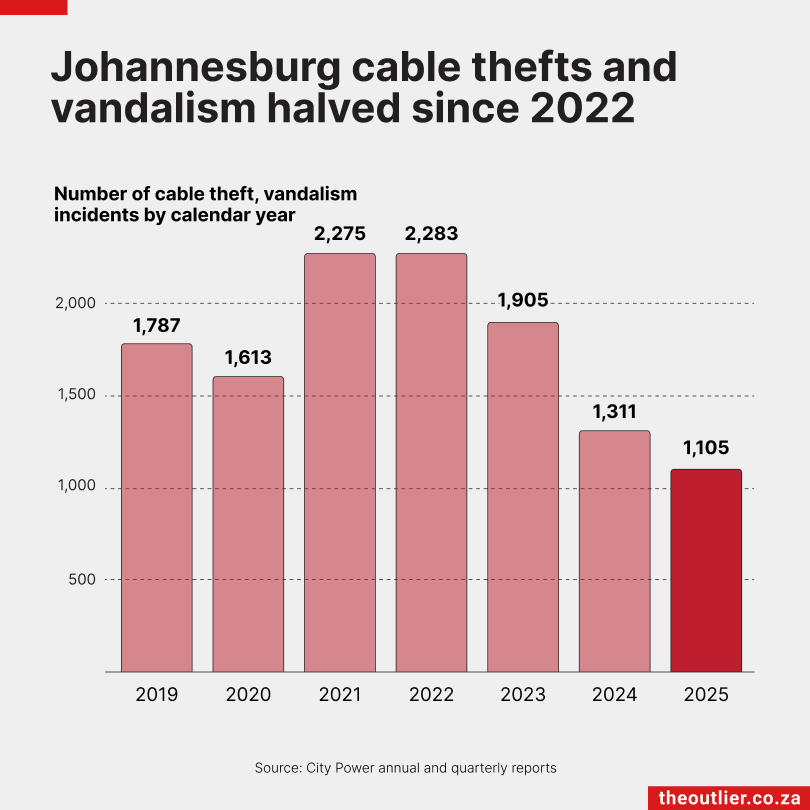
Joburg recorded 1,105 incidents of cable theft and vandalism in 2025, roughly three a day. While it’s a major improvement from the 2,283 incidents in 2022, or six a day, it is still a problem for residents and businesses that lose power because of vandalised and stolen cables.
Loadshedding was behind the rise in cable theft and vandalism in 2022, said City Power, explaining that criminals took “advantage of the situation when the network [was] ‘dead’”. Flooding in December 2022 didn’t help either: “floods exacerbated cable theft and vandalism by washing cables open from trenches.” This left cables “exposed and easy for criminals to cut and steal them,” said City Power.
City Power has implemented a variety of measures to stop vandalism and cable theft:
- Installing alarm systems with armed response at substations,
- Welding substations with heavy-duty steel brackets, and
- Replacing underground cables with overhead lines.
One of the biggest deterrents has been City Power’s plan to replace copper with aluminium, which holds significantly less value for thieves.
However, City Power told Daily Maverick that it had observed a “worrying resurgence in incidents of cable theft and infrastructure vandalism” between November 2025 and January 2026, 307 incidents in total, including 105 incidents in January 2026, because of the rising market demand for scrap metal.
- Produced in partnership with Our City News
 Slippery situation
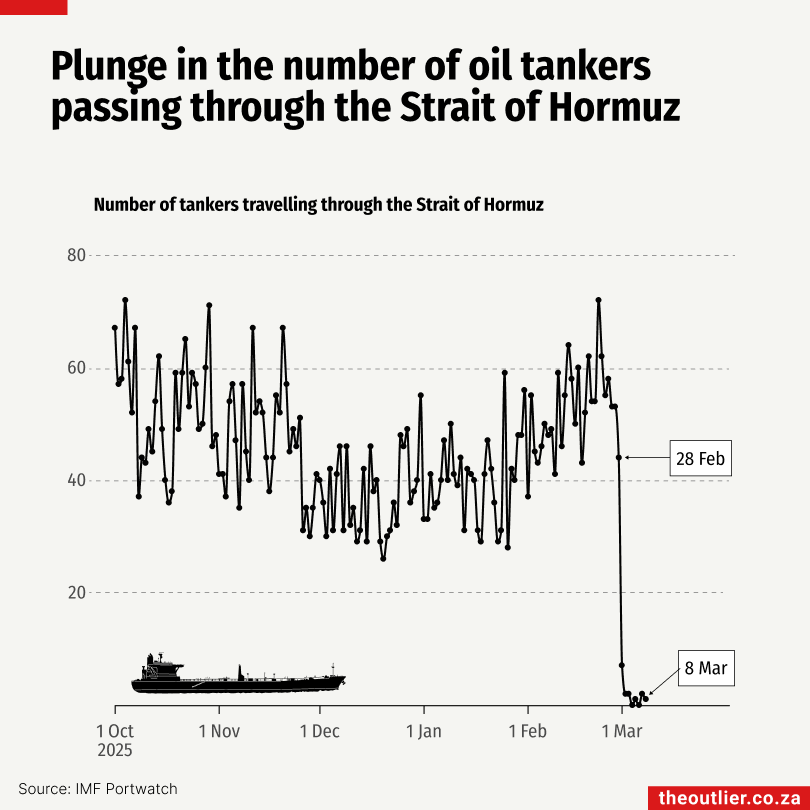
The number of oil tankers transiting the Strait of Hormuz, a critical oil shipping chokepoint, collapsed in early March. On 28 February 2026, the United States and Israel launched coordinated airstrikes on Iran, killing Supreme Leader Ali Khamenei. Iran’s Revolutionary Guard responded by prohibiting vessel passage through the strait, bringing shipping to an effective halt. By 8 March, traffic had fallen to near zero.
South Africa imports most of its crude oil from Nigeria and other West African producers, so it isn’t directly exposed to a Hormuz shutdown through crude supply. But the picture changes significantly when refined fuels are included: Gulf producers like Oman, UAE, Bahrain and Saudi Arabia, supply a substantial share of the diesel and petrol South Africa imports, much of it transiting Hormuz. Diesel alone accounts for about 67% of South Africa’s refined fuel imports.
Even without a direct supply shock, a sustained Hormuz disruption will tighten global oil markets and push up prices.
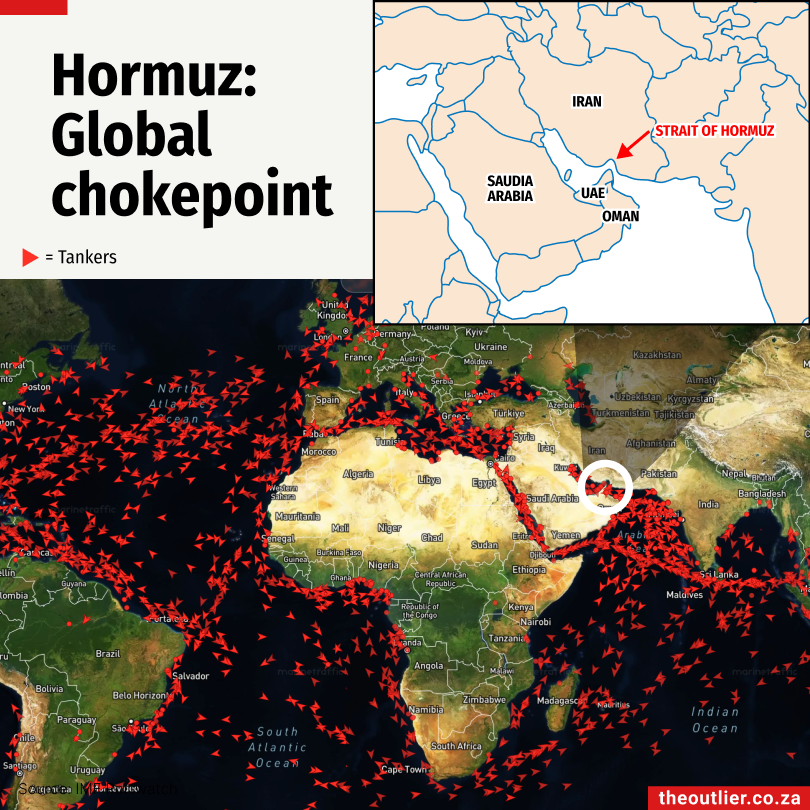
The Strait of Hormuz connects the Persian Gulf to the Gulf of Oman and the broader Arabian Sea. It sits between Iran to the north and the Oman peninsula to the south. At its narrowest point, it’s only about 33 km (21 miles) wide, though the navigable shipping lanes are much narrower: two inbound and two outbound lanes, each just 3 km wide, separated by a buffer zone.
Click here for a link to all references for this newsletter.