
South Africa’s first off-grid electric highway is weeks away
Two fully off-grid EV charging stations on the N3 are set to go live in mid-May, making it possible to drive from Johannesburg to Durban powered entirely by solar energy.
Zero Carbon Charge, the company behind the network, has signed a deal with logistics integrator Zimi to take 50% of the available energy at both sites: 500 kilowatt hours per day per station. That makes both sites cash-positive from inception, according to co-founder and executive chairman Joubert Roux who spoke to us during our recent Out to Lunch webinar.
Roux said that each solar charging station costs R16.5-million to build, with a 360-kilowatt charger feeding six dispensers, a solar farm, battery storage and a backup generator. There is no grid connection, which means no load shedding. The break-even point is just four charging sessions per day. Seven per day makes the company profitable.
The design of the charging stations is modular so that as demand grows, more solar, batteries or chargers can be added. Roux says that doubling a site’s capacity costs R6-million and that he already expects the N3 sites will need to be expanded by year-end.
Zero Carbon Charge’s proof of concept at Wolmaransstad has been running for 14 months, charging vehicles at up to 240 kilowatts and handling heavy trucks. That gave the company the confidence to move to the N3.
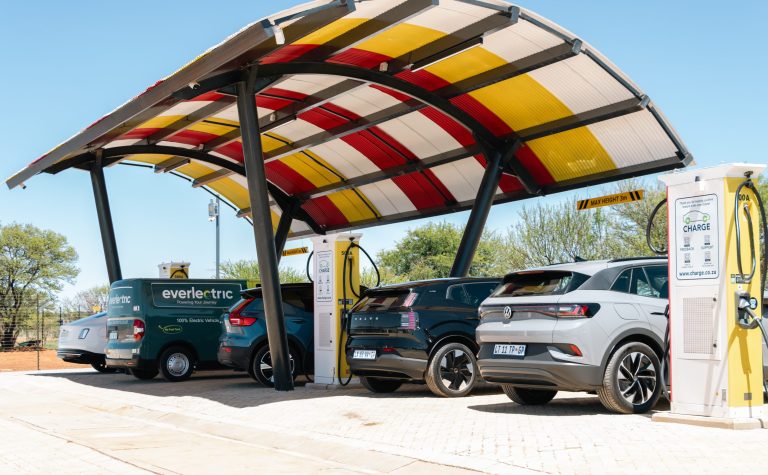
EV charging station at Wolmaransstad (Photo: Charge)
But the biggest obstacle hasn’t been technology; it’s been getting the necessary permits. Roux says some sites have been waiting more than 1,000 days for a comment from SANRAL.
Nonetheless, Roux is undaunted and his longer-term ambition goes well beyond South Africa. He estimates 638 off-grid stations could electrify all major transport corridors across Africa.
Read more or watch the webinar recording (members only)
PLUG-AND-GO
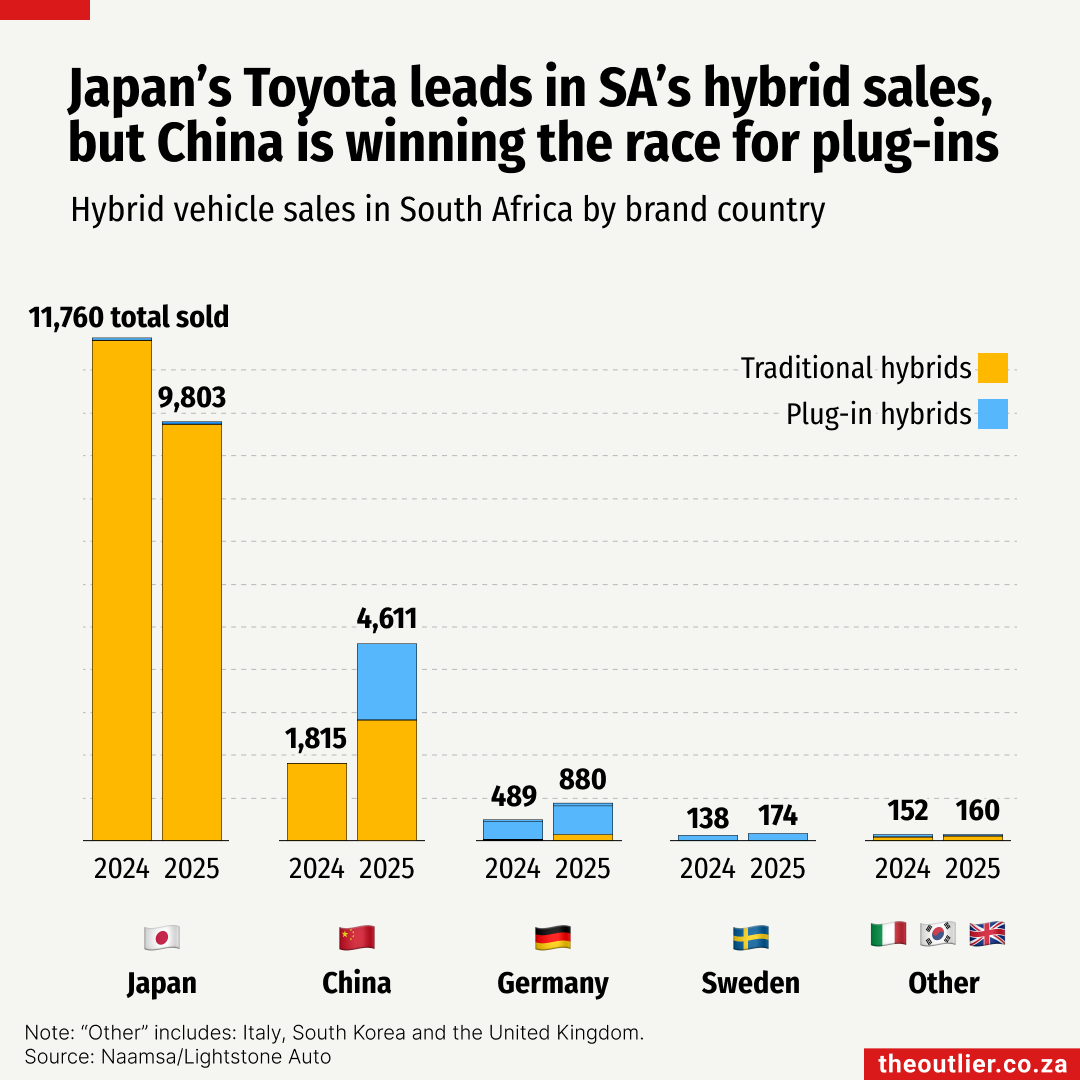
Japan’s Toyota dominated South Africa’s hybrid market in 2024, accounting for three out of every four hybrid vehicles sold. A year later, Chinese competitors are starting to chip away at that dominance.
Traditional hybrids remain the most popular type of new energy vehicle in South Africa, with 12,818 units sold in 2025. These vehicles charge through the engine and regenerative braking. Plug-in hybrids, which can be connected to the grid, recorded 2,810 sales.
While Japan, led by Toyota, continues to dominate traditional hybrids (71% share) in 2025, the tide is turning. Toyota sold 1,984 fewer vehicles in 2025 than the year before, an 18% year-on-year decrease. In contrast, Chinese brands are gaining traction in the plug-in hybrid market. From a negligible base in 2024, China sold 1,791 plug-in hybrids in 2025, led by Chery (751 units) and supported by the arrival of Haval (448), Jaecoo (317), and Omoda (273). The only major non-Chinese challenger in the top five brands of plug-in vehicles sold is Germany’s BMW, which recorded 681 sales.
NEWS WRAP
🚗 Johannesburg’s electricity company, City Power, launched a pilot EV charging station at its offices in Booysens last month. The facility uses a combination of solar photovoltaic, battery storage and grid supply. City Power told us that it has only one electric vehicle and 14 hybrid vehicles in its fleet at the moment. But says it has plans to transition its fleet of 680 internal combustion vehicles to EVs in phases. The utility also plans to roll out EV charging stations across all service delivery centres and City of Johannesburg offices. The 20 charging points at Booysens are open to the public.
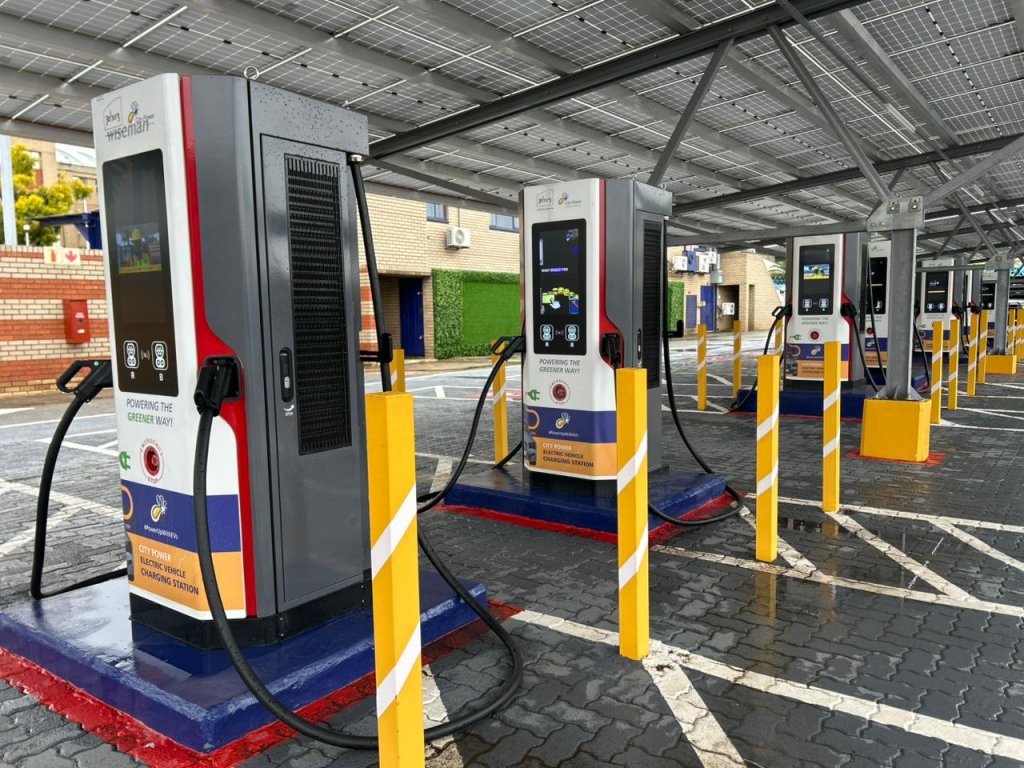
City Power’s pilot EV charging stations in Booysens, Johannesburg
☀️ City Power is also deploying microgrids to provide formal electricity to Johannesburg’s 312 un-electrified informal settlements. Since 2024, five microgrids have been built and are operating around the city, confirmed City Power General Manager Qhakazile Mathebula at the Solar and Storage Live Africa conference last month.
The sites are:
- Vukani: 4MW
- Vlakfontein: 4MW
- Shalazile: 1.2MW
- Amarasta (Alexandra): 1MW
- View: 0.65MW
Electricity is wired from the microgrid to residents’ houses, much like normal electricity connections.
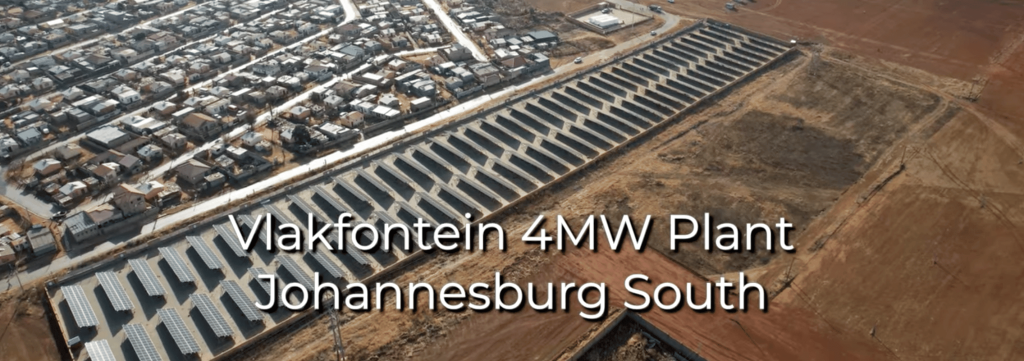
Microgrid at Vlakfontein (Photo: City of Joburg)
⚡️ The City of Cape Town wants to reduce its reliance on Eskom by procuring 500MW of electricity from energy traders and aggregators who can source electricity from a range of independent power producers. The intention is to procure electricity at a lower cost than from Eskom. The city also wants to be able to participate in the South African Wholesale Electricity Market. Submissions for the city’s Tender no 156S/2025/26 close on 13 May 2026.
💰 Two companies announced multi-billion-rand investments in renewable energy projects at the 6th South African Investment Conference in Sandton this week. Mulilo said it plans to invest R14.8-billion in new projects, specifically three solar photovoltaic projects and a battery storage system. Together they are expected to add 716MW to the grid. Seriti Green says it will invest another R10-billion in Mpumalanga. The company has already spent R15-billion on the Ummbila Emoyeni project, which will eventually combine five wind farms, a solar power plant and battery storage with a capacity of 900MW. Other independent power producers that made commitments were: Anthem Energy (R10.2-billion), NOA (R9.9-billion), Enel Green Power (9.8-billion), Hosana Green Energy (R5-billion), Mzansi Energy (R3-billion) and Parsons Power Park (R2.8-billion) as well as Shaurya Steel (R0.2-billion) and Tinna Mbodla Rubber (R0.1-billion) both from India.
💰 The African Development Bank and the Nordic Development Fund will provide finance of $11.3m to pilot the Peace Renewable Energy Certificate (P-Rec) Aggregration Facility. The facility will deploy the certificates to fund mini-grid projects in energy-poor and conflict affected countries. The facility will be managed by Camco Clean Energy and Energy Peace Partners.
EVENTS and RESOURCES
Webinar. Enhancing safety and reducing fire risk in residential and commercial solar PV and BES systems. As rooftop solar PV and battery energy storage (BES) systems proliferate across residential and commercial premises, safety and fire-risk mitigation have never been more critical. This free webinar covers the latest strategies, technologies and best practice for improving system safety and reducing fire incidents on customer sites. Hosted by EE Business Intelligence. Date: April 13 2026 at 2pm. Register here.
The International Renewable Energy Agency (IRENA) this week released its Renewable Capacity Statistics 2026, which covers the past decade (2016-2025). Global renewable power capacity was 5,149GW at the end of 2025, nearly half of which was solar, according to the report. Africa’s capacity was 82GW.