 Dwindling forests
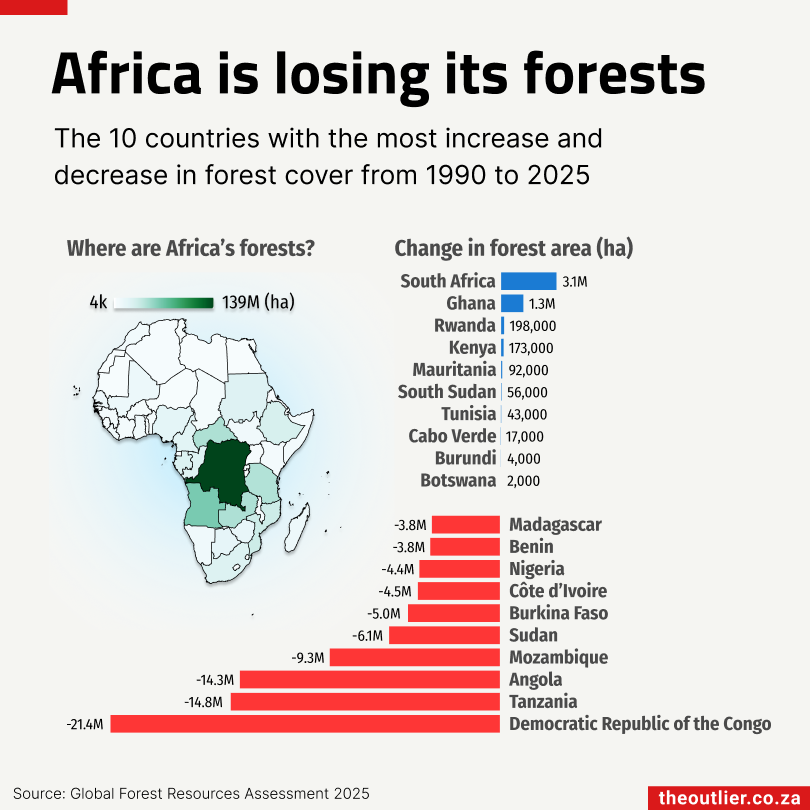
Africa lost roughly 116-million hectares of forest between 1990 and 2025, according to the 2025 Global Forest Resource Assessment. That’s an area of forest that isn’t coming back fast enough.
Only 10 of the continent’s 54 countries recorded any increase in forest cover. South Africa gained 3.1-million hectares and Ghana added 1.25-million, but these modest recoveries are dwarfed by losses elsewhere. The Democratic Republic of the Congo lost 21.4-million hectares, Tanzania 14.8-million, and Angola 14.3-million.
The pattern is stark. Individual gains are small and rare. Losses are massive and widespread. Recovery efforts exist, but they are not keeping pace with the scale of destruction. For a continent already vulnerable to climate impacts, the steady disappearance of forest cover carries consequences that compound over time, for biodiversity, water systems, and the communities that depend on them.
 Swift transfer
If you’ve ever sent money overseas, you’ve used a SWIFT code. That unique identifier ensures money reaches the correct bank and account internationally.
SWIFT, the Society for Worldwide Interbank Financial Telecommunication, was founded in 1973. It doesn’t actually transfer money; instead, it sends secure messages instructing banks to move funds.
Transfers once took one to five business days, but 90% now reach the recipient bank within an hour, according to SWIFT’s 2024 annual review. However, SWIFT’s fees make sending smaller amounts across borders less practical, creating a market for mobile-first remittance fintechs like Mukuru and WorldRemit, which offer cheaper, more accessible alternatives.
SWIFT remains dominant for large, high-value transactions and continues to evolve, most notably through its Global Payments Innovation initiative, which enables real-time end-to-end payment tracking and clearer visibility on transaction costs.
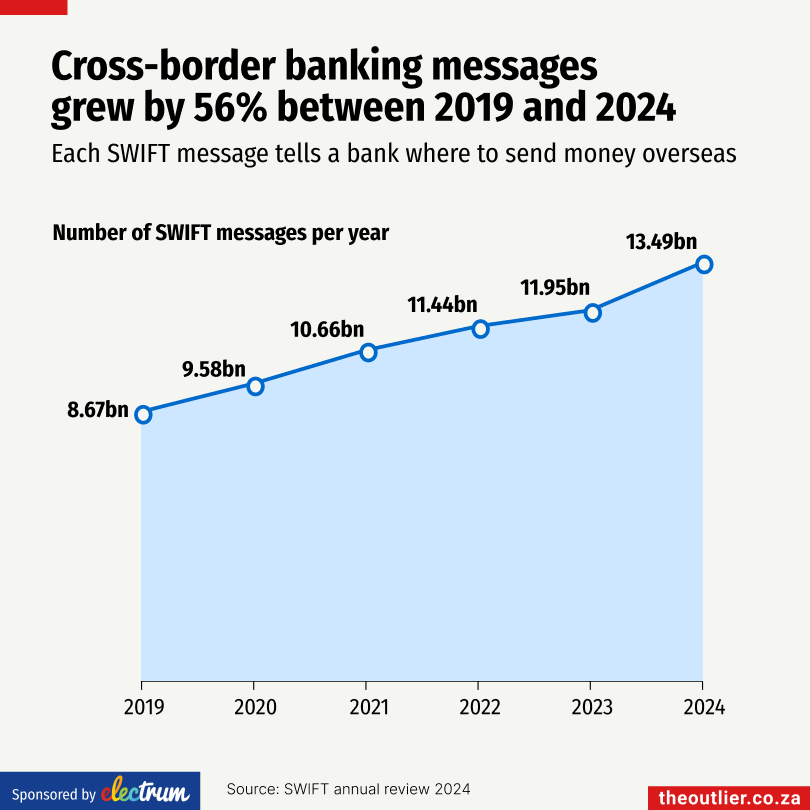
SWIFT message volumes rose from 8.67-billion in 2019 to 13.49-billion in 2024, a 56% increase in five years. As global rails evolve, our latest research predicts a further “disruptive expansion” in the cross-border landscape driven by regional links and tokenised instruments. Download the full South Africa’s Payments Future Report to see how bank leaders can navigate this transition and define the next generation of payments.
- Produced by The Outlier in partnership with Electrum, the next-generation payments software company, powering payments for banks and retailers.
 Micro-power
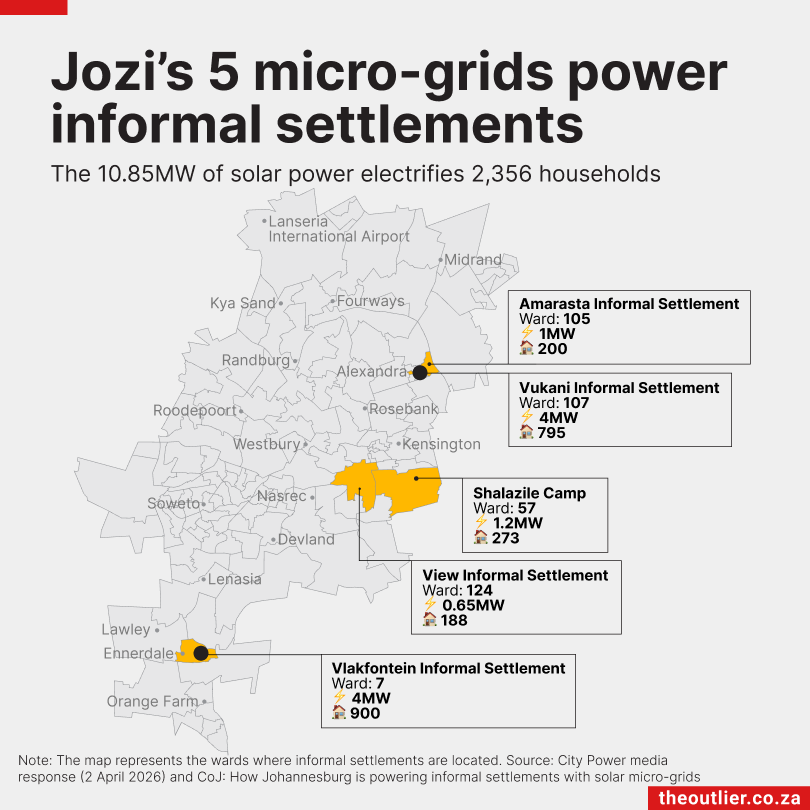
City Power launched a solar micro-grid pilot during the 2023/24 financial year to electrify five informal settlements across Johannesburg, Amarasta, Shalazile Camp, View Informal Settlement, Vukani and Vlakfontein, targeting 2,356 households where conventional grid connection is unfeasible. The initiative aimed to curb dangerous illegal connections that cause fires, electrocutions and infrastructure damage.
Johannesburg has over 300 informal settlements, and City Power had planned to expand the programme to 21 additional informal settlements through 2025/26. But the project has since been transferred to the Department of Human Settlements as part of the City’s Informal Settlements Upgrading Programme. While City Power no longer leads the project, it does continue to provide technical support.
However, “budgetary constraints remain a key factor affecting the pace of rollout, both previously under City Power and currently under Human Settlements,” explained City Power spokesperson Isaac Mangena.
While the residents in these five informal settlements may have solar power, the electricity isn’t free. City Power said standard tariffs apply, but qualifying residents can access the Expanded Social Package, saving approximately R200 a month and the Free Basic Electricity programme, providing up to 120kWh of free power.
- Produced in partnership with Our City News
 Tax record
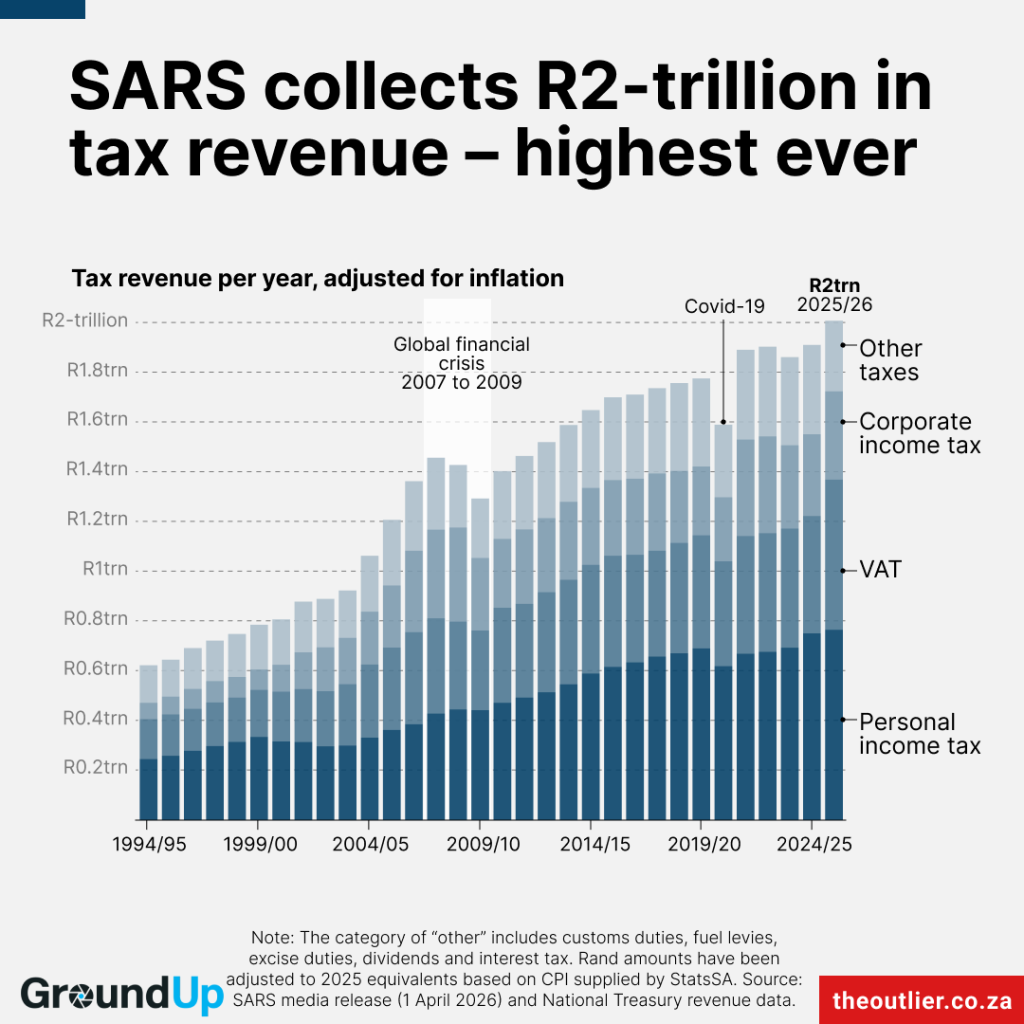
In 1994, when South Africa became a democracy, the South African Revenue Service (SARS) collected R113.8-billion in taxes. When adjusted for inflation, this would have been equivalent to about R624.3-billion in 2025.
31 years later, in the 2025/26 financial year, SARS broke records by bringing in R2-trillion in tax revenue.
Collection over the last three decades has been far from smooth. Large increases were seen in the early 2000s as a commodity boom (minerals, metals) boosted corporate income tax, but then during the global financial crisis between 2007 and 2009, the economy contracted and revenue collection dropped.
Revenue only reached pre-crisis levels in 2011/12. Tax income started to grow again in the years that followed, but slow economic growth hampered tax collection. Then, in 2020, the covid pandemic hit the economy, and tax revenue dropped again.
There has been significant recovery since covid as the economy has started to grow again, and SARS, under the leadership of outgoing commissioner Edward Kieswetter, has rebuilt its capacity after a period of state capture.
Chart produced in partnership with GroundUp.
Click here for a link to all references for this newsletter.