
Three private power projects that have purchase agreements with private companies started operating in the past few weeks (see our news wrap). To me they are indicators of how quickly things are changing in this country.
Two of the projects were conceived during Covid and took a while to get going, according to the developer Sturdee Energy. Those two 10MW projects are behind the meter. Back in those days of loadshedding, companies had a reason to seek out a reliable source of power. But the third one is a big 148MW solar plant in Limpopo that will supply power to Richards Bay Minerals in KwaZulu-Natal through a wheeling agreement.
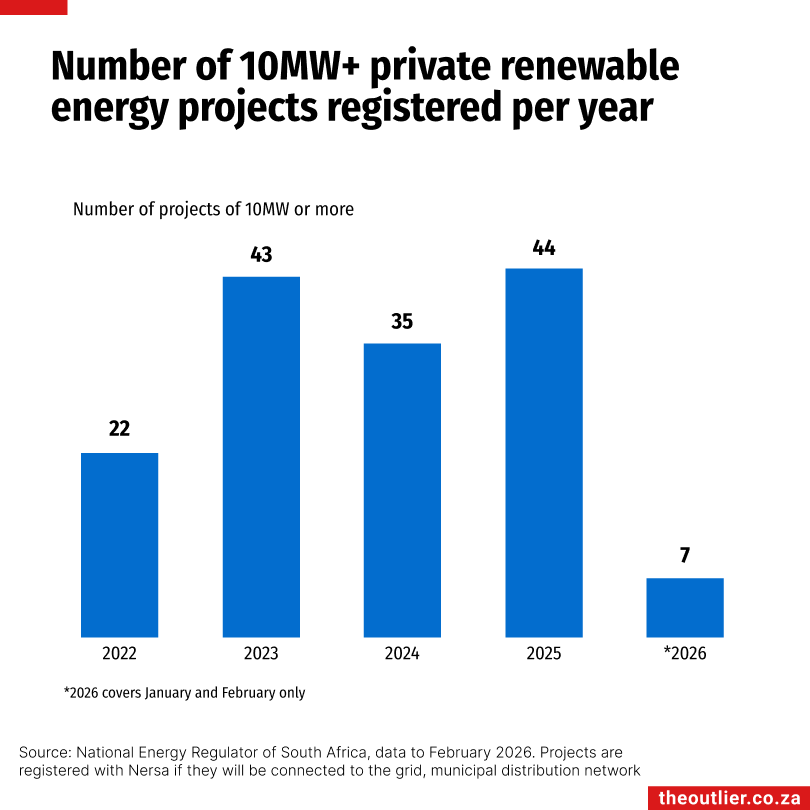
Wheeling and the proposed wholesale electricity market are changing the energy landscape. I was interested to see if the number of big energy projects – 10MW or more – being registered with Nersa had increased over time.
They have been. There were no 10MW+ projects registered between 2019 and 2021. But things started to take off in 2022 (see the chart below).
Nersa registers private power projects that will be connected to the national grid or a municipal distribution network when they’re built.
I thought it would be interesting to look at where the 10MW+ projects were – Nersa only gives the province. It was striking how many were registered in Gauteng in 2025 – 12 projects, all solar PV, and nine of them 100MW or more. Limpopo had 10, of which eight were 100MW or more.
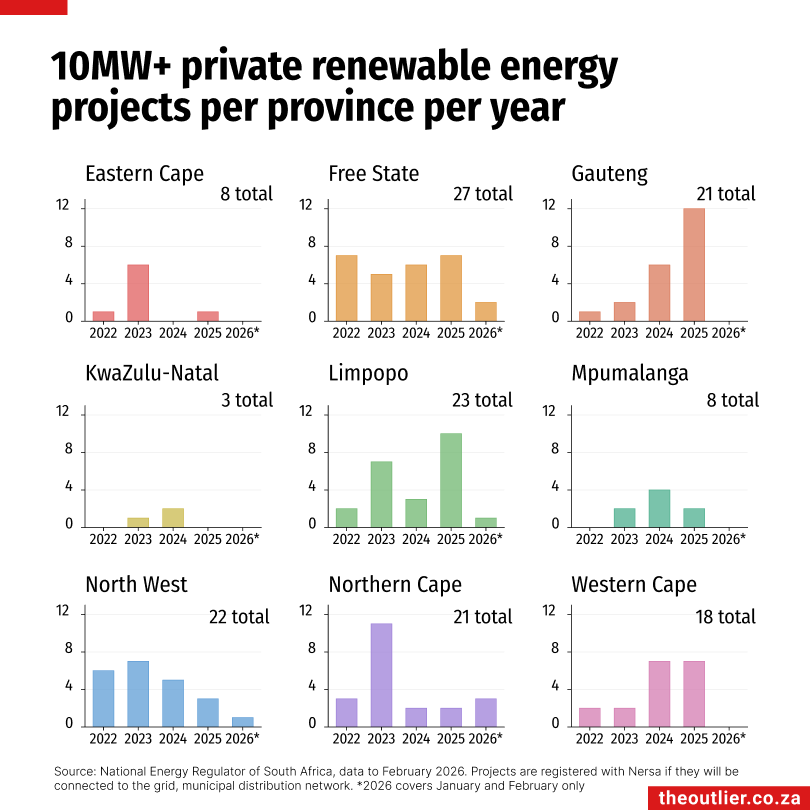
Only information for January and February 2026 has been made publicly available but the Northern Cape seems to be making a resurgence. Three 10MW projects have been registered in two months. That’s more than 2024 and 2025. This year got off to a good start with an average of 3.5 ‘big’ projects a month. If the pace keeps up, this year could match 2025.
A picture that tells it all
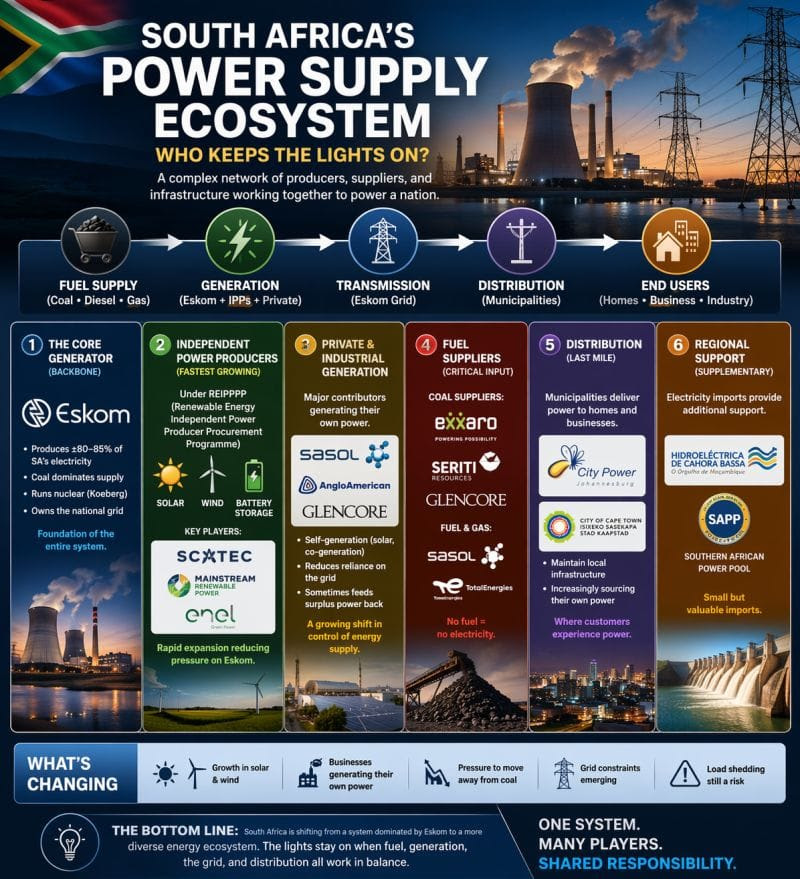
I’m a data nerd who has spent most of my career in journalism wishing that people would get their point across in fewer words. I love it when somebody unpacks complicated information succinctly in a graphic. This week Alastair Otter found the one below made by Dianne Davies on LinkedIn which I’m sharing here (with her permission, thanks Dianne) because it’s packed with interesting info.
RENEWABLE PIN-UP
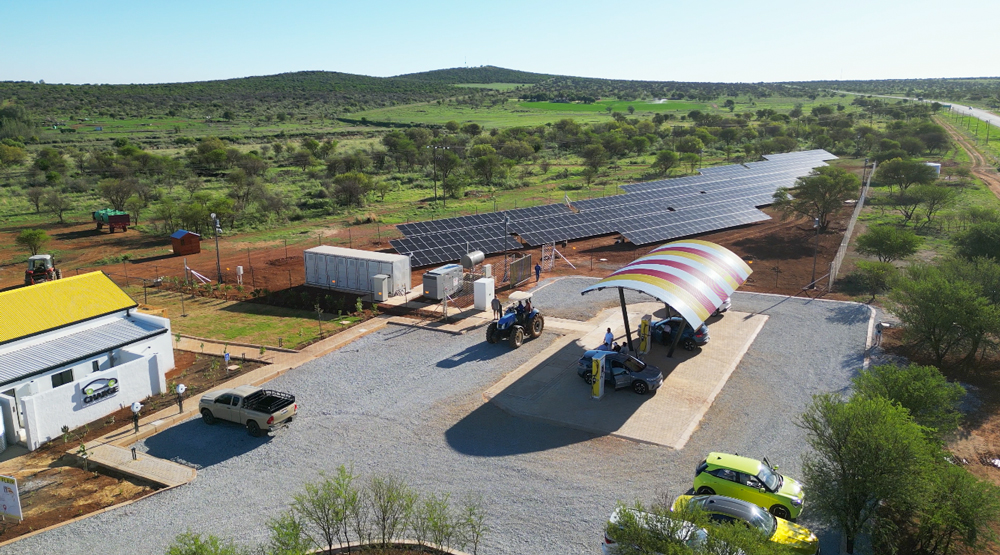
Drone footage of the Wolmaransstad electric vehicle charging stations (Photo: Charge)
Charge will open its next two micro-grid charging stations along the N3 in May, but it has also been over 14 months since it launched its pilot micro-grid charging station in Wolmaransstad in the North West.
Vital statistics
Charge N12 Wolmaransstad
Time to build: 6 months
Launched: 28 November 2024
Number of solar panels: 480
Total power produced by the solar panels: 280 kWp
Battery storage: 550 kWh
Charging stations: Six ultra-fast (DC) chargers for passenger and commercial electric vehicles up to 8 tonnes and two AC charging points for plug-in hybrids
Time to charge: +-20 mins, vehicle dependent
Benefit to landowners: Earn 5% of the revenue from the charging vehicles
Benefit to community: 1% of the annual sale of electricity will be given in the form of supporting education in local communities.
Charge co-founder and executive chairman Joubert Roux spoke to us during an Out to Lunch webinar. Read more or watch the webinar recording (members only).
NEWS WRAP
️⚡️ The Industrial Development Corporation and the Development Bank of Southern Africa (DBSA) have agreed to collaborate to develop and finance energy security projects within South African special economic zones (SEZs). Energy constraints have prevented SEZs from reaching their full potential, says Dr Phindile Masangane of the DBSA. The collaboration aims to scale and accelerate the development of energy projects to supply reliable, affordable, low-carbon energy to the zones.
🔋 Mulilo this month reached financial close on its 76MW/304MWh Mercury Battery Energy Storage System in the Free State. The project, which is near Viljoenskroon, is part of the government’s Battery Energy Storage Independent Power Producer Procurement Programme (BESSIPPPP). Mulilo was awarded nine projects under the programme, three of which are already under construction.
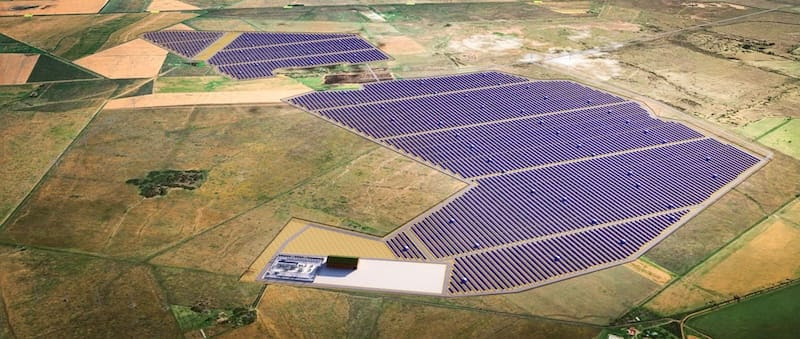
Middlepunt solar PV project (Photo: Mulilo/LinkedIn)
☀️ Mulilo also reached financial close on the 337MW Middlepunt Solar PV project this month. This facility near Welkom in the Free State is one of the projects under Bid Window 7 of the Renewable Energy Independent Power Producer Procurement Programme. Once operational, the project is expected to generate 770GWh of electricity into the national grid.
⛏️ Eskom has signed a coal supply agreement with Exxaro to supply its Matla Power Station until 2043. The power station is scheduled to be decommissioned on 20 July 2034. Exxaro’s Matla coal mine’s output is exclusively tied to Matla Power Station.
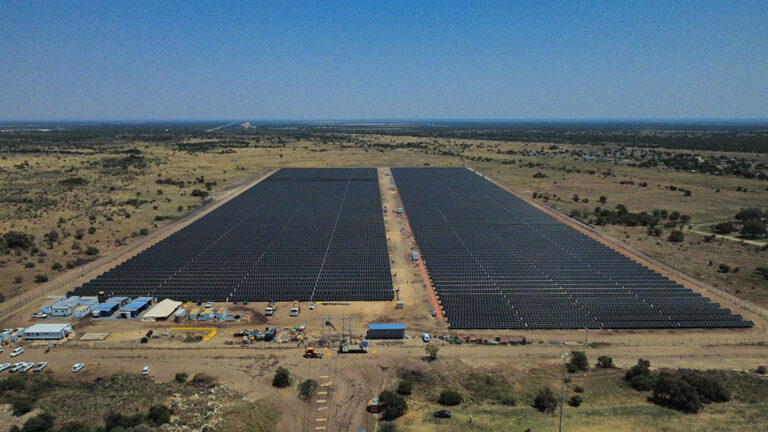
Slurry Solar Park (Photo: Sturdee Energy)
☀️ Sturdee Energy celebrated the commercial operation of two solar projects it built with cement company PPC, the Dwaalboom Solar Park and the Slurry Solar Park. Both facilities deliver behind-the-meter electricity to PPC Cement operations. The two plants have a combined capacity of 20MW, will generate 56-million kWh of clean energy and avoid 50,000 tonnes of carbon dioxide emissions a year.
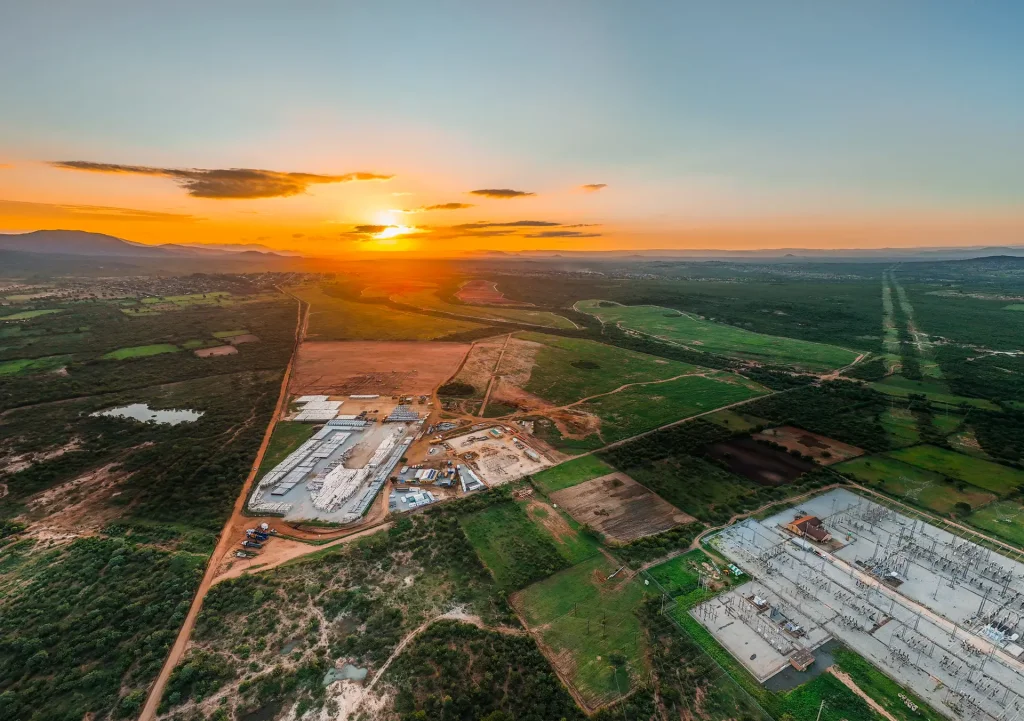
Bolobedu solar power (Photo: Bolobedu Solar)
☀️ Voltalia has announced the full commissioning of the 148MW Bolobedu solar power plant in Limpopo. The plant, which spans approximately 347 hectares, is expected to generate approximately 300GWh of clean electricity each year. All output will be supplied to Richards Bay Minerals, a subsidiary of Rio Tinto, under a 20-year corporate power purchase agreement. Electricity will be transmitted to the mining operations in KwaZulu-Natal through a wheeling arrangement using the national grid operated by Eskom.
EVENTS
🖥️ Webinar. How is transmission infrastructure financed? Who ultimately pays for it? What needs to change to accelerate delivery? These questions will be explored in a webinar in Energize Mzansi’s Global Grid Expansion Dialogue Series in collaboration with the World Energy Council and the Africa Sustainable Energy Centre. The webinar is on 21 April at 2pm. You can register here.
🖥️ Webinar. The National Transmission Company South Africa (NTCSA) is holding a webinar series on the South African Wholesale Electricity Market (SAWEM). The first one is an introduction to SAWEM, unpacking what is changing in the electricity sector, how the market is structured, who’s involved and an implementation progress update. It will be held on 22 April 2026, from 10am to 11.30am. You can find out more on NTCSA’s LinkedIn page. There isn’t a link to register, but the direct link to the Teams webinar is here.
🖥️ Webinar. EE Business Intelligence is hosting a free webinar titled: Building South Africa’s Competitive Electricity Market: The Role of Trading, Transmission and Market Reform. It will examine the key findings and recommendations of a recent SAETA report, Policy to Power: Ten Actions to Deliver Green, Accessible and Secure Electricity, to explore what they mean for South Africa’s electricity market reform process, the development of competitive electricity trading, and the practical steps required to unlock large-scale private investment while maintaining security of supply and affordability. Date 12 May 2026. Time 2pm to 4.40pm. Register to attend here.