🛤️ On the rails to recovery?
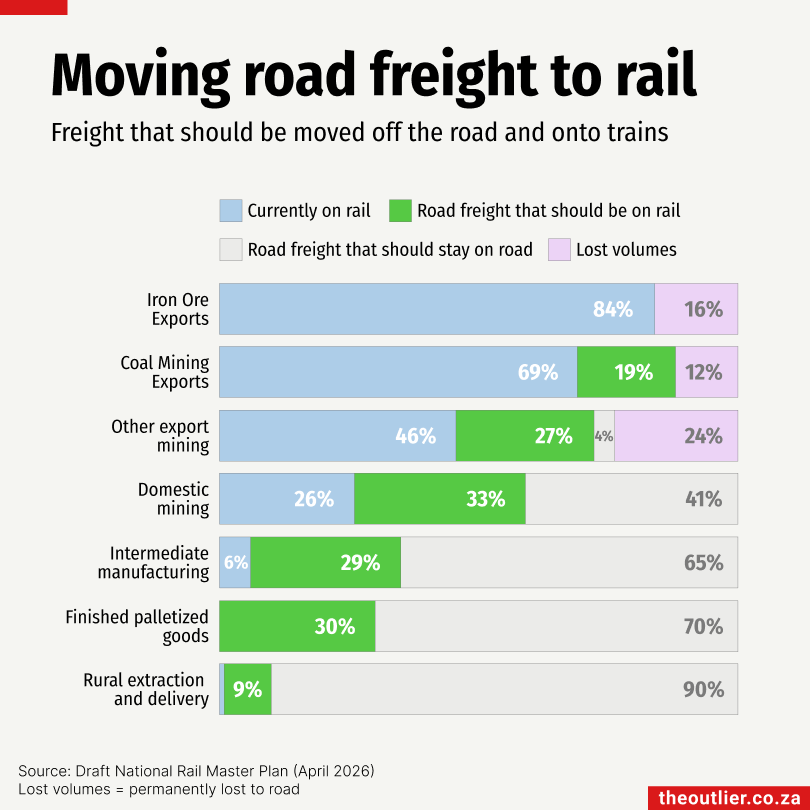
South Africa loses between R150-billion and R300-billion a year because ageing infrastructure, theft, and vandalism have left 16% of iron ore, 12% of coal, and 24% of other export mining products stranded off rail. To rehabilitate the ore line would cost R10-billion, while the coal line could cost between R10-billion and R15-billion, according to the draft National Rail Master Plan published in April 2026.
Road freight has grown from 53.5-million tonnes in January 2008 to 78.5-million tonnes in 2026, while rail has barely moved, according to Land Transport Survey data from Statistics South Africa.
To transport more freight by rail, the Transnet Rail Infrastructure Manager announced on 13 May 2026 that 11 private Train Operating Companies had been allocated slots across five corridors, adding 24-million tonnes of freight capacity, with potential to scale to 52-million tonnes over five years. But the real target is 250-million tonnes per year by 2030. That’s more than 80-million tonnes more than was transported last year.
In this week’s feature we take a closer look at the numbers behind rail’s planned recovery.
💳 Going digital
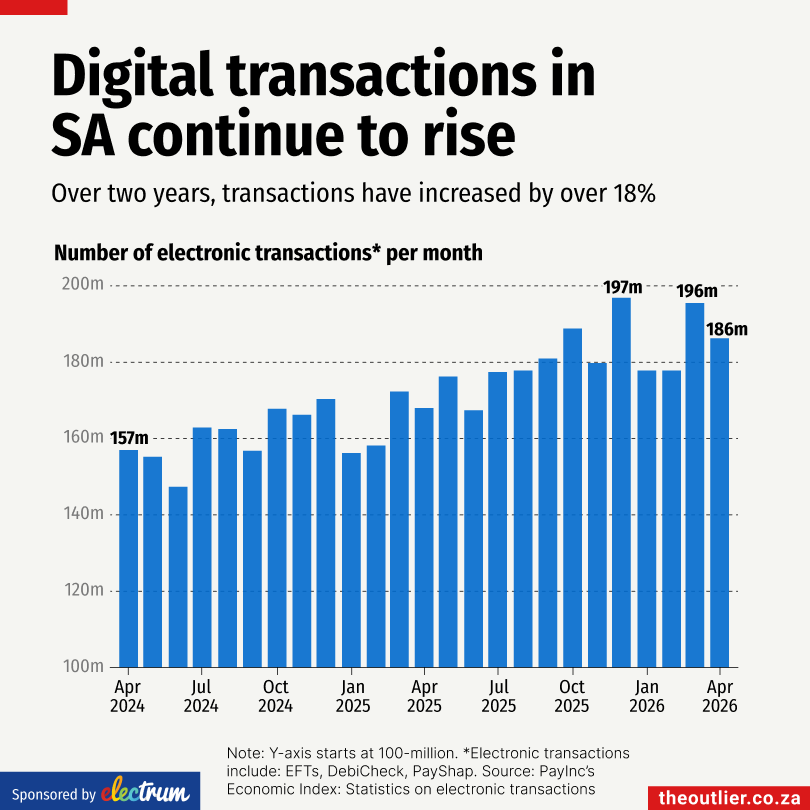
The way South Africans manage daily expenses is changing, with digital platforms increasingly becoming a normal part of life. According to the latest PayInc Economic Index report, consumers cleared an impressive 186.3-million electronic transactions in April 2026.
While this represents a slight moderation from the 195.5-million transactions seen in March, the bigger picture shows a highly resilient digital economy. Electronic payment volumes are up 11% compared to the same time last year, highlighting a consistent, long-term migration away from traditional cash toward convenient digital alternatives.
This steady appetite for digital transactions is especially notable given the significant economic pressures hitting household budgets. A massive fuel price adjustment at the start of April forced many families to rethink their daily travel and discretionary spending. Yet, even as people tightened their belts, the reliance on digital channels remained robust.
Whether it is everyday shopping, quick person-to-person transfers, or instant payments, electronic transactions have firmly established themselves as an essential daily habit. For businesses, this ongoing volume growth proves that offering fast, reliable digital payment options is no longer optional – it is a critical requirement for meeting modern consumer needs.
To learn more about the trends shaping how South Africans connect and pay, download Electrum’s latest research, South Africa’s Payments Future.
- Produced by The Outlier in partnership with Electrum, the next-generation payments software company powering payments for banks and retailers.
 ️ Fuel crunch
A war that began on 28 February, more than 5,000km away, is now felt at every African pump. Iran’s closure of the Strait of Hormuz choked off a fifth of the world’s oil shipments, and the cost has worked its way down to drivers across the continent.
In Kenya, it turned deadly. Four people were killed and more than 30 injured this week in protests against fuel prices. A nationwide transport strike also brought the country to a standstill. Note: Kenya is not in the chart below because despite hefty increases it still is not among the countries with the largest increases over the period, even though the price of petrol and diesel in Kenya is above the continental average.
The chart also shows two things at once: what fuel costs now, and how much the price has jumped since February. They don’t always move together.
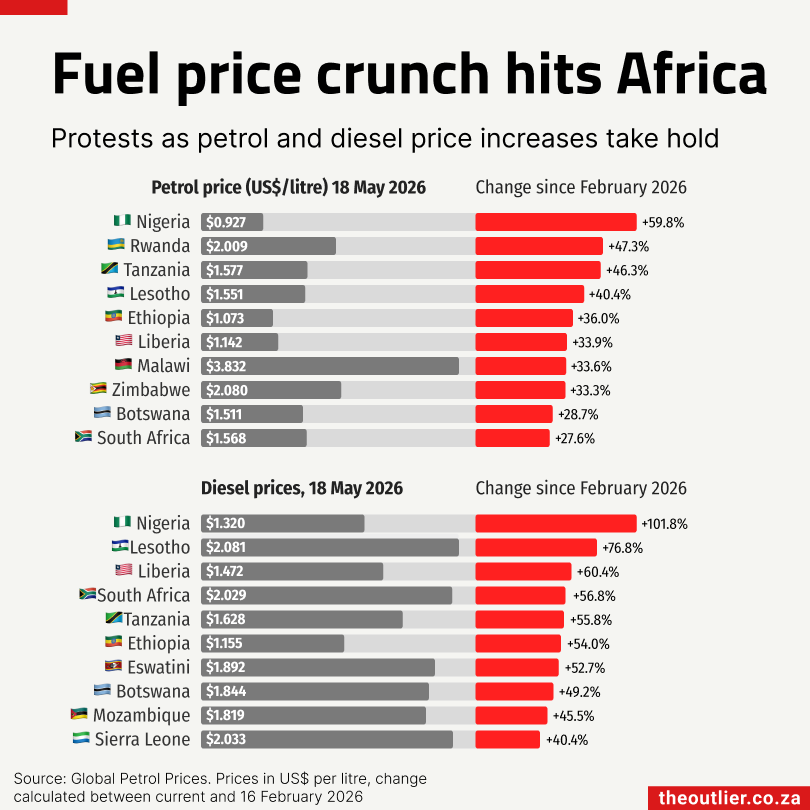
Take Nigeria. It has the cheapest petrol at $0.93 a litre, yet the price rose the most: nearly 60%. Its diesel did the same, more than doubling. That looks like a contradiction. It isn’t. Nigeria refines its own fuel at the giant Dangote plant near Lagos, so it starts from a very low base. But it still buys crude at the global price. When crude jumps, even a home refiner passes some cost on. A big rise on a small starting price makes a huge percentage. The fuel is still cheap.
For South Africans, the pain is sharper. Petrol sits at $1.57 a litre and diesel at $2.03. Diesel breached R32 a litre for the first time in May. Treasury cut the fuel levy to soften the blow, which is why our petrol rise of 28% looks mild next to Nigeria’s. The result still showed up fast: inflation hit 4% in April, a 20-month high, driven by fuel.
Petrol hits drivers in the pocket but it is diesel that is really worth watching as it moves the economy, and a change there has noticeable impacts across the country.

📢 Reimagining census data
How do you estimate how many people live in a building, without knocking on a single door?
Join our Out to Lunch on 27 May 2026 at 1pm for a conversation with Ross Solomons, senior geospatial specialist at GeoTerraImage, and Elsie Zwennis, their marketing and communications manager. Together, they’ll unpack how geospatial data is collected, modelled, and used to understand how South Africa’s cities, suburbs, and informal settlements are changing.
Free live. Recording for Outlier members. Questions ahead of time to gemma.ritchie@theoutlier.co.za.
⚡ Unpaid power
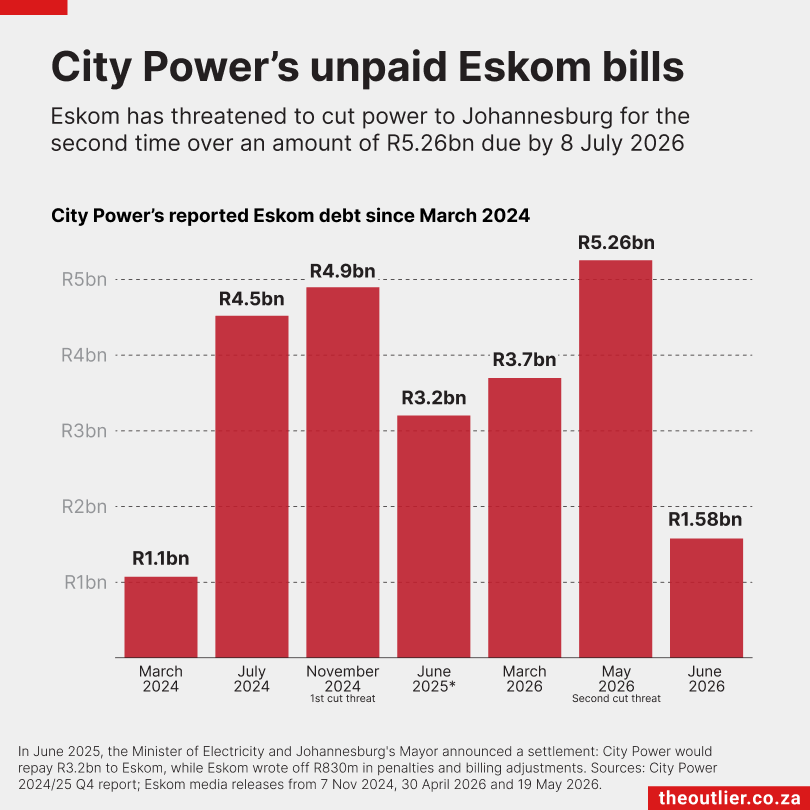
City Power, Johannesburg’s electricity distributor, owes Eskom, the national electricity utility, R5.26-billion. City Power has been given a deadline of 8 July 2026 to pay up, or at least agree to a payment agreement or Eskom will cut electricity supply to parts of Johannesburg, including the CBD, Midrand and Fairland.
This is the second time Eskom has threatened to cut off power to Johannesburg over debt owed by City Power. The first time was in November 2024.
The drama began in March 2024, when Eskom went to court over an amount of R1.1-billion. This amount was for City Power’s unpaid March 2024 electricity bill. Several months later, Eskom went to court again to claim R4.5-billion because City Power hadn’t paid its April to July invoices.
Meanwhile, City Power argued that it had been overcharged by R3.4-billion.
By November 2024, the total debt, according to Eskom, had reached R4.9-billion, prompting Eskom to threaten to cut power to Johannesburg.
The Electricity Minister intervened and appointed an independent investigator, who found fault on both sides: City Power’s billing tracking was unreliable, and Eskom’s estimation methods during loadshedding did not meet industry standards. In June 2025, a settlement amount was reached: Eskom agreed to write off R830-million in penalties and billing adjustments, and City Power agreed to repay R3.2-billion over four years.
But by May 2026, City Power’s arrears had climbed back up to R5.26-billion. Another R1.58-billion is due in June 2026. That brings the total due to R6.84-billion.
Produced in partnership with Our City News.
🚨 Deportations
South Africa “is a neglected part of the global migration story”, Home Affairs Minister Leon Schreiber told Bloomberg TV in October last year. Pointing to tensions between South Africans and immigrants in the country, he said that deporting undocumented people is important to “protect social cohesion”.
Those tensions have been on full display in recent weeks, with the anti-immigration movement March and March holding protests in several cities, with reports of immigrants being assaulted. Among March and March’s demands are tighter immigration controls and the deportation of undocumented immigrants.
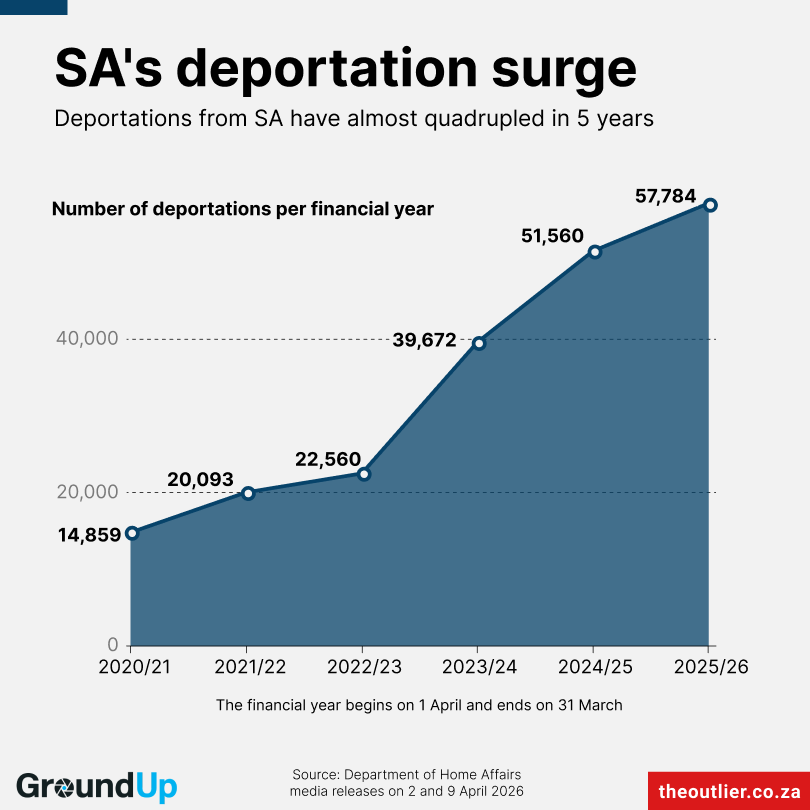
Over the past five years, the number of people deported from South Africa has surged (Schreiber entered office in the 2024/25 financial year, so the climb in numbers started before his time).
57,784 people were deported from the country in the 2025/26 financial year, compared to 14,589 in 2020/21, when the covid pandemic presumably weakened the state’s ability to deport undocumented people.
Read the full GroundUp article here.
Click here for a link to all references for this newsletter.