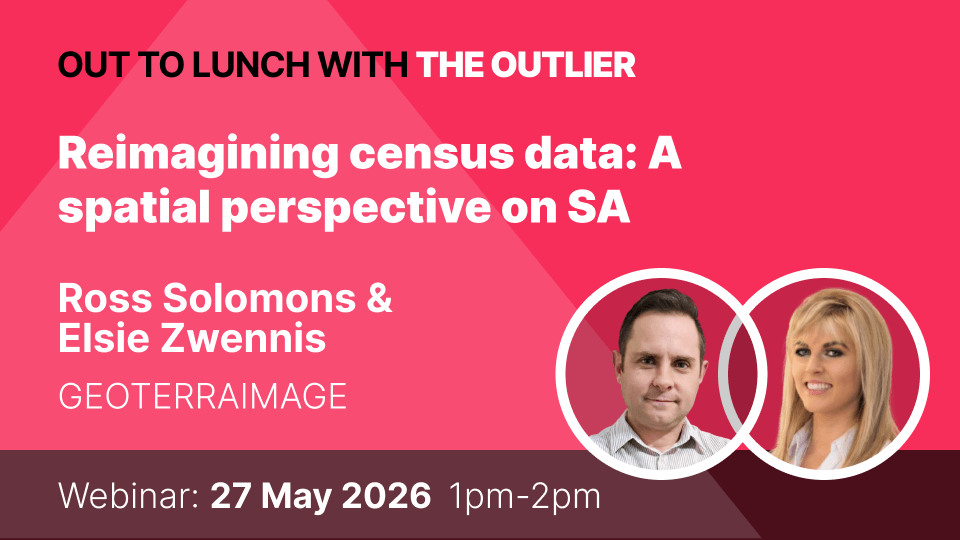
For 27 years, GeoTerraImage has been quietly building one of the most comprehensive spatial datasets in the country. More than 32-million buildings catalogued, 90 different classifications, and updates running on an annual cycle rather than a 10-year census rhythm.
Senior geospatial specialist Ross Solomons joined The Outlier’s Out to Lunch webinar to walk through what the Pretoria-based company does, who uses its data, and why spatial information is becoming harder to escape.
Information, not data
GeoTerraImage draws a deliberate line between raw data and what it calls information products. Raw population counts or building footprints are useful to specialists. But most decision-makers are not spatial professionals and do not have time to interrogate unprocessed datasets. The job is to package spatial information so anyone can use it.
The company’s clients span banks, insurers, telecoms, retailers, fast food chains, government departments, agricultural conglomerates and researchers. Most of its products are built at the enumeration area level, the smallest unit Stats SA uses for census processing. That allows different datasets to be overlaid, swapped and compared without friction.
How the population numbers get made
GeoTerraImage does not knock on doors. It builds its population estimates by working outwards from buildings.
The company maintains an inventory of every structure it has identified across the country, classified by type: standalone houses, complex flats, backyard dwellings, commercial, industrial, and so on. A new developments application runs monthly, comparing satellite imagery over time to flag where new construction has appeared. Higher resolution imagery then sharpens the picture in those specific areas.
Once buildings are classified, an in-house statistician (Dr Ariane Neethling) applies population models that weigh location, building type and surrounding context. A flat in rural Free State carries a very different population profile to a flat in Alexandra or Sandton. The output is then benchmarked against Stats SA’s mid-year estimates at a higher geographic level, so the two pictures stay in alignment.
Solomons was emphatic that the goal is not to replace Stats SA. The census remains essential. But a census runs every decade, and South African cities do not. Johannesburg alone has more than 300 informal settlements, with new ones appearing faster than any 10-year cycle can capture. The gap between census moments is where modelled data earns its keep.
Solar tells two stories
Load shedding pushed solar installations sharply higher from 2022, in both the residential and commercial markets. What surprised GeoTerraImage was what happened next. When load shedding eased and panel prices fell, adoption did not slow. The motivation had shifted from keeping the lights on to cutting electricity costs, with the fear of load shedding returning still in the background.
The geographic pattern is starker. Roughly 90% of installations sit in the wealthiest four segments of GeoTerraImage’s Neighbourhood Lifestyle Index, which classifies areas by household income on a scale of one to 10. In the lowest-income segments, installations were so rare in early years that running the detection process was not worth the margin of error.
The same dataset answers two very different questions. Solar companies use it to find new customers. NGOs and the government use it to identify communities locked out of the transition. As paying customers move off municipal grids, the revenue implications for cities like Johannesburg are an open question.
Where else the data shows up
Insurers combine GeoTerraImage’s fire risk, flood risk, property and solar data to evaluate neighbourhood and individual risk profiles. Telecoms operators use radio propagation data alongside demographics to site new towers. Government departments draw on the income-based segmentation for service delivery and housing planning.
The company also runs Geofarmer, a platform that uses satellite imagery and vegetation indices to give farmers a micro-level view of crop health, and Mzansi Amanzi, which monitors dam levels for the government.
AI is sharpening the picture, not replacing it
GeoTerraImage won an Amazon Web Services grant to build a centralised data cube, with AI models sitting on top to answer questions across all its datasets at once. Solar panel detection, which used to be partly manual and took months, has been cut to hours.
Solomons was clear that AI does not reduce the need for spatial data. It increases it. Models are only as accurate as the inputs, and spatial data has the awkward property of needing constant renewal. Yesterday’s map does not help during today’s flood.
That temporal demand is what Solomons sees driving the next five years. Spatial data is already embedded in most things people do, from ordering a package to checking the weather. As decision-making becomes more automated, the pressure to keep the underlying data current and accurate will only grow.
The full Out to Lunch session with Ross Solomons is available to Outlier members in the recordings archive. Out to Lunch runs free webinars with researchers, journalists and analysts working with data. Subscribe to The Outlier to get invitations to the next one.