🎓 Graduating university
The Department of Higher Education and Training has university performance targets, most of which it has failed to meet since 2019.
One target is the annual number of students who “complete a university qualification” – in other words, they graduate. That target was 237,000 per year. That target has been met only twice between 2019 and 2024: once in 2020 and again in 2024.
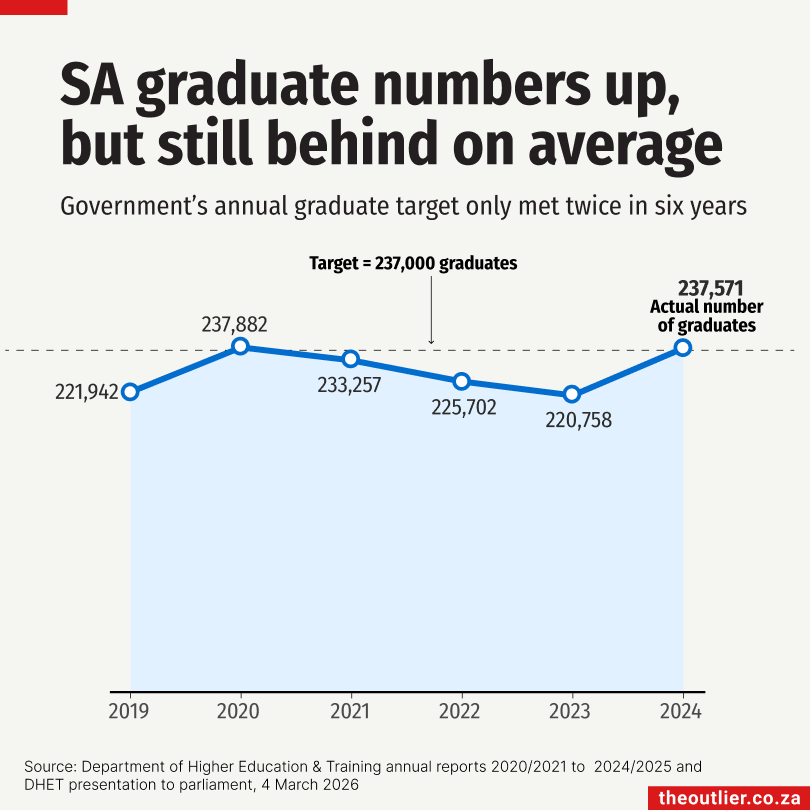
Budget cuts are given as the reason for failing to meet the targets. “Budget cuts from national treasury has affected universities’ funding and enrolments,” states the department’s 2024/2025 annual report.
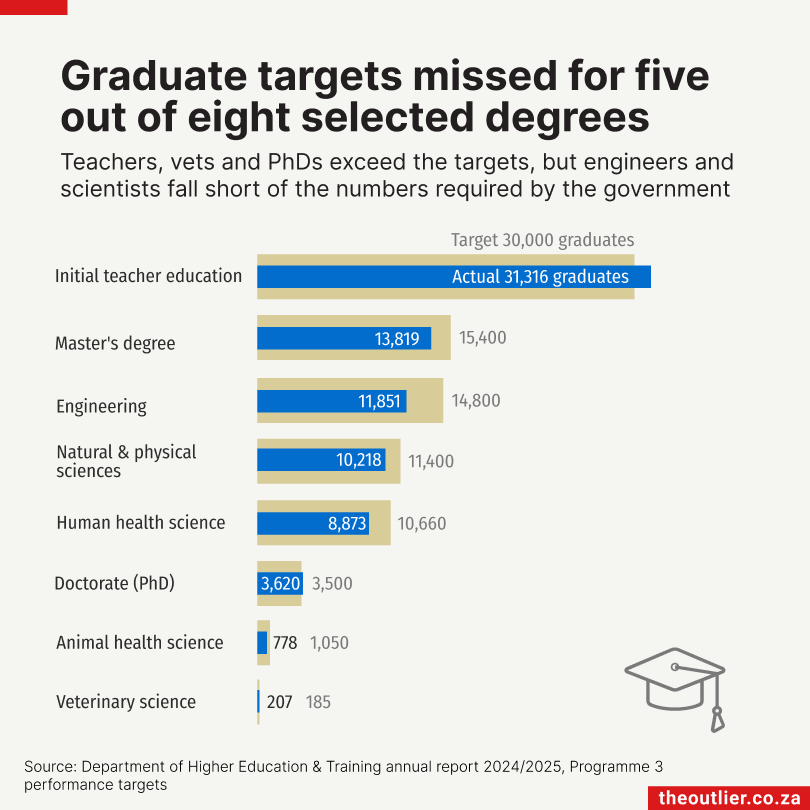
Then there are eight targets for qualifications, five of them involve science, technology, engineering and maths (STEM) subjects (see chart 2), the sixth is for qualified teachers and the other two are for master’s degrees and doctorates (in all subjects).
The targets for teachers, veterinary science graduates and doctorates were met in 2023, according to the latest available annual report. None of the other targets was met.
The number of engineering graduates is particularly problematic because it has decreased every year for the past six years – from 13,714 graduates in 2019 to 10,805 in 2024.
Annual human health science graduates have also decreased since 2022 – from 9,646 in 2020 to 8,663 in 2024.
Natural and physical science graduates are also below the target, but at least their number has increased from 9,121 in 2019 to 10,960 in 2024.
The reason given by the department for the underperformance of these graduates lies in a shortage of matrics who pass the subjects needed to do those subjects at university, as well as budget cuts: “Many students who qualify to study at universities do not meet the requirements to pursue STEM,” states its annual report.
💸 AI and banking
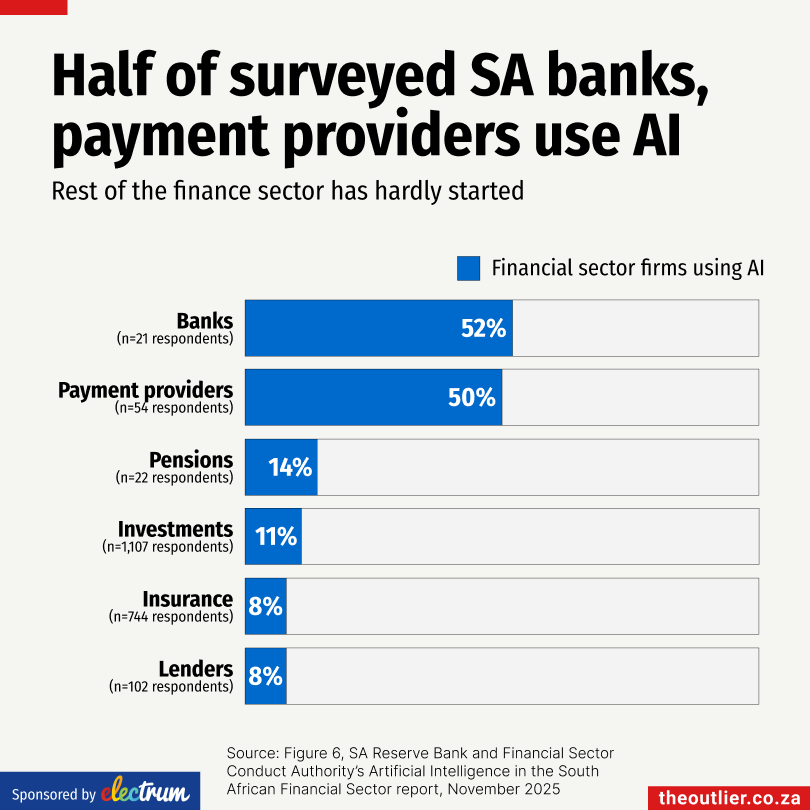
Artificial Intelligence has fast become a core operating tool for South Africa’s financial sector. According to data published by the South African Reserve Bank, a clear trend has emerged: 52% of banks and 50% of payment providers are now actively using AI in their daily operations. In contrast, other areas of finance, like insurance (8%), lending (8%), and investments (11%), are moving at a more gradual pace.
This major uptake for banks and payment providers is not just a matter of chasing trends; it is a direct response to a massive shift in consumer behaviour. With the explosion of real-time transactions across South Africa, banks and payment providers are handling volumes that legacy, manual systems simply cannot keep up with. As a result, AI is being deployed as an essential tool to manage automated reconciliation, optimise liquidity, and spot sophisticated fraud patterns in milliseconds before transactions clear irrevocably. With AI handling the administrative heavy lifting, human advisors have more time to look after clients and make complex financial judgments. The goal for early adopters isn’t to create automated, faceless platforms, but rather to use technology to strengthen trust, improve back-office speed, and create highly personalised touchpoints for their customers.
To learn more about the technologies and trends transforming how South Africans connect and transact, download Electrum’s latest research, South Africa’s Payments Future.
- Produced by The Outlier in partnership with Electrum, the next-generation payments software company powering payments for banks and retailers.
Wheeling, decoded
Commercial property owners are quietly cashing in on South Africa’s renewable energy boom. Dr Werner van Antwerpen, head of corporate advisory at Growthpoint Properties, spoke with The Outlier on Wednesday’s Out to Lunch webinar to unpack all things wheeling.

Read the summary story here. Outlier members can also watch the full recording here.
🖊️ Poor opinions
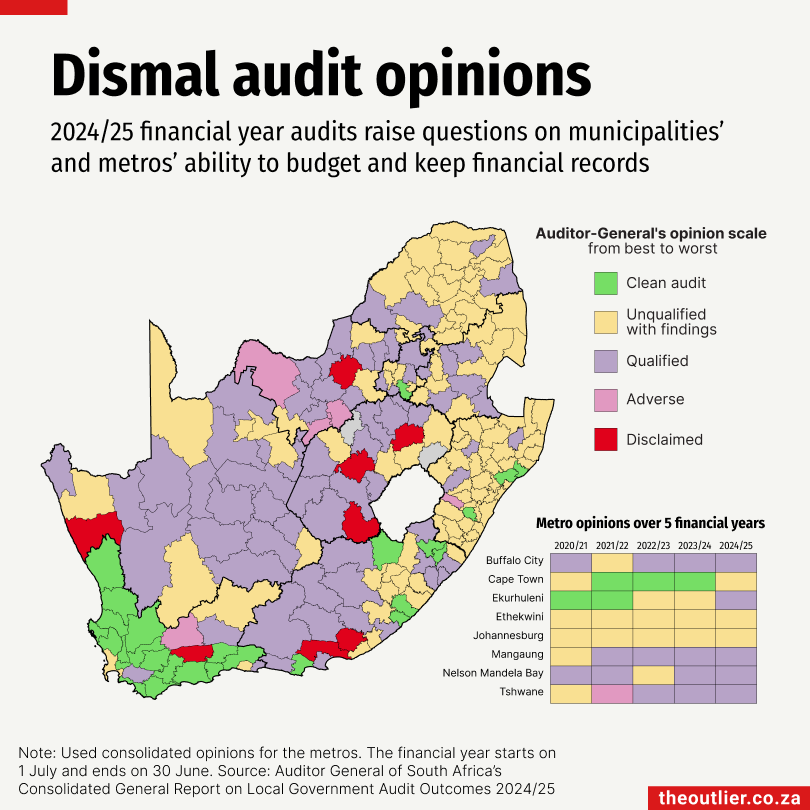
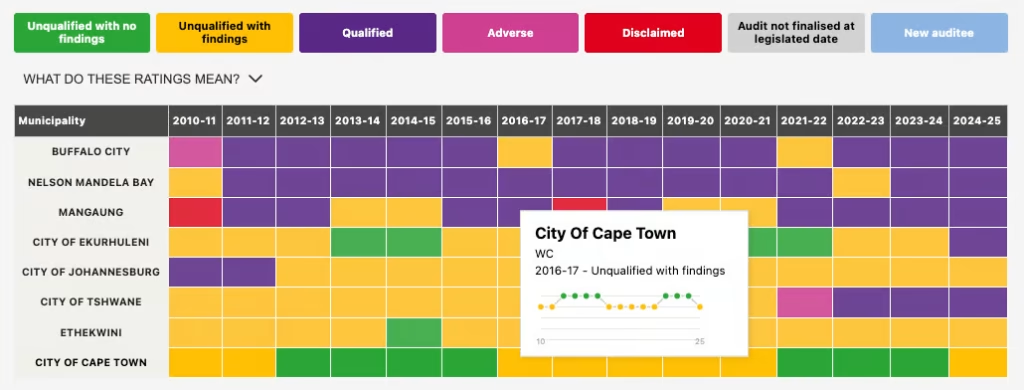
When unpacking South Africa’s municipalities’ financial reports for 2024/25, the Auditor-General of South Africa raised serious concerns. While the Auditor General doesn’t directly audit performance, its work on financial statements can reveal whether a municipality’s finances and service delivery are at risk.
Municipalities receive one of five possible audit opinions, from best to worst: clean, unqualified with findings, qualified, adverse, and disclaimed. A clean audit means everything checks out. A disclaimed audit, the worst, means the books are in such a mess that auditors can’t say whether the numbers are right.
Of South Africa’s 257 municipalities, 39 received a clean audit and eight received a disclaimed opinion. While the number of disclaimed opinions dropped from 15 in 2023/24, the number of clean audits also fell, from 41 to 39. Just under half of all municipalities received an unqualified opinion with findings.
The eight metros fared no better. The number of qualified opinions rose from two in 2020/21 to five in 2024/25. The Auditor General flagged poor record-keeping, weak internal controls and over-reliance on the audit process to catch errors that should have been identified internally. Unfunded budgets, late payments and deteriorating infrastructure compound the crisis, and only Cape Town and eThekwini showed healthy financial indicators.
The Outlier has been collecting audit data since 2010. You can see all the audit ratings for the past 15 years here.
🗳️ Register and vote
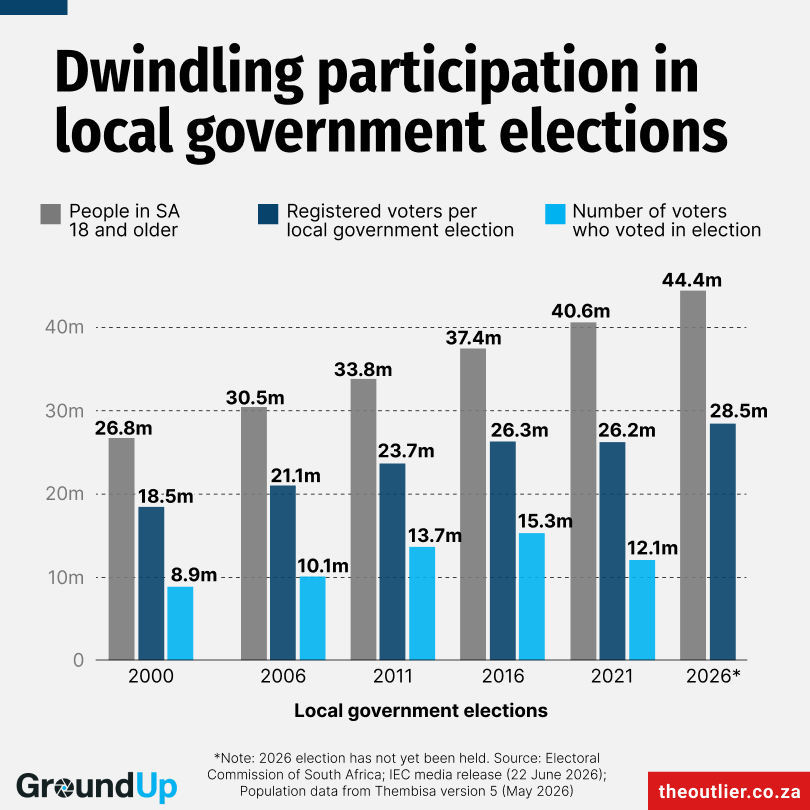
After the registration weekend on 20 and 21 June, there were 28.5-million people on the voters’ roll. That’s about 64% of people in South Africa who are 18 years and older.
The percentage has not increased since the last government elections in 2021, when there were 26.2-million people and about 40.6-million eligible voters.
There are, however, more people on the voters’ roll than the 27.7-million people who were registered for the 2024 national election.
Nearly three million people participated in the recent registration weekend, but most people were just updating their details. Only about 477,000 people were registering for the first time.
Between 2000 and 2016, the percentage of eligible voters registered to vote grew from 69% to 70%, before dropping in 2021 and 2026.
The drop in voter turnout has been even more stark. About 48% of registered voters took part in the 2000 and 2006 local government elections. Almost 58% voted in 2011 and 2016. In 2021, only 46% voted.
Read the full GroundUp article here.
Click here for a link to all references for this newsletter.