 What nearly 5 years of by-elections can tell us
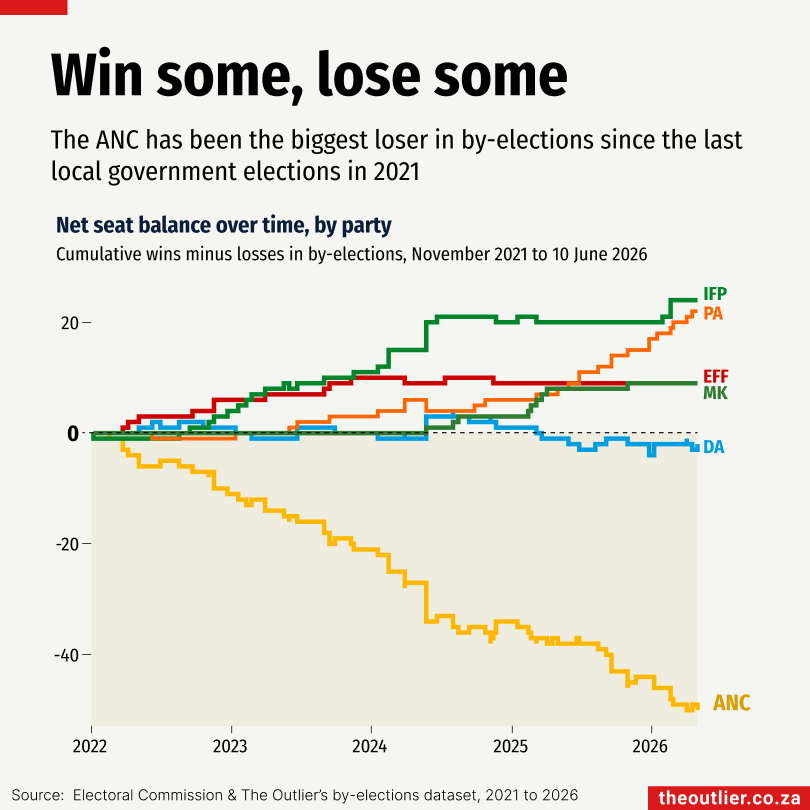
Since 2021, South Africa has held 432 ward by-elections, each one triggered by a death, resignation, or expulsion. We’ve been tracking them all and the pattern is stark: 27.5% of by-elections resulted in a change of party, a rate that’s climbed every year, from 22% in 2022 to 53% so far in 2026.
The ANC is the biggest loser, shedding 68 seats to five different parties — the IFP, Patriotic Alliance, DA, EFF and MK — with no single challenger dominating. KwaZulu-Natal and the Eastern Cape, which also account for most of the 31 confirmed councillor murders since 2022, are driving a disproportionate share of the seat swings.
With interactive charts mapping seat flows, murder patterns and provincial breakdowns, this feature reads the granular data behind the ANC’s decline — province by province, vacancy by vacancy — ahead of the 2026 local elections.
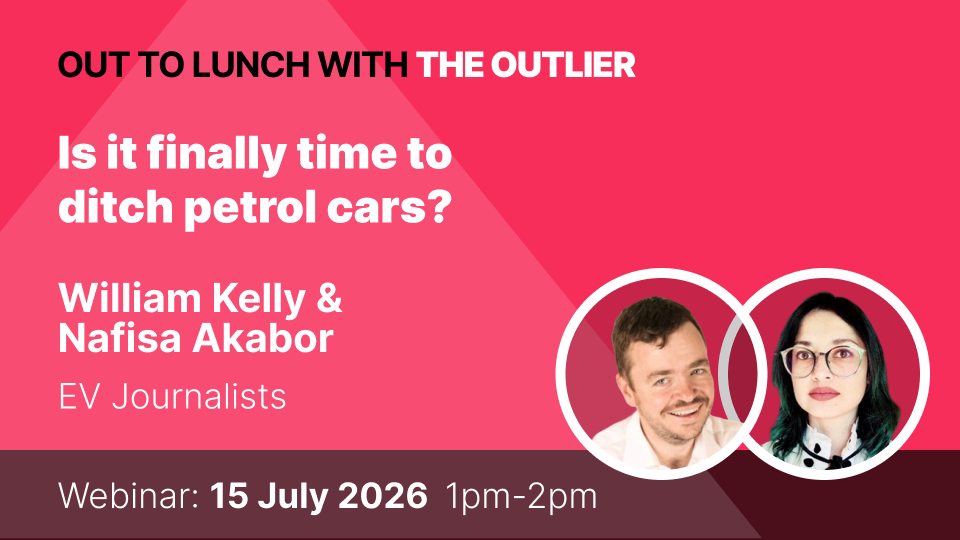
Freelance technology and EV journalist Nafisa Akabor and EV enthusiast William Kelly join Out to Lunch with The Outlier on 15 July 2026 at 1pm to discuss the real cost of going electric and what it means to your pocket.
Sign up here.
Have a question for Nafisa and William? Email it to gemma.ritchie@theoutlier.co.za
We’ve run seven Out to Lunches in 2026, and we would love to hear from you. Please answer this super quick survey on how you are finding the talks.
 Retail Therapy
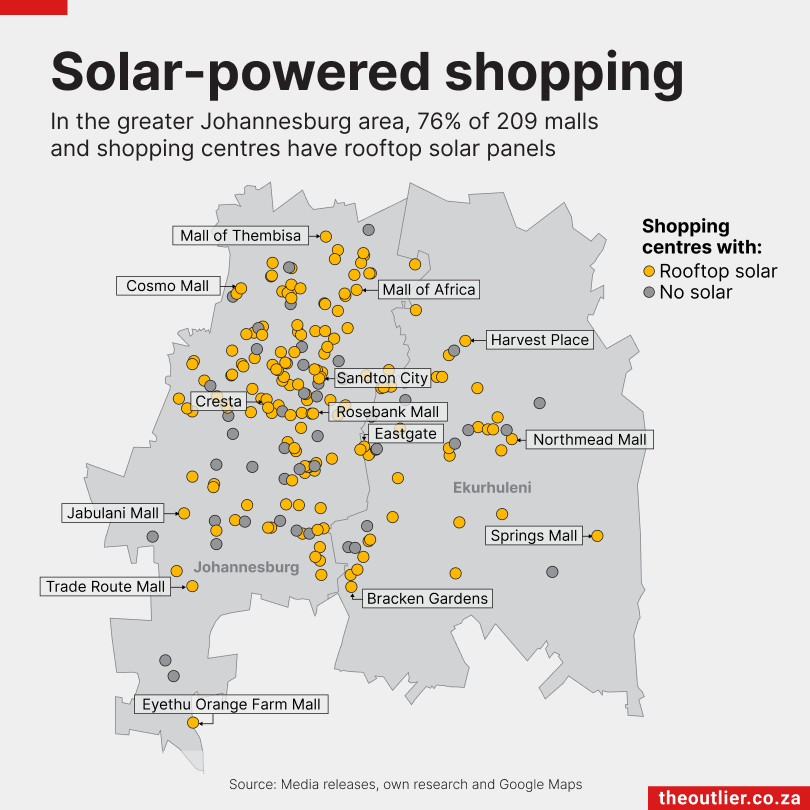
Gauteng has more rooftop solar than any other province, 2.25GW, or 27% of South Africa’s total, and much more than KwaZulu-Natal’s 1.4 GW, the second-highest province.
The gigawatts installed in Gauteng have nearly tripled since 2022, according to data published by Eskom. Rooftop solar covers the solar installations on private households as well as on commercial and industrial buildings like malls.
In Gauteng it’s hard to find a mall without solar panels. We decided to count the malls to see how many have solar panels on their roofs.
We counted 209 shopping malls in Johannesburg and Ekurhuleni and then, using satellite images, we found 76% of them have rooftop solar. We mapped all the shopping malls, and the distribution of those with solar panels is fairly widespread.
Eastgate Mall has the biggest solar installation. It started small in 2020 and has grown to 7.2MW powered by 13,675 solar panels.
The Mall of Africa also has a big 4.8MW installation that it commissioned in 2018, before the worst of the loadshedding hit. At the time, it was one of the biggest rooftop PV systems of its kind in the world.
Most of the solar was installed in response to loadshedding as a way to keep the lights on, keep the malls open and reduce the need to run expensive diesel generators. Solar has the added advantage of helping to reduce the mall’s carbon footprint.
Surprisingly, the Maponya Mall in Soweto is one of the very few big malls that don’t have rooftop solar.
Produced in partnership with Our City News.
 Miners’ health
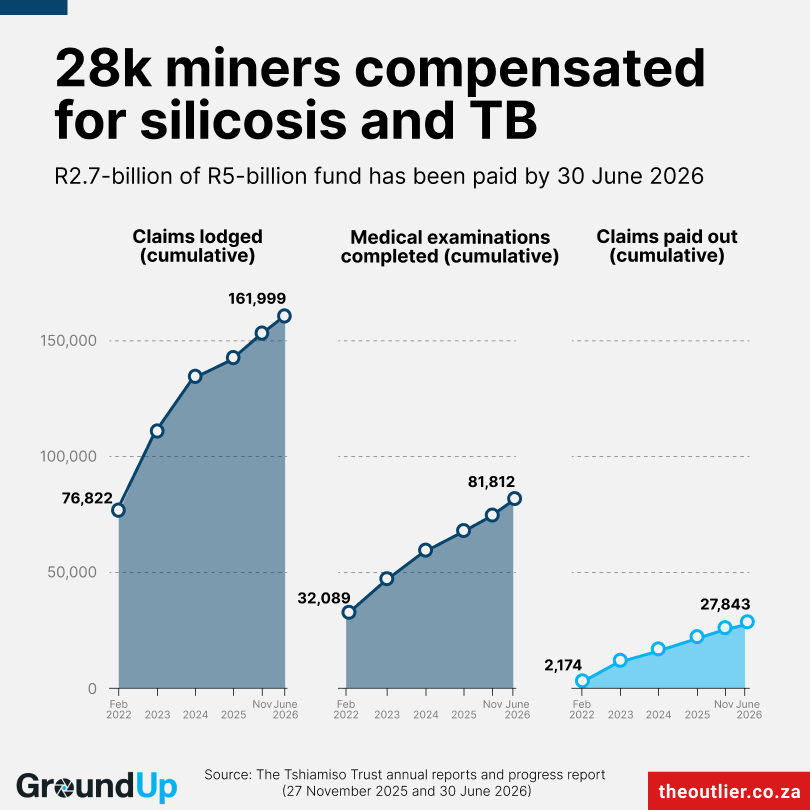
The Tshiamiso Trust has paid out R2.7-billion in compensation to gold mineworkers who died from or became ill with silicosis and TB from working in South African mines.
The R5-billion trust was established in 2020 following a landmark class action settlement with six gold mining companies.
As of 30 June, 17% of claims have been paid out. This is partly because a large proportion of claims are found to be medically ineligible. About 47% of all claims lodged have been deemed medically ineligible. Another 34% still need to be examined. The remainder are at other stages in the claims process.
Current and former mineworkers who developed tuberculosis or silicosis, as well as the dependents of mineworkers who died from these diseases, will still be able to lay claims until 10 December 2029.
Lesotho is the region with the most beneficiaries to date, more than any other region of South Africa or its neighbouring countries. About R1-billion has been paid to former mineworkers from Lesotho.
Read the full GroundUp article here.
 Goaaaaaal!
World Cup ’26 is well underway, which for South Africans has meant early mornings or late nights with kickoff times across the US, Mexico and Canada mostly in the small hours or the crack-of-dawn in SA time.
Even though South Africa has sadly been knocked out of the competition, we may as well have fun looking at World Cup numbers.
First up, the most-capped players heading into the tournament — and it’s the usual suspects at the top. Cristiano Ronaldo leads the pack with a staggering 231 appearances for Portugal, just ahead of Lionel Messi (202 for Argentina) and Luka Modrić (201 for Croatia), with Qatar’s Hassan Alhaydos rounding out the top four on 191.
Fun fact: both Ronaldo and Messi are now billionaires, so it’s not just caps they’re racking up while playing. Ronaldo’s fortune sits north of $1.2-billion, with Messi not far behind at over $1-billion.
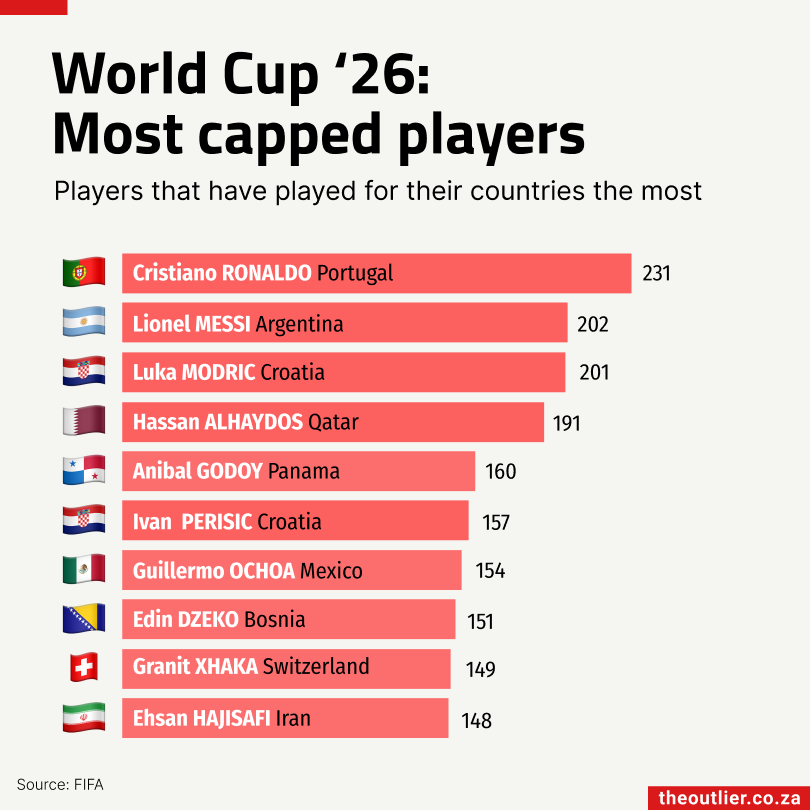
Take a look at the full list of caps for each player in our working document here: World Cup players ranked.
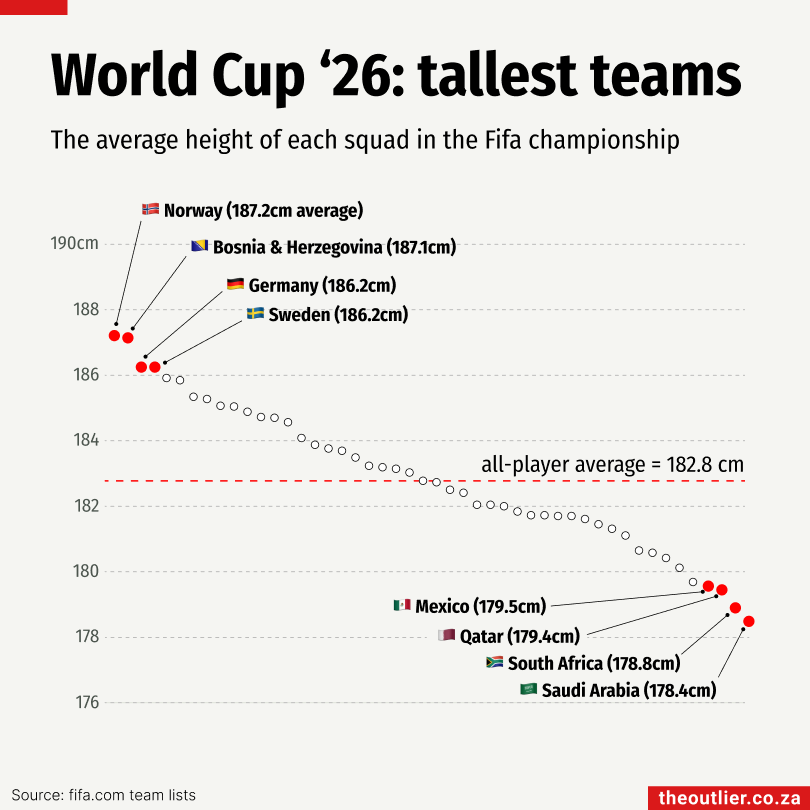
Then there’s average team height. There are a few stereotypes in this, with Norway and Bosnia & Herzegovina heading the table at over 187cm on average. Strangely missing from the tallest side list is the Netherlands, which has a reputation for being tall.
On the other end of the scale, Mexico, Qatar, South Africa and Saudi Arabia all feature and all average under 180cm.
Tallest players in the World Cup 2026
| Florian WIEGELE | Austria  | 205 cm |
| Stjepan RADELJIC | Bosnia and Herzegovina  | 201 cm |
| Alvaro MONTERO | Colombia  | 201 cm |
| Dan BURN | England  | 201 cm |
| Sasa KALAJDZIC | Austria | 200 cm |
| Mike PENDERS | Belgium  | 200 cm |
| Thibaut COURTOIS | Belgium | 199 cm |
| Tomas CHORY | Czechia  | 199 cm |
| Harry SOUTTAR | Australia  | 198 cm |
| Lukas HORNICEK | Czechia | 198 cm |
Take a look at the full list of player heights in our working document here: World Cup players ranked.
Click here for a link to all references for this newsletter.