
Earlier this week, Johan Fourie published a great post on why newsrooms are struggling and what might save them. His argument is around the value of trusted columnists to both readers and publishers. “The column’s job is to earn the next month’s subscription, and what earns it is scarce analysis from a voice the reader trusts,” he writes. To be fair, Johan is also arguing that economists, his profession, are well equipped to take up the columnist role. But he isn’t wrong. Apart from his own writing, there are many other great examples of excellent economics-based writing from the likes of Wandile Sihlobo and Ken Opalo, who penned an excellent piece this week on why it is so difficult and expensive to fly in Africa.
I don’t think what we do at The Outlier is anything like the economic research-backed writing Johan talks about, but there are similarities in the intention. We live in a world of relatively cheap opinions. Everyone has one, platforms encourage them, and AI agents are eager to share theirs. We don’t really need more opinions in the media, but we do need more evidence-backed analysis and insight. It’s something we’re trying to do at The Outlier.
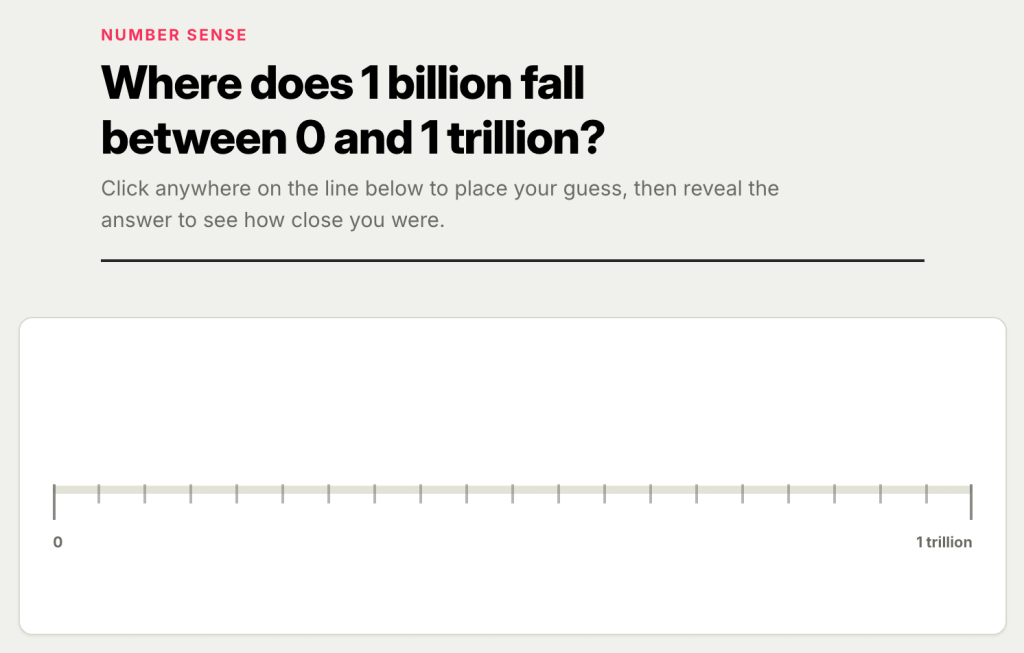
🎈 Which is not to say we’re not up for a little bit of fun. Earlier this week, I saw a social media post about the size of a billion versus a trillion. So I made a little tool to visualise the gap. Test yourself.
Have an excellent weekend.
Alastair
alastair@theoutlier.co.za
 Voting data
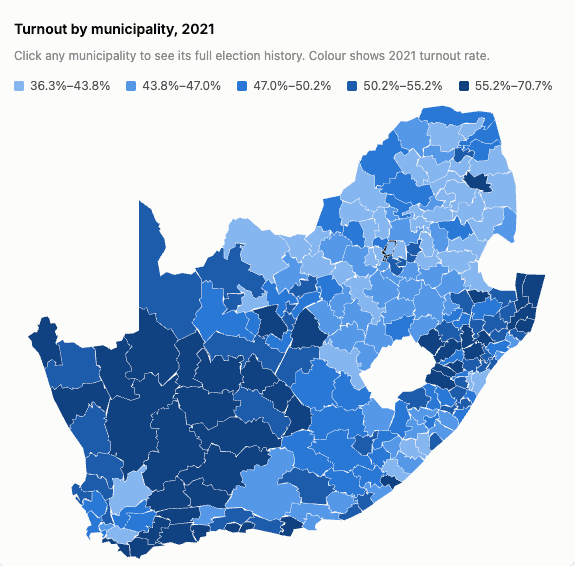
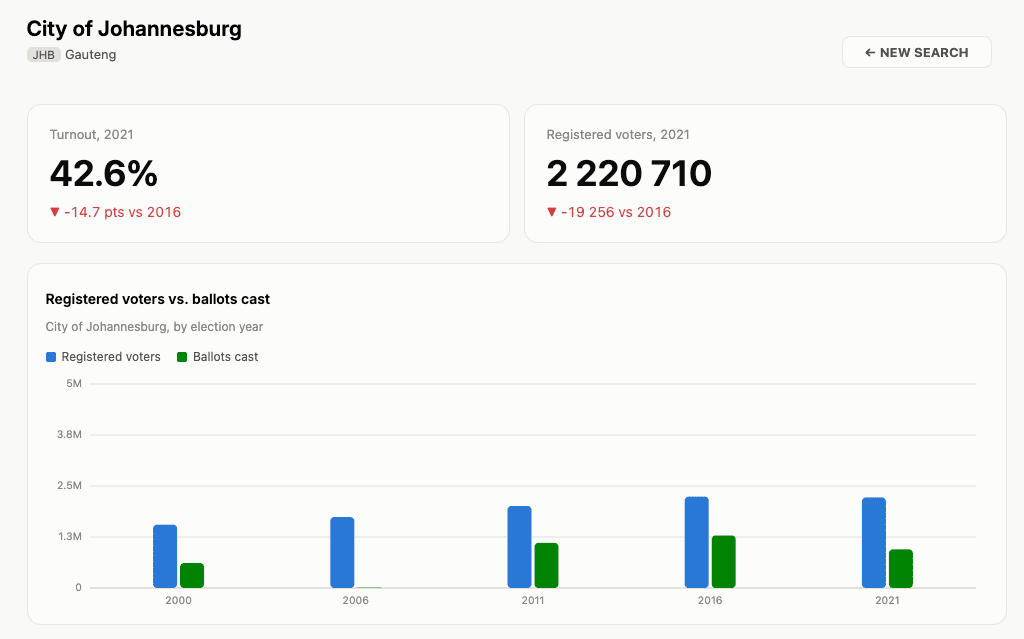
Last week we shared a chart comparing voter turnout in the last two local government elections. This week we’ve added data going back to the 2000 elections and turned that data into an explorable interactive tool. So if you want to see how apathetic your municipality is, give it a whirl: South African Municipal Voter Turnout.
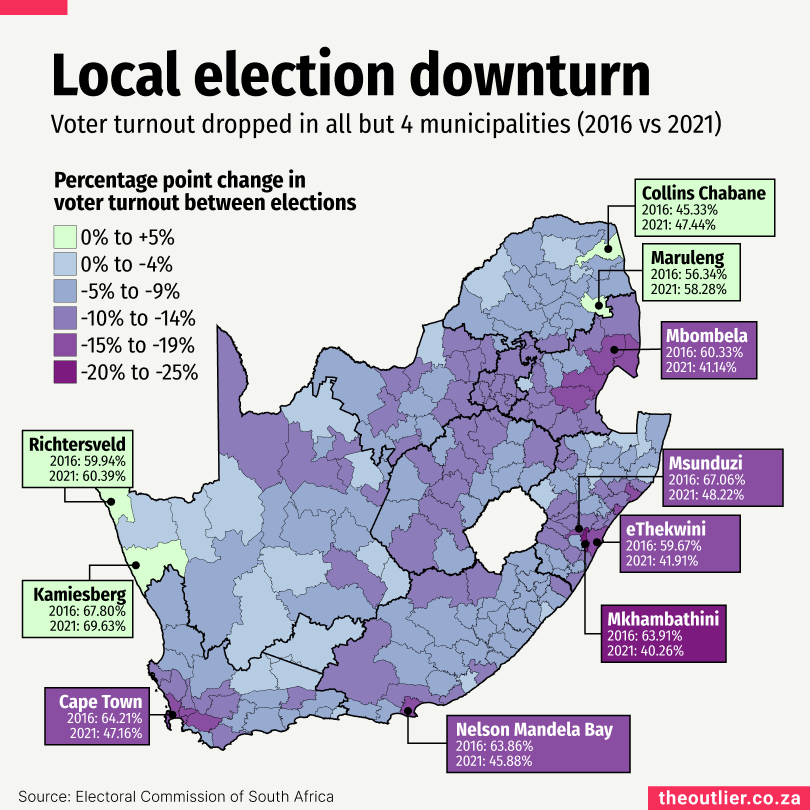
The underlying data for both the chart and interactive is part of our DataDesk repository which is now home to more than 1,000 styled charts and a rapidly growing collection of raw datasets (~75) and charts (~85). DataDesk is already being used by a number of early users while in beta but we are opening up limited access for new test users now. Get in touch to let us know you’re interested.
 Webinar
 What you need to know before buying an EV
The first surprise for new EV drivers is silence. This past Wednesday during our Out to Lunch webinar we talked to seasoned EV journalists William Kelly and Nafisa Akabor who shared practical tips on owning an EV in South Africa. We also discussed what needs to change to get more EVs on the road.

Read the full summary here. The recording is available for Outlier members.
 Bad debts
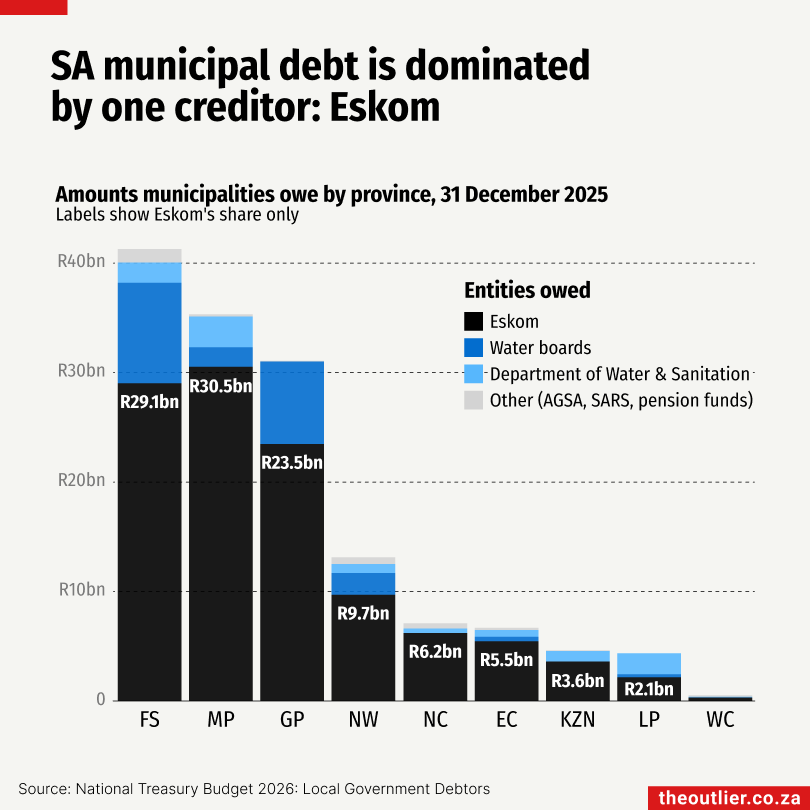
South Africa’s National Treasury declared it would temporarily withhold funding to 69 municipalities to force them to fix their problems, which include unfunded budgets, irregular and wasteful expenditure, and failure to repay money owed to Eskom, water boards, the revenue service, the Auditor-General, and pension funds. When these entities are not paid for the electricity, water and services supplied, it threatens service delivery and the operation of these entities.
So how bad is the situation? At the end of December 2025, municipalities said they owed creditors R161-billion. This is a self-reported figure from municipalities themselves; separate figures reported directly by creditors paint a similarly grim picture. Eskom said it was owed R110.5-billion. Mpumalanga has the highest amount owed to Eskom at R30.5-billion, followed by the Free State at R29.1-billion. Water boards, which supply municipalities with water, are owed a combined R21-billion.
Municipalities won’t have to repay all the money they owe, but they will need to demonstrate that their budgets are funded and that they’re addressing irregular spending. Of the 69 municipalities on the list, 39 had issues with unauthorised, irregular, fruitless or wasteful expenditure, and 12 had unfunded budgets. Treasury has also set a target of cutting irregular expenditure by 15% by August, and another 15% by September, before funding is reinstated.
 Problematic municipalities
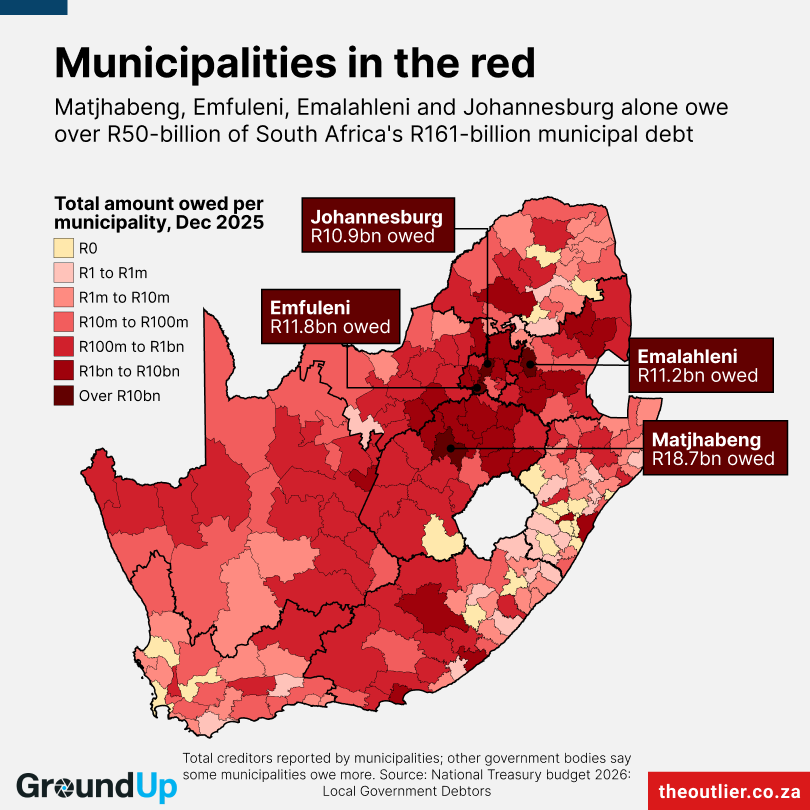
Almost a third of municipal debt belongs to just four municipalities, which each owe more than R10-billion. They are: Matjhabeng (Free State), Emfuleni (Gauteng), Emalahleni (Mpumalanga) and the City of Johannesburg (Gauteng). Together they owe more than R50-billion.
Municipalities owe the most money, R110.5-billion, to Eskom because they struggle to take in revenue for electricity used – billing systems are dysfunctional and illegal connections are rife. This means revenue has not been high enough to pay Eskom and repay the debt.
The National Treasury launched an Eskom debt relief programme in 2023. The idea was that municipalities’ debt would be written off over three years, as long as they met strict conditions, including paying their monthly electricity accounts and increasing their revenue collection through proper billing.
While some municipalities have benefited from it, more than 61 out of the 71 municipalities that signed up for the programme have failed to meet the conditions. “Persistent defaulters” are being removed from the programme.
Read the full GroundUp article here.
 Neighbourly distrust
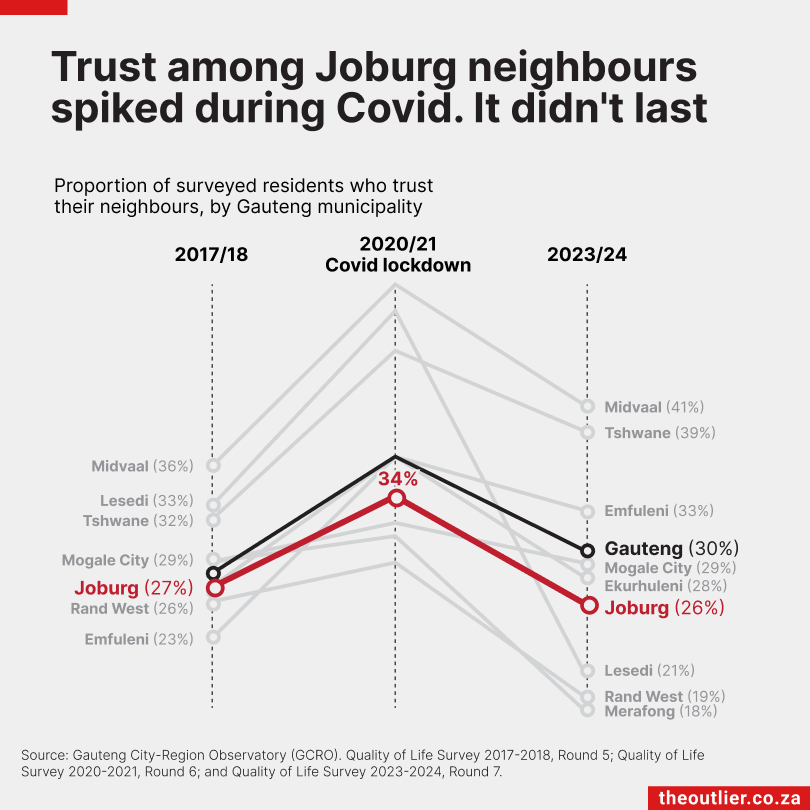
Johannesburg residents don’t trust each other much, but the real story isn’t about a decrease; it’s a rebound that faded. Just 26% of Joburg residents say most people in their community can be trusted today, almost exactly where that figure sat in 2017/18 (27%). In between, though, trust spiked to 34% in the 2020/21 GCRO survey, fielded in the wake of the hardest Covid-19 lockdowns.
Joburg isn’t alone in this pattern, though its rebound-and-fade was unusually clean. Some municipalities, like Tshwane and Midvaal, never fully came back down, while others, like Merafong and Rand West, dropped even lower than before.
GCRO researcher Christian Hamann says the timing is telling, even if there’s no confirmed cause. He suggests lockdown life pushed neighbours into each other’s view for the first time. You couldn’t really say you knew your neighbour if all you knew was that they left for work at 5am and returned at 7pm. He also suggests there could have been a sense of solidarity during the Covid-19 pandemic, as people supported each other. But as he put it, that goodwill “dissipated a bit after Covid as things returned to normal”.
Produced in partnership with Our City News.
Click here for a link to all references for this newsletter.