
Every time Eskom’s rooftop solar estimates are published, I feel the need to share my excitement about how fast this off-grid generation capacity is growing. In June it passed nine gigawatts, mainly because the Gauteng estimate increased for the first time since June 2025. You can see from the chart below that the provincial estimates are not updated every month or at the same time.
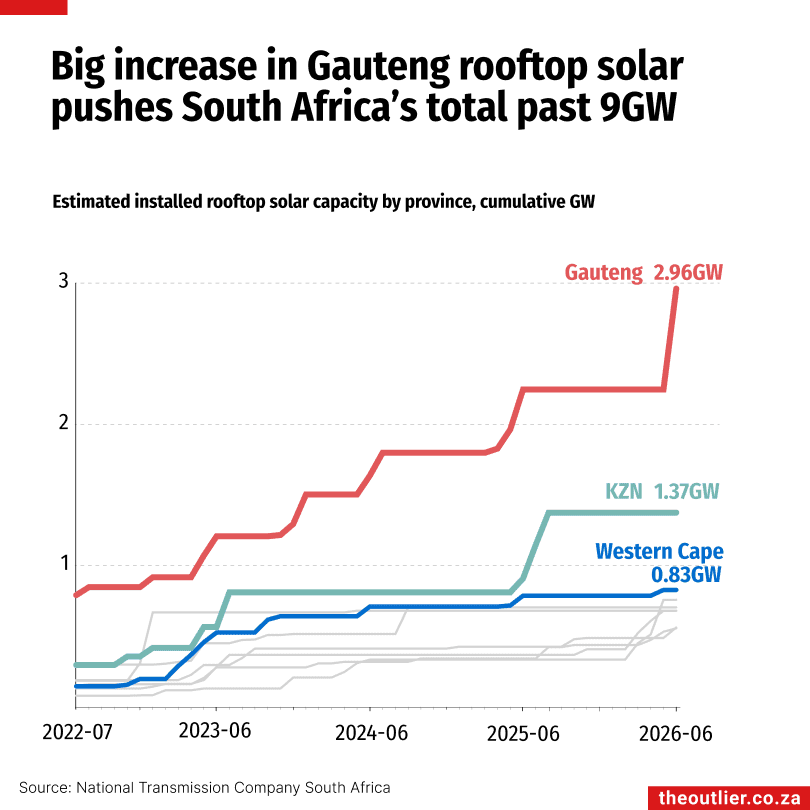
The fact that off-grid solar has soared in the province is a testament to how the people who live there are making a plan to keep things running, despite the collapsing municipal infrastructure.
This brings me to research published earlier this month by the Public Affairs Research Institute (PARI) in a report entitled Powering Development. A Pathway to integrating rooftop solar PV into municipal electricity distribution. The chart below is from that report and shows the researchers’ calculations using Geoterra Image’s data of how off-grid (behind-the-meter) solar in each province breaks down into residential, commercial and industrial at the end of 2024. Gauteng had far more residential rooftop solar than any other province, as well as more commercial and industrial rooftop solar.
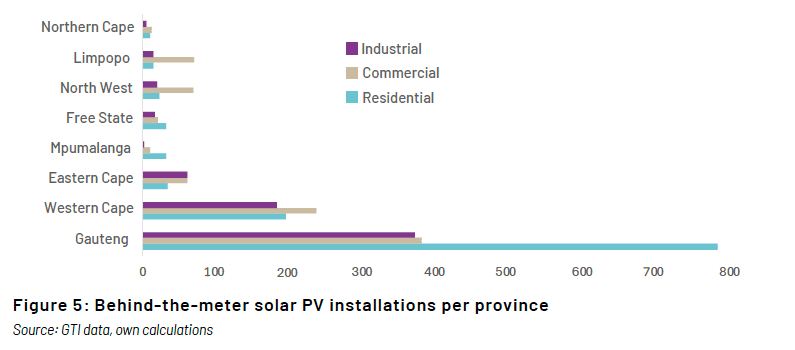
The report also states that Johannesburg, Ekurhuleni and Tshwane are four of the top five municipalities with installed rooftop solar (Cape Town is the other one). PARI sees this rooftop solar as a way to make electricity more affordable for everyone, not just those who can afford to install it.
Their argument is that even though rooftop solar is installed to meet the needs of a household or business – not to feed into the grid – once those needs have been met and the batteries are full, the solar systems stop producing power. They could produce more power, but there’s nowhere for it to go. This ‘curtailed’ electricity is what could be fed into the municipal grid. And it’s cheaper than the electricity bought from Eskom. It’s a supply that municipalities could be tapping into, but aren’t.
The report argues that with the right feed-in and battery energy storage policies, rooftop solar could be one of the fastest, cheapest levers municipalities have to cut bulk costs, fund infrastructure, and ultimately bring tariffs down for everyone – including the millions of people who can’t afford electricity.
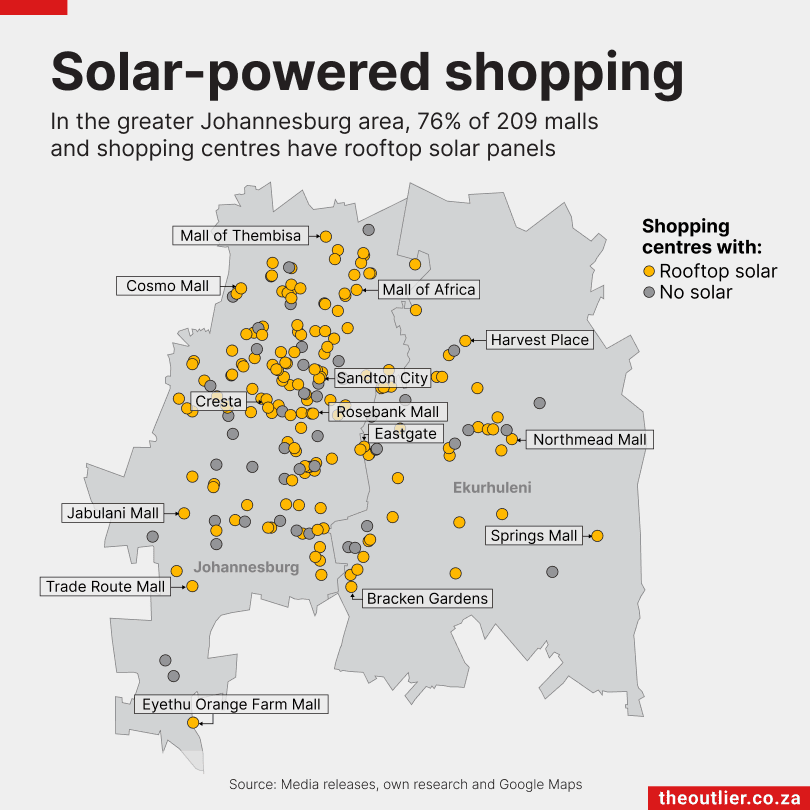
The malls in Johannesburg alone must have hundreds of thousands of solar panels. I used to live near Eastgate and watched with a kind of awe how the rooftop car park was gradually covered by a structure supporting more than 13,000 panels. My colleague Gemma Ritchie created a dataset containing 209 malls in Johannesburg and Ekurhuleni and found that 76% of them already have solar panels. These alone generate a significant amount of electricity.
The PARI research estimates that around 750,000MWh of rooftop generation is ‘curtailed’ – which would be available to feed into the municipal grids if that were made possible.
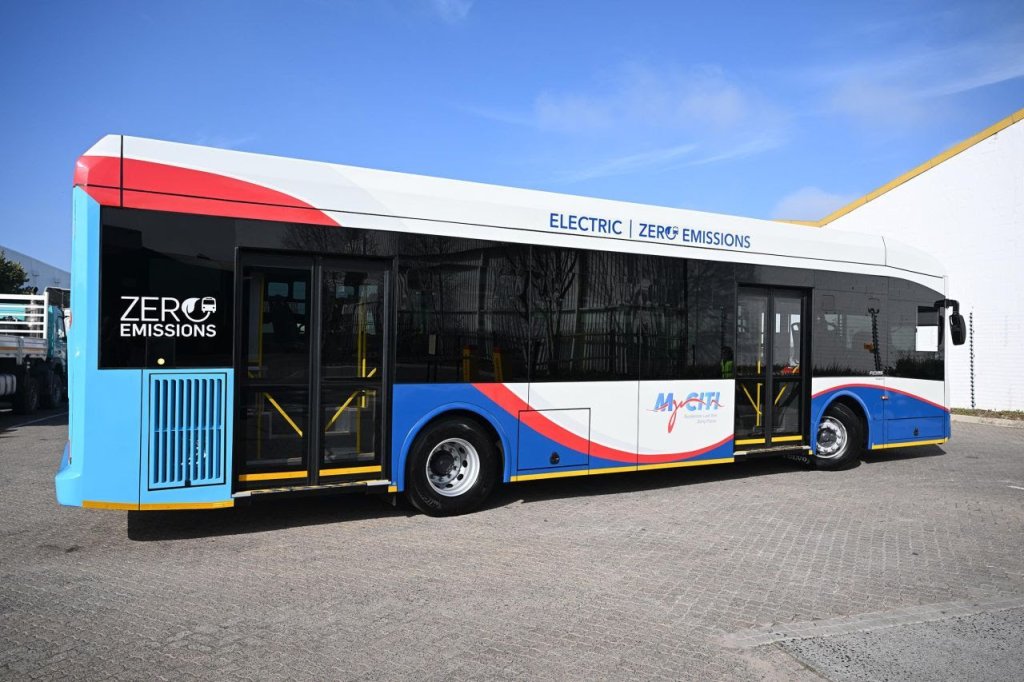
Cape Town’s electric buses
Cape Town mayor Geordin Hill-Lewis posted an Instagram reel today giving a guided tour of Evie, the first MyCiti electric bus. It is the first of a fleet of 38 12-metre Volvo BZRLE buses. The bus body was designed in South Africa and manufactured in Johannesburg. It’s being tested under different operating conditions, but if all goes as planned, the first e-buses will start operating by 1 July 2027 between Mitchells Plain and Khayelitsha, Wynberg and Claremont, as well as the CBD, says the City of Cape Town.
Golden Arrow Bus Services already has a fleet of 120 electric buses, which have been running in Cape Town since the start of the year. The buses are BYD 65-seaters.
RENEWABLE PIN-UP
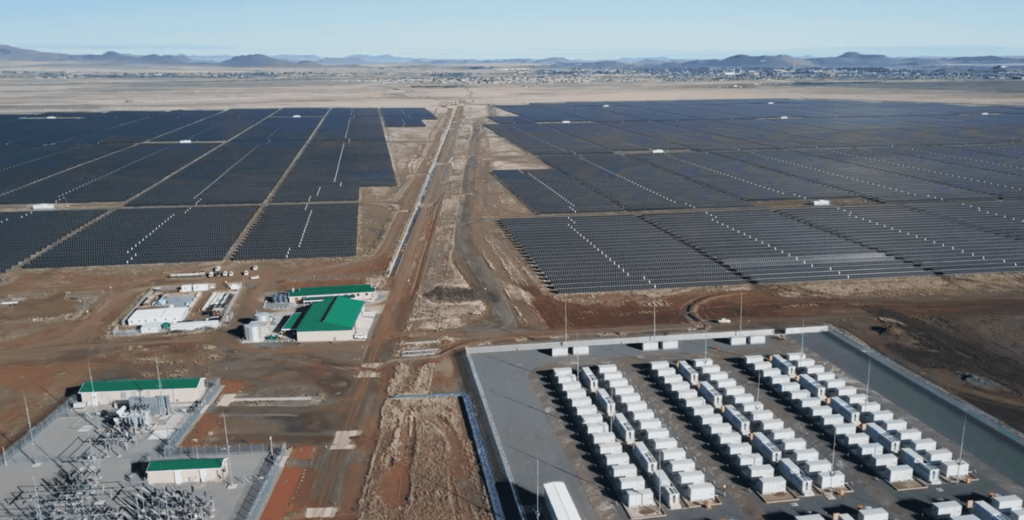
Africa’s largest hybrid renewable project was commissioned this month. TotalEnergies Hydra Project in the Northern Cape is one of South Africa’s 2021 Risk Mitigation Independent Power Producer Procurement Programme projects. It combines 216MW of solar PV with 500MWh of battery storage. It will supply 75MW of dispatchable electricity to the national grid continuously between 5am and 9.30pm under a 20-year power purchase agreement with Eskom. The Hydra Project was developed by a consortium comprising TotalEnergies (35%), Hydra Storage Holding (35%), and Reatile Renewables (30%).
Location: De Aar, Northern Cape
Size: 650 hectares
Capacity: 216MW of solar PV and 500MWh of battery energy storage system
Annual power supply: 400GWh, enough to power 200,000 homes
Number of battery containers: 158
Number of solar modules installed: 373,626
Power purchase agreement: Eskom
NEWS WRAP
The World Bank has provided a $1.5-billion development policy loan to South Africa to support infrastructure reform, of which a key area is strengthening energy competitiveness and security, says the National Treasury. This includes “the launch of a competitive wholesale electricity market and scaled-up private investment in transmission, with a target of 300,000 new household electricity connections by December 2027”, says the World Bank. Other key areas are upgrading freight transport services and improving the delivery of water and sanitation services. It is the fourth development policy loan South Africa has received from the World Bank since 2022.
💡 Wits University, the Technical University of Munich, the University of Johannesburg, Tshwane University of Technology and the University of Venda have partnered to create the Energise Centre of Excellence based at Wits University. The Germany-funded collaboration aims to address the practical challenges of the energy transition by bringing together universities, communities, policymakers, industry and civil society. Its flagship project focuses on peri-urban energy challenges and community electrification, including how decentralised energy systems can support income-generation in communities.
💨 The African Development Bank (AfDB) has provided a financing package of up to $110-millionto support the development of the 300MW Aysha Wind Project in Ethiopia’s Somali region. Developed by Dubai-based AMEA Power, it is said to be Ethiopia’s first independent wind power project. The finance package includes $80-million from the AfDB, $20-million from the Clean Technology Fund and $10-million from the Sustainable Energy Fund for Africa, which is managed by the AfDB. The project’s is estimated to cost $508-million. Ethiopian Electric Power will be the sole off-taker under a 25-year power purchase agreement. The wind farm is expected to generate just over 1GWh of electricity a year.
☀️⛏️ Mining company Exxaro Resources’ 68MW Lephalale Solar Project in Limpopo was officially opened this month. The off-grid project, which was developed by Exxaro’s renewable energy subsidiary Cennergi, will supply the Grootgeluk coal mine under a 25-year power purchase agreement. It comprises 129,024 solar modules across 185 hectares and will generate about 176MWh of electricity a year, reducing the mine’s reliance on grid-supplied electricity during daylight hours and cutting electricity costs by over R100-million a year, says TotalEnergies. The project is licensed for future battery storage. The project’s commercial operations date was in April 2026.
Eskom Green has received approval to raise funding and enter into partnerships with private companies and it has started the process of looking for strategic partners for renewable energy projects. Eskom has appointed PwC and the Development of Southern Africa as advisers for this process. Eskom Green is targeting to deliver up to 32GW of renewable energy by 2040.
☀️🚘 Volkswagen has added an 880kW solar installation to its Kariega components plant in the Eastern Cape. The project comprises 1,410 solar panels mounted on the roofs of the building and its car park, as well as a ground-mounted portion.
☀️ RenEnergy Africa has been appointed to develop a 4.89MWp ground-mounted solar PV array and a 20MWh battery storage system at the Belle Rive Farm on the Vaal River in the Free State. The off-grid system will supply irrigation systems, cold rooms, packhouses and processing facilities across the farm’s 2,000 hectares of farmland. “We had reached a point where the question wasn’t whether to invest in energy independence, but how quickly we could make it happen. Our operations run across a large area of farmland — there’s no room for power interruptions when you’re managing cold storage and irrigation at this scale. This installation gives us the certainty to plan and operate without that exposure,” said Stanley de Beer, the owner of Belle Rive Farm.
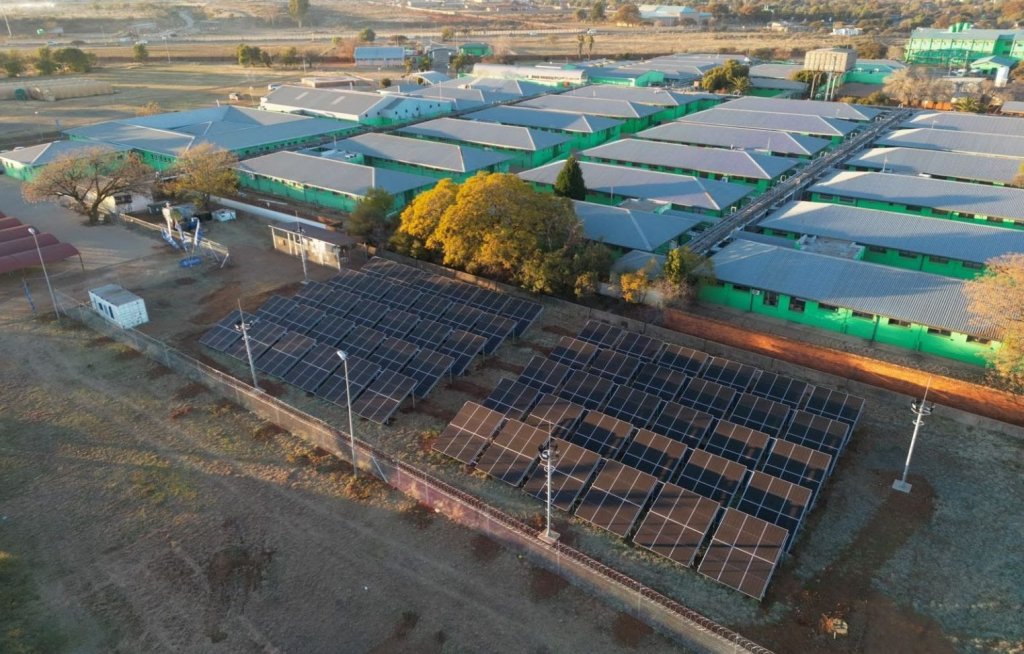
☀️ Eskom has installed a microgrid at Mafikeng Provincial Hospital in North West through its Eskom Development Foundation. The microgrid comprises a 200kW solar PV system with 400kWh battery storage integrated through Eskom’s central microgrid controller. The system will ensure the hospital, which is located in an area prone to cable theft, has a reliable electricity supply and reduce the need for diesel-powered backup generators, says Eskom.