
At The Outlier we spend a lot of time tracking down new data, making new charts and creating new visual tools. It’s easy to be caught up in the rush to find or make new things, so I’ve been spending some time over the past few weeks going through work that we may have neglected for too long or even forgotten. Like our municipality tracker, which we used as the basis for our by-elections feature a couple of weeks ago. And this week, inflation numbers were updated by StatsSA, which prompted me to give our consumer prices dashboard a refresh (more on that below 👇🏾).
🧩 One of our most popular and long-running creations, though, is not a dataset or dashboard but a game. Cluedle is our daily cryptic clue game, which we’ve been running for more than three years, and hundreds of people play the game daily. Long-time friend Jonathan Ancer came up with the idea for the game, and he does the hard work of adding new clues daily. Check out today’s clue.
Also in today’s newsletter we look at:
 Women home buyers
 Diamond mine jobs
 Employment challenges
 The rise of gambling
Homebuyers
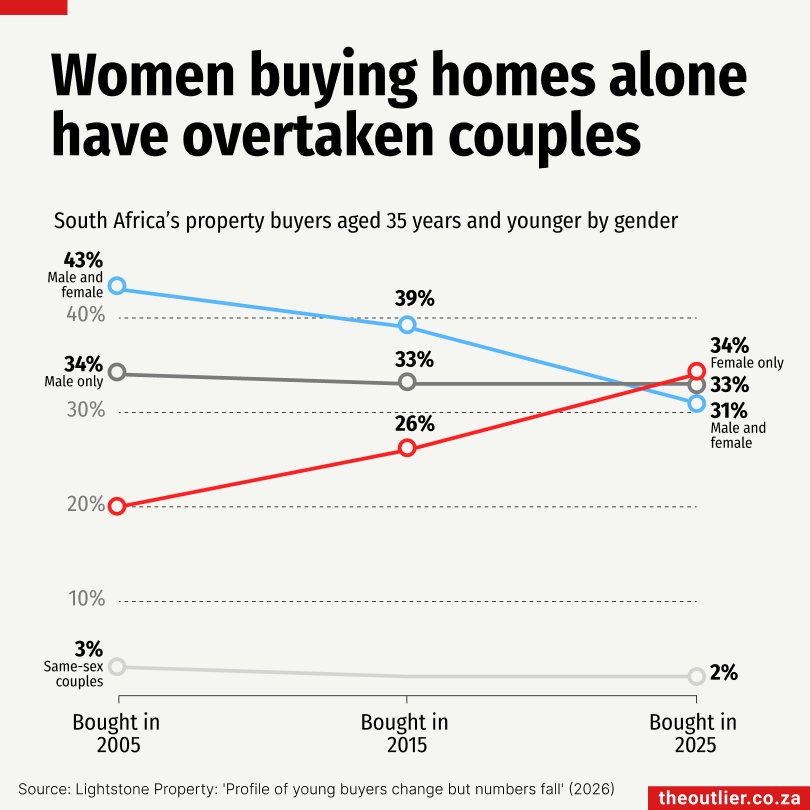
Young women are increasingly buying homes by themselves. In 2005, women buying homes on their own accounted for 20% of homebuyers aged 35 and younger. Twenty years later, that share has jumped to 34%.
While this has risen, the percentage of homebuyers who were men and women has dropped from 43% to 31%.
This is according to Lightstone Property, whose data shows that between 2005 and 2025, the number of people 35 and younger buying homes has dropped by 58%.
Lightstone Property says this is because of several factors. Houses are more expensive, and banks have stricter bond requirements. For potential owners, wages are stagnant, living costs are high, and South Africa has an unemployment rate of 40.6% for people in the 25-34 year age group. The average unemployment rate in South Africa is 32.7%, according to Statistics South Africa’s Quarterly Labour Force Survey, Q1 of 2026.
 Price comparison
This week Statistics South Africa updated its consumer price index (CPI) data, which saw inflation increase to 5%, up half a percentage point since the previous month.
We’ve been keeping track of consumer prices based on StatsSA data since 2017 on our consumer prices dashboard. And this week we also added two new features to the dashboard to make it more useful. The first is a list of the products with the largest price increases over the past 12 months, and the products that saw the largest decrease. You can see that below and on the dashboard.
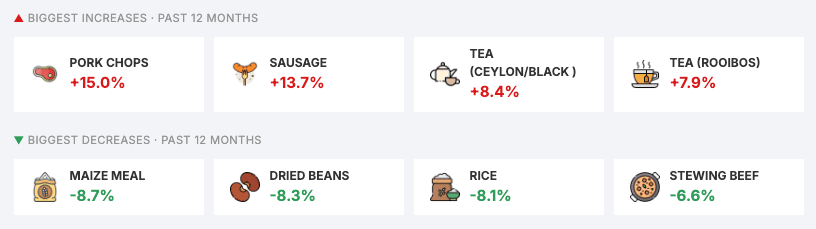
It’s worth noting that we excluded fresh fruit and vegetables from the top and bottom lists because many of them are highly seasonal. We also excluded non-food items this time around.
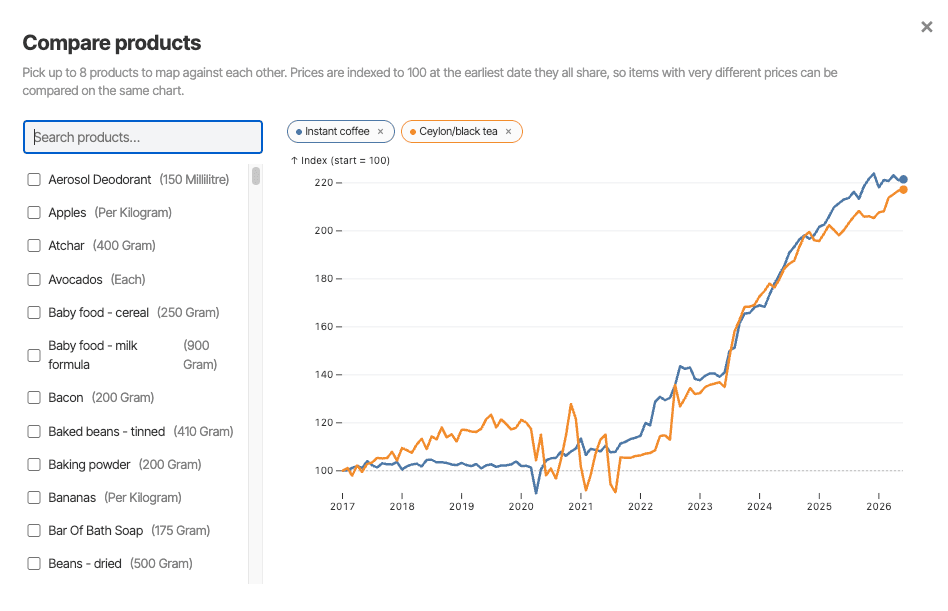
But while we excluded some products from the visualised list, you can also see those comparisons in the other new feature we’ve added: a comparison tool for all products. Select the products you want to compare and see them mapped against one another.
Diamond jobs
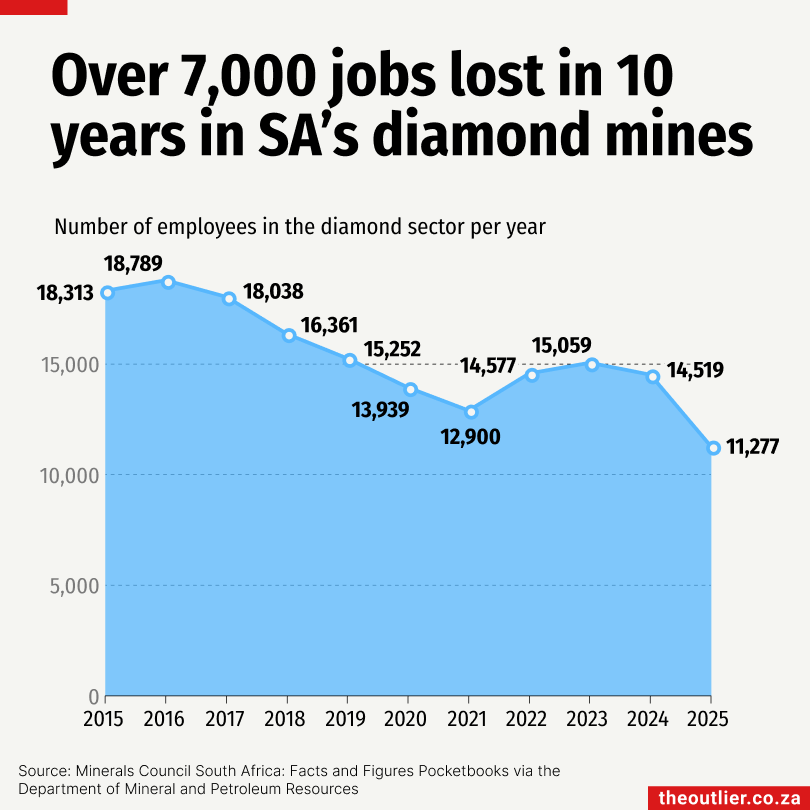
South Africa’s diamond mines have lost over 7,000 jobs in the past decade. It’s a 38% drop, according to figures from Minerals Council South Africa. The culprit? Lab-grown diamonds. They’re nearly identical to the real thing but cheaper, and demand has swung hard enough in their direction that major producers, including De Beers, signed the 2025 Luanda Accord, an agreement to pool 1% of rough-diamond revenue into a joint marketing push for natural, mined diamonds.
To add to the problem, annual diamond production in South Africa decreased from 8.2-million carats in 2015 to 6.8-million; while overall sales revenues decreased from R14.4-billion to R10.8-billion.
And that’s before you factor in 2026, which has been rough for diamond mining. In February, a mud rush at Ekapa Minerals in Kimberley, in the Northern Cape, killed five workers; the company has since gone into liquidation, and its liquidators are hunting for a buyer to keep it running, with offers due 14 August. Finsch has entered business rescue and started cutting jobs, while De Beers has hit pause on Venetia for two years, putting over a thousand jobs on the line.
 Harder to find work
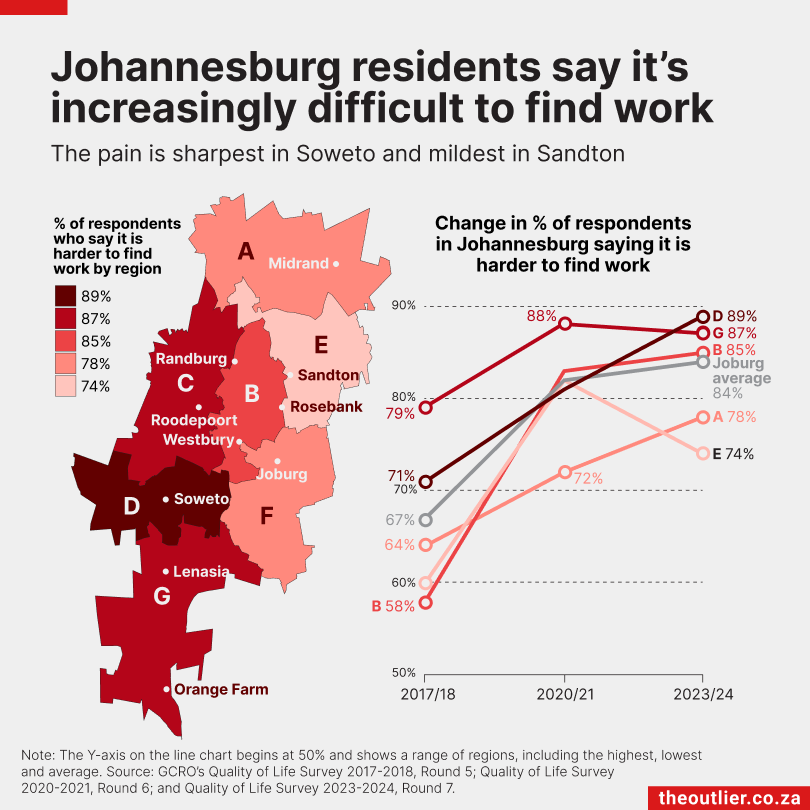
It’s getting harder to find a job. That’s what Johannesburg residents said in three surveys conducted by the Gauteng City Region Observatory between 2017 and 2024. In the latest survey, 84% of residents said it was harder to find a job. It’s an increase from 67% in the first survey.
If we look at Johannesburg by region, Region E, which includes Sandton and Alexandra, had the lowest percentage of people surveyed who found it harder to find a job at 74%. Interestingly, Region G, home to Lenasia and Orange Farm, was the toughest place to find work in both 2017/18 and 2020/21 surveys. It was only in the most recent survey that Region D, which includes Soweto, overtook it.
This perception lines up with actual employment patterns. A 2024 GCRO report based on the Quality of Life 6 Survey found that areas with lower unemployment levels were found in so-called “major economic nodes” such as financial and industrial centres like Sandton and Midrand in the northern parts of Johannesburg.
Produced in partnership with Our City News.
 Gambling problems
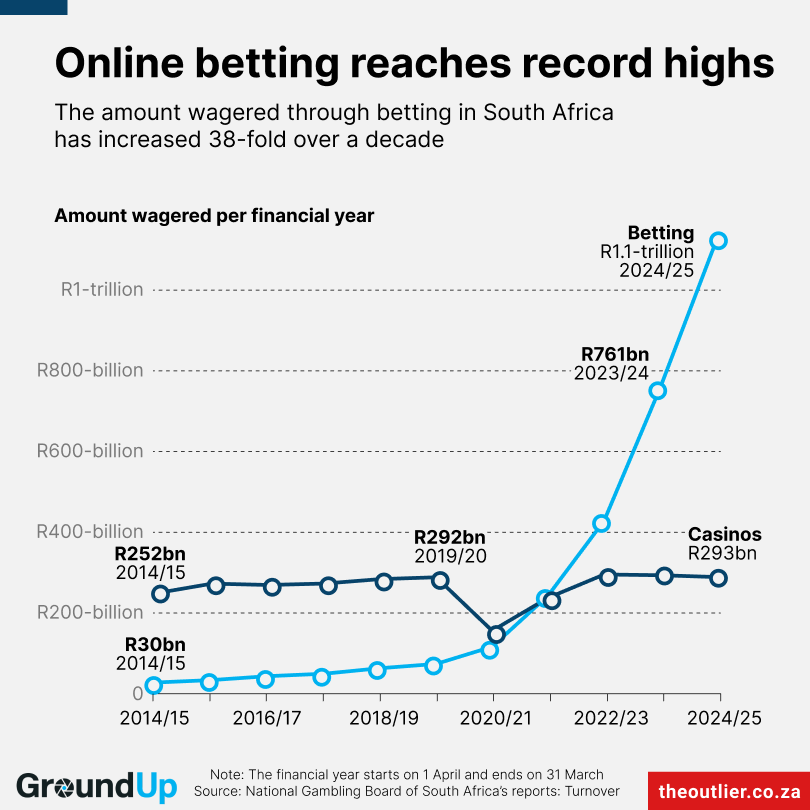
In 2014, South Africans gambled about R252-billion at casinos and bet about R30-billion. Betting has since risen exponentially, to R1.1-trillion in 2024/25.
This has been fuelled by an increase in betting sites and the addictive products they offer, coupled with aggressive and highly deceptive marketing.
Betting includes online gambling and online casinos, which have become ubiquitous, and the horse racing industry, which has become relatively small.
Meanwhile, gambling at casinos has stayed constant in recent years and was under R300-billion in 2024/25.
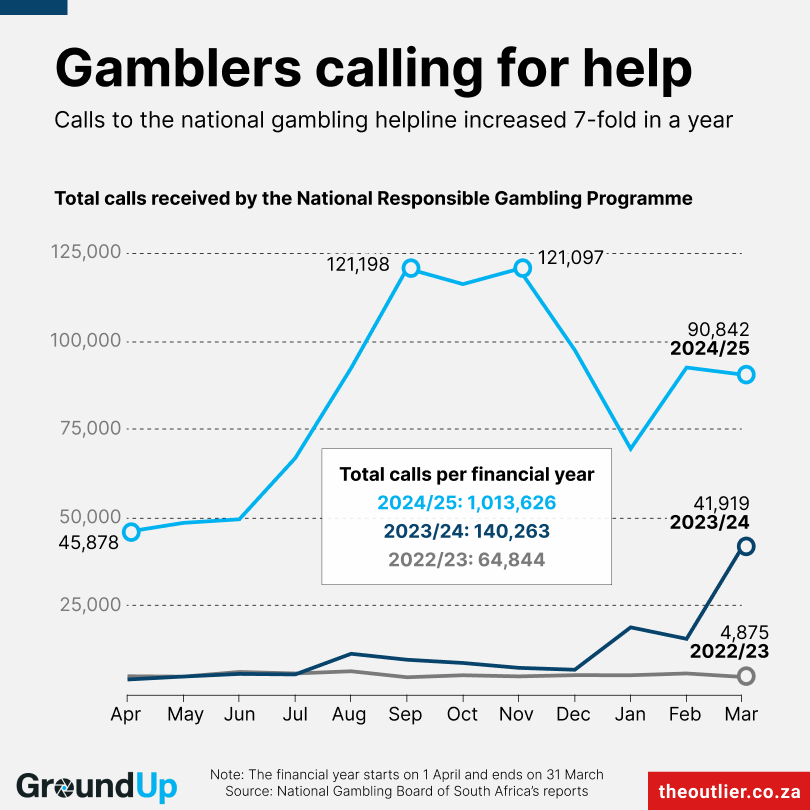
While betting has been on the rise, there has been a dramatic increase in calls made to the national gambling helpline: 65,000 in 2022/23, 140,000 in 2023/24 and over a million in 2024/25.
The helpline is funded by the national gambling board through levies paid by gambling companies. The costs of running the line have skyrocketed – from R1.1-million in 2023/24 to R3.4-million in 2024/25.
Many people see gambling as a source of income and are gambling with their SASSA grants or NSFAS allowances – while the gambling companies profit.
Click here for a link to all references for this newsletter.