
New energy vehicle sales figures were released last week and in line with my data nerd “show don’t tell” tendencies, the two charts below show something I think is exciting. In the second quarter of 2026 (April to June), the plug-in-electric vehicles (plug-in hybrid + battery electric) made up a bigger share of sales than traditional hybrids for the first time. And, in another first, new energy vehicle sales as a whole are 5.6% of total vehicle sales this quarter, says Naamsa.
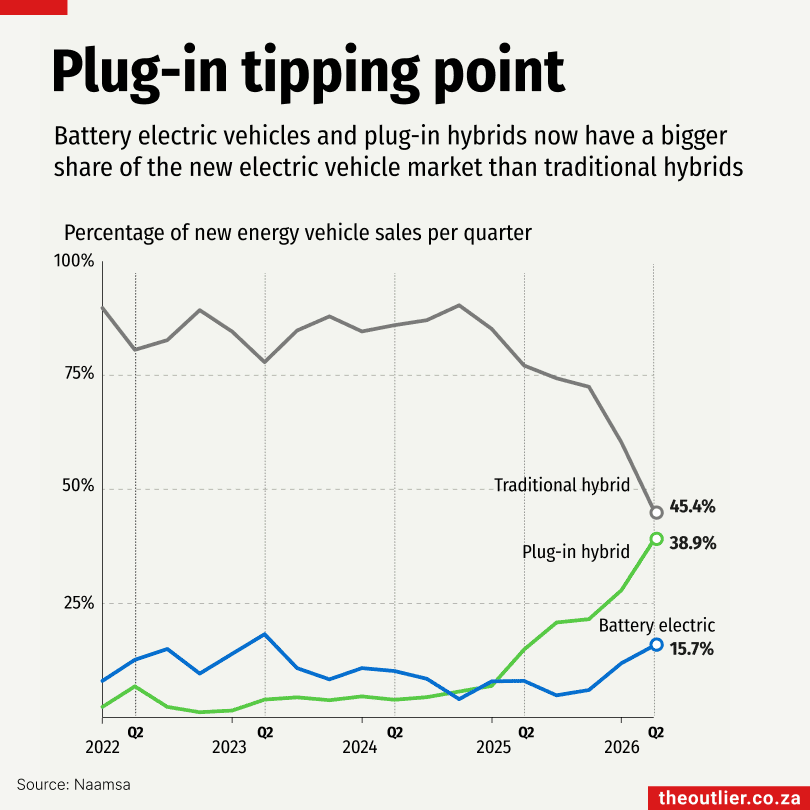
Traditional hybrids, which have dominated the new energy market in this country since 2022, dropped to 45.4% of sales; plug-in hybrids rose to 38.9% and battery electric vehicles rose to 15.7% (so 54.6% combined – more than half).
This is a significant change from a year ago (Q2 2025) when they accounted for just 22.9% of sales. In number terms that’s a jump from 841 to 4,699 plug-in vehicles sold.
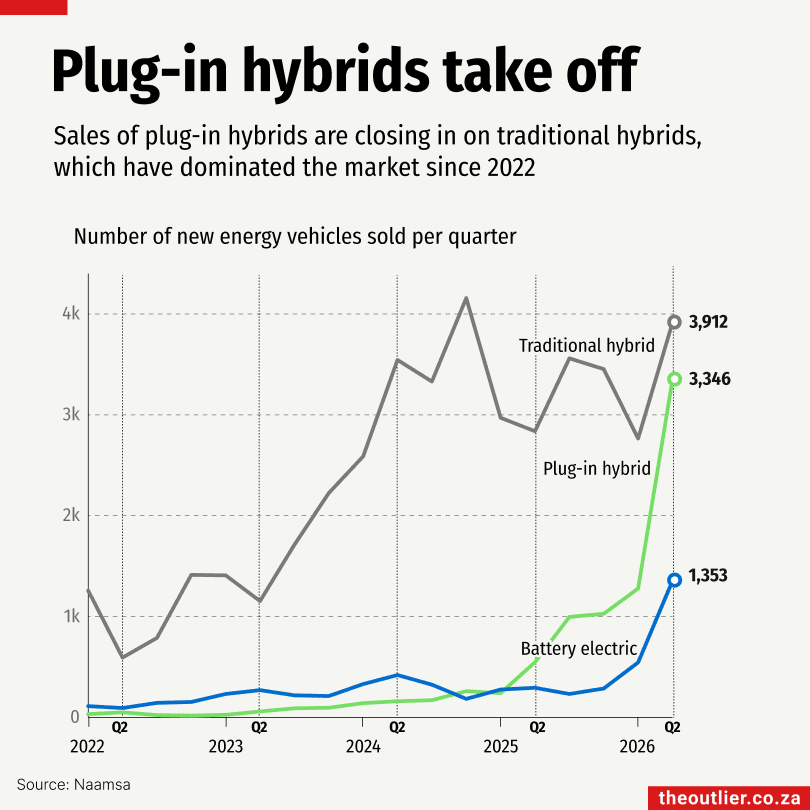
The shift has been driven primarily by the rapid growth of plug-in hybrids. Their sales increased from just 122 cars for the whole of 2022 to 4,623 in just the first 6 months of 2026. Battery electric vehicles went from 502 units sold in the whole of 2022 to 1,897 in the first half of 2026. Some of this significant change can be attributed to more electric vehicle companies starting to report their new vehicle sales data to Naamsa. This quarter’s data covers 30 industry brands, says Naamsa.
The share of conventional hybrids may have dipped, but the number of units sold is holding relatively stable. The size of the market as a whole is just increasing. Total new energy vehicle sales rose by nearly 90% from 4,585 units in the first quarter of this year to 8,611 units in the second quarter.
The number of plug-in vehicles (hybrid and battery electric) sold in the first half of this year is already higher than the number sold in the whole of 2025 (6,520 vs 3,898). If things carry on at this pace, sales could soar way past the 10,000 mark by the end of the year. Let’s hope the charging stations keep up with the number of new vehicles on the road.
RENEWABLE PIN-UP
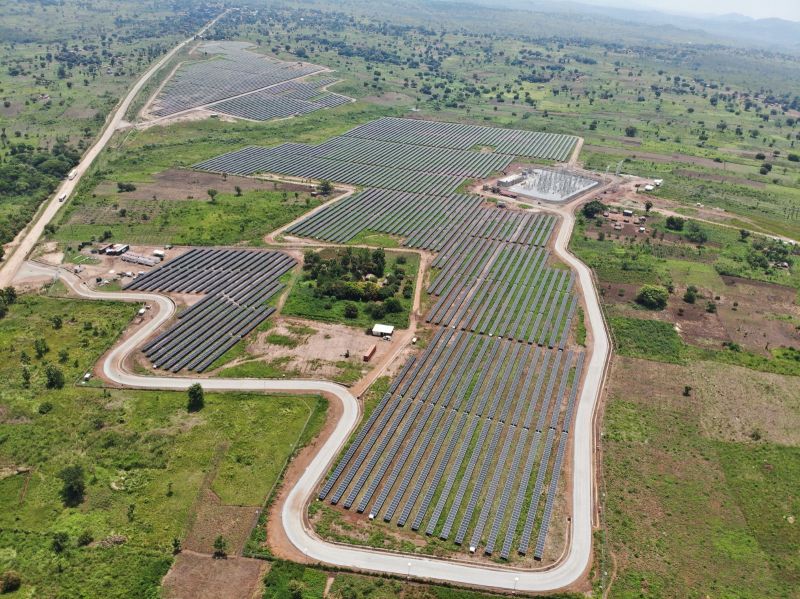
Uganda’s West Nile region got its first-utility scale solar plant when AMEA Power’s 24MWp Ituka Solar plant began generating electricity on 11 August 2026 ahead of its formal commercial operations date. AMEA Power estimates the plant could power roughly 192,000 households and offset 26,600 tonnes of carbon dioxide annually. The plant was built by Ituka West Nile Uganda Limited, a Dubai-based AMEA Power subsidiary, for $19-million, financed by the Emerging Africa Infrastructure Fund, secured during the COP28 United Nations climate change summit. The African Trade and Investment Development Insurance also provided liquidity-risk support.
Location: Ombachi village, Uganda
Size: 52 hectares
System: Solar PV
Capacity: 24 MWp of solar
Estimated households powered: 192,000
Carbon emissions offset: 26,600 tonnes
Offtaker: Uganda Electricity Transmission Company Limited
NEWS WRAP
🍾 2026 is heading to be a record year for independent power producers in South Africa, with 17 projects reaching commercial operation between January and June, adding 1,920MW of capacity to the grid. It’s the largest half-year addition of capacity ever, according to the University of Cape Town’s Power Futures Lab August Briefing Note. Seven projects are government procured, 10 are private projects that are either wheeling electricity to private clients or are supplying behind-the-meter power to a customer. Another 28 projects are expected to reach commercial operation by the end of the year, bringing the total capacity to 4,123MW, which is more than double the previous record.
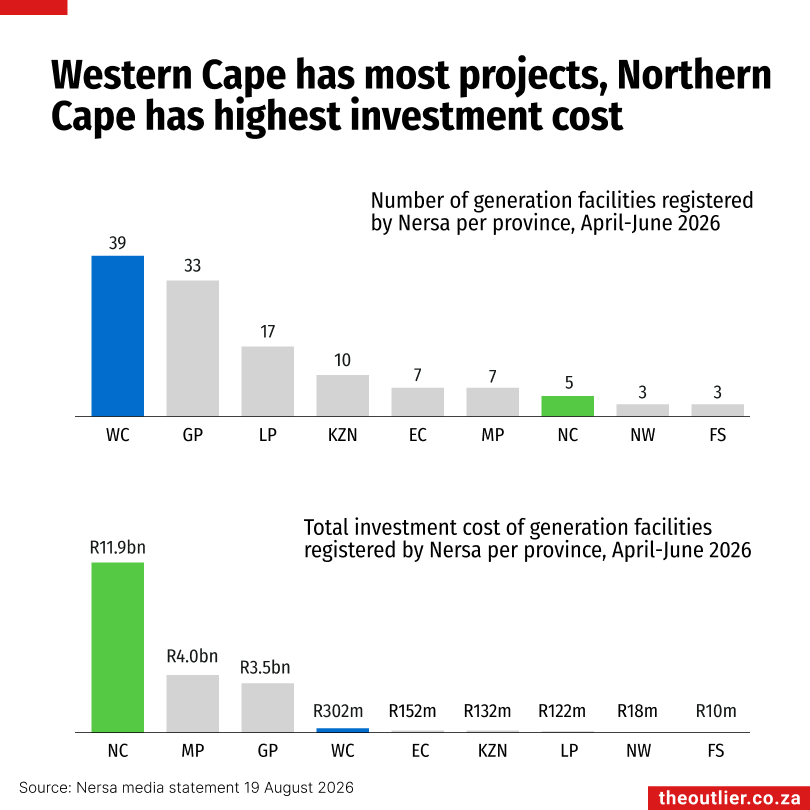
⚡️️Last week Nersa published some investment cost numbers for private generation facilities it registered between April and June this year. There were 124 generation facilities registered in those three months, with a total investment cost of R20.18-billion. Five facilities in the Northern Cape account for 60% of that investment. Another 37% is shared by Mpumalanga and Gauteng. The remaining 3% is distributed among the other six provinces.
The capacity of the Northern Cape facilities is a factor. The five facilities total 440MW, much more than the total capacity registered in Mpumalanga (182MW) and Gauteng (132MW), which were second and third. Most of the Northern Cape’s capacity is the 388MW Kuduskop Wind Farm and the 50MW Orange River Solar Facility 1. Mpumalanga is dominated by the 182MW Ummbila Emoyeni Four wind farm. In Gauteng 110MW of the total 132MW is the Merafong Energy solar PV facility. The remaining 22MW is distributed between the other 32 much smaller facilities. In the Western Cape, the largest of the 39 projects registered is 3MW. Although a 140MW Trakas wind farm was registered in June, but it was left out of Nersa’s calculations.
A new quarterly Renewable Energy Value Chain Newsletter by Southern Transitions, a climate and transition think tank, tracks where solar, wind and battery supply chains are heading, and what it means for emerging manufacturers and markets. It has three key takeaways for the second quarter of 2026:
1. Solar manufacturing is spreading beyond China as India and Saudi Arabia scale up factories. The Middle East may be able to make enough panels for its own needs by the end of the year, although its factories are heavily funded and run by Chinese firms. 2. Cheap Chinese solar panels are keeping prices low and new regulations will make it hard to compete with them on price
3. Wind turbines’ reliance on Chinese rare earth magnets is now a vulnerability.
It’s an interesting read and there’s a link where you can sign up here.
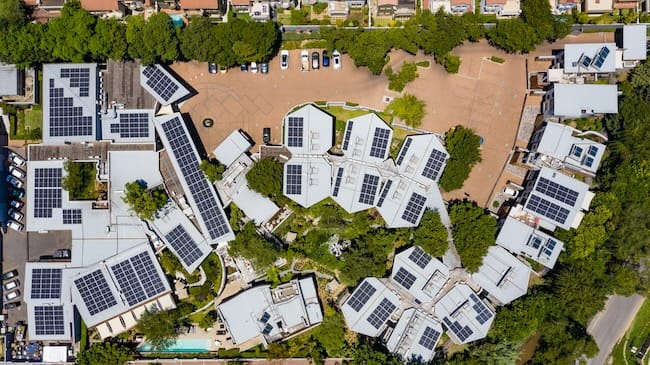
☀️🔋 Rhino Energy Solutions has completed five grid-tied solar PV installations at The Capital Hotel and Apartments properties. The projects are funded through a power purchase agreement delivered through a joint venture between Capital Hotels and Apartments and HyperionRE, Rhino Energy Holdings’ PPA entity. The joint venture owns the solar assets and sells the electricity generated back to each hotel. Capital Empire in Sandton was the pilot project in 2022. Grid-tied solar was then added to Capital Seven Villa and Spa in Sandton, Capital Melrose and Capital Mbombela and Capital 15 on Orange in Cape Town. Carport solar and 2.5MWh battery energy storage installations are being piloted at Capital Seven Villa and Spa, Capital Mbombela and Capital Zimbali. The battery storage systems, which is designed to reduce electricity costs through time-of-use tariff arbitrage rather than as backup power, charge from solar generation during the day and from off-peak grid supply overnight, then discharge during each hotel’s peak tariff periods in the early morning and evening.
☀️ Kenya’s Rural Electrification and Renewable Energy Corporation (REREC) is preparing to commission 120 new mini-grids in remote communities by the end of September. The projects are part of the $150-million, World Bank-supported Kenya Off-grid Solar Access Project. It combines solar mini-grids, standalone home solar systems, clean cooking solutions and solar-powered water pumps.
☀️ A 50MW solar power plant with 15MWh battery storage has been inaugurated near Bangui in the Central African Republic. Developed by Abu Dhabi-based Global South Utilities. The project received concessional funding from the Abu Dhabi Fund for Development under an economic cooperation agreement between the Central African Republic and the United Arab Emirates. The plant comprises 80,000 solar panels and 156 inverters.
☀️ The final phase of Scatec’s 1.1GW Obelisk project in Nagaa Hammadi in Egypt has reached commercial operation. The Obelisk complex includes 100MW / 200MWh of battery storage. The project was developed in two phases. The first was 561MW of solar with the battery storage system; the second phase added another 564MW of solar. The Egyptian Electricity Transmission Company is the offtaker under a 25-year power purchase agreement.
☀️ AMEA Power’s 24MWp solar power plant in Uganda’s West Nile region has started generating electricity. When the plant achieves commercial operation, it will supply electricity to the national grid.
INSIGHTS & EVENTS
💻 Solar Funding 101 webinar. Fund manager Jaltech and EE Business Solutions is hosting a free 30-minute webinar on 28 August at 12pm to help businesses, EPCs, solar developers and energy professionals better understand the financing landscape for solar projects. Jonty Sacks, a partner at Jaltech, will provide a practical overview of the commercial solar funding market and explain how to identify the most appropriate funding solution. Find out more here.
📖 An online panel discussion to launch Navigating World Energy – Amidst War, Climate, Geopolitics and AI, a book by Andy Calitz, will be held on 7 September between 3pm and 4pm. Calitz is a Stellenbosch-trained industrialist who began at Eskom’s Koeberg and went on to lead major projects across five continents. He is currently the World Energy Laureate of the World Energy Council. He will be in conversation with Wale Shonibare of the African Development Bank; Vasanie Pather of the Energy Council of South Africa; Kesh Mudaly of Boston Consulting Group and Chris Yelland, the moderator and managing director of EE Business Intelligence. Register for the free event here.
💻 Creamer Media is hosting a webinar on 30 September which spotlights what the South African Wholesale Energy Market (SAWEM) will mean for renewable energy. Panellists include Cornel Claasen of the Energy Council of South Africa, Brian Day of 2Day Innovation, Dr Rethabile Melamu of Sapvia, Andrew Etzinger of the NTCSA, and Robyn Reinhardt of NOA. Find out more here.
☀️🔋 Solar and Storage Live will be at the Cape Town International Conference Centre from 21 to 26 October. It includes a two-day conference exploring the trends, technologies and opportunities shaping the market through keynotes, panel discussions, case studies and interviews as well as an exhibition and sessions curated by the South African Photovoltaic Industry Association (Sapvia). Find out more here.