Votemaxxing! It’s a thing. If you’re not up to date with internet parlance, this means “taking all measures” to get people to vote. Over the past few weeks and months we’ve done our bit, from delivering voter information tools to analysing past voting trends in charts.
The best time to vote? Here’s what 15 years of IEC data tells us.
Mid-morning is busiest. In 2011 and 2021, the 09:00 to 11:00 slot handled more voters than any other. In 2024 it was level with 11:00 to 13:00.
It stays busy. In the 2021 local elections, every two-hour slot from 09:00 to 19:00 handled 14% to 17% of voters. The old morning rush has become an all-day one.
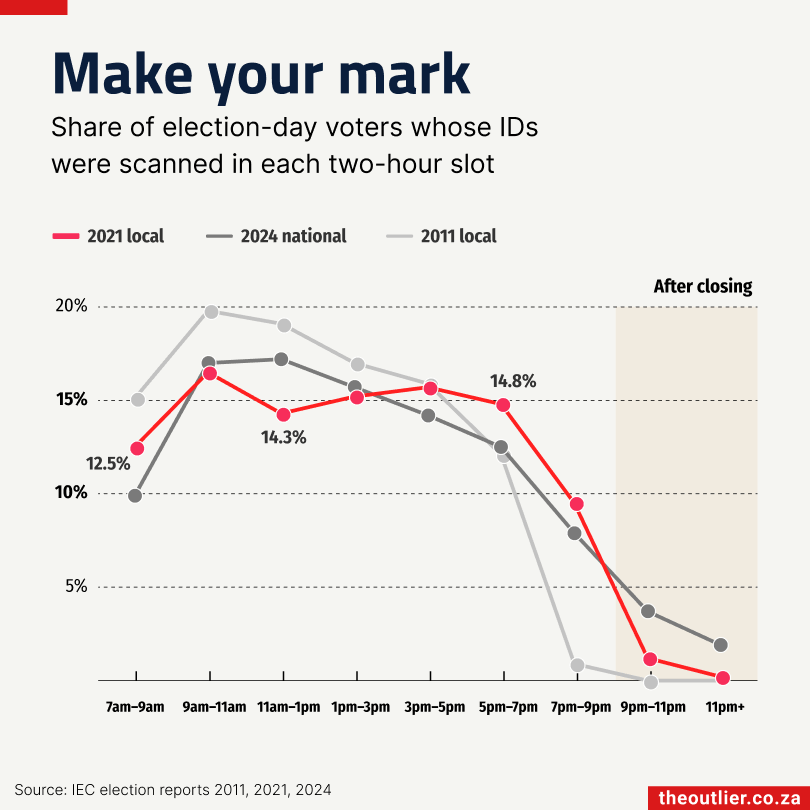
Don’t leave it late. In 2024, about 463,000 people were still being processed after the 21:00 close. More than 157,000 voted after 23:00, after queuing for at least two hours.
Early isn’t always quick. Queues form before 07:00, and some stations start slowly.
Hot tip: go late in the morning or early in the afternoon, and give yourself time in case something goes wrong.
🗳️ Outlier Smart Voting Tools
- Desi, our AI chatbot, answers your plain-English election questions
- BallotBox: Find out about candidates and the wards they’re in
- Council seats won, by city in previous elections
- Find your voting station
- Voting patterns from 15 years of IEC data
In this week’s newsletter:
- ✅ Results: Last week’s poll on water supplies
- 🔆 Clean energy loans
- 📖 Child literacy
- ✔️ Joburg voter turnout
- 👩🏽👧🏽👦🏽 Social grant recipients
- ⛽ Poll: Do you care if your bank invests in the fossil fuel industry?
- 💥 Fact check: Are you up on the news?
Have a lekker weekend.
Gavin
newsletters@theoutlier.co.za
When you choose to give R120 per month to The Outlier you are helping us make important data more accessible to schools, small businesses and even into government. Help us on our mission. Subscribe today.
🛢️Cleaner cash
South Africa’s banks have played a crucial role in the country’s development by lending to dozens of local renewable energy projects. But most banks still have a lot of fossil fuel lending on their books.
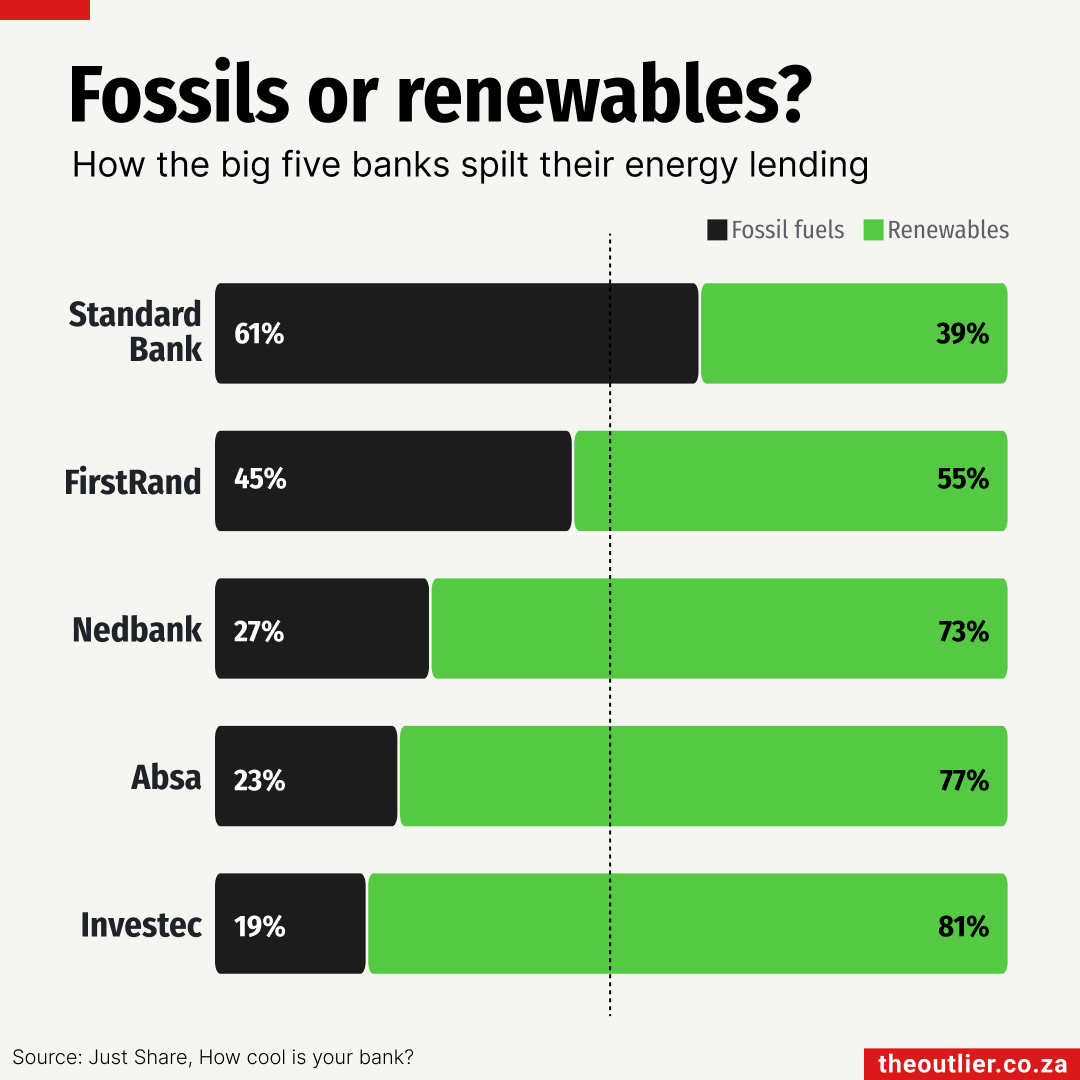
According to Just Share’s How Cool is Your Bank report, Standard Bank is the only one of South Africa’s big banks that still puts most of its energy lending into fossil fuels. 61% of its energy lending goes to fossil fuels, compares with just 19% at Investec, the lowest of the five.
All five banks have sharply increased their renewable energy lending since the last 2024 assessment, by between 68% (Nedbank) and 175% (FirstRand). This has shifted the balance at every bank, with fossil fuels’ share of energy lending falling by between 12 (Nedbank) and 20 (FirstRand) percentage points. But smaller share doesn’t always mean less money. Only Investec(-16%) and Nedbank (-4%) actually cut their fossil fuel lending in rand terms. At Standard Bank (+7%), Absa (+10%) and FirstRand (+19%), fossil fuel lending grew, renewables simply grew faster.
Standard Bank’s position is even more severe than it seems. Fossil fuels make up 5.5% of its total loan book, that’s 3.5 percentage points higher than the next highest bank.
🔤 Wordplay
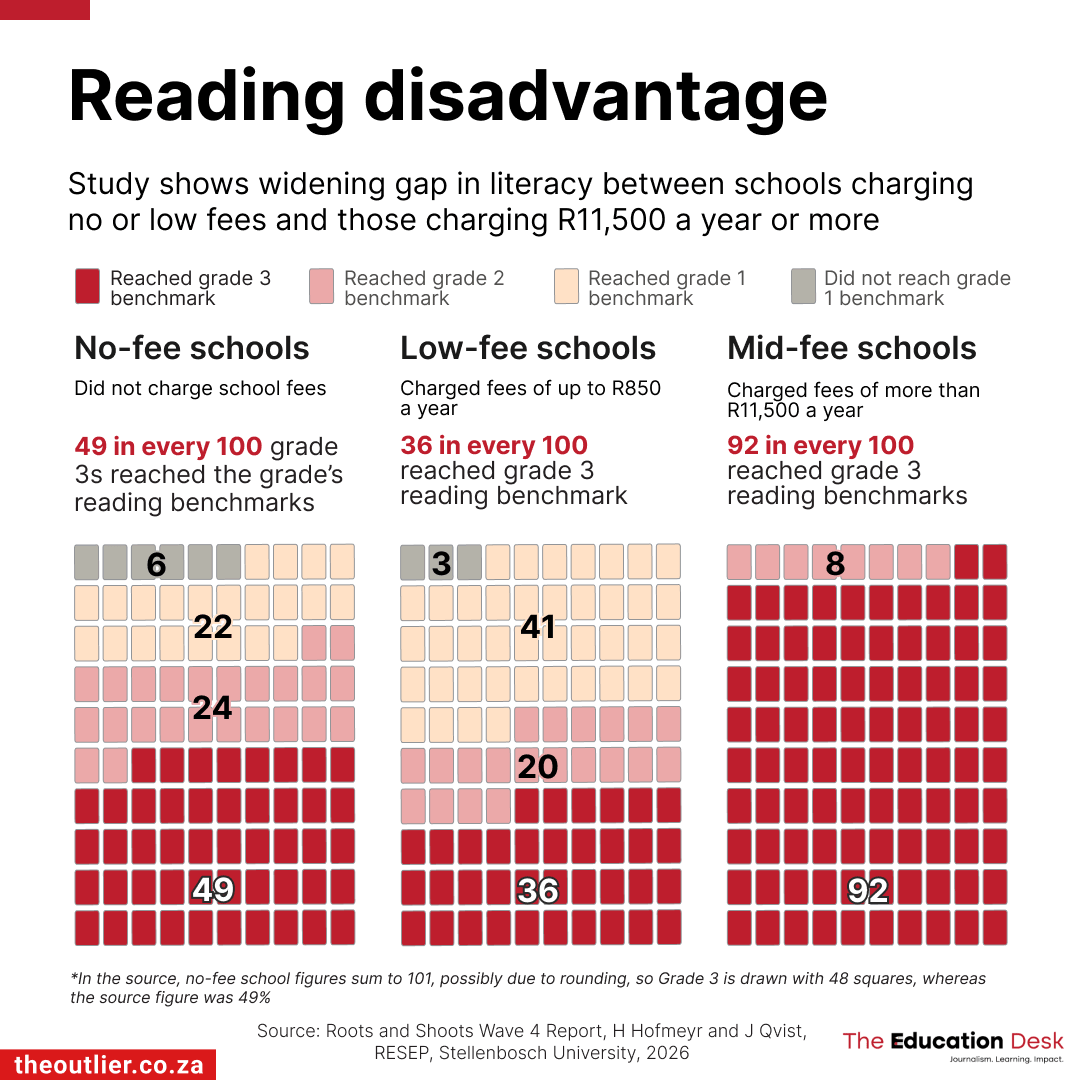
A study that followed the same group of children from the start of grade R to the end of Grade 3 in public primary schools in Cape Town found that large gaps existed in literacy between children at the poorer schools, which charged no or low fees (up to R850 a year), and mid-fee schools that charged R11,500 a year or more.
The children at the mid-fee schools outperformed children from the poorer schools with 92% reaching the grade 3 reading benchmarks, the study known as Roots and Shoots found. In the poorer schools less than half the children reached the grade 3 reading benchmarks.
Inequalities in learning outcomes that existed when the children started school persist as the children fall behind as they move through the grades, the study found. This indicates that expanding access to early childhood development is essential, but not enough on its own to ensure that children reach the reading levels required at the end of the foundation phase, the study found. Improvements in teaching and learning in the early grades are also required.
Produced in partnership with The Education Desk.
☝🏽 Ballot blocks
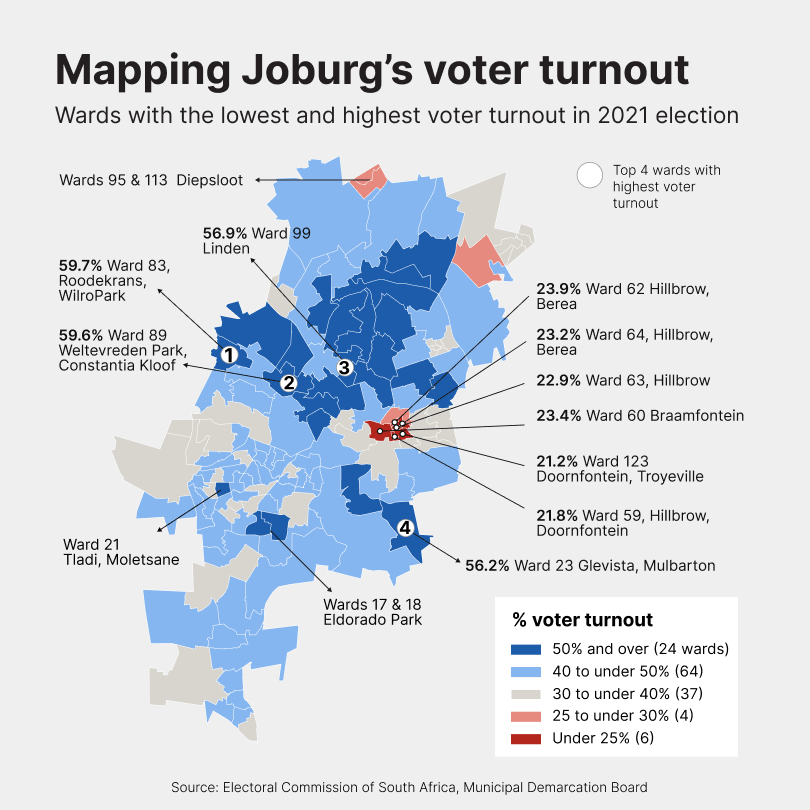
The highs and lows of Johannesburg’s voter turnout follow a fairly predictable pattern. Voter turnout in the city as a whole was 42.6% in the 2021 elections. But in 24 wards, voter turnout topped 50% and in six it was below 25%.
The wards with 50%+ voter turnout are coloured dark blue on the map, those with below 25% are dark red.
The wards with the highest turnouts were in suburbs in the north-west of the city – Wilro Park, Constantia Kloof and Helderkruin. High turnouts stretch from there in a band across Greenside, Rosebank and out to Linksfield in the east, then north through Sandton, Randburg and up to Barbeque Downs and Vorna Valley.
The six wards with the lowest voter turnout in the city are clustered close to the old CBD, around Braamfontein, Hillbrow, Berea, Doornfontein and Troyeville. Ward 67 on the other side of Louis Botha Avenue from Hillbrow, where the Wits education campus is, also had one of the lower turnouts, below 30%.
The ANC won all six of those wards in 2021, with the EFF second.
This chart and analysis were made with the help of The Outlier’s Ballot Box and Desi, The Outlier’s AI chatbot.
Produced in partnership with Our City News.
👥 Grant access
25% of the South African population received a grant in 2006. Today, it is about 41%.
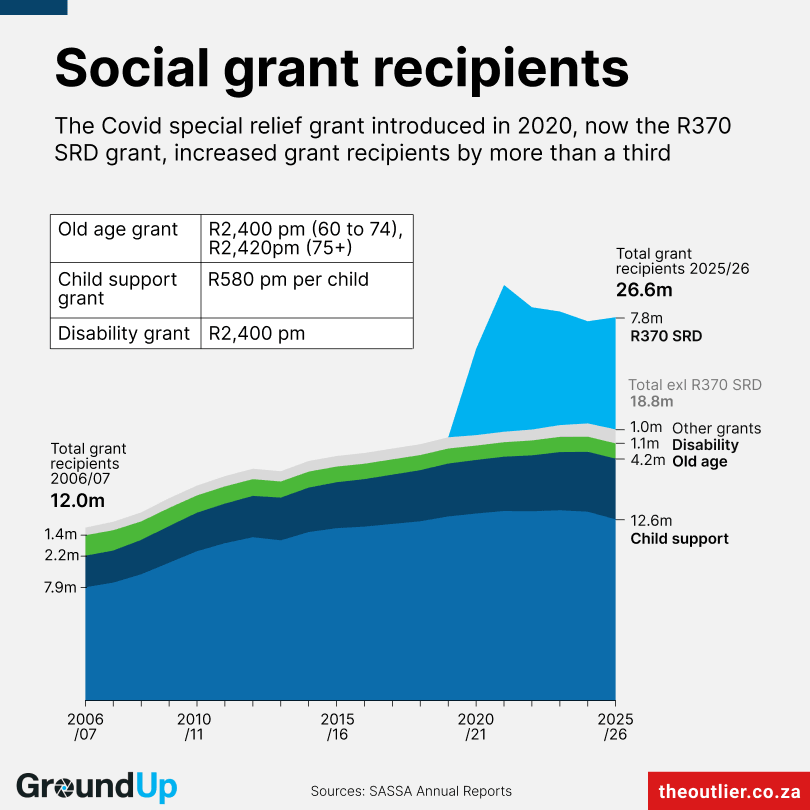
When the South African Social Security Agency (SASSA) began operating in 2006, about 12-million social grants were being paid. Last year, the figure had risen to 26.6-million, including the Covid-19 Social Relief of Distress (SRD) grant.
The biggest change came during the Covid pandemic, when the government introduced the SRD grant to support people without income. The grant, now worth R370 a month, added about eight-million people to the social grant system. It was intended as temporary relief but has been extended repeatedly, most recently until March 2028.
The number of grant recipients peaked at nearly 29-million in 2021/22. Excluding the SRD grant, the number receiving regular grants has grown from about 12-million in 2006/07 to 18.8-million in 2025/26.
🙏 Produced in partnership with GroundUp News. Read the full story.

How you can help us
- Become a paying Outlier member. For just R120/month you get access to all our charts and datasets, and occasional Outlier freebies.