The week that was in charts.
💰 Pay scale
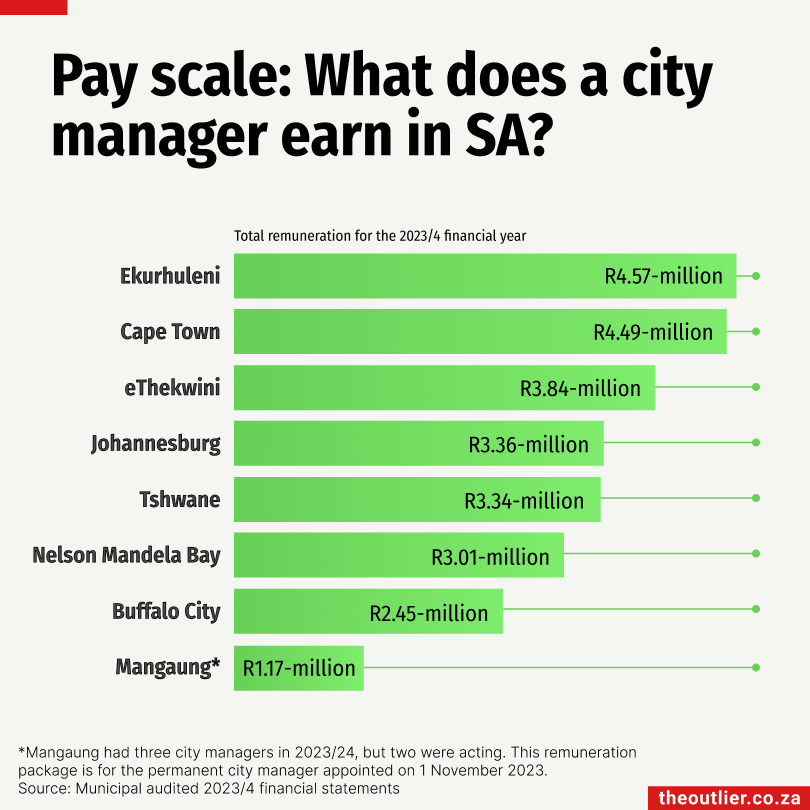
Last week we looked at the salaries of state-owned enterprise CEOs. Many of you asked about the salaries of other officials, particularly those that manage our municipalities. Today we’re doing that.
The highest paid is Ekurhuleni’s city manager, whose package for the 2023/24 financial year was R4.6-million. Next best paid was Cape Town’s city manager with R4.5-million, followed by eThekwini’s, who received R3.8-million and Johannesburg’s, whose package was R3.4-million.
City managers are normally better paid than mayors. As a municipality’s chief executive, the city manager is the person who is meant to get things done, overseeing daily operations, implementing policies, ensuring service delivery, and enforcing compliance with key legislation.
I’m not sure how I feel about Joburg’s city manager being paid more than R3-million, given that my suburb had no water or electricity for days, and sewage has been running down my street on and off for the past month. This is not what we envisaged when we bought a house in the leafy ‘burbs.
Mangaung’s manager earned far less in 2023/24 than those in the other metros, but that’s because he only took up the position on 1 November 2023, so didn’t work a full year.
✈️ 🚞 🚌 Trains, planes and buses
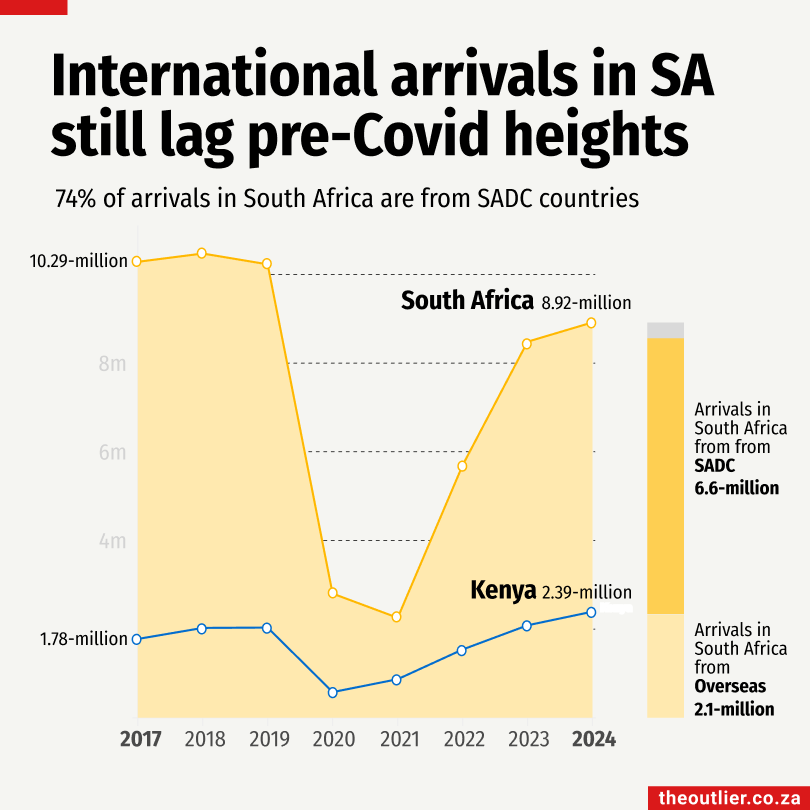
Even though it’s been more than five years since the first major Covid lockdown, the effect of the pandemic remains. One of the sectors most affected by the global lockdown was tourism and travel.
Five years after Covid, international arrivals in South Africa are much improved but not yet back to pre-Covid highs.
Arrivals in 2024 were almost 9-million, still 13% down on the highs of 2017 and 2018. Kenya, in comparison, has recovered and even exceeded pre-Covid arrivals in the time since the lockdowns, albeit off a smaller base.
The vast majority of arrivals in South Africa are from within Africa, especially SADC (Southern African Development Community) countries. In 2024, 6.6-million arrivals in SA were from SADC countries, or 74% of the total.
The majority of SADC visitors to South Africa stayed in the country for 2 to 4 days. Visitors from overseas spent an average of 8 to 14 days in the country. (Statistics South Africa)
🎰 Bad odds

South Africans wagered more than R1-trillion last year. Two-thirds of it was spent on betting, mostly online, on things like sports and horse racing. The money spent on betting has been going up and up since around 2021. The turnover from betting now far surpasses casinos, which used to be the most popular way to gamble in this country.
Betting on sports and other contingencies is driving this surge. Half the gross revenue from gambling is from online betting, according to National Gambling Board statistics.
“Gambling has transitioned from a pastime enjoyed by small pockets of society to being a commonplace activity,” notes the National Gambling Authority.
In an April 2025 survey conducted by InfoQuest – a follow-up to its March 2024 study on approximately 300 South African gamblers – nearly half (48%) said they are gambling more often than a year ago.
According to Claire Heckrath, managing director of InfoQuest, “This surge in frequency points to growing engagement, possibly fuelled by the rise of easily accessible online platforms, aggressive marketing, and shifting social norms.”
But how are people funding their gambling? According to Heckrath, a third of gamblers claim to use surplus funds. “This means that a concerning 63% are likely using money meant for essentials, savings, or other financial commitments,” she said.

The Western Cape and Mpumalanga have reported the steepest rises in gambling revenue. The Western Cape has surged past Gauteng, which four years ago was the top revenue earner (see chart above), to record more than R5-billion more in revenue than Gauteng in the 2024 financial year.
Mpumalanga, recorded nearly the same gross revenue as Gauteng, which is surprising given its much smaller population. In fact, in terms of the amount of money spent on gambling, or turnover, Mpumalanga beat both Gauteng and the Western Cape in the 2024 financial year.

Betting on sports and contingencies is the hands-down favourite way to wager in Mpumalanga and the Western Cape. It accounts for 96% of the money spent on gambling in Mpumalanga and 84% in the Western Cape.
Casinos are still where the gambling money in Gauteng is spent, recording 77% of the turnover for the 2024 financial year, according to the National Gambling Board. More was spent in casinos in KwaZulu-Natal, the Free State and the Eastern Cape.
Bingo is popular in North West and the Eastern Cape, where it contributes a quarter of the gambling turnover.
But the meteoric rise of betting means it has by far the highest turnover in the country: R761-billion compared with R297-billion for casinos.
The government isn’t complaining because it collected R4.8-billion from taxes and levies on all that money people spent on gambling in the last financial year.
But, as Johan Fourie points out in his newsletter this week, this massive increase in sports betting comes at great cost, particularly among poorer communities, and not just in South Africa but also most other developing economies across Africa and Latin America. “The costs of inaction are mounting, and the social risks are becoming impossible to ignore.” Take the time to read Johan’s article here.
