The week that was in charts.
🗞️ Unread
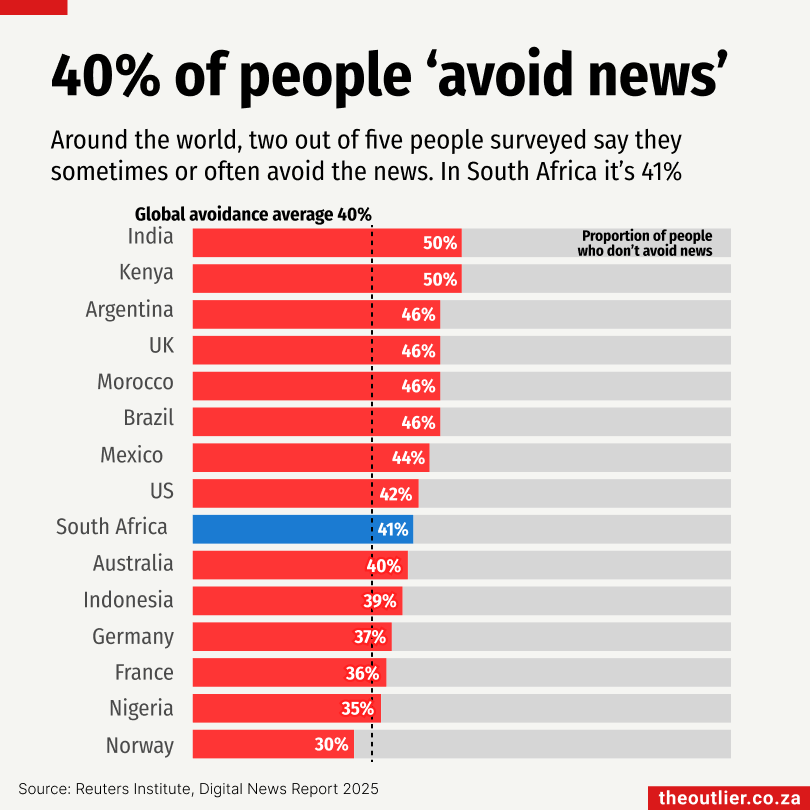
An increasing proportion of people say they avoid reading, watching or listening to the news. According to this year’s edition of the Reuters Institute’s Digital News Report, 40% of people say they sometimes or often avoid the news, up from 29% in 2017. At 41%, the South Africans who took part in the survey were in line with the global average.
The top eight reasons people avoid the news are:
☹️ It has a negative effect on their mood
😮💨 They are worn out by the amount of news
💣 There is too much coverage of conflict/war
🗣️ There is too much coverage of politics
🤷🏽♀️ There is nothing they can do with the information
🤯 It leads to arguments they’d rather avoid
🧚🏼♀️ It doesn’t feel relevant to their lives
🤔 It’s too hard to understand
At The Outlier we are well aware that people feel overwhelmed by the amount of information out there because it’s something we experience ourselves. It’s especially frustrating when information is contradictory or when it leaves you feeling powerless in the face of a deluge of negativity.
Our approach at The Outlier is to limit the amount of information we publish, focus on facts and visuals, avoid the negative unless we think we can add (data) value and, wherever possible, include a sense of humour or surprise.
🛑 No-go zone
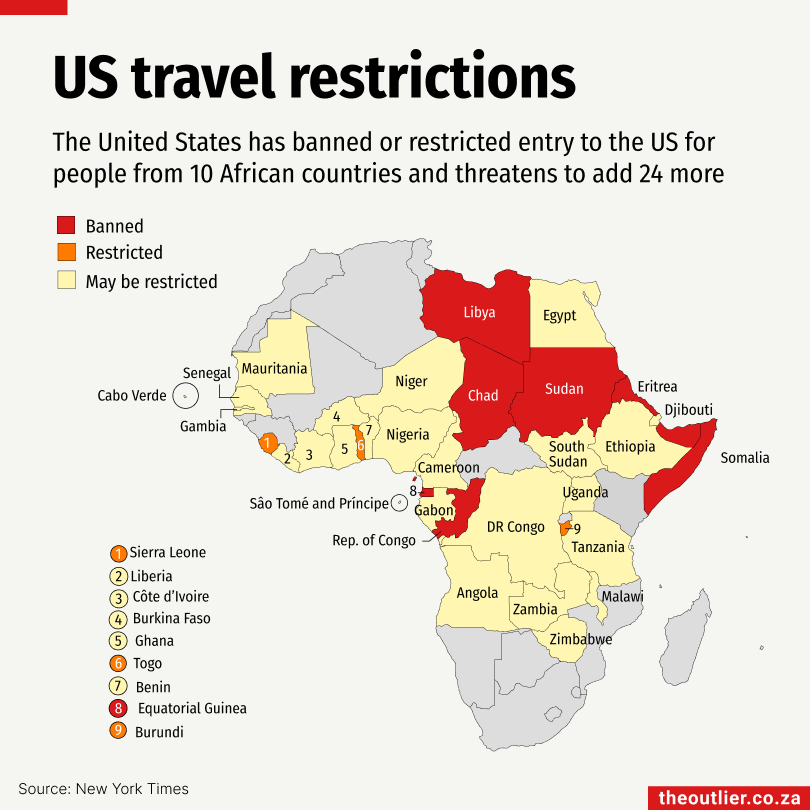
President Donald Trump banned travel to the United States for citizens of seven African countries and restricted access for another three countries from 9 June.
In a separate list, he included an additional 24 African countries that may be subject to travel restrictions if they didn’t provide ‘remediation plans’ for concerns identified by the US government that include security vetting and people overstaying their US visas, according to the New York Times.
The 34 countries are:
Banned: Chad, Republic of Congo, Equatorial Guinea, Eritrea, Libya, Somalia and Sudan.
Restricted travel: Burundi, Sierra Leone and Togo. People from these countries cannot go to the US permanently or get tourist or student visas.
May be restricted: Angola, Benin, Burkina Faso, Cameroon, Cape Verde, the Democratic Republic of Congo, Djibouti, Ethiopia, Egypt, Gabon, Gambia, Ghana, Côte d’Ivoire, Liberia, Malawi, Mauritania, Niger, Nigeria, São Tomé and Príncipe, Senegal, South Sudan, Tanzania, Uganda, Zambia and Zimbabwe.
Nice to see that South Africa is not one of them.
European view
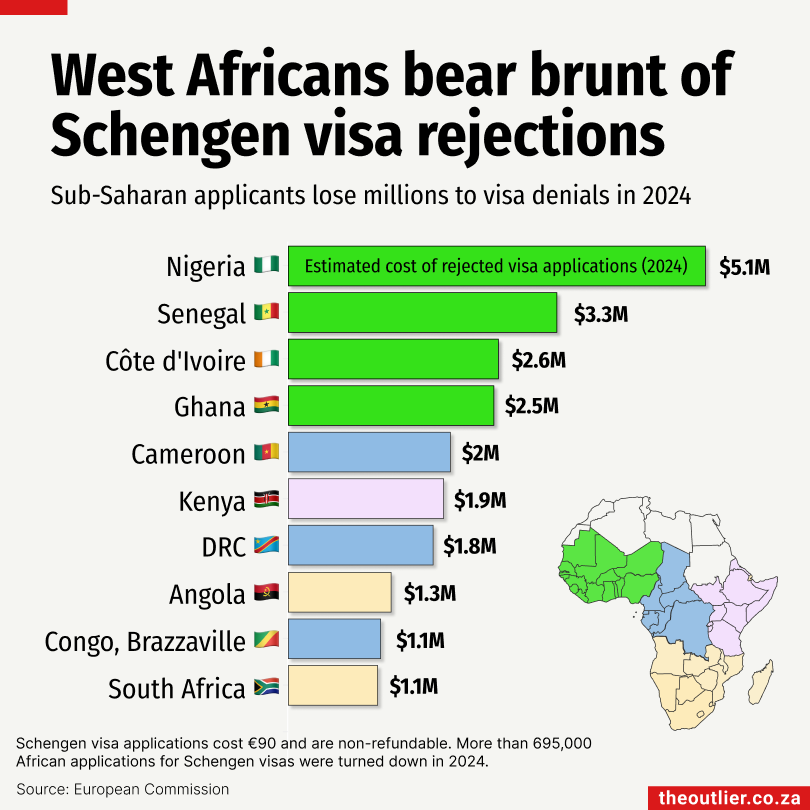
We previously looked at the number of Schengen visas rejected for African applicants in 2024. Some of you asked about the cost of these visa rejections and which countries were affected. Here we go:
🌊 Underspend
The severe weather that hit the Eastern Cape last week has been classified as a national disaster. Last week, parts of the Eastern Cape were hit by devastating floods which killed more than 90 people. Mthatha was hardest hit. In a single day, 9 June 2025, 129mm of rain fell on Mthatha, smashing a 28-year record set when 76.6mm fell on 11 June 1997.
The severe weather that brought snow, damaging winds and heavy rainfall with devastating loss of life, as well as damaging infrastructure and disrupting basic services, has been listed as a national disaster by the head of the Disaster Management Centre.
When a weather event is classified as a disaster, it allows different levels of government to step in to coordinate and manage the disaster.
Since 2015, there have been 76 disasters classified at various levels of government. Over a third of them were due to severe weather such as heavy rains, floods, hailstorms and strong winds. The Eastern Cape has featured in 11 of the disasters related to severe weather.
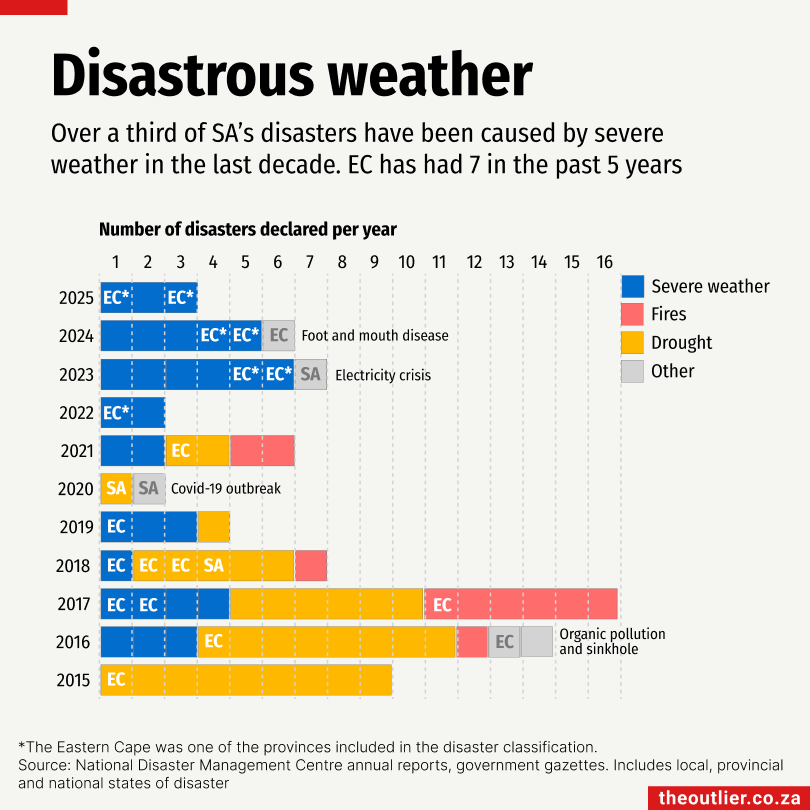
In January 2025, there was already a national disaster in the Eastern Cape caused by heavy rains, so the latest weather-related disaster is the second this year.
When a disaster hits, the National Disaster Management Centre, under the Department of Cooperative Governance and Traditional Affairs, can disburse two types of grants: disaster response and disaster recovery.
- Disaster response grants fund immediate emergency relief — such as urgent repairs to infrastructure and the emergency provision of goods and services.
- Disaster recovery grants support the longer-term rehabilitation and reconstruction of damaged infrastructure, such as roads, bridges and water systems, aiming to restore functionality and reduce future disaster risk.
For example, after devastating floods in eThekwini (Durban) in April 2022, a state of disaster was declared and R1.8-billion was made available for emergency relief.
Disappointingly, the auditor general found that only 6% of that money had been spent more than three months after the disaster was declared.
The slow pace of disaster-relief spending appears to be common in municipalities. In the 2023/24 financial year, R873-million rand in disaster response grants went to 75 municipalities. Only 25 municipalities spent 80% or more of the funds. Thirty municipalities didn’t spend a cent. In total, just R220.5-million – only 25% of the available funding – was used by the end of the financial year.
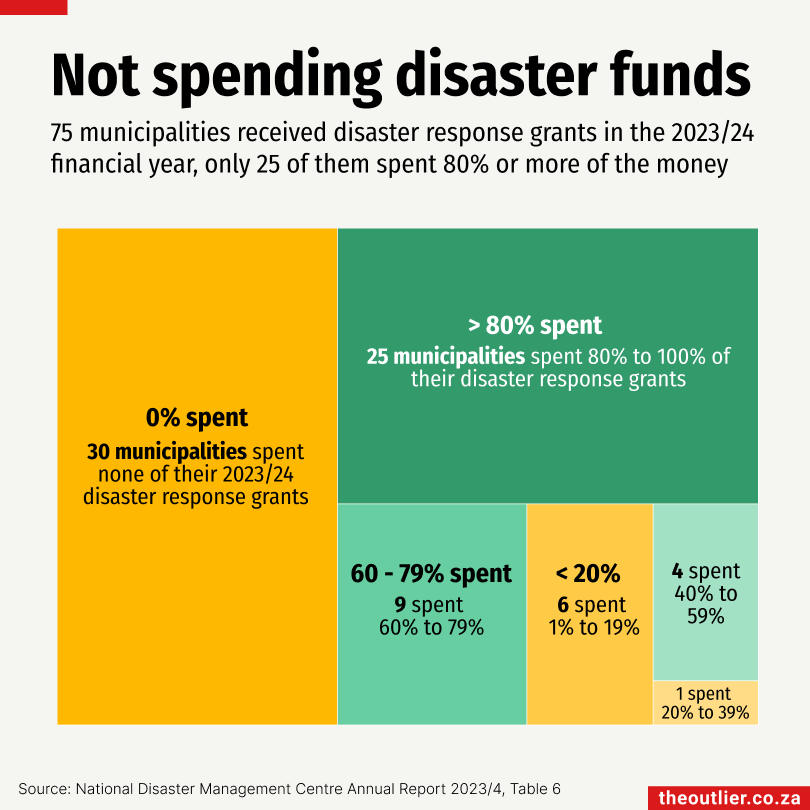
King Sabata Dalindyebo local municipality, where Mthatha is based, was one of 22 municipalities in the Eastern Cape that received disaster relief funding in the 2023/24 financial year. It received R5.4-million after it was hit by severe weather. It spent 94% of it, which is encouraging.
When allocations aren’t spent, the Treasury can reallocate the money. Although if funds are already committed to specific projects, the Treasury may allow municipalities to carry them over into the next financial year.