💰 Accumulating assets
In an attempt to counter the current negativity around the police and justice system, we are focusing on something positive: the Special Investigating Unit. It’s “one of South Africa’s most effective anti-corruption agencies”, says the Institute for Security Studies (ISS) in a policy brief titled The future of South Africa’s Special Investigating Unit.
The unit’s job is to recover government losses from financial crime. When there are serious allegations of corruption, malpractice and maladministration in state institutions, the presidency can authorise the unit to investigate with a presidential proclamation.
The presidency has issued 300 presidential proclamations since 2001, according to the ISS. Fifty-five percent of those were by Cyril Ramaphosa since he became president in February 2018. The 2024/2025 financial year was particularly prolific with 49 proclamations issued.

The 49 authorisations for the last financial year cover a wide range of government departments and institutions, including the SABC, the departments of water and sanitation, and public works and infrastructure, as well as several municipalities. These include Tshwane, Ekurhuleni, and Nelson Mandela Bay municipalities. There’s also eThekwini’s water and sanitation unit, the Mpumalanga department of education and the Eastern Cape provincial health department.
How effective are these investigations? “It is difficult to measure the effectiveness of anti-corruption agencies, and reputation is often used as an indication of effectiveness,” says the ISS.
But one measurable metric is the value of cash and assets recovered. Over the past five years, the SIU has recovered nearly R5-billion in assets. Another R19.5-billion worth of contracts were set aside because of SIU investigations.
The 2023/24 financial year was particularly successful, with R2.3-billion in assets recovered, most of which were from two major investigations into Transnet and the National Student Financial Aid Scheme.

🤖 Who’s blocking AI?
Should news publishers be blocking AI scrapers and bots? This debate surfaced in the past couple of weeks after Cloudflare announced a service to block and even charge AI web scrapers. There are some good reasons to block AI scrapers. Mostly publishers view this as ‘stealing’ their content (justifiably) but these bots also often swamp servers with traffic so there is a good financial reason to block them. Earlier this year Wikipedia said the spike in AI bot activity was driving up costs for the project to unsustainable levels, for example.
On the other hand, does blocking AI scrapers mean news articles won’t appear in AI-generated results? We have to face the fact that traditional searches like those on Google are dwindling fast and most people are now either clicking on AI-generated summaries on search sites or simply asking questions on their favourite AI chatbot. Not appearing in those AI results pretty much renders your content invisible. It’s a real rock-hard-place situation.
A couple of weeks ago media friend Ali Mahmood put together an interesting piece looking at which publishers in Europe were trying to block AI scrapers. It got me thinking about local publishers and their intentions.
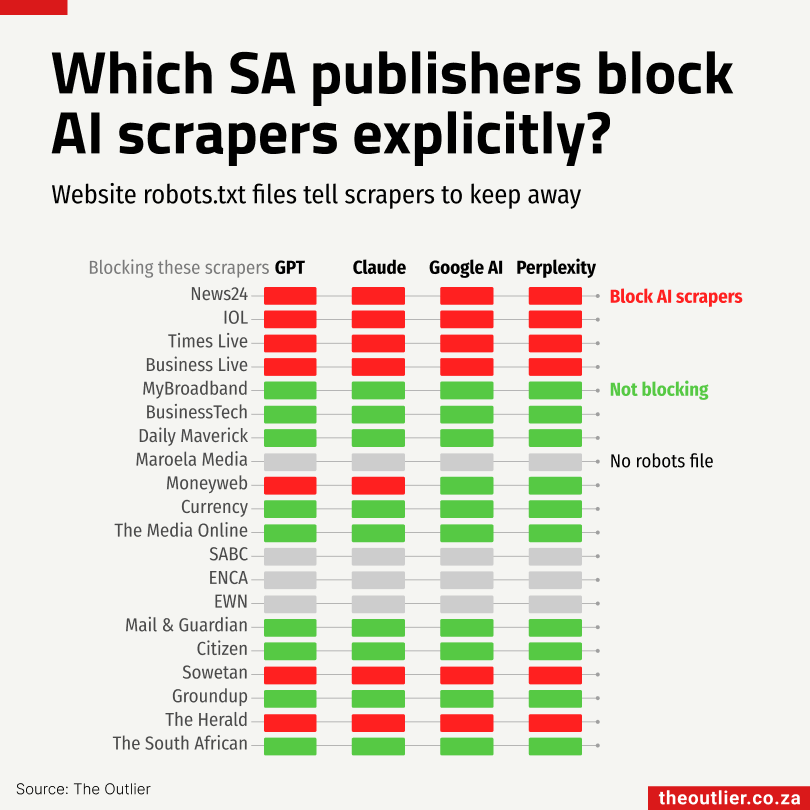
Like in Ali’s piece I looked at the robots.txt file for a number of local publishers. The robots.txt file is a standard way of telling bots to ‘stay away’. It’s mostly a suggestion and while most well-known scrapers will take the hint, less reputable scrapers will ignore the robots.txt file.
While there are many other technical (and better) ways to block scrapers, the robots.txt file is a proxy for the intention of each publisher. If they’re not disallowing AI scrapers in the robots.txt file they probably aren’t doing anything else to block scrapers.
In the chart below we looked at the most common names for the main AI scrapers (GPT, Claude/Anthropic, Google’s AI and Perplexity) to see which appeared in the robots.txt files for local publishers.
PS. At The Outlier our robots.txt file currently disallows most AI scrapers but I confess I’m still in two minds about this.
🐮 Foot, mouth and mince
Beef mince is at its highest price in eight years, according to Statistics South Africa’s Consumer Price Index released this week. It’s R14/kg more expensive than it was at the beginning of the year.

The increase is largely due to a widespread outbreak of foot-and-mouth disease (FMD), a highly contagious virus that affects cattle, which has caused supply shortages. Infected cattle have been quarantined, and animal movement has been restricted until herds are vaccinated. There have been 270 reported outbreaks of the disease across five provinces.
South Africa currently relies on Botswana to supply its FMD vaccines. The Botswana Vaccine Institute is one of just five FMD vaccine producers in Africa.
At the Foot-and-Mouth Disease Indaba earlier this week, Agriculture Minister John Steenhuisen admitted that South Africa had been unprepared. “The national FMD vaccine bank was depleted,” he said.
“Onderstepoort Biological Products [a state-owned vaccine manufacturer] currently lacks the infrastructure to produce FMD vaccines at the scale and speed required to respond to outbreaks,” said Steenhuisen.
“As a result, we were compelled to import vaccines from Botswana to mount even a partial response. This situation is unsustainable for a country with South Africa’s livestock footprint and export ambitions.”
PS. Our consumer price goods dashboard is updated as soon as new CPI data is released by Stats SA. Check it out.
💡 Power outages
We’ve been mildly obsessed for a while now with the City of Joburg’s water problems because, let’s face it, having no water for a few days is worse than having no electricity. But let’s not forget that on some days in this not-so-fair city we have neither water nor electricity.
City Power customers continued to have loadshedding – but it was called ‘load reduction’ – for months after Eskom stopped its planned outages in March last year. Load reduction ended in February, but power outages most certainly haven’t.
We were delighted to discover that City Power publishes the number of power outage reports it receives. We’ve used that data in the charts below to see whether the number of power cuts has been increasing or not.
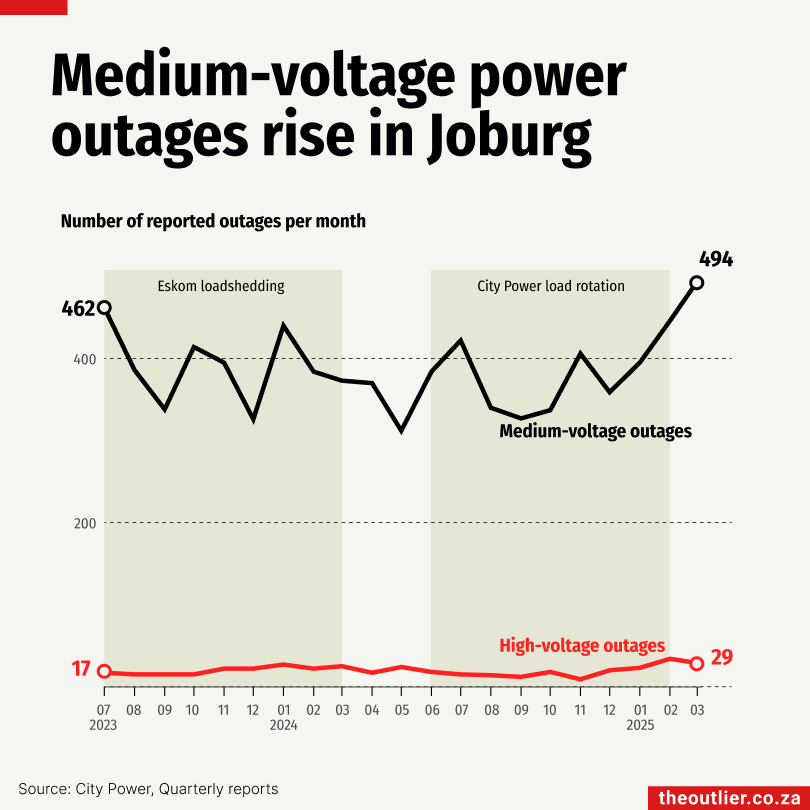
Starting with the most serious outages: reports of faults on high-voltage power lines did start to rise at the end of last year. These outages are at a regional scale and are considered ‘critical’, says City Power.
But, it’s on the medium voltage distribution network that reported outages have steadily increased since January. The medium voltage network carries electricity from the high-voltage transmission lines to the low-voltage network that connects to our households. Medium-voltage outages typically affect an entire suburb or multiple suburbs, say City Power. 494 medium-voltage outages were reported in March.
City Power provides real-time updates on repair progress on high- and medium-voltage outages via its various public communication channels.
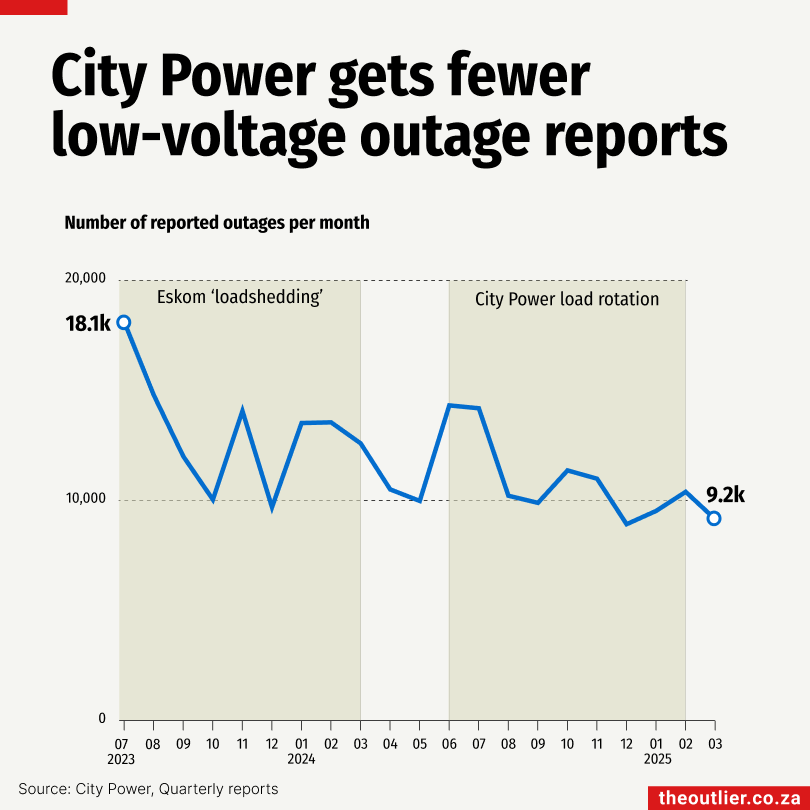
The low-voltage outages, which tend to affect individual households or a few houses on a street or a block, are reported far more frequently. City Power doesn’t report on these outages on its public channels, but it does keep a record of them. City Power customers who log calls about outages get a reference number they can use to track repair progress.
In March, City Power received 9,200 outage reports, which sounds bad, but a year-and-a-half ago, in July 2023, the worst year of Eskom’s loadshedding, it received more than 18,000 outage reports. Low-voltage outage reports regularly top 10,000 a month.
The reported figures of low-voltage outages refer specifically to the number of logged outage calls, not the actual number of unique fault incidents on the electricity network, says City Power. “For instance, 300 calls from residents on the same street could all stem from one technical fault.”
Equipment failure is the root cause of around 60% of the outages on the medium-voltage distribution network. But the outages caused by thieves and vandals are the most infuriating for the city’s residents. Cable theft is particularly triggering.
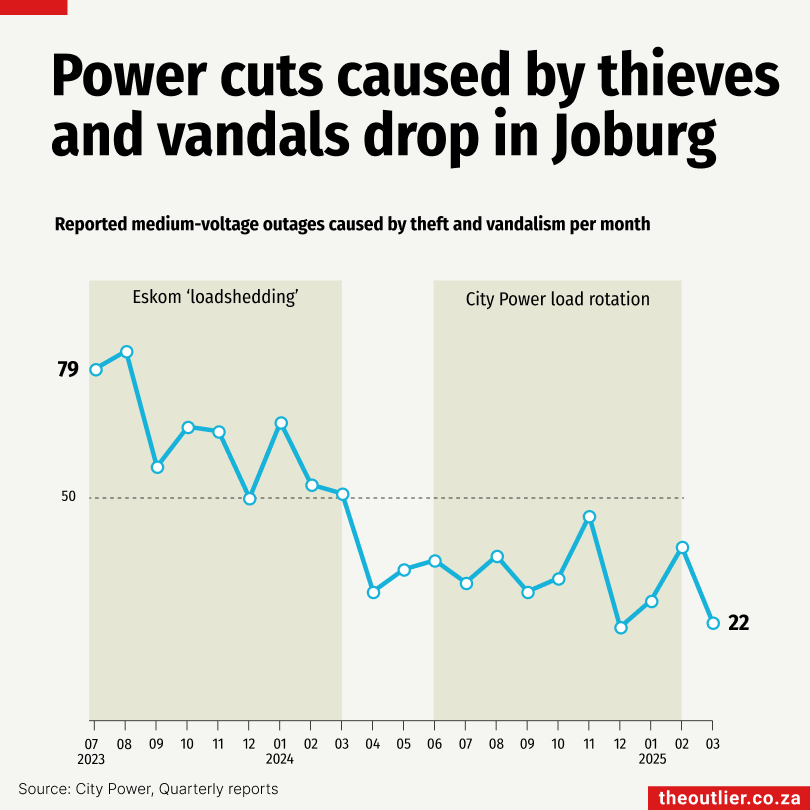
On the bright side, there has been a sharp drop in theft and vandalism-related outages on the medium-voltage network since Eskom’s loadshedding ended in March last year. In the last six months of 2023, theft and vandalism were the cause of 17% of the outages, that dropped to 9% in the last six months of 2024. Only 4% of MV outages in March this year were caused by thieves and vandals. A light at the end of that tunnel, perhaps? But it doesn’t explain why the overall number of outages on the medium-voltage networks is still rising.