The week that was in charts.
💰 Experience counts
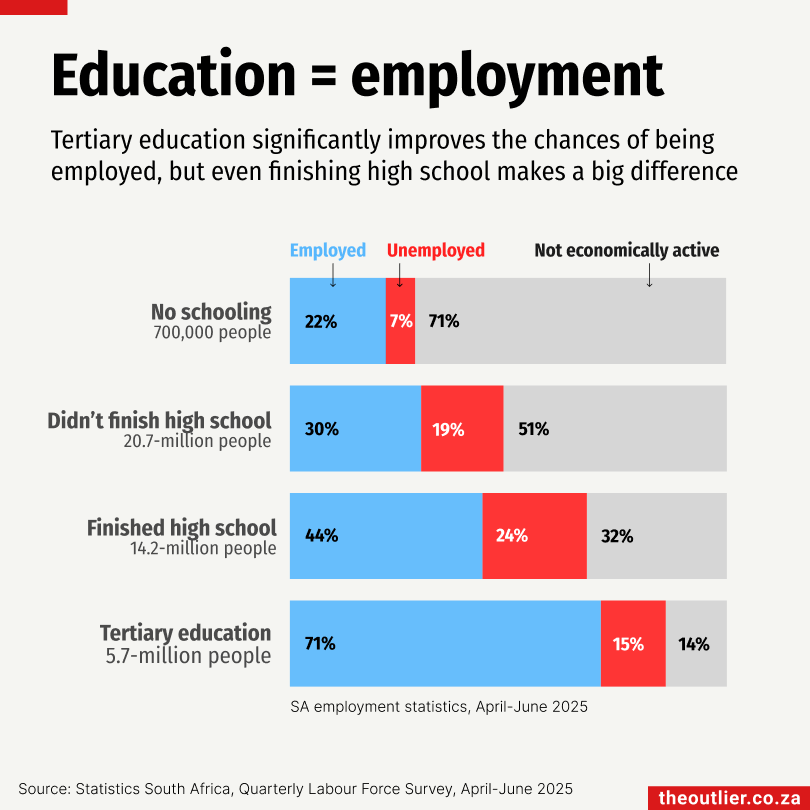
It’s a truism that education is the path to a good job. Parents save up so they can afford to pay for a child to get a degree or a tertiary qualification, so they can give them the best start in life. But when you see the employment numbers broken down by education level, the stark reality hits home. People with a tertiary education are far more likely to have a job (71%), are far less likely to be unemployed (15%) and far less likely to be ‘not economically active’ (14%).
For those without any schooling the pattern reverses completely.
People who haven’t finished high school are not only far less likely to have a job, but they are also far more likely to fall into the ‘not economically active category’. These are people who are unemployed and have not taken steps to look for work or to start a business in the four weeks before the survey was conducted and basically, they are not counted as part of the labour force.
There are a variety of reasons why people aren’t looking for work. Many are students, some are people who are ill or retired in the 15-to-64-year age range. But some are what StatsSA defines as ‘discouraged work seekers’ because they want to work, but they can’t find jobs in the area they live, or that require their skills, or, most depressingly, they have just ‘lost hope of finding any kind of work’.
Another disturbing pattern in the latest labour force survey is the number of people who are new entrants to the job market who are unemployed. There were 3.6-million new entrants among the unemployed in the latest quarterly labour force survey, which covered April to June this year. These are people who have never worked before and are currently looking for jobs. The likelihood of these people being young and looking for their first job is high.
As the population grows more young people are expected to enter the job market every year, but the proportion of new entrants in the ranks of the unemployed has increased over the past 10 years from 41% to 43%, which may not sound a lot, but it is an increase in numbers from 1.9-million to 3.6-million and is an indication that not enough is being done to create jobs for people with no work experience.

🎒 School run
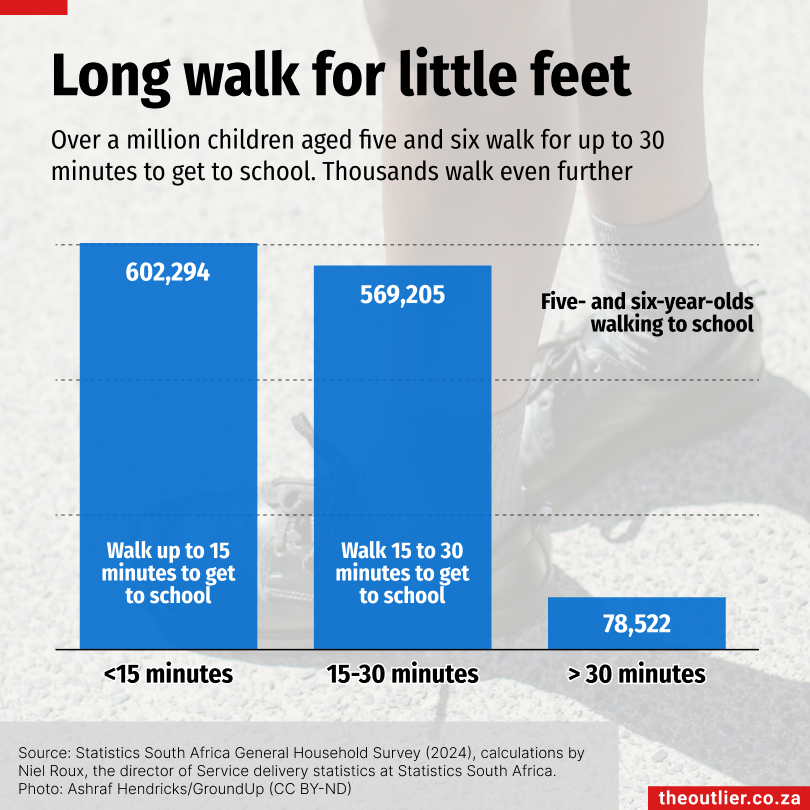
More than a million five- and six-year-olds walk to school. Nearly half (48%) walk for up to 15 minutes, and about 569,200 spend 15–30 minutes on foot. Another 78,500 walk for over half an hour, according to Statistics South Africa’s 2024 General Household Survey.
Nationally, the share of young children walking 30 minutes or more has dropped since 2010. But in Mpumalanga, it has more than doubled, from 5% in 2010 to 12% in 2023, according to a Department of Basic Education report.
For many in rural areas, these long walks remain a physically demanding and potentially unsafe part of the school day, especially where public transport is scarce and early learning centres are far from home.
▼Brought to you by our partner Electrum
📱 Buying data
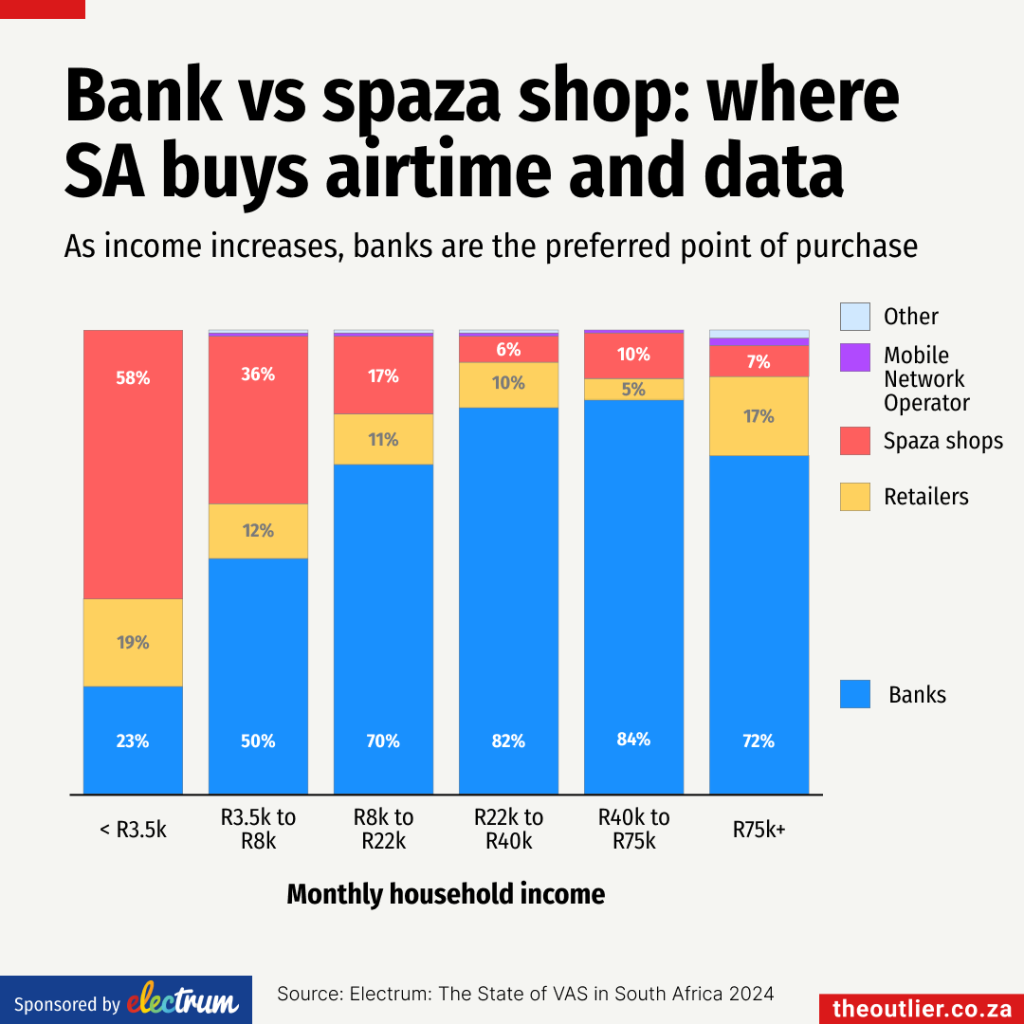
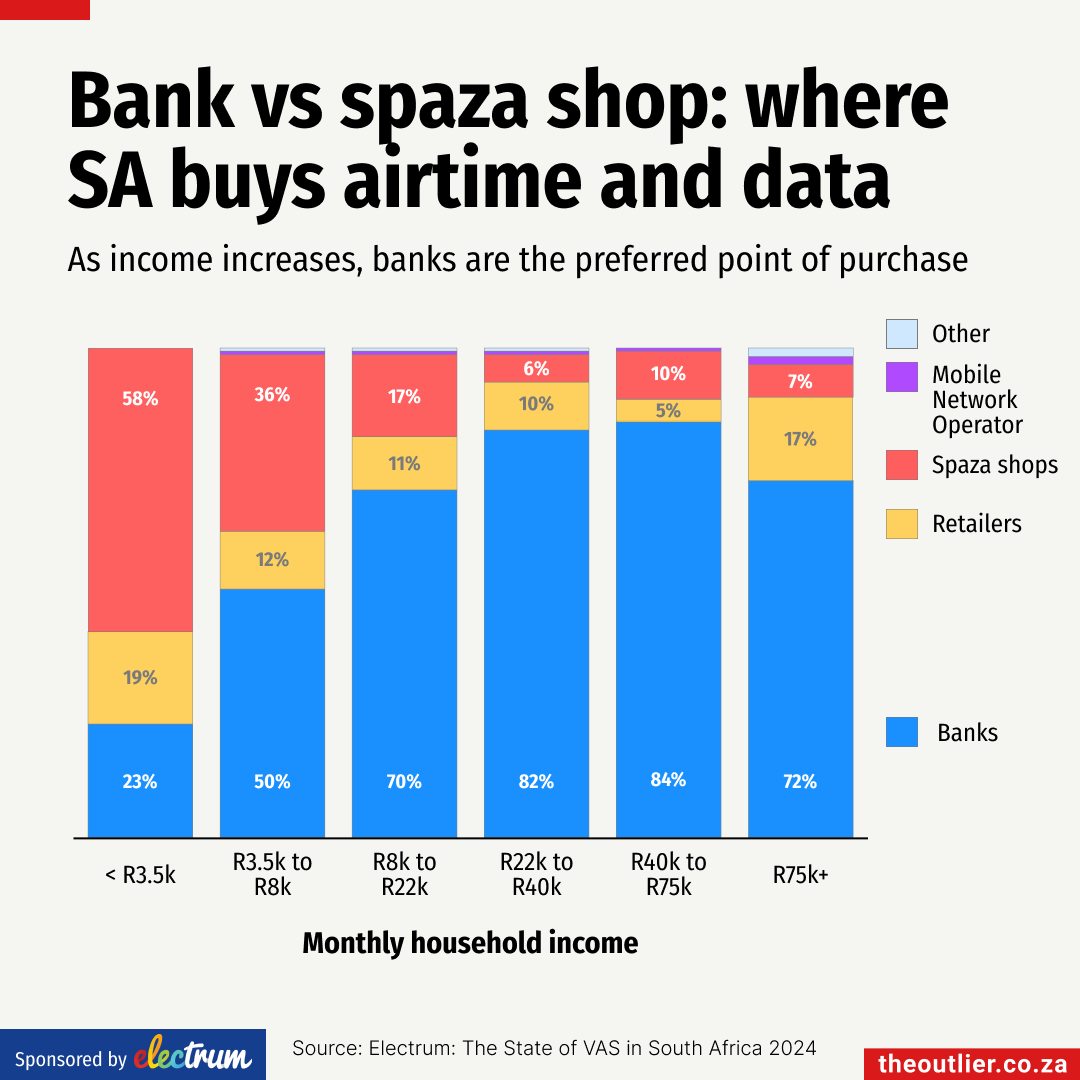
Prepaid airtime and data are the most used value-added services, with 95% of the South African population purchasing this VAS.
The majority of low-income households prefer to buy airtime and data through spaza shops.
This recent research into consumer behaviour by Electrum suggests that accessibility is a strong driver. Spaza shops have the highest daily transactions for airtime and data and they are more accessible in low-income areas than larger retailers.
In a country where mobile access is often the first and only digital touchpoint, prepaid airtime and data are no longer luxuries – they’re lifelines that support every level of human need.
The research into how South Africans purchase value-added services such as prepaid airtime and data, prepaid electricity, and betting vouchers took place in November last year. Fieldwork took place across all nine provinces, in both urban and peri-urban areas.
- Electrum is the next-generation payments software company, powering payments for banks and retailers.
🖥️ Automating work
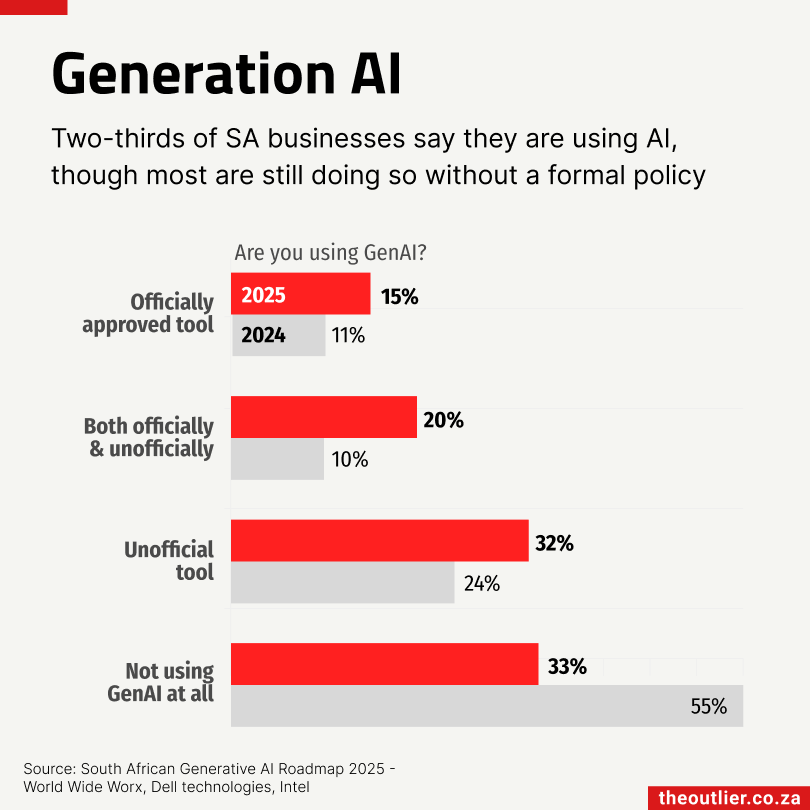
South African enterprises are integrating Generative AI (GenAI) into their operations fairly quickly, but most are doing so without formal strategies, says Arthur Goldstuck.
In the latest South African Generative AI Roadmap 2025, Goldstuck says that GenAI usage in large enterprises has increased from 45% in 2024 to 67% in 2025.
The GenAI report surveyed over 100 mid-sized and large enterprises across industry sectors
From a benefit point of view most users cited an increase in competitiveness (86%) as a reason for using AI, followed by improved productivity (83%) and enhanced customer service (66%).
But only 14% of the companies surveyed had a formal, company-wide GenAI strategy according to the report.