The week that was in charts.
💰 Bursary billions
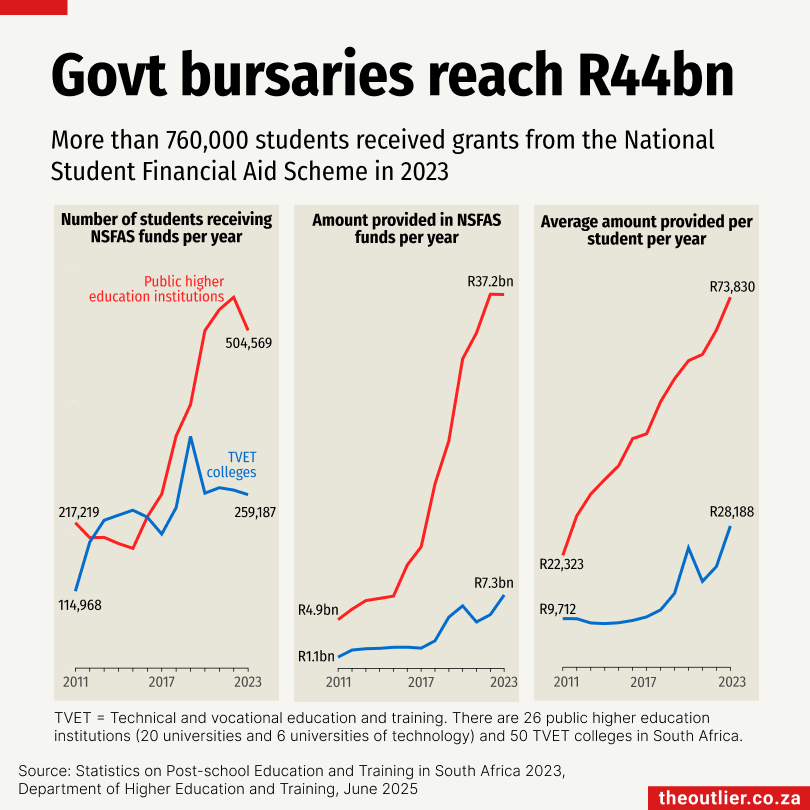
Any parent who has a child studying at university will be well aware of how expensive it is, particularly if they don’t live at home. The National Student Financial Aid Scheme (NSFAS) has provided funds to thousands of students from poor and working-class families so they get an opportunity to study at one of South Africa’s 26 public universities or 50 technical and vocational education and training colleges (TVET colleges).
In 2023 alone, more than 760,000 people received NSFAS funding, 500,000 of them women. NSFAS paid out R44.6-billion in funds that year, most of it to university students.
Nearly half (47%) of the just over a million students enrolled at public universities in 2023 were receiving NSFAS funds, according to Department of Higher Education and Training statistics.
The average bursary for a university student was R73,830, compared with R28,188 for TVET college students.
Before 2018, NSFAS funding was mostly loans, but in December 2017, then president Jacob Zuma announced that the government would subsidise higher education for students from households with annual incomes of up to R350,000. Since 2018 funding has been in the form of bursaries.
🎒 Opportunity shortfall
South Africa’s 21 Sector Education and Training Authorities (SETAs) are supposed to help workers gain new skills, grow their careers and boost productivity in sectors like agriculture, banking, energy, health, media, mining and transport, to name a few. Sounds good, right?
But the SETAs have long been plagued by inefficiency and red tape. A recent report by the Bureau for Economic Research notes that billions of rands collected for skills training are sitting idle rather than being put to use. That’s a serious problem when you consider South Africa’s youth unemployment crisis and skills shortage. SETAs should be part of the solution.
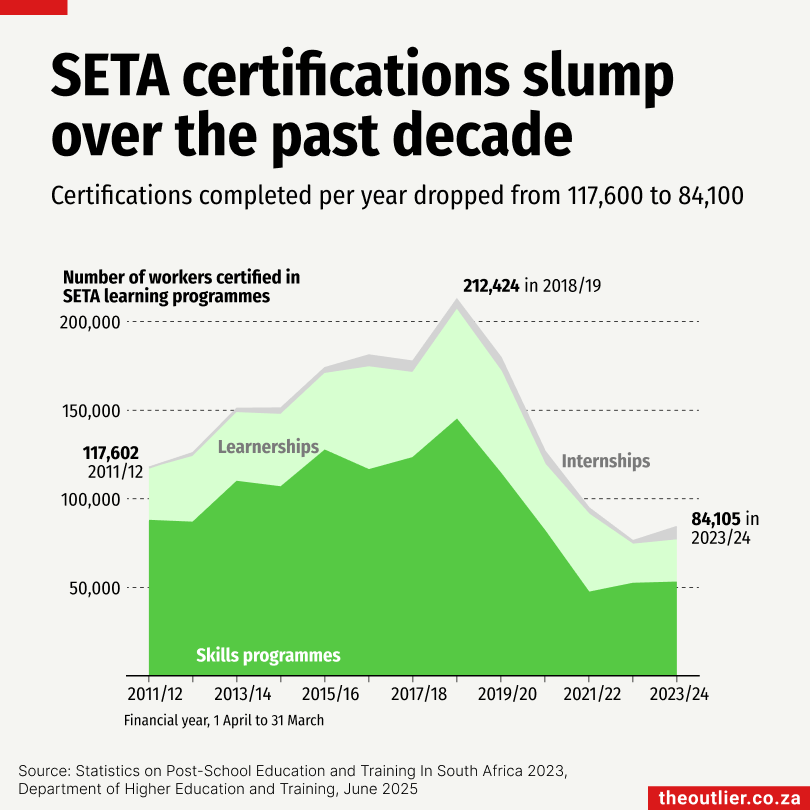
But the numbers tell a different story. Back in the 2011/12 financial year, about 135,000 people signed up for SETA learnerships, internships and skills programmes. Twelve years later, that figure had risen to about 149,000. Yet the number of people finishing their SETA programme and getting a certification has fallen from 117,600 to 84,100.
This is happening despite the SETAs being flush with cash. Employers pay 1% of their total wage bill into the National Skills Development Levy. In 2023/24, this brought in R22.4-billion. Almost R18-billion was allocated to SETAs, according to the Department of Higher Education and Training.

The government says it plans to restructure the SETAs, strengthening oversight and ensuring they deliver measurable value. On 19 August, Higher Education Minister Buti Manamela placed three SETAs under administration over governance failures and procurement irregularities.
But, as Wayne Duvenage, the CEO of anti-corruption advocacy organisation OUTA, cautions, putting a SETA under administration doesn’t “magically clean it up”.
🏉 Scrum down
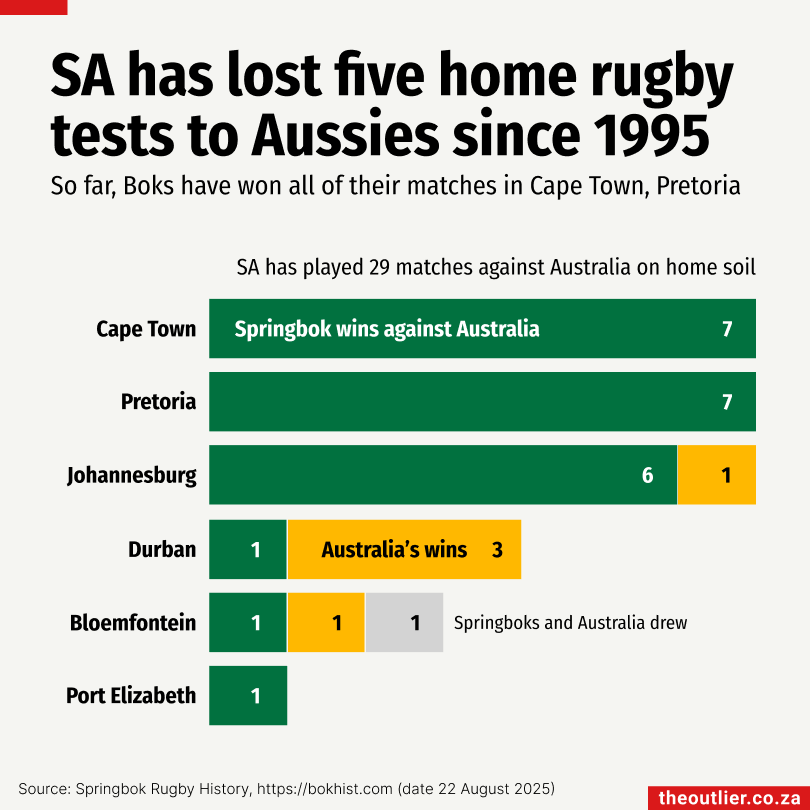
South Africa’s 16-point loss to Australia (22–38) last weekend was one for the rugby history books – and not in a good way. You’d have to go back to 2008 in Durban, when the Aussies beat the Boks 27–15, to find another defeat by that kind of margin.
Since 1995, the Springboks and Wallabies have squared off 64 times. Twenty nine of those games have been on South African turf, where the Boks usually own it, winning close to 80% of the time.
Some stadiums have been impenetrable fortresses: the Boks have never lost to Australia in Cape Town or Pretoria in the last 30 years. Last week’s clash at Ellis Park in Johannesburg marked the Wallabies’ first win there since 1995. Before that the Wallabies last beat the Boks at Ellis Park in 1963.
Durban, on the other hand, has never been the happiest hunting ground for South Africa. Against Australia, they’ve only managed one win in four matches. The last time the Wallabies beat the Boks at home was in Durban, on 13 August 2011, when they won 14–9.
Bloemfontein has been a mixed bag for the Boks. When the Boks faced the Australians there on 30 September 2017, they drew 27-27.
Despite their recent Ellis Park loss, when the Boks do beat Australia on home soil, they tend to win by a wider margin.

🖥️ AI jobs-apocalypse?
If you’re an interpreter, writer, customer service rep, or data scientist, you may want to pay attention. A recent study by Microsoft Research found that these are the types of jobs that most people now consult AI tools about.
An analysis of 200,000 conversations with Microsoft Bing Copilot found that information gathering, writing, and communicating are the most common user goals for AI assistance. The study looked at three variables for jobs to predict how ‘applicable’ AI would be to replace these roles: coverage (how many of the tasks in a particular job could be done by AI), scope (how many hours of a work day could AI cover) and completion (how well could AI complete tasks) to come up with a composite score.
Perhaps unsurprisingly the jobs deemed the ‘most at risk’ by the study were those that entailed knowledge work or communication, which is very much the domain of large language models (LLMs). Jobs that involved more manual labour or a human touch scored very low on the replacement score.
There are many caveats with the study, like it just studied a single LLM and is based on what users are asking for help with. But that’s maybe also the point: these are the kinds of help users are going back to AI tools for, so perhaps we need to pay attention.

🔗 All References for this newsletter