The week that was in charts.
💳 Big deal
The payments space in South Africa is particularly dynamic at the moment. A couple of weeks ago Nedbank announced the purchase of iKhokha for R1.65-billion. And a few months before that Lesaka Technologies, which owns Kazang, announced the purchase of Bank Zero for R1.1-billion.
Most of this activity is being driven by an interest in the previously unbanked sector and particularly the small and medium-sized spaza shop networks.
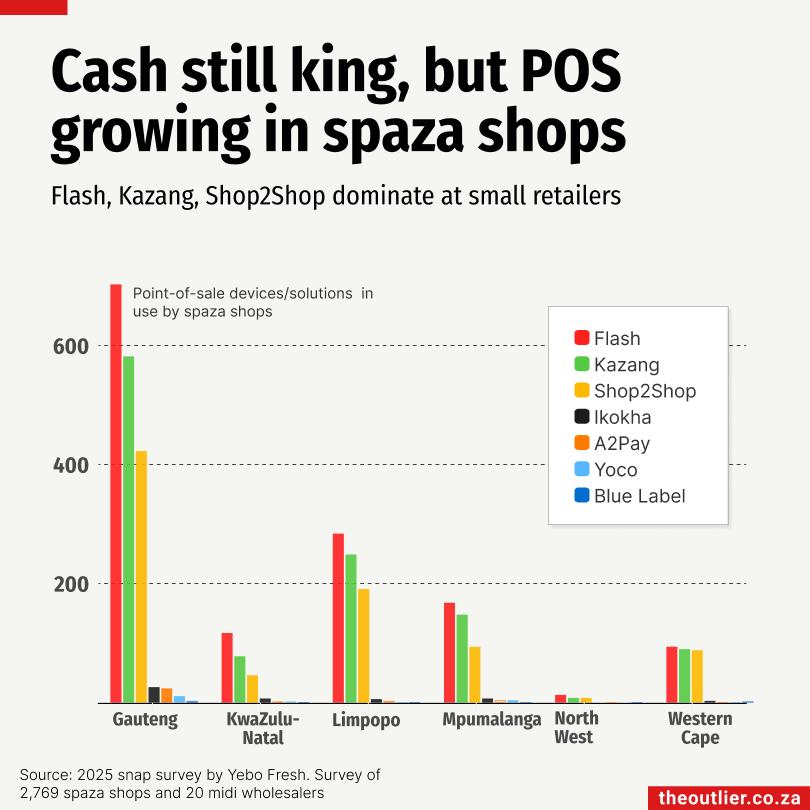
A recent snap survey of spaza shop operators by Yebo Fresh found that while cash is still king, most operators are now using one or more point-of-sale devices. The research focused on 2,769 spazas and 20 midi wholesalers. The midi wholesalers mostly supply the spaza shops.
The larger businesses tended to use more devices while smaller shops used fewer. Average usage ranged between 1.4 and 2.1 devices per shop.
The most dominant systems are Flash, Kazang, and Shop2Shop. Shop2Shop was used universally in midis. Other solutions include Blue Label, Yoco, Ikokha, and A2Pay.
Regional trends show Flash dominating across provinces, with more shops surveyed in Gauteng, but the Western Cape was found to have the highest average number of devices per shop.
💸 Not going postal
In our new partnership with GroundUp we looked at where South Africa’s 12-million social grant beneficiaries collect their grants.
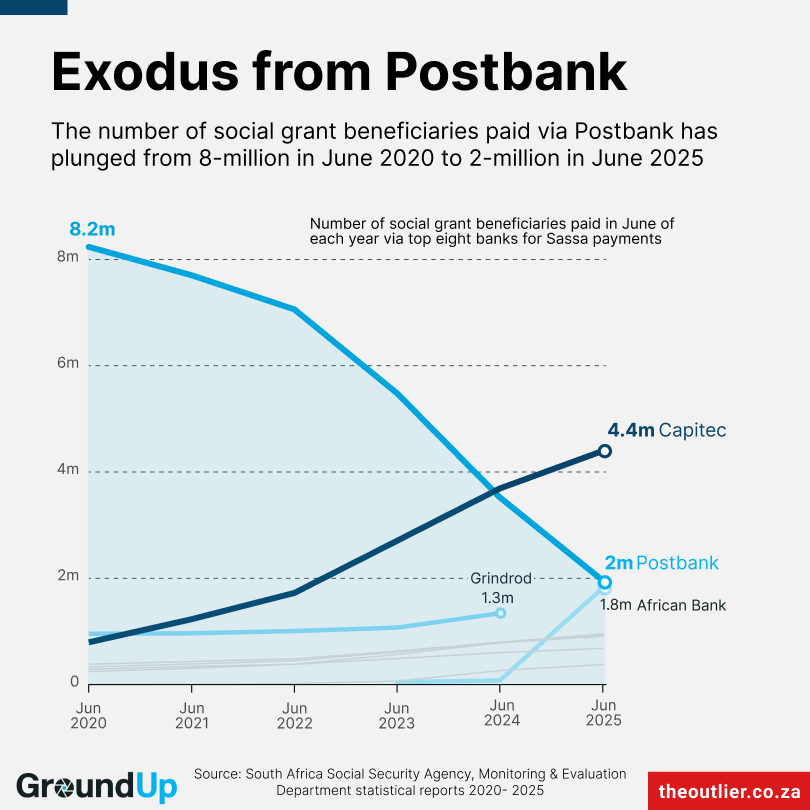
Postbank, once championed as a no-fee banking alternative for social grant recipients, has lost about 75% of its social grant customers in the past five years.
After the South African Social Security Agency (SASSA) ended its unlawful contract with Cash Paymaster Services for the payment of social grants in 2018, the South African Post Office (SAPO) took over.
Postbank, a subsidiary of SAPO, stepped in to administer payments to newly issued SASSA-branded bank cards, which provided social grant beneficiaries with a no-fee alternative to private banks.
But a series of events has caused an exodus from Postbank and an increase in social grant beneficiaries relying on private banks.
From at least 2022 onwards, customers experienced periodic payment delays, due to cyber attacks and other technical problems.
Postbank was issued notices by the SA Reserve Bank in 2021, 2022 and 2023 to replace all SASSA Gold Cards with new Black Cards that have improved security features.
But it was only in 2024 that a concerted campaign started to swap Gold Card users to the new cards by March this year.
This caused chaos across the country as millions of people rushed to switch their cards. The process was slow and marred with difficulties. The deadlines kept shifting, until Postbank finally announced that the Gold Card would keep working beyond 31 May.
The deadline has now been extended by another 15 months, with about 450,000 people still needing to switch to Black Cards.
SASSA has terminated its Master Service Agreement with Postbank, which will come to an end on 30 September.
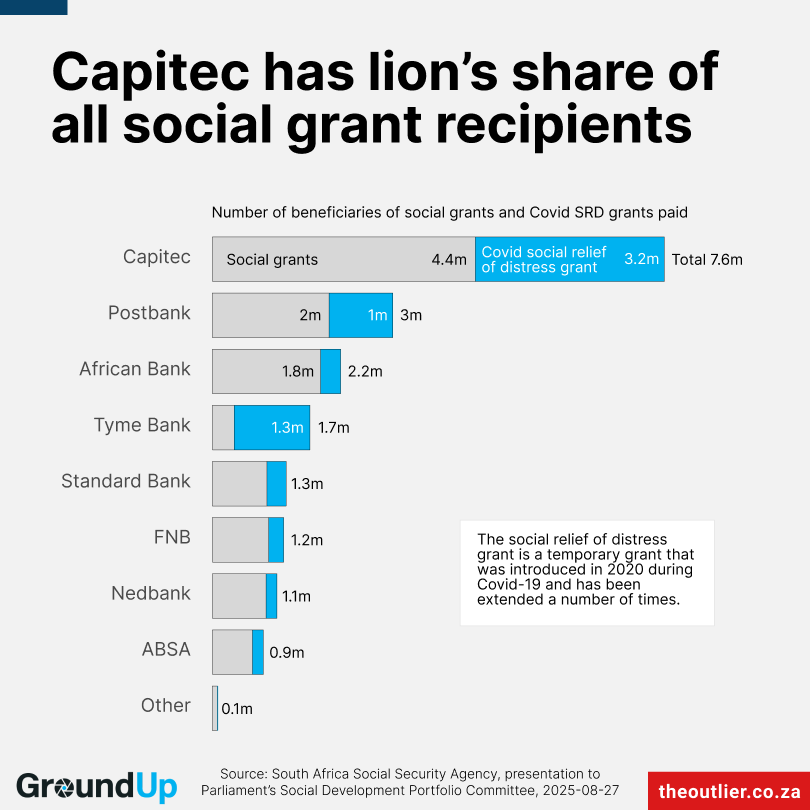
Capitec has become the bank of choice for grant beneficiaries. 7.6-million people collected their grant money from Capitec in June 2025 – that’s 40% of the combined total of 19-million people who received government grants that month: 12-million received a social grant (eg, child support, old-age or disability grants), and 7-million received social relief of distress grants, according to SASSA statistics.
🪣 Dripping away
This week we also started working with Our City News, a new publication which will focus on the city of Johannesburg, something we have long needed.
Over the coming weeks we will be producing charts for the Our City News team. You can find out more about the project here.
Also, please subscribe to the Our City News newsletter for updates.
One of the issues we looked at this week was the ongoing water problems in Johannesburg.

Johannesburg is leaking water. In its latest annual report (which covers the 2023/24 financial year), Johannesburg Water, the city’s water and sanitation utility, revealed there were 402 pipe bursts for every 100km of pipe – or roughly one burst every 250 metres.
It’s the city’s second-worst year for pipe bursts in a decade. The culprit? Ageing infrastructure.
Those bursts come at a high price. The city lost R2.1-billion worth of water to leaks and bursts in 2023/24 alone.
Johannesburg Water is replacing pipes, but progress is slow. Only 17km of pipes were replaced last year and 19km in 2022/23. This is a sharp drop from the 100km replaced in 2021/22.
All references for this newsletter: 🔗 References