🏦 Banks
South Africa is dominated by five major banks: Absa, Capitec, FNB, Nedbank, and Standard Bank.
Whether it’s where your salary lands or where you swipe your card, these five banks dominate South Africans’ financial lives. But they differ sharply in how they serve and employ the country.
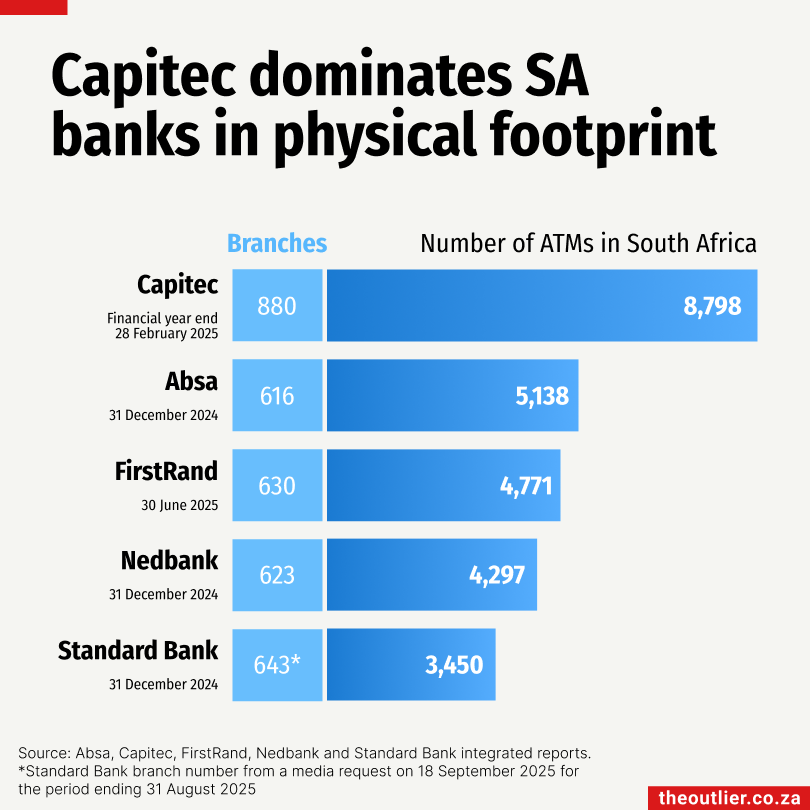
Capitec has the largest customer base at 24-million people. It also has the largest physical footprint with 880 branches and 8,798 ATMs.
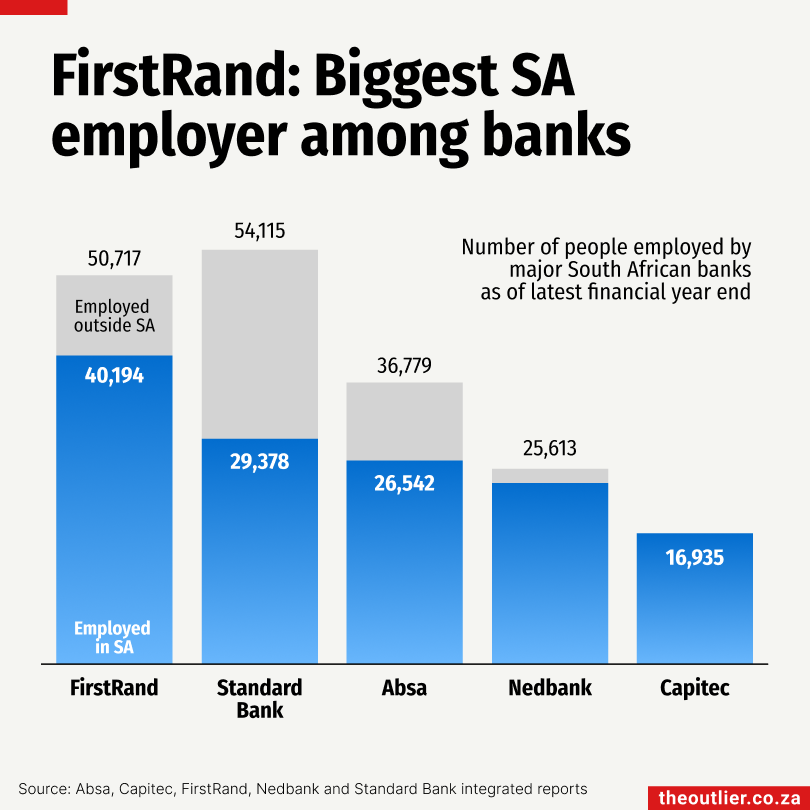
Despite its huge client base, Capitec employs the fewest number of people of South Africa’s major banks at 16,935.
On the other hand, FirstRand, which owns FNB, is South Africa’s biggest domestic banking employer (40,194), though Standard Bank employs more people overall.
Standard Bank operates in 26 countries and has 19.6-million customers. Of that number, almost two-thirds (12.4-million) are in South Africa. The bank with the smallest customer base is Nedbank at 7.6-million people, but just because it has the smallest customer base does not mean it has the lowest physical footprint. Nedbank has 623 branches and 4,297 ATMs.
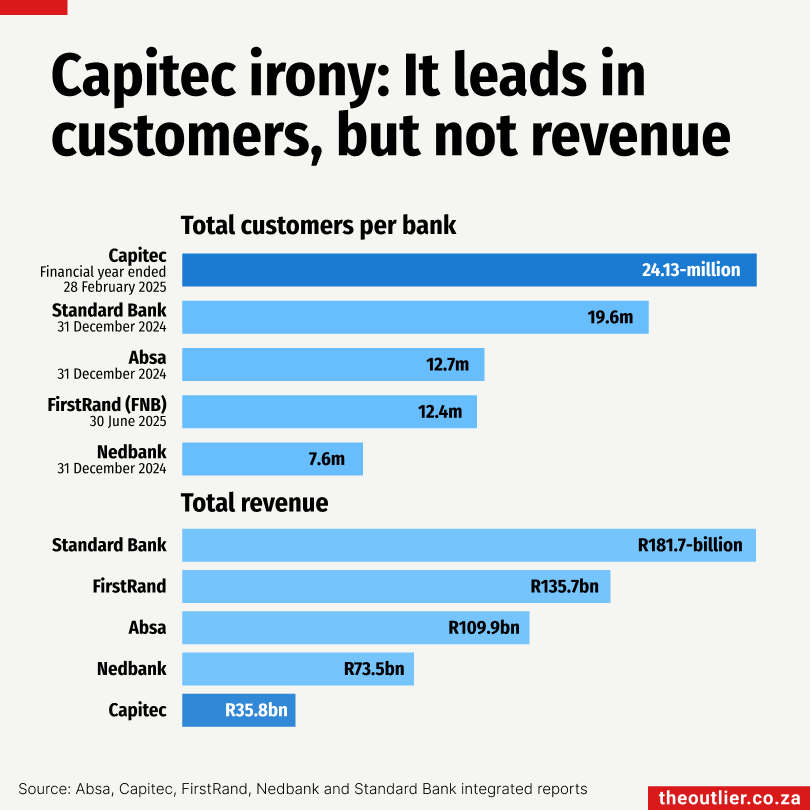
Of these banks, Standard Bank recorded the largest revenue at R181.7-billion, followed by FirstRand at R135.7-billion and Absa at R109.9-billion. Capitec brought in the least at R35.8-billion. But it’s also the youngest of the established banks, having launched in 2001 compared to FNB’s 1838 origins and Standard Bank’s 1862 founding.
📱 Buying data
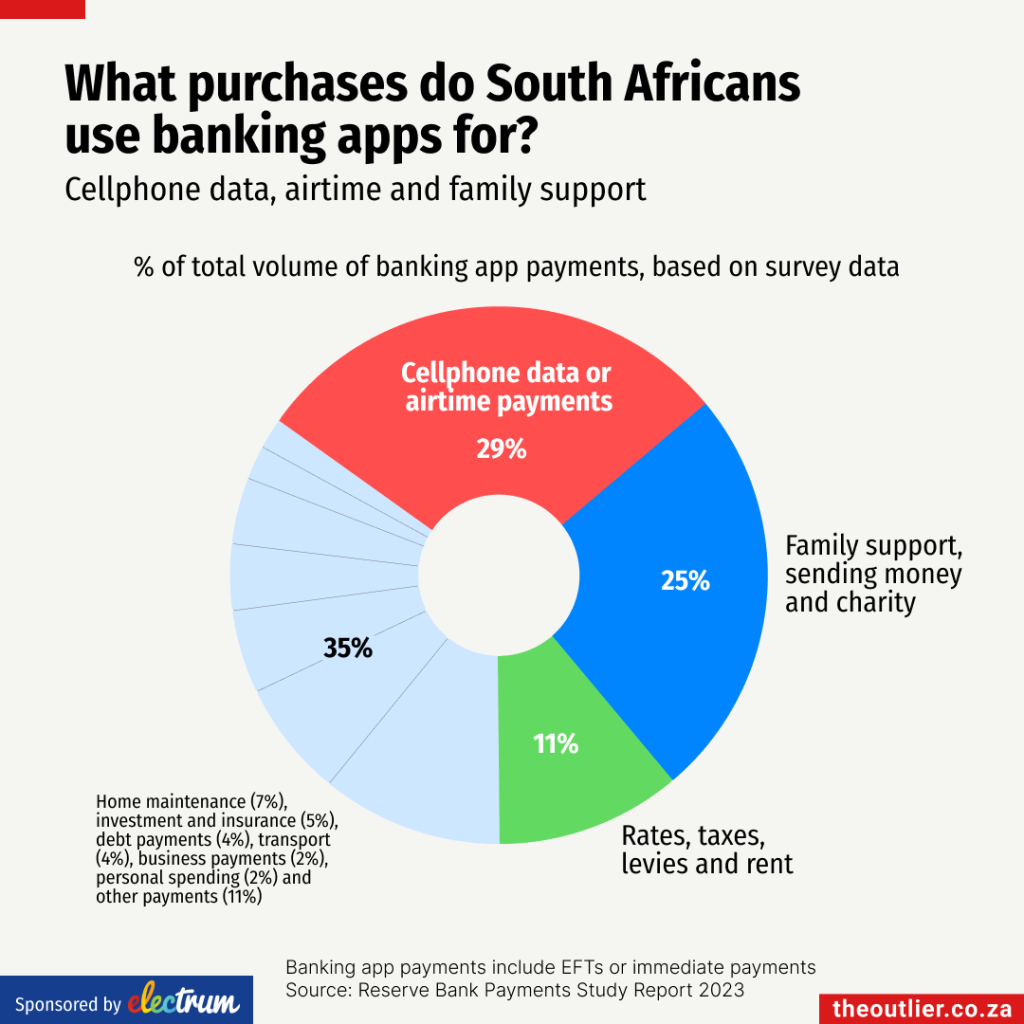
Cellphone data or airtime payments are the most common purchases South Africans make through banking apps, according to the latest South African Reserve Bank Payments Study, based on two 2023 surveys of 7,000 people. These small but frequent payments were an average of R136.
The report noted that while this might seem like a “basic” use of a sophisticated tool, “banking apps are a convenient way to top up on data or airtime”.
Sending money to family or charities was the second most common use (25%), with an average transaction value of R830.
Banking apps weren’t commonly used to pay for groceries or restaurant bills. But people did use them to make larger monthly payments for rates, taxes, levies and rent (11%). These payments averaged at R2,080.
Business payments, primarily made by self-employed individuals, were among the least common (2%), but had the largest average payment at R5,474.
- Produced by The Outlier in partnership with Electrum, the next-generation payments software company, powering payments for banks and retailers.
🍃 Wind advantage
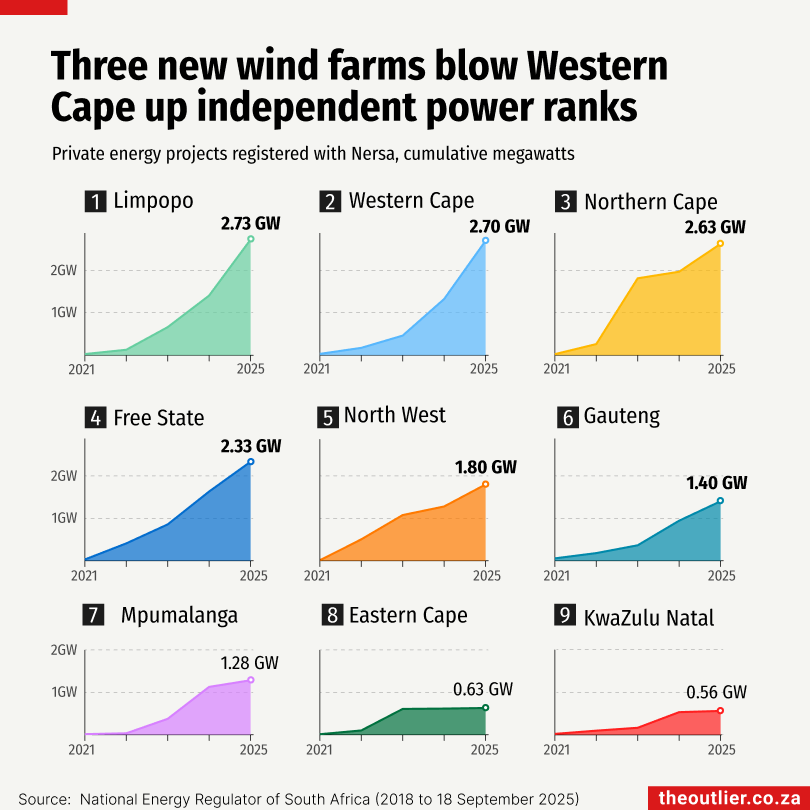
The Western Cape has climbed to second place for megawatts registered by private companies, according to the National Energy Regulator of South Africa (Nersa) up to mid-September 2025. In just two months, three big wind farms in Beaufort West and Laingsburg added 600MW, bringing the province’s total to 2.7GW.
It’s part of a bigger trend. South Africa’s largest planned wind farm, the 380MW Fe Overberg near Swellendam, was registered in the Western Cape in August 2024. Three 240MW Red Cap Nuweveld projects in the Upper Karoo, Western Cape, were registered in April and May 2025.
Limpopo remains in first place with 2.73GW, thanks to several large solar projects registered earlier this year. The Northern Cape, once the leader, has slipped to third (2.63GW), hampered by grid constraints that are discouraging new large-scale projects.
🛤️ Transnet’s load
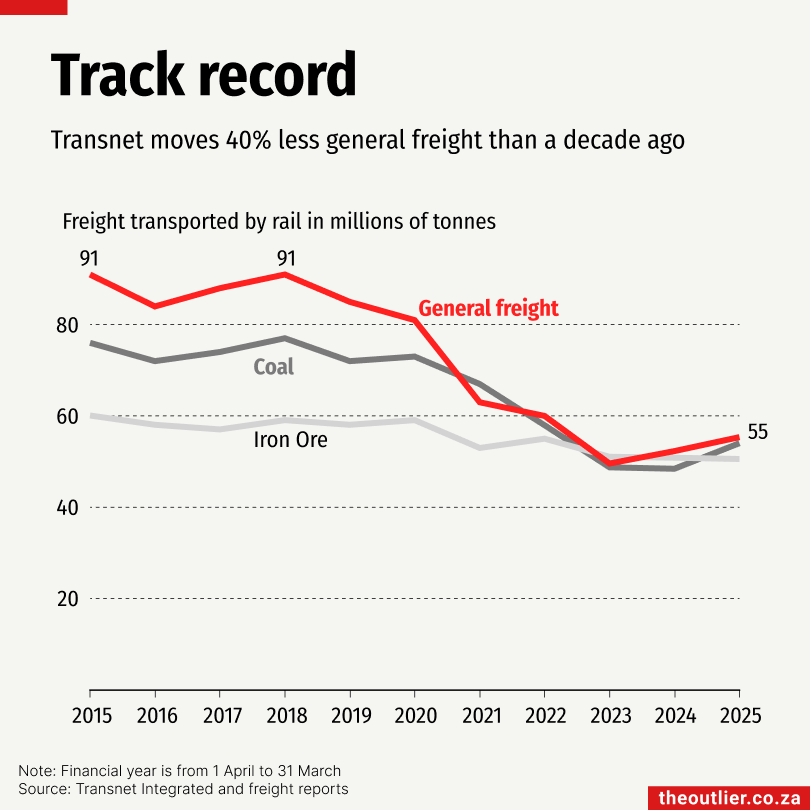
The collapse of South Africa’s freight rail network has placed a significant strain on the economy, forcing goods that should move quickly and efficiently by rail onto congested roads. Theft of electric cables has been a major driver of the crisis. In 2025 alone, Transnet said its teams had to replace 700km of stolen cable.
In 2015, Transnet moved 227-million tonnes of freight, but by 2023, this had dropped to 150-million tonnes. By 2025, volumes had recovered slightly to 160-million tonnes, but that’s still nearly a third lower than a decade ago.
General freight, which includes all goods except iron ore and coal, has been hardest hit, dropping by 40% over the past decade from 91-million tonnes to 55-million tonnes. Coal transport has also fallen by 30% since 2015.
To improve the situation, Transnet has opened its rail network to private companies, with the aim of increasing volumes to 250-million tonnes a year by 2029.
🚝 Passenger rail gets back on track, slowly
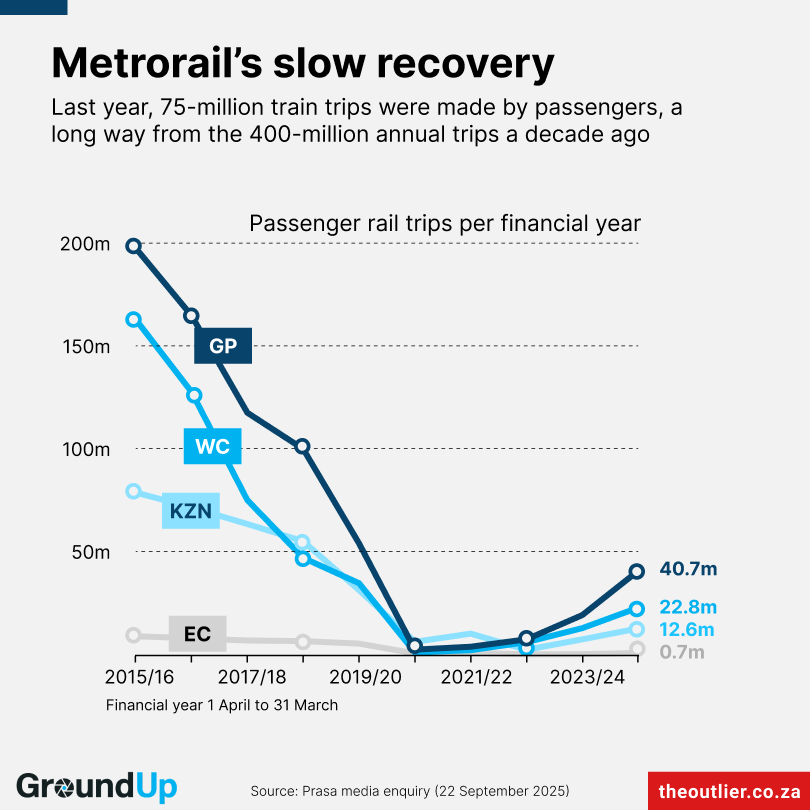
By 2021, the Passenger Rail Agency of South Africa (Prasa) had collapsed. As corruption and mismanagement took hold over the previous ten years, the rail service became increasingly unreliable and unsafe. Almost all of Prasa’s customers stopped using the train in this period, many opting for more expensive but reliable taxi and bus services.
Infrastructure decayed without being maintained or replaced. Security contracts were allowed to lapse, leading to widespread vandalism. The covid pandemic saw the final destruction of the rail service.
Since then, there has been some improvement. Rail lines have been restored, new trains have been procured, and more people are taking the train.
But there is still a long way to go. Prasa has not received a clean audit opinion since 2016. It has recorded irregular expenditure of between R1-billion and R6.5-billion a year over the past three years. And some lines and stations, especially in the Eastern Cape, are yet to be brought back to service.