🚚 Township economy
For years, the township economy was largely ignored in South Africa’s economic story. But that’s changing, and everyone from policymakers to banks is starting to pay attention to township economies with real growth potential. After all, townships are where roughly a third of South Africans live and trade.
Township trade isn’t just a ‘side-hustle’, it is estimated to be worth anywhere between R200-billion and R900-billion annually, depending on the sources you use. What is for sure is that it is a network of entrepreneurs, traders, and small business owners who keep communities running, create jobs, and circulate cash long before it reaches the formal sector.
A recent Standard Bank report is the latest attempt to understand this often overlooked sector of the economy.
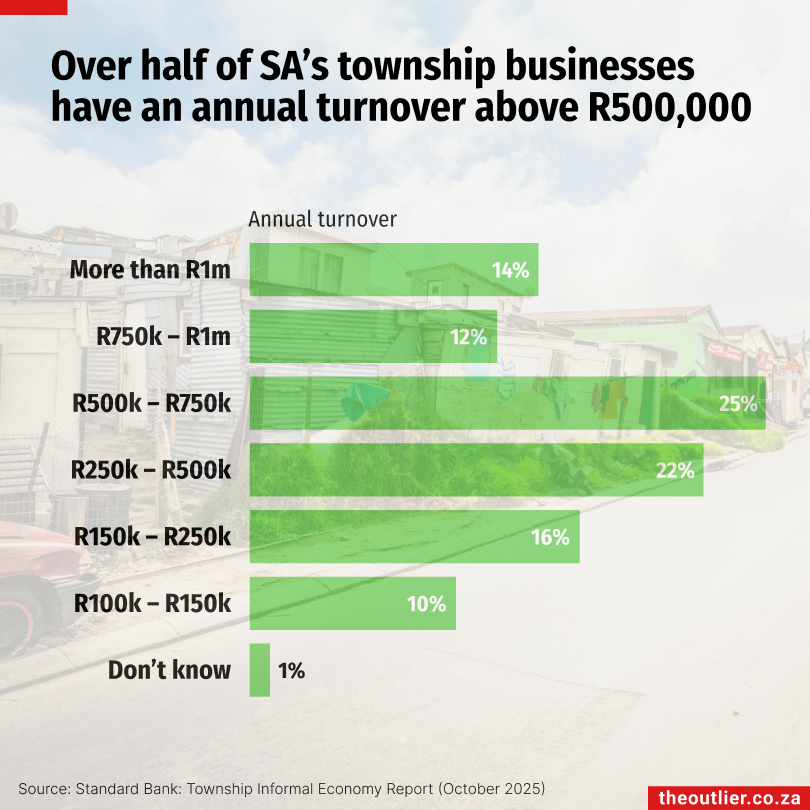
The report, based on a survey of 250 township businesses, found that while many businesses had relatively low revenues, around 25% of the operators reported turnover of between R500,000 and R750,000 a year. And 14% of businesses reported a turnover of more than R1-million.
The survey underpinning the report was conducted between March and May 2025 and covered businesses ranging from micro enterprises to small businesses.
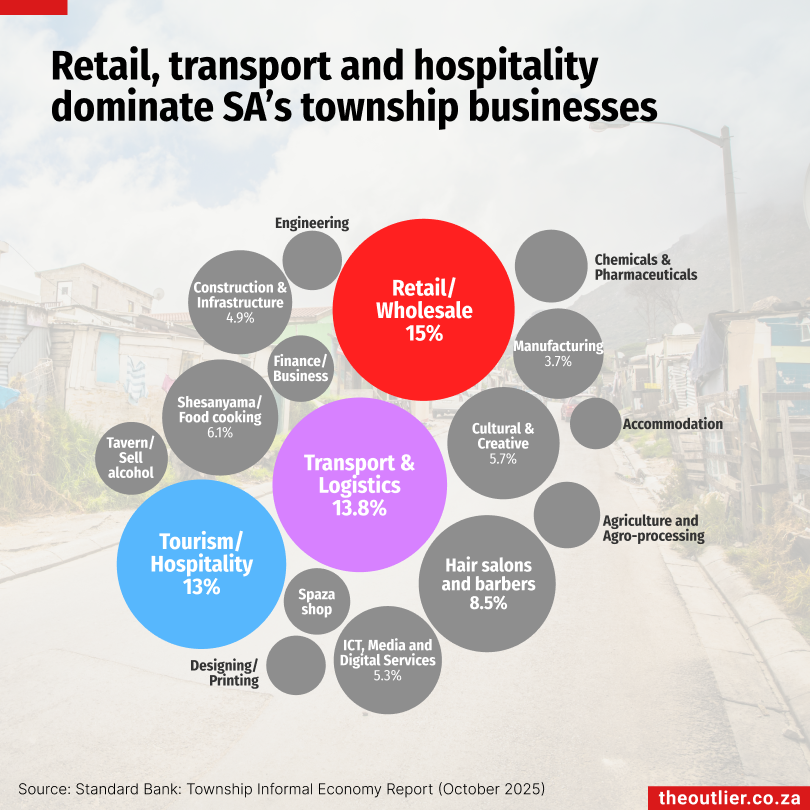
At the heart of township economies are retailers and wholesalers, followed by transport and logistics businesses like taxis and delivery services that keep things and people moving. The third largest sector is tourism and hospitality.
Together, these three sectors account for nearly half of all township businesses. Around them, smaller clusters are emerging in construction, creative industries, ICT and digital services and even agriculture.
There is a catch though: 80% of these businesses are unregistered, locking them out of funding, contracts, and formal supply chains. Many also compete in overcrowded markets with razor-thin margins, where survival depends on hustle, not scale, and where the barriers to entry are low, so competition is high. But even while the market is crowded, these entrepreneurs are filling the gaps that big business ignores.
🥬 Food prices
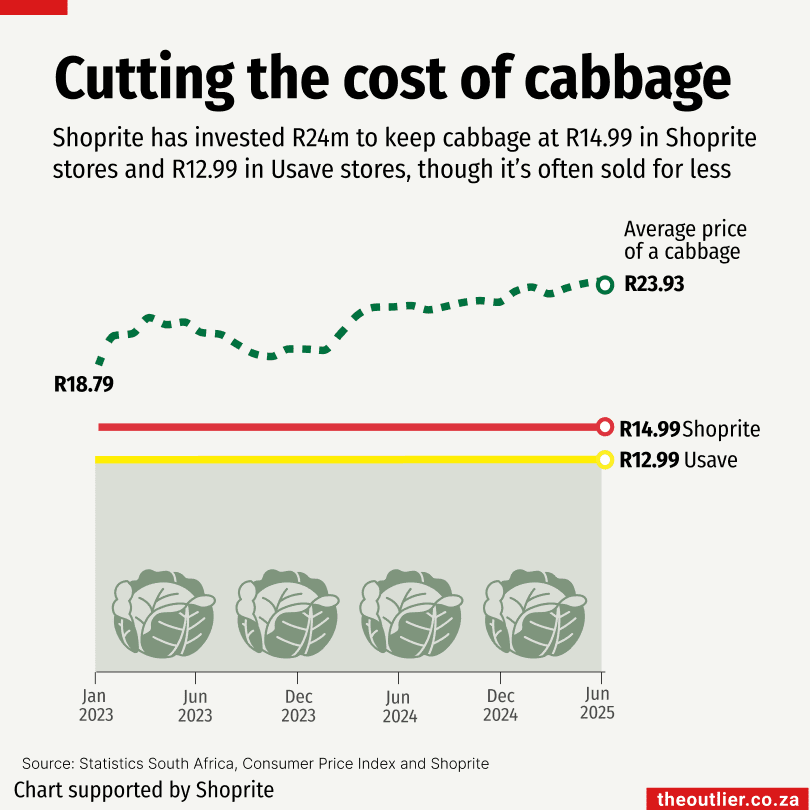
For millions of South Africans, cabbage is a daily staple that’s filling, packed with nutrition and affordable. In 2024, South Africa produced more than 160,000 tonnes of cabbage for the formal market – and far more if informal and smallholder production is included. Fuel, fertiliser, water shortages and transport challenges have driven prices up, making it harder to afford for the families who rely on it most. The Shoprite Group has been investing millions of rands to keep cabbage affordable. Between June 2024 and July 2025, the group spent R24-million to subsidise the price of cabbage for its customers by absorbing costs and capping prices at a maximum of R12.99 in Usave and R14.99 in Shoprite supermarkets – although prices in stores may vary by region and are often lower. It is an investment in food security, dignity and health, says the Shoprite Group.
- Produced by The Outlier in partnership with the Shoprite Group.
🗳️ Who’s your mayor?
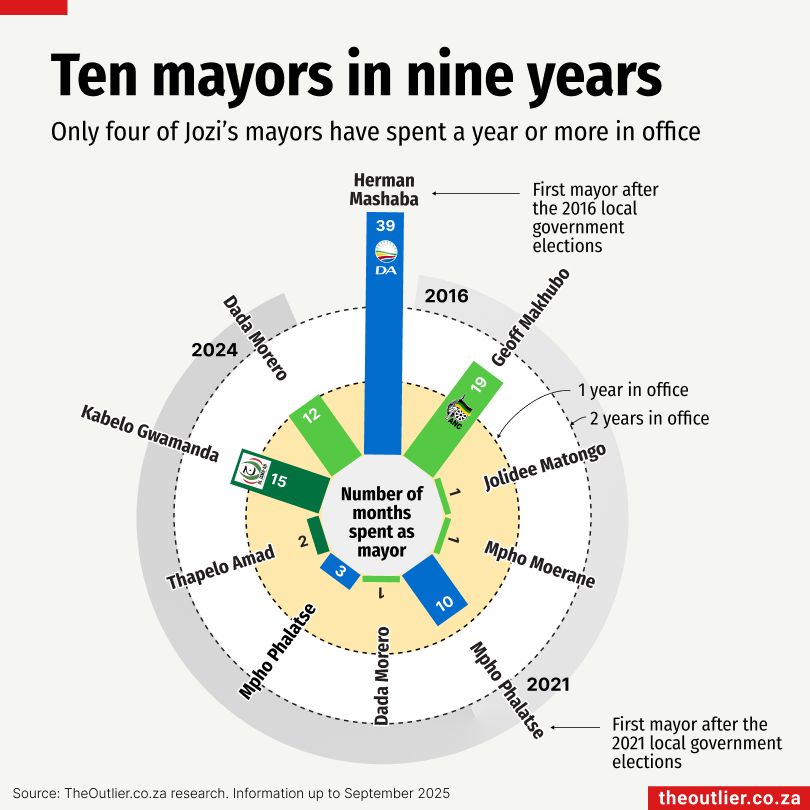
Johannesburg has had 10 mayors in nine years. It’s a revolving door of leadership that leaves the city politically unstable as services rapidly deteriorate and the city looks dirty and neglected.
No mayor has served a full five-year term since the 2016 elections, and only four have spent a year or more in office.
The longest-serving mayor since the 2016 elections was Herman Mashaba, then a member of the Democratic Alliance. He was in office for just over three years, but in October 2019, he left the DA after clashing with the party’s national leadership and stepped down as mayor at the end of November.
The ANC’s Geoff Makhubo replaced him, but had served for only 19 months when he died of Covid-19 in July 2021. Jolidee Matongo (ANC) took over, but he died in a car crash after just a month in office. Mpho Moerane (ANC) briefly held the post until the local government elections in November 2021.
After that election, the DA’s Mpho Phalatse became mayor with the support of a DA-led coalition. Then began a series of power shuffles.
First, Phalatse was ousted in a disputed motion of no confidence and was replaced by the ANC’s Dada Morero in October 2022. She was reinstated by the Johannesburg high court – only to be voted out again three months later.
Al Jama-ah’s Thapelo Amad followed in January 2023 when an ANC-led coalition, which included the EFF, decided to put forward a candidate from a minority party. Amad resigned two months later, just before he was due to face a motion of no confidence. Another Al Jama-ah member, Kabelo Gwamanda, took over, but he resigned in August 2024.
The ANC’s Morero returned to the mayor’s office and has held the seat for just over a year.
⚡️ Lost in transmission
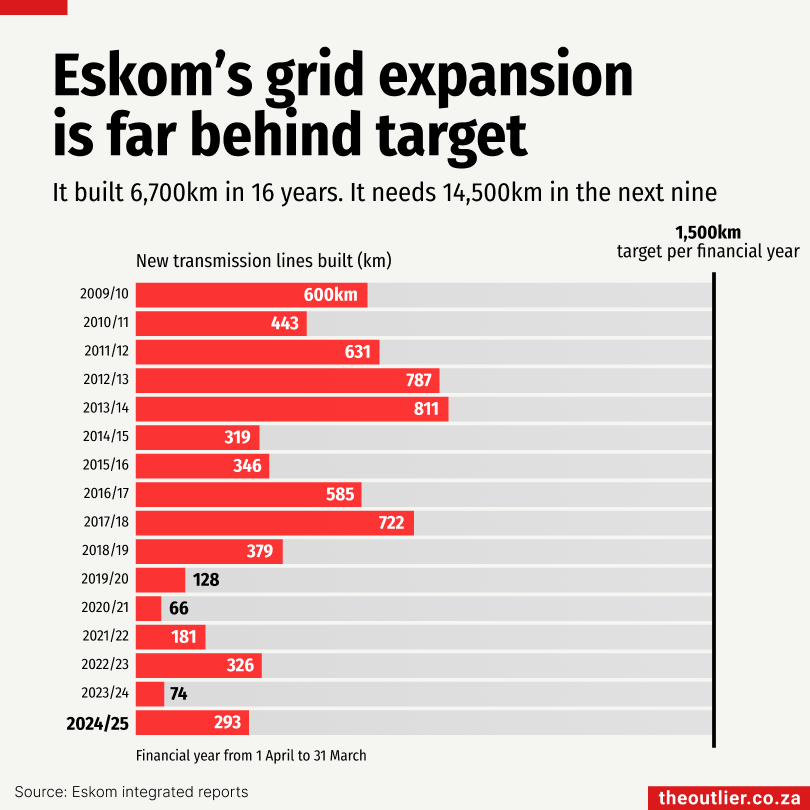
Eskom installed 293km of transmission lines in 2024/25. It is almost four times more than the 74km built in the previous financial year, but far below what’s needed to expand South Africa’s electricity grid and connect new power projects.
The National Transmission Company of South Africa (NTCSA) has a plan to build 14,500km of transmission lines by 2034 to “unlock grid capacity for new generation”. This is roughly equivalent to 1,500km per year. In the past five years, only 940km of transmission lines were installed.
In the short term, the utility aims to add 2,600km over the next three years, focusing on the Western, Eastern and Northern Cape provinces, as well as Mpumalanga. South Africa’s grid currently spans 33,367km.
Click here for a link to all references for this newsletter.