🎰 Wager nation
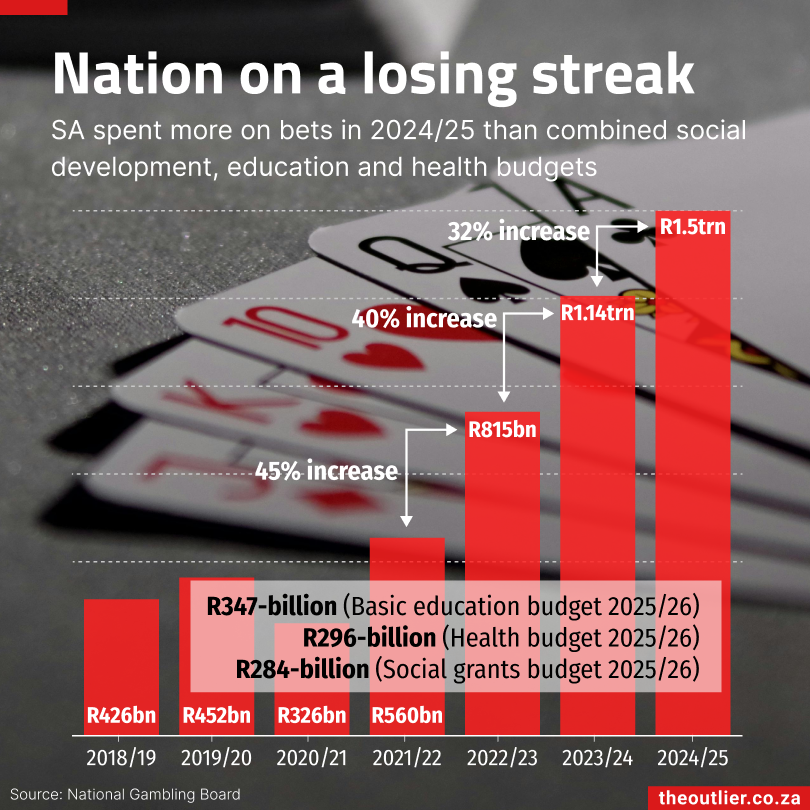
South Africans are gambling staggering amounts of money, and it’s growing fast. The latest National Gambling Board report shows that in the 2024/25 financial year, a total of R1.5-trillion was wagered across all forms of legal gambling. That’s not the total lost, it’s the amount spent placing bets, much of it recycled through repeated wagering.
To put it in perspective: that figure is higher than the combined national budgets for health, education, and social grants. It’s an eye-watering level of gambling activity for a country grappling with unemployment and poverty.
Most of this explosion comes from sports betting, which now dominates the market. Of the R1.5-trillion total, about R1.13-trillion, or three-quarters, came from betting on sports and horse racing. Casinos accounted for just under 20%, with the rest from bingo and limited-payout machines.
In just five years, total gambling turnover has multiplied several times over, driven by online and mobile betting platforms that make it effortless to wager again and again.
📱Going digital
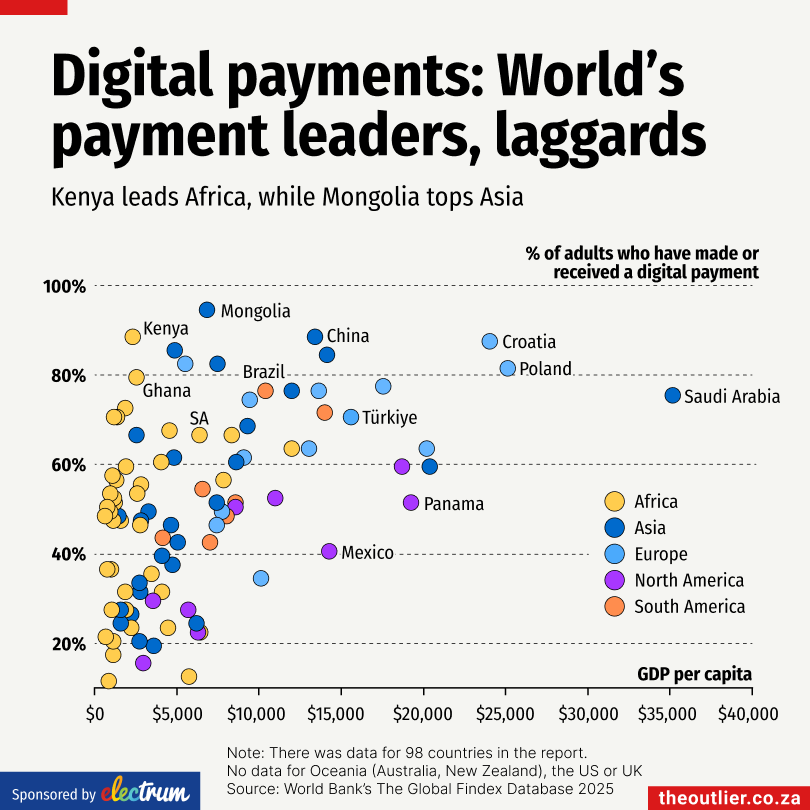
In Africa, 21 countries reported that over half of their adult population had made or received a digital payment in 2024, according to the World Bank’s Global Findex 2025 report. The report defines a digital payment as any payment sent from or received in a bank, financial institution, post office, or through a mobile money account.
Digital payments are not only safer than cash, but they can also help small-scale merchants access credit. The report notes that digital payments help merchants “by giving them real-time records of cash flows they can use to support loan applications aimed at funding working capital or job creation”.
Kenya leads the continent, with 89% of adults using digital payments, compared to South Africa’s 67%. Interestingly, Mauritius, which has continent’s highest GDP per capita, had only 64%, while Malawi, with one of the lowest GDPs per capita, had 49% adoption. While higher GDP per capita generally supports digital payment adoption, Africa shows some exceptions, with some lower-income countries leading the way, most likely due to the high use of mobile money transfer services, such as M-Pesa.In Sub-Saharan Africa, 27% of adults said they still pay with cash because they are accustomed to it, and 8% said their merchants only accept cash. “Digital payments cannot replace cash payments until merchants and other payment recipients operate in a supportive business environment, with affordable and reliable access to a digital ecosystem,” the report found.
Globally, over 60% of adults in low- and middle-income countries made or received at least one digital payment. That is up from 34% a decade ago.
- Produced by The Outlier in partnership with Electrum, the next-generation payments software company, powering payments for banks and retailers.
☀️ Future power
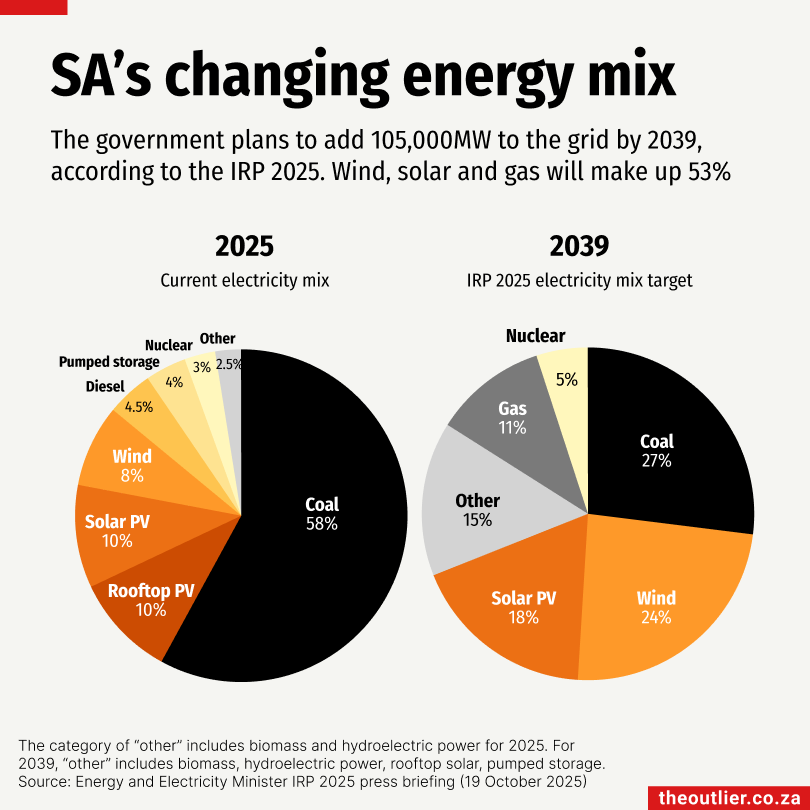
South Africa plans to add 105GW of new power to the grid by 2039, according to the new Integrated Resource Plan (IRP 2025). Almost a third of that will come from wind, and nearly a quarter from solar. Gas, storage and nuclear will fill in the rest.
It’s a big goal. Right now, South Africa’s total generation capacity is around 54GW. That’s the maximum we can produce under perfect conditions.
If the plan comes together, total capacity would rise to almost triple current levels over the next 14 years, with a massive shift away from coal (down from 58% to 27%). Wind and solar would take centre stage, and gas would become a key new player, making up 11% of the mix.
Together, wind, solar and gas could supply more than half of South Africa’s electricity by 2039, a very different grid from the one we have today.
The planned 105GW energy additions will include:
| Type | Capacity |
| Wind | 34GW |
| Solar PV | 25GW |
| Gas | 16GW |
| Distributed generation | 16GW |
| Energy storage | 8.5GW |
| Nuclear | 5.2GW |
🍲 Scraping the bowl
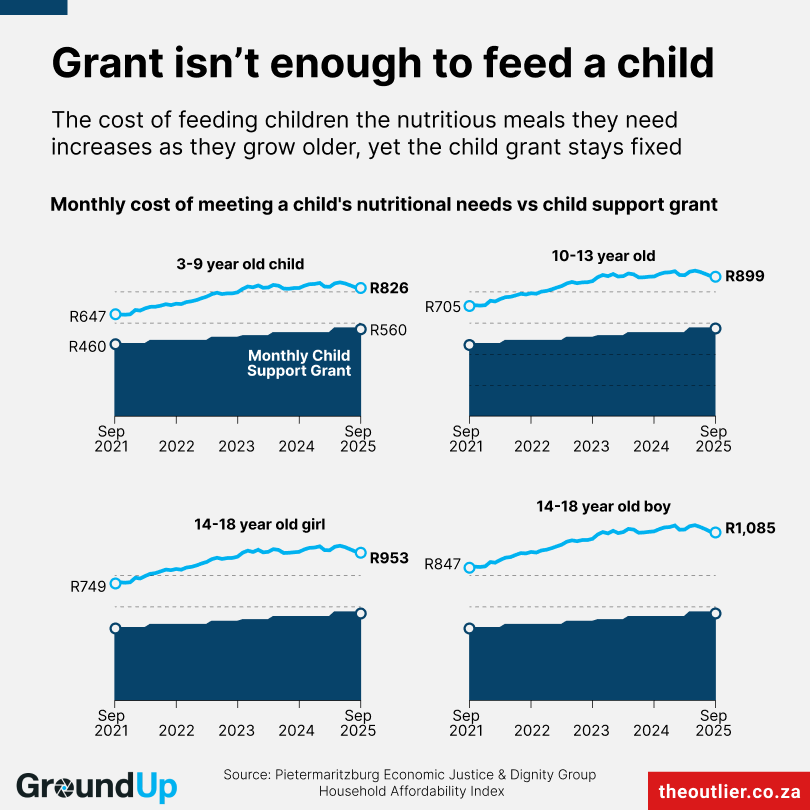
The cost of meeting a child’s nutritional needs varies between R826 and R1,085 a month, depending on the age, according to the Pietermaritzburg Economic Justice and Dignity Group (PEJDG). [GroundUp story]
This is significantly more than the Child Support Grant, currently valued at R560 a month. More than 13-million children receive this grant. Children are eligible for the grant if their caregiver earns less than R5,600 a month. The official food poverty line is R796 per person per month.
A silver lining is that the prices of foods included in PEJDG’s calculation have stayed stable over the past year, while the Child Support Grant has increased by R30.
Child hunger is a growing issue in South Africa. According to one estimate, food insecurity affects over 60% of households in the country, and about a quarter of children in South Africa are stunted due to malnutrition. A parliamentary question revealed last year that about 1,450 children under the age of five died of acute malnutrition in 2023.
Click here for a link to all references for this newsletter.