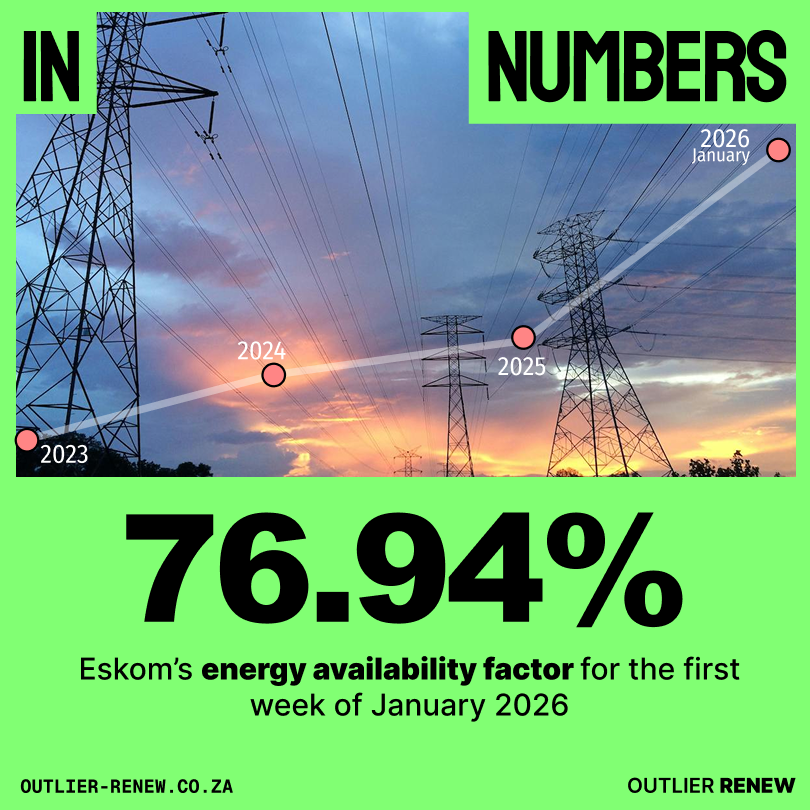
This week we’re looking at Eskom data. The utility has started off the year well, with its energy availability factor improving from 54.69% in 2023 to 62.44% in 2025. This year it’s averaging 73.21%, but that’s only for the first two weeks, there’s another 50 to go.
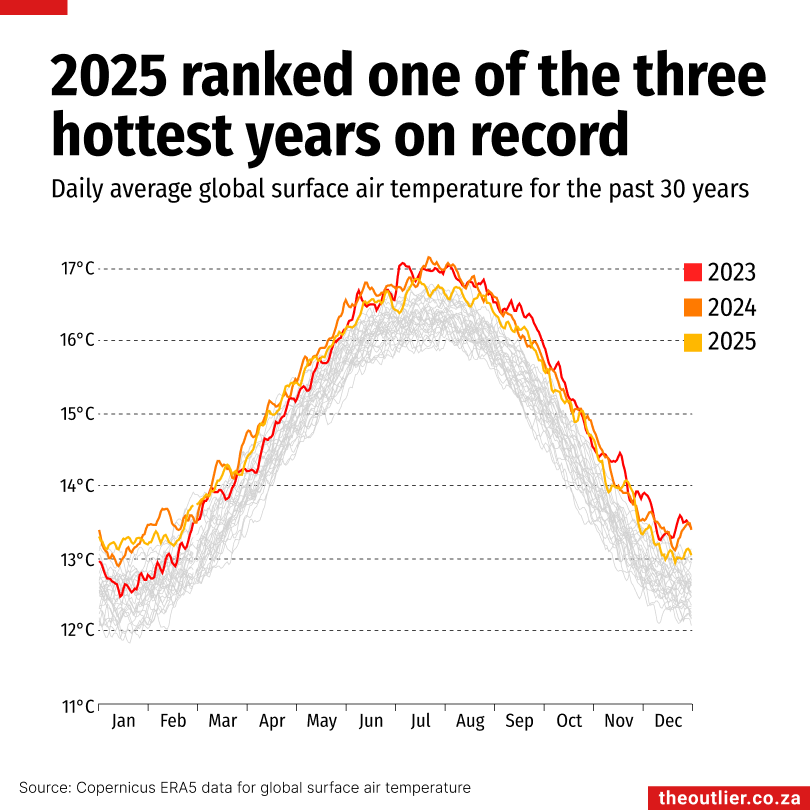
South Africa’s coal power plants are performing better than they have in years. On the one hand, that’s a good thing because no loadshedding. On the other, there’s carbon emissions. Last year was the third-hottest year on record, according to temperature data released by three independent agencies. Do we really need more fossil electricity on the grid?
We also looked at how much renewables have been contributing to the national grid each year since 2016 – data that Eskom publishes. Plus we asked Eskom about curtailment.
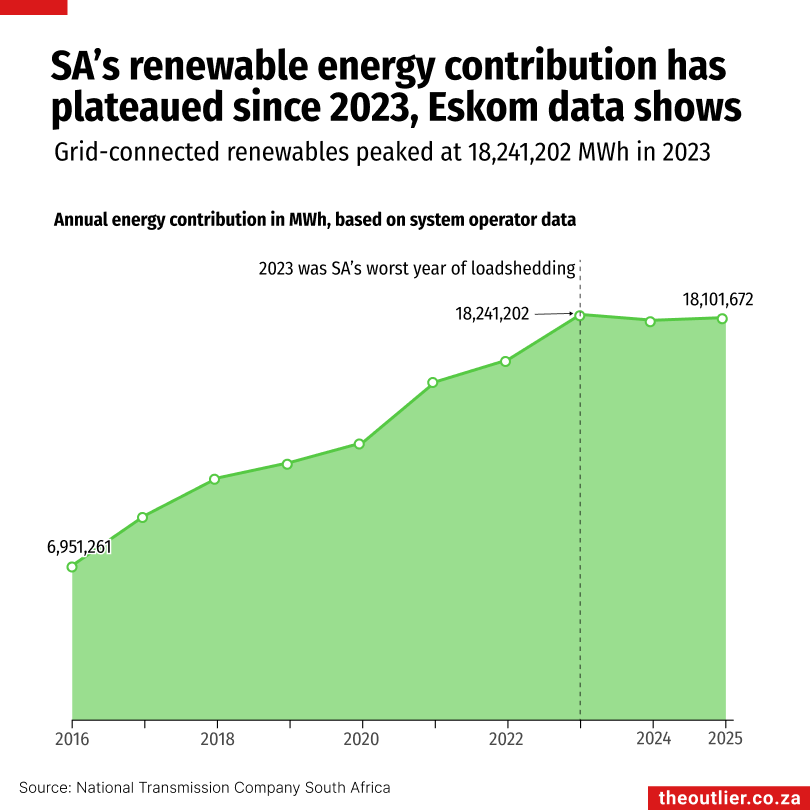
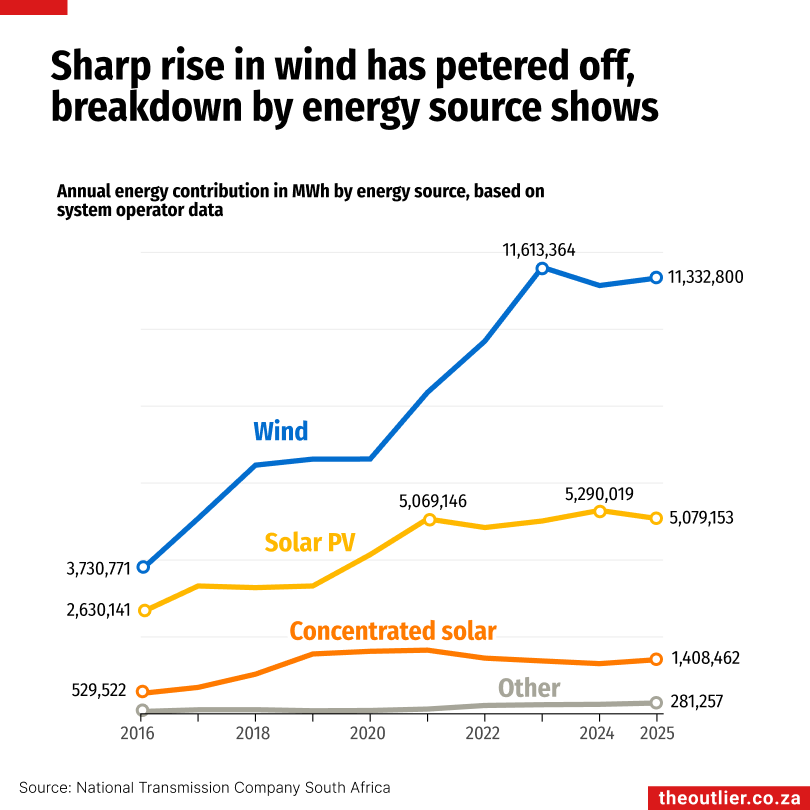
Renewable energy’s contribution to annual generation hasn’t grown since 2023
With many utility-scale projects starting to operate in the past few years, we assumed the annual contribution of renewables on the grid would be increasing. We looked at the stats in Eskom’s latest status update report and they show that the total annual energy contribution increased steadily until 2023 (which was the worst year of loadshedding), but has remained pretty much the same since then.
We asked Eskom why.
Demand for electricity had decreased due to the “uptake of behind-the-meter PV”, Eskom says. That’s the off-the-grid solar installations that households and businesses (commercial and industrial) have installed over the past few years.
In its weekly system update reports Eskom estimates that rooftop solar PV has increased from 2,574.3 MW of installed capacity in December 2022 to 7,463.6 MW in December 2025 – a 190% increase in three years.
There’s more behind-the-meter solar now than there is grid-connected renewable capacity – which totalled 7,098.3 MW at the end of 2025, according to Eskom. In December 2022 there was 6,280.2 MW, so that’s grown by 13%.
The off-the-grid installations have reduced the demand for power from the national grid during the day but they have not reduced the demand over morning and evening peak periods, says Eskom.
This means dispatchable generators, predominantly coal need to generate over these peak periods, it says.
“Coal-fired generators take many hours to shut down and start up, making it impractical to shut them down during the low-demand periods in the early hours of the morning and during the middle of the day,” says Eskom.
“In contrast, the renewable generation can be shut down and started up rapidly (depending on solar and wind conditions), allowing the system operator to maintain the stability of the power system.”
In the 2024/2025 financial year, it was necessary to curtail renewable generation 43 times, which equated to about 155 GWh. In the 2025/2026 financial year-to-date, renewables have been curtailed 103 times, equating to about 463 GWh, said Eskom.
We asked Eskom if grid capacity has been an issue. They responded that there had been “localised curtailment of renewable generation due to network capacity constraints, [but] the energy associated with this curtailment has been low”.
Eskom added that the system operator “strives to minimise the amount of renewable generation curtailed by shutting down the appropriate amount of coal-fired generators and maximising the flexible pumped storage and hydro generation.”
NEWS WRAP
☀️ Swartland Municipality in the Western Cape wants to procure renewable energy via a 20-year power purchase agreement from an independent power producer. The municipality is looking for 10 MWp of photovoltaic solar. It has designated 30 hectares of land in Malmesbury for the generation facility. An RFP will be issued in March/April.
☀️ Spark Energy Services has secured financing for a solar and storage project at Bushvalley Chickens, a large poultry producer in Limpopo. Developed with New Southern Energy, the second phase of the project adds 2.7 MWp of solar PV and a 7.2 MWh battery to an existing 2.5 MWp plant completed in late 2024. The system is expected to cut electricity costs by nearly 30%, saving around R2.1-million a year.
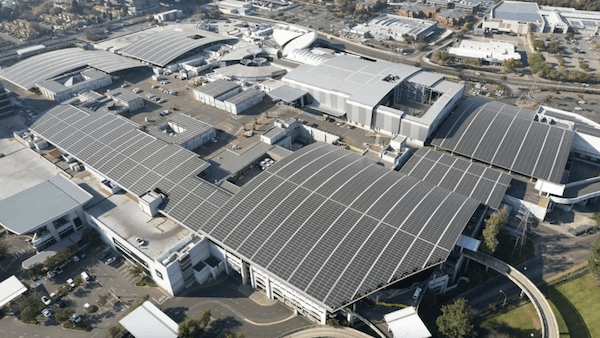
🏢☀️ SA’s largest rooftop solar installer was founded after two brothers came up with the idea of buying solar panels at a braai in 2010. By the end of 2025, Solareff had installed 279 MWp of solar panel capacity and more than 47 MWh of battery energy storage systems. Four of the five largest rooftop solar installations in the country were installed by Solareff, including the 7.2 MWp installation at the Eastgate shopping centre in Gauteng (below). Read the full profile.
🥵 2025 was one of the three hottest years on record, even though the year began and ended with a La Niña event, which typically has a cooling influence. Scientists expect 2026 to be similarly warm.
🔌 Is Eskom prepared to tolerate competition? This question was raised this week by energy analyst Chris Yelland who wrote that even though Eskom said it had paused its legal challenge against Nersa’s granting of energy trading licences to five private electricity traders, proceedings in court appear to tell a different story. In response, Eskom issued a statement saying it had “no intention of restarting or escalating litigation” and that it “supports the reform of South Africa’s electricity market, welcomes competition, and remains committed and is participating alongside other traders in the process to develop trading rules”.
EVENTS
🎤 Engineering News’ two-part series on SA’s energy outlook for 2026 kicks off on 28 January with a look at sustaining reform momentum in the sector. Part two will be held on 3 February and will discuss investment in SA’s electricity transmission grid.
🔋 Solar & Storage Live Africa returns to the Gallagher Convention Centre from 25 to 27 March. The exhibition will feature more than 650 solution providers showcasing technologies across solar generation, energy storage, power electronics and smart energy systems. Alongside the exhibition will be a three-day conference. Outlier Renew is a media partner for the event. To register to attend the exhibition and conference for free you can register here.
⚡️The Africa Energy Indaba will be happening at the Cape Town Convention Centre on 3 – 5 March.