Earlier this week we hosted the first of our Out to Lunch webinars for the year. We couldn’t have chosen a better guest for the first one of the year in Dr Martin Gustafsson, a renowned education researcher and advisor. Martin was generous with his time and knowledge and he challenged many of the common assumptions around education in South Africa based on currently available data and his own research. More than anything though he demonstrated the power and importance of data in understanding education in SA. 👇 Read on below for some of his insights into the key issues and challenges. Outlier members (not yet a subscriber?) can watch a full recording of the webinar.
In this week’s newsletter:
- African startups in 2025
- Shoprite’s rooftop solar rollout
- 2025 among hottest years on record
- Murders on the Cape Flats continue to climb
- SA schools are not producing enough quality maths students
📚 Series A-frica
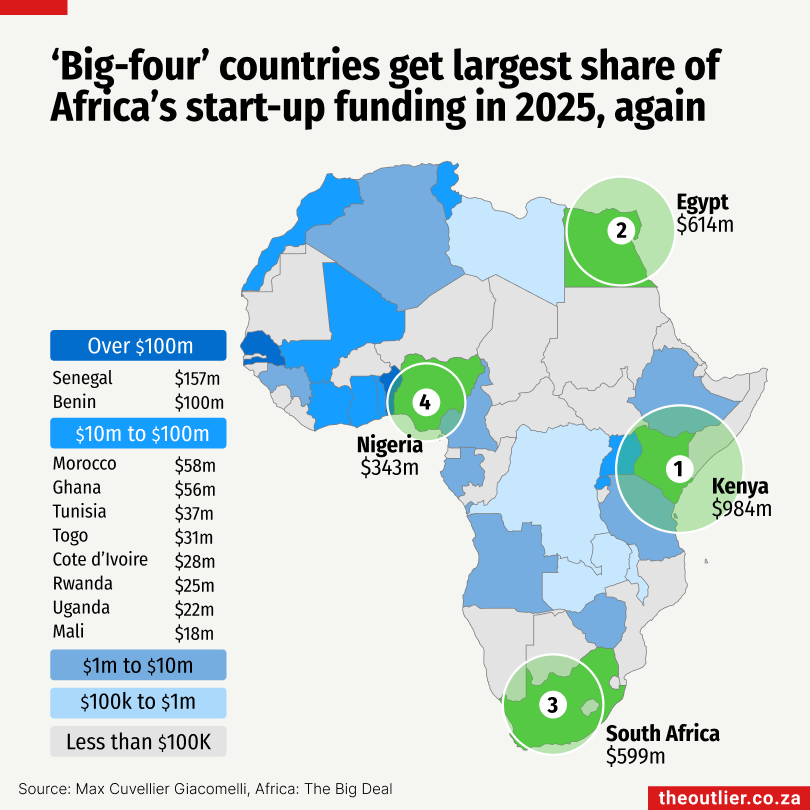
Africa’s start-up funding in 2025 had a now familiar look: The ‘Big Four’ (Egypt, Kenya, Nigeria and South Africa) once again absorbed the bulk of capital raised on the continent. In the latest year-end-wrap from Africa: The Big Deal startups in the four countries together took 82% of all start-up funding on the continent, a share that’s barely shifted since 2019. Typically, this sits between 80% and 86%. That dominance holds whether you look at equity or debt (both at 82%). But the grip loosens when you shift from money to deal activity: 64% of ventures raising funding were based in these four countries, and the concentration falls further as deal sizes get smaller, from 81% of $10m+ raises, to 69% for $1m–$10m, and 56% for $100k–$1m. In other words: the Big Four still own the mega-rounds, but there’s growing momentum outside the usual hubs.
Within the top four countries, Kenya led the continent in 2025, pulling in almost $1bn — nearly a third of Africa’s total. Egypt followed with $614m, split roughly evenly between equity and debt, while South Africa came in close behind at $600m, powered overwhelmingly by equity ($545m). Nigeria was the outlier: funding fell 17% year-on-year to $343m, shrinking its share of continental funding to 11% its lowest level since tracking began in 2019, even though it still topped the chart for the number of ventures raising $100k+ (86).
Read the full breakdown of funding at Africa: The Big Deal and check out their startup funding database for deeper insight into African startups.
▼Brought to you by our partner Shoprite
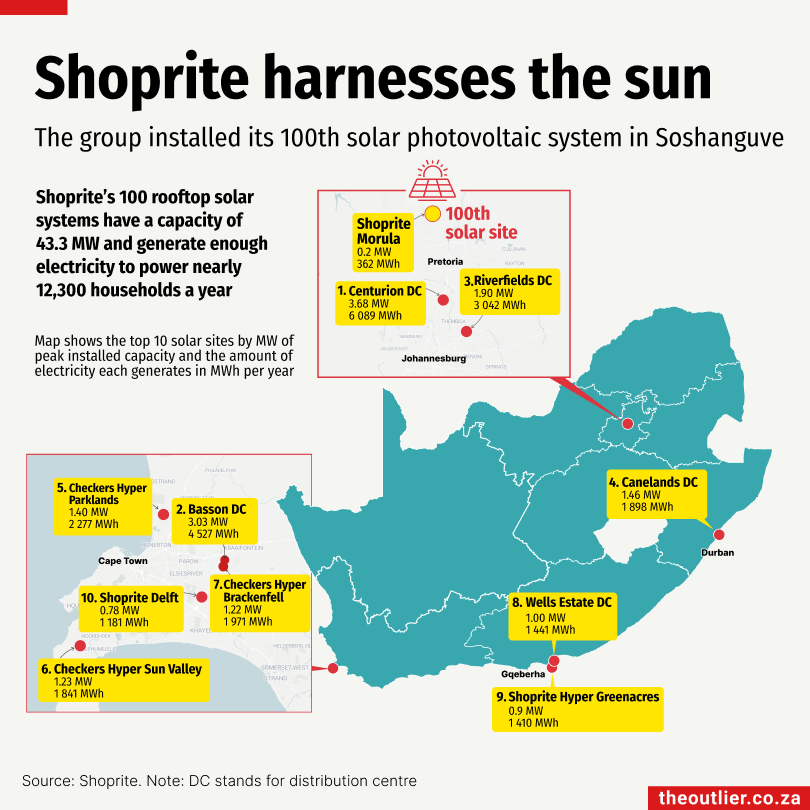
The Shoprite Group has now installed 100 solar systems and reached this milestone at Shoprite Morula supermarket in Soshanguve, near Pretoria. Since 2015, the Group has installed photovoltaic systems with a peak capacity of over 43.3 MW, which generate enough clean electricity to power nearly 12,300 households a year.
In the 2025 financial year, 7.2% of the retailer’s electricity came from renewable sources, up from 6.5% in 2024. It consumed 151,243 MWh of renewable energy, reducing its carbon emissions by 137,026 tonnes.
The Shoprite Group was also one of the first companies to wheel renewable electricity through the City of Cape Town’s grid in 2024. It is currently wheeling electricity to 13 sites, including its home office in Brackenfell, and is actively seeking further wheeling partners.
The group has also fitted 1,397 refrigerated trailers with solar panels, saving 3.2 litres of diesel per trailer per day and reducing emissions by an additional 6,000 tonnes.
Becoming an Outlier member gives you access to all our newsletters, tools and charts. Pro members also get free access to all Renew reports. Being a supporting member also means you’re helping us continue to collect data and produce charts. From just R120/month you get all this and you get to help us. Thank you.
Become an Outlier member today
🔋 Hot trend
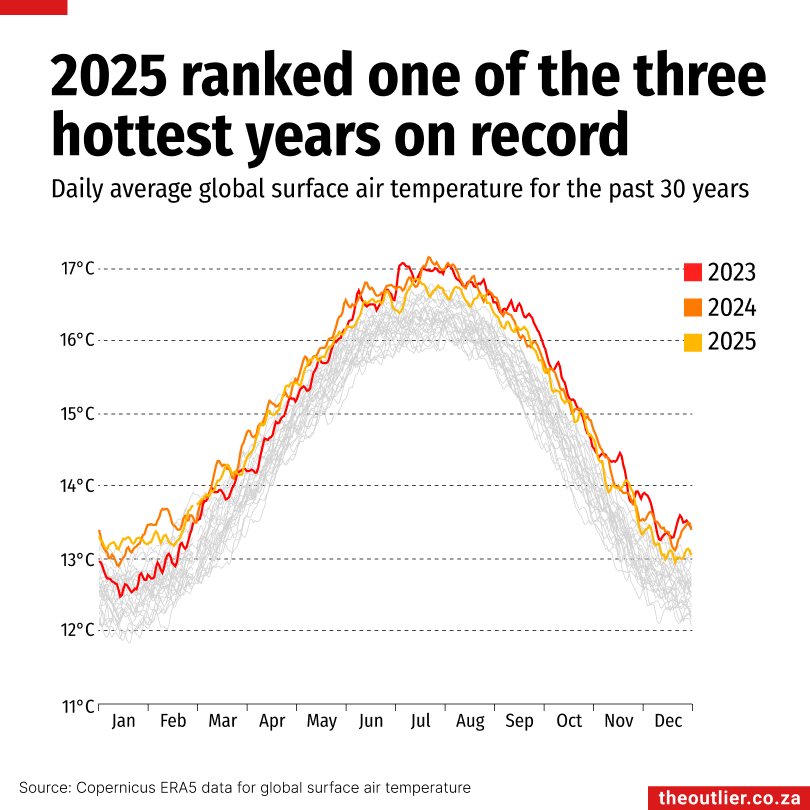
🥵 2025 was one of the three hottest years on record, even though the year began and ended with a La Niña event, which typically has a cooling influence. Scientists expect 2026 to be similarly warm.
Subscribe to Outlier Renew to receive the weekly renewables and climate updates.
🚨 Murder Cape
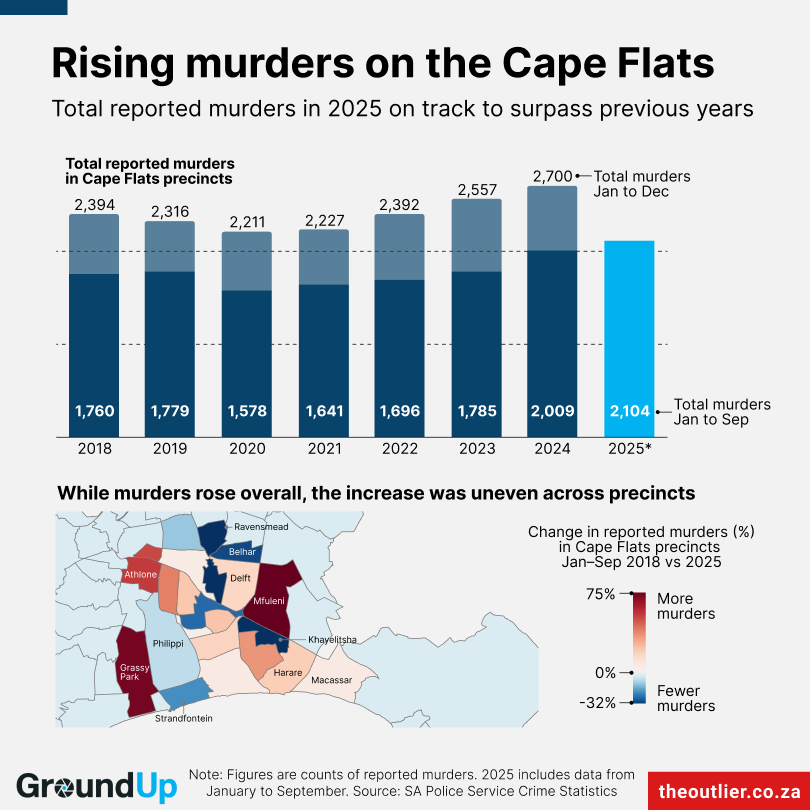
Police figures for October to December 2025 are not yet available, but in the first nine months of the year, 2,104 murders were reported to police stations on the Cape Flats. That’s a 20% increase since 2018, when 1,760 murders were reported between January and September.
The Cape Flats’ suburbs are notoriously gang-ridden and face high youth unemployment. Murders on the Cape Flats make up 75% of all murders reported in the City of Cape Town district between January and September 2025.
See the full story and statistics at GroundUp.
🏫 Not adding up
South Africa’s schools don’t produce enough good maths graduates, but there are unexpected pockets that do better than expected, said education economist Dr Martin Gustafsson in a webinar hosted by The Outlier earlier this week.
South Africa’s biggest schooling bottleneck isn’t the matric pass rate; it’s the small pipeline of learners leaving school with strong enough maths to enter university programmes. There’s a myth that because the number of learners achieving bachelor-level passes has been increasing that the schooling system is producing more students than are needed, he said. But his analysis of the data suggests the schooling system is under-producing maths-ready students by about 10% relative to what universities actually require, forcing institutions to admit students who don’t meet their own minimum maths thresholds.
That is not a good thing for the whole tertiary education system, he said.