☀️ Sunspot
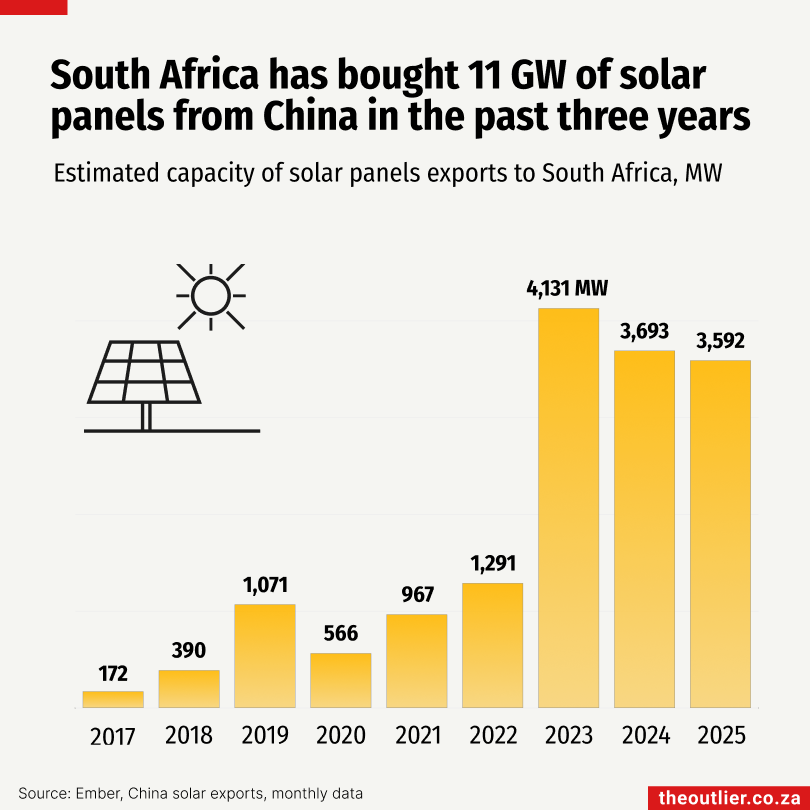
Chinese solar panel exports to South Africa shot up in 2023. And even though national loadshedding effectively ended early in 2024, the demand for solar panels has remained high. In 2025 alone, more than 6-million solar panels were imported into South Africa from China, according to energy think-tank Ember’s data.
In three years, an estimated 11,000 MW of solar PV capacity has been imported from China. It’s become more about keeping the cost of electricity down than simply keeping the lights on. China totally dominates the global solar photovoltaic market and it has been instrumental in bringing down the price of solar PV.
📱 Mobile money
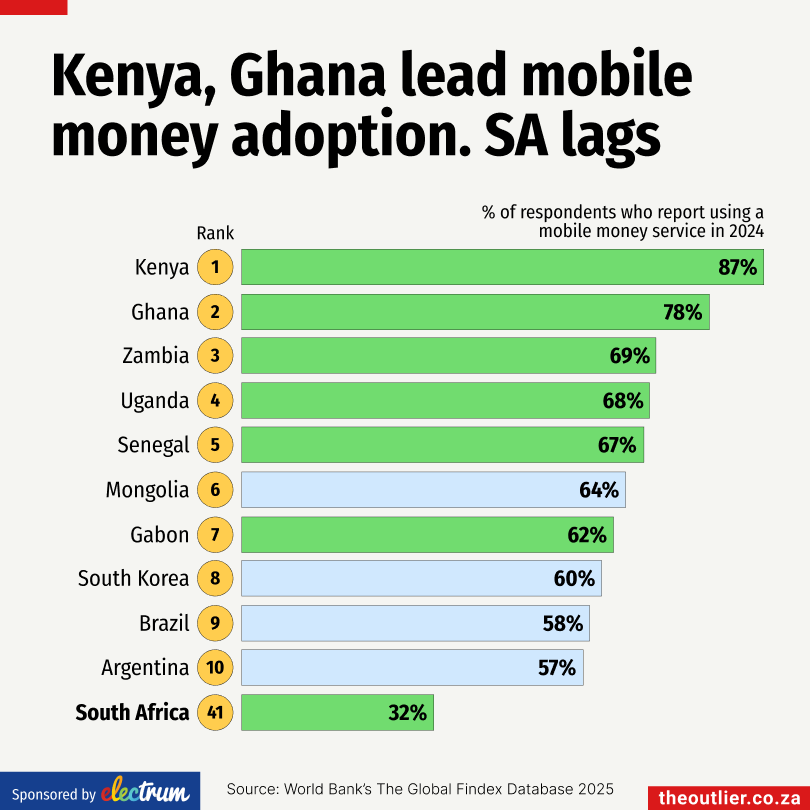
Africa leads the world in mobile money use with six of the top 10 countries globally coming from the continent. Kenya ranked first worldwide, with 87% of adults reporting that they personally used a mobile money service in 2024, according to the World Bank’s 2025 Global Findex survey. Ghana followed in second place at 78%, while Zambia, Uganda and Senegal also featured in the top five.
Africa’s dominance reflects how mobile money has become a core part of everyday financial life across much of the continent. High mobile phone penetration has played a central role: Global Findex data shows that 75% of adults in Sub-Saharan Africa own a mobile phone. The rapid expansion of mobile money operators, including M-Pesa, MoMo and Orange Money, has further driven adoption by offering widely accessible alternatives to traditional banking.
By contrast, South Africa ranked 41st globally, with just 32% of adults reporting mobile money use. It underscores how uptake varies sharply across African markets despite the continent’s overall leadership in the sector.
- Produced by The Outlier in partnership with Electrum, the next-generation payments software company, powering payments for banks and retailers.
💵 Web profits
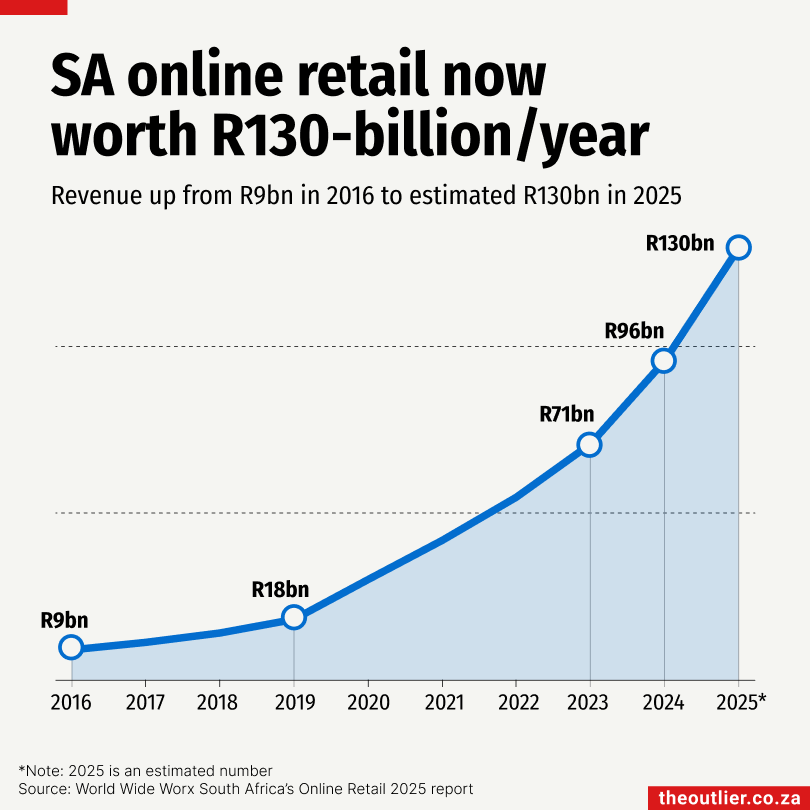
South Africa’s online shopping boom didn’t happen overnight, but the curve has gone up, noticeably. In 1996, online retail barely existed, clocking in at just R0.9-million. By 2025, it was expected to reach R130-billion, according to World Wide Worx’s Online Retail in South Africa 2025 report.
That growth has pushed online shopping firmly into the mainstream. “For the first time in South Africa’s history, nearly one in every ten rand spent on retail will be spent online,” said World Wide Worx CEO Arthur Goldstuck.
The big accelerator was Covid-19. Lockdowns forced consumers to shop from home, pulling millions of South Africans online almost overnight. Before the pandemic, e-commerce accounted for less than 2% of total retail sales. Six years later, that share has multiplied several times over.
Some retailers have benefited more than others. Grocery, in particular, has emerged as a clear winner. If the swarm of Checkers Sixty60 scooters on SA roads is anything to go by, convenience sells. Shoprite Holdings, which owns Checkers, says Sixty60 racked up R18.9-billion in sales by 29 June 2025. It’s a sign that online shopping in South Africa is no longer just about electronics and fashion, but about everyday essentials.
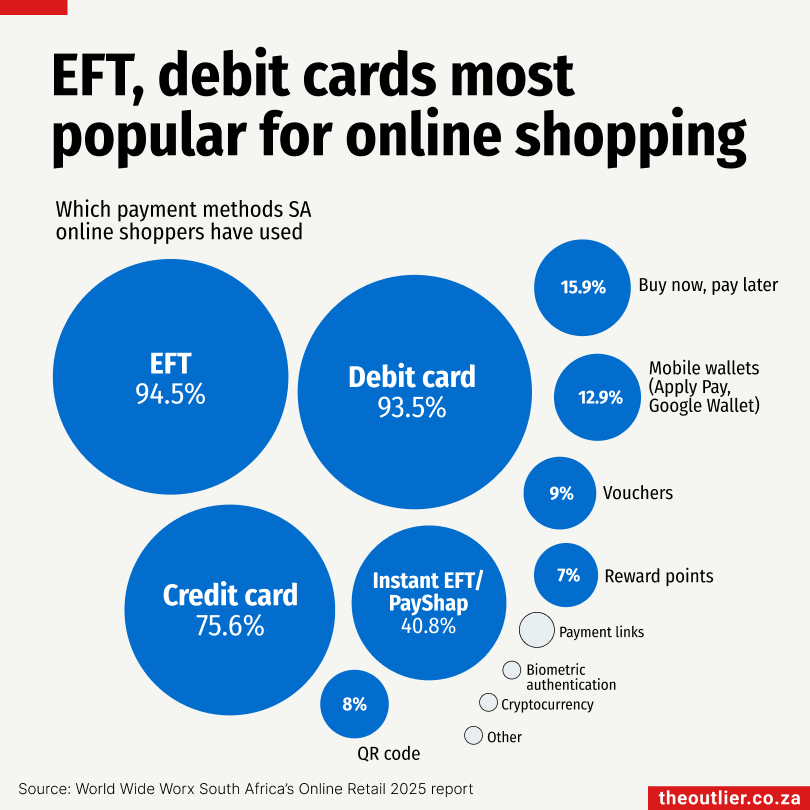
So how are South Africans actually paying for all of this online shopping? If you guessed EFTs and debit cards, you’re right.
A 2025 survey of 201 heads of technology at South African retailers, including owners, managing directors and CEOs, found that EFTs dominate online payments, used 94.5% of the time by customers. Debit cards follow closely at 93.5%, while credit cards lag a little bit at 75.6%.
The takeaway isn’t just about payment preferences, though; it’s about friction. The same survey shows retailers are focused on making online shopping faster, simpler and more secure. When asked about the major causes for customers to abandon their online cart, overly complicated checkouts (37.3%) and shipping fees (31.3%) came out on top.
But some problems are harder to solve. Failed transactions are often out of the retailer’s hands. But the message from the data is clear: in South Africa’s online retail market, convenience isn’t a nice-to-have. It’s the difference between a sale made and a customer lost.
💧 Water system crisis
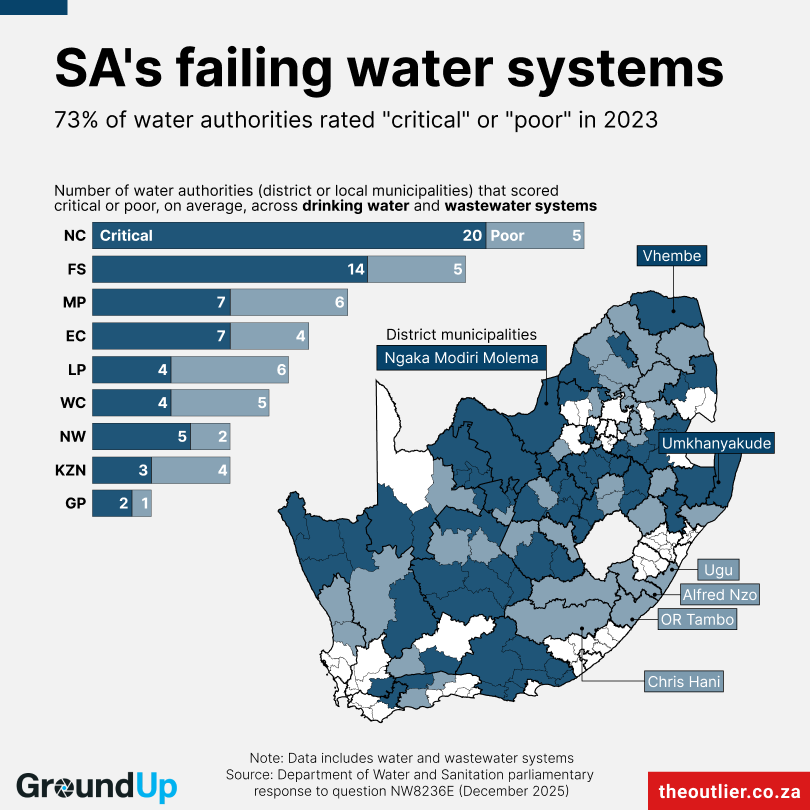
There are 144 water services authorities in South Africa. These are local and district municipalities meant to provide drinking water and sanitation systems.
The water systems in 104 of these municipalities were rated “poor” or “critical” by the Department of Water and Sanitation’s most recent Green and Blue Drop assessments in 2023. The assessments consider the condition, capacity, and maintenance of water infrastructure.
38 municipalities were rated “poor”, and 66 were rated “critical”.
- Read the full GroundUp story.
Click here for a link to all references for this newsletter.