✈️ On a jet plane
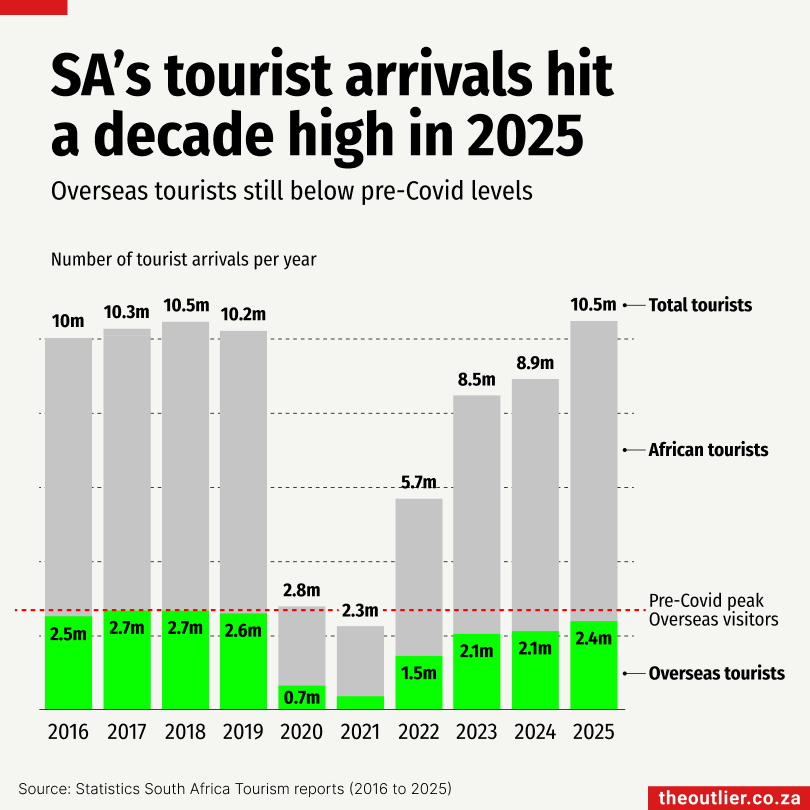
There’s been much excitement this week about tourist arrivals hitting a 10-year high. Last year, 10.5-million tourists visited the country, a nice jump of 1.6-million on last year. It’s taken four years, but it looks like South Africa may have finally recovered from the Covid slump.
What the big number doesn’t immediately show is that most of the visitors arrived from African countries, particularly the Southern African Development Community (SADC). Those visitor numbers are 6% higher than they were in 2019, but overseas visitor numbers still have a way to go, although they are inching upwards.
Tourism Business Council of South Africa CEO Tshifhiwa Tshivhengwa criticised state-funded SA Tourism, which is responsible for promoting South Africa abroad, “[SA Tourism] receives a huge chunk of money to market South Africa to international markets, but we are still not back to pre-Covid levels in terms of overseas arrivals,” he said.
 Dollar down
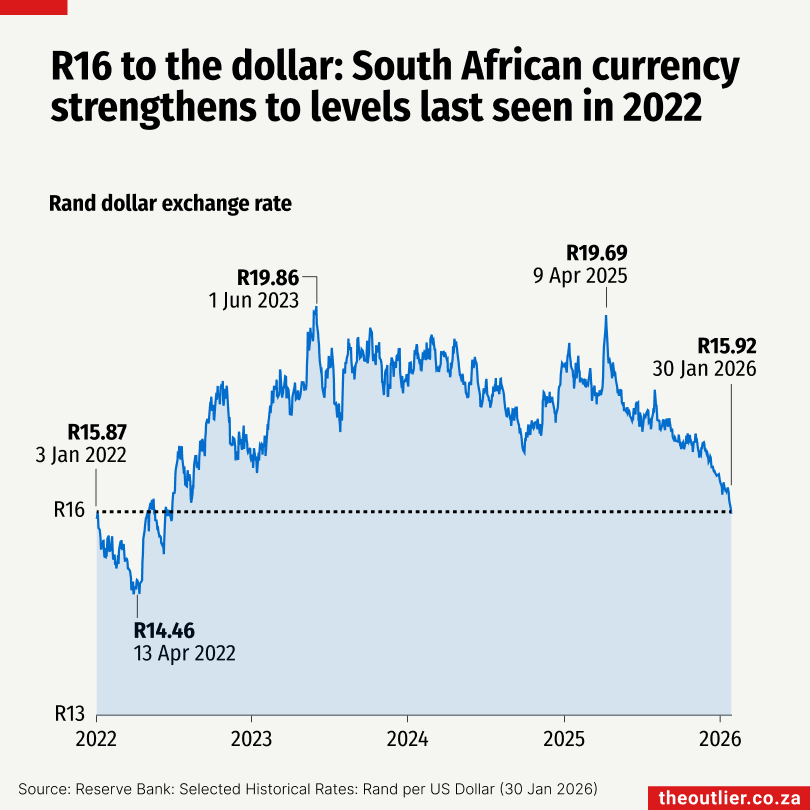
For this week’s reason to be cheerful chart, we have chosen the rand/dollar exchange rate. The rand has been strengthening (or the dollar has been weakening) fairly steadily since April last year and this week it dipped below R16 to the dollar. We haven’t seen that since 2022.
 Chinese energy loans
Africa has 43 GW of installed hydro capacity, according to the International Hydropower Association. That’s 20% of the total electricity generated on the continent but only a “small fraction” of its potential, says the association.
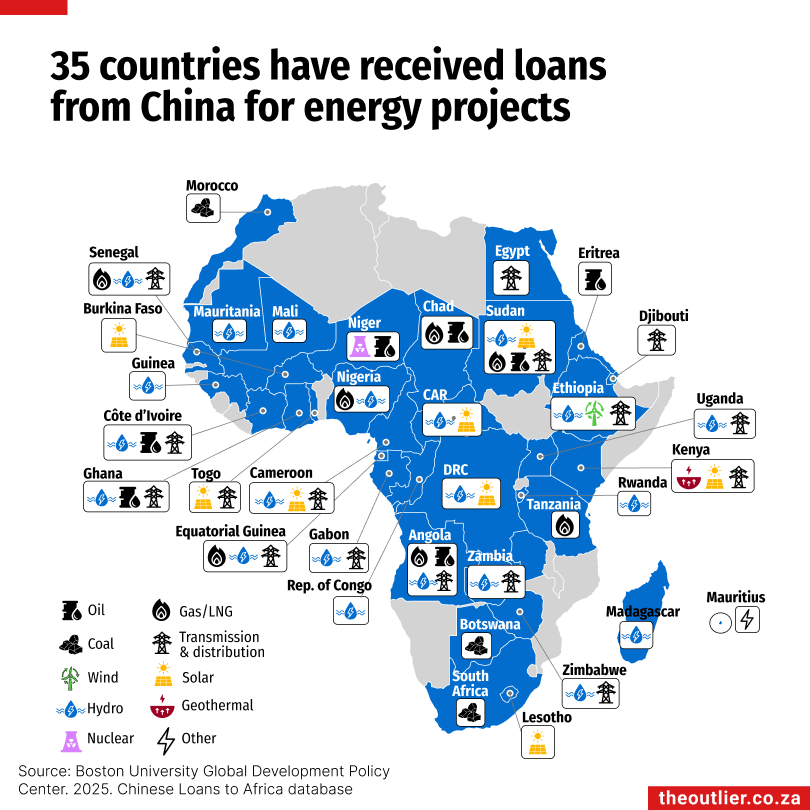
Many African hydro projects have received loans from China, which has made $66-billion in loan commitments for various energy-related projects. In all, 207 loans were recorded in the Chinese Loans to Africa database maintained by Boston University’s Global Development Policy Centre. The database covers 2000 to 2024.
The projects ranged from gas, oil and coal to clean energy and transmission and distribution across 35 countries. There’s even a nuclear project: a $100-million loan in 2011 for Niger’s Azelik uranium mine.
About half the loans were for transmission and distribution projects, the infrastructure that moves electricity from the facilities that generate it to the places that use it. In terms of power generation, the database lists more than 30 hydro projects.
Subscribe to Outlier Renew for more stories like this.
 Unaccounted
Auditor-General Tsakani Maluleke says the government’s “no-consequence” culture is keeping the country back from better service delivery and financial performance.
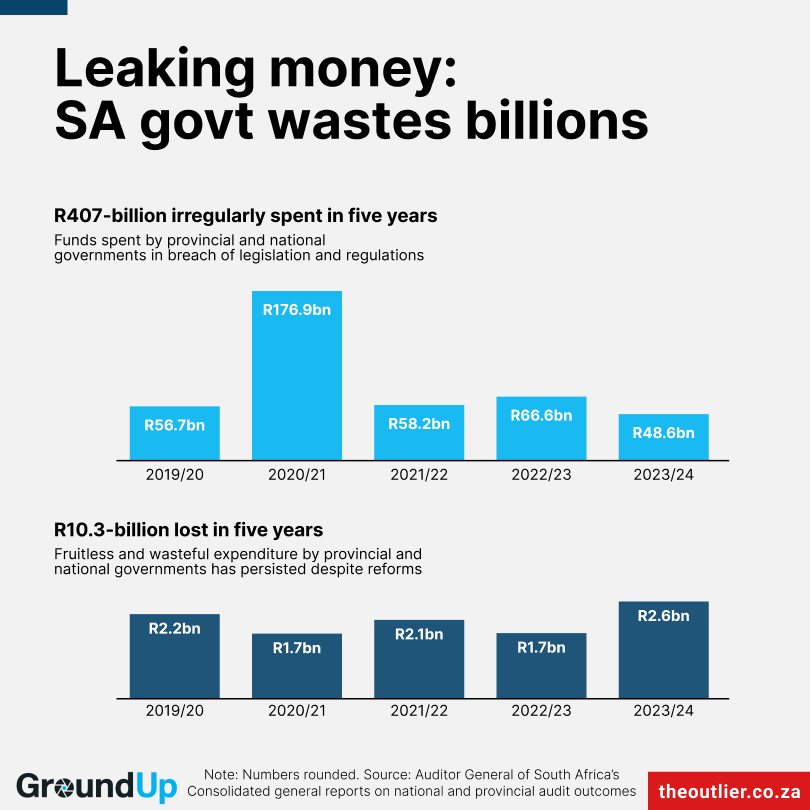
At least R407-billion was irregularly spent by South Africa’s national and provincial governments between 2018 and 2024. Irregular expenditure is when the Auditor-General finds breaches in procurement and financial regulations.
Irregular expenditure peaked in 2020, at R177-billion. The National Student Financial Aid Scheme (NSFAS) was the main contributor to this, spending R77.5-billion without sufficiently consulting with the minister of higher education.
National and provincial governments also had R10.3-billion of fruitless and wasteful expenditure between 2018 and 2024. Fruitless and wasteful expenditure occurs when the government receives no or very little value for money. This includes when suppliers are paid and no goods or services are delivered, or when penalties and interest are imposed for late payments. Legal claims against departments and overspending of budgets are also included.
- Read the full GroundUp story.
Click here for a link to all references for this newsletter.