🚘 Shipping out
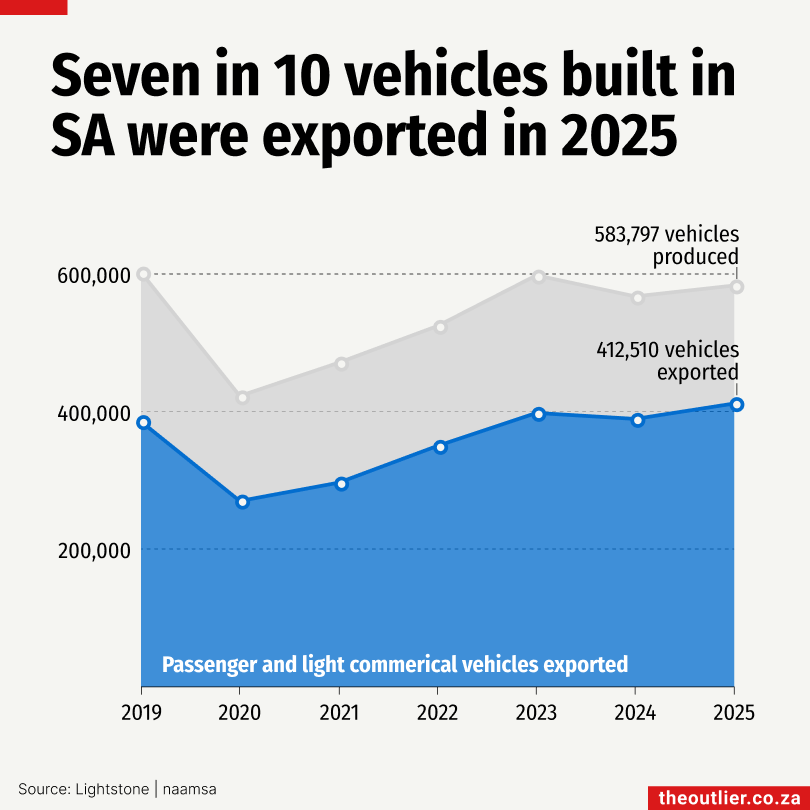
South Africa exported 412,510 passenger and light commercial vehicles in 2025. That is 70% of the 580,000+ vehicles manufactured in South Africa that year.
Germany is now the biggest destination for export vehicles. One in every five exported vehicles went there in 2025. Germany overtook the United Kingdom as South Africa’s top export market in 2023. Before then, as many as one in four locally produced vehicles were shipped to the UK. The reason the UK doesn’t import as many cars from South Africa as it used to is because it is phasing out petrol and diesel cars in favour of electric vehicles.
Unfortunately, South Africa is still heavily focused on producing these types of vehicles.
Other key markets for South Africa include France, Belgium and Italy.
| Country | 2019 | 2025 | Difference |
|---|---|---|---|
| Germany | 37,152 | 77,890 | 40,738 |
| UK | 101,401 | 70,798 | -30,603 |
| France | 25,629 | 36,082 | 10,453 |
| Belgium | 11,379 | 27,643 | 16,264 |
| Italy | 14,624 | 23,041 | 8,417 |
| Total exported | 386,265 | 412,510 | 26,245 |
 Digital payments
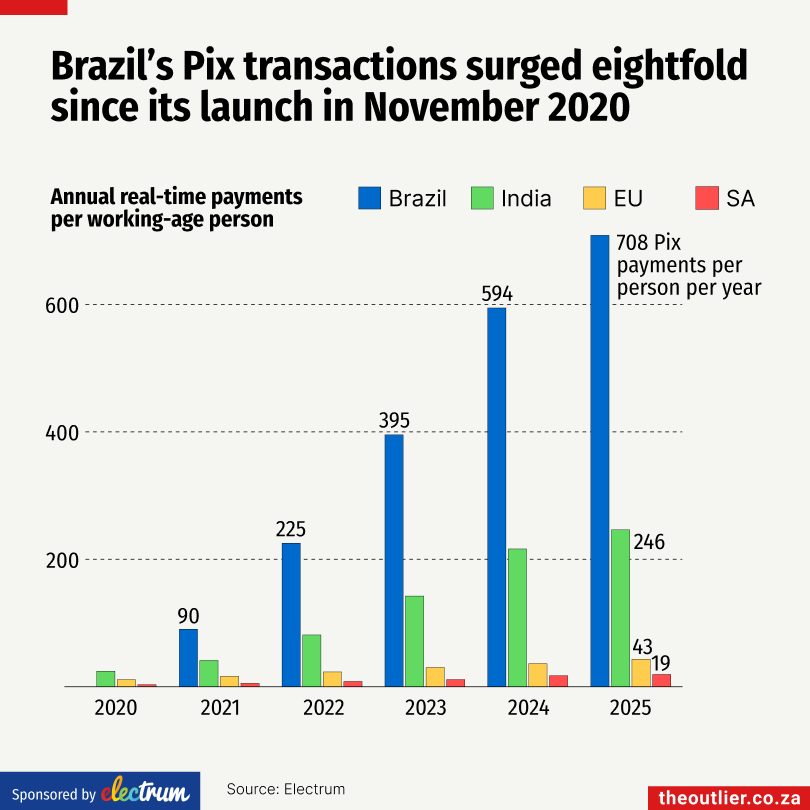
Real-time payment (RTP) systems are more than a convenience – they are catalysts for economic efficiency and financial inclusion. Globally, the shift towards instant, 24/7 payments is reshaping how we manage liquidity.
Brazil’s Pix is a standout success, reaching 708 annual RTP transactions per labour force participant since 2020. India’s UPI shows similar momentum with 246 transactions. In South Africa, PayShap follows this trajectory, designed to displace cash and provide a safer digital alternative for the informal economy. For local banks and retailers, the question is no longer if real-time payments will dominate, but how quickly they can scale.
As the landscape matures, digital adoption is hitting a new milestone. Electrum’s latest research, in partnership with Cyan EA, predicts three scenarios for real-time payments volumes by 2030.
Are your systems ready for the surge? Pre-register for the exclusive report to access the full forecast and a step-by-step action plan to lead the next decade of payments.
 ️ 7.5GW
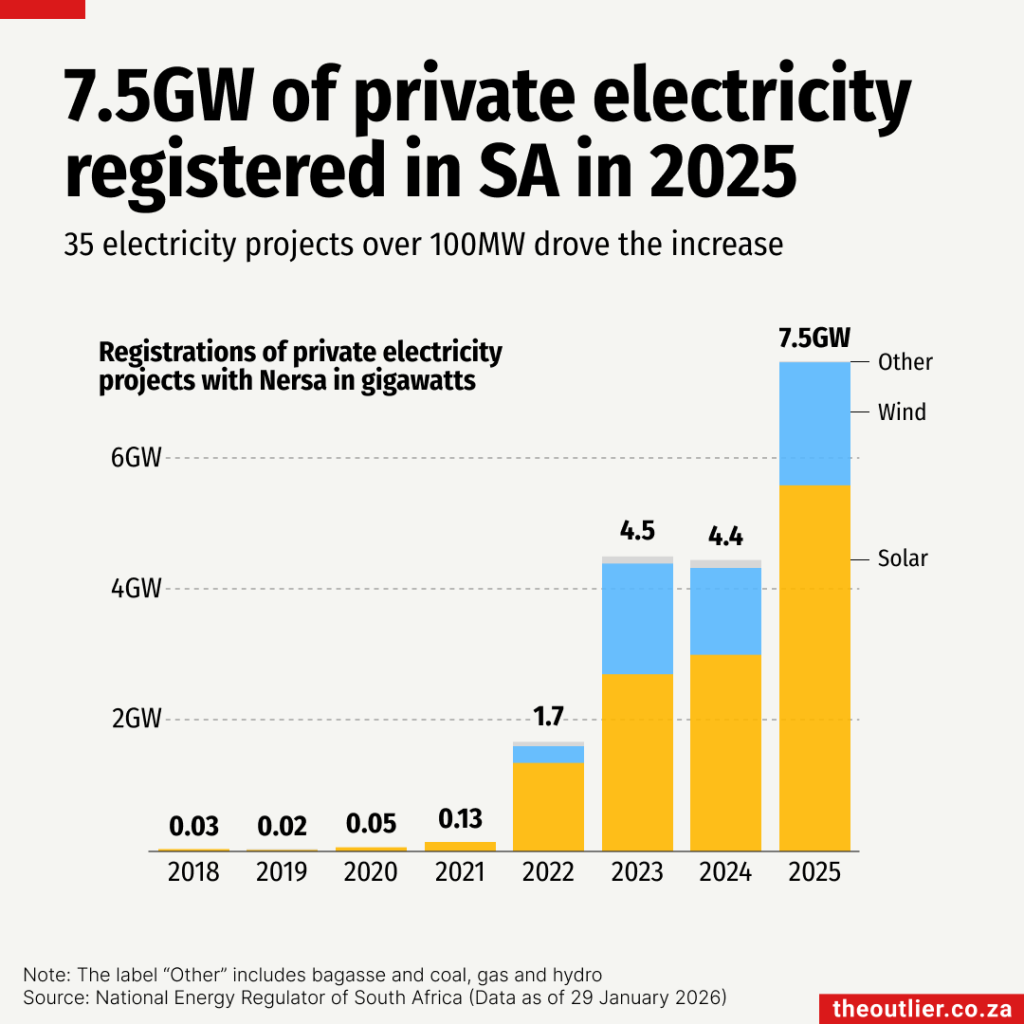
2025 was a record year for private electricity registration in South Africa with 7.5GW registered with the National Energy Regulator of South Africa (Nersa). It’s a 68% jump from the 4.4GW registered in 2024.
Thirty-five large-scale electricity projects, each with a capacity of 100MW or more, made up 90% of the megawatts registered in 2025.
Most of that new capacity came from solar. Around 75% of the megawatts registered in 2025 were for solar projects. These include:
- Naos Solar PV Project One in the Free State (378MW)
- RC Kuschke Solar in Limpopo (300MW)
- Norsk Solar South Africa in Limpopo (262MW)
- Beaufort West Solar PV Energy Facility in the Western Cape (250MW)
Wind also made a strong showing. Among the major projects registered were the Great Karoo Phase 1 project in the Northern Cape, with 280MW of wind capacity (part of a larger 505MW hybrid project). Four 240MW wind projects were also registered in the Western Cape. Three of these were developed by Red Cap, with the fourth by Mulilo.
By the end of 2025, Nersa had registered a total of 2,393 electricity generation facilities, representing 18GW of capacity.
 Metro housing race
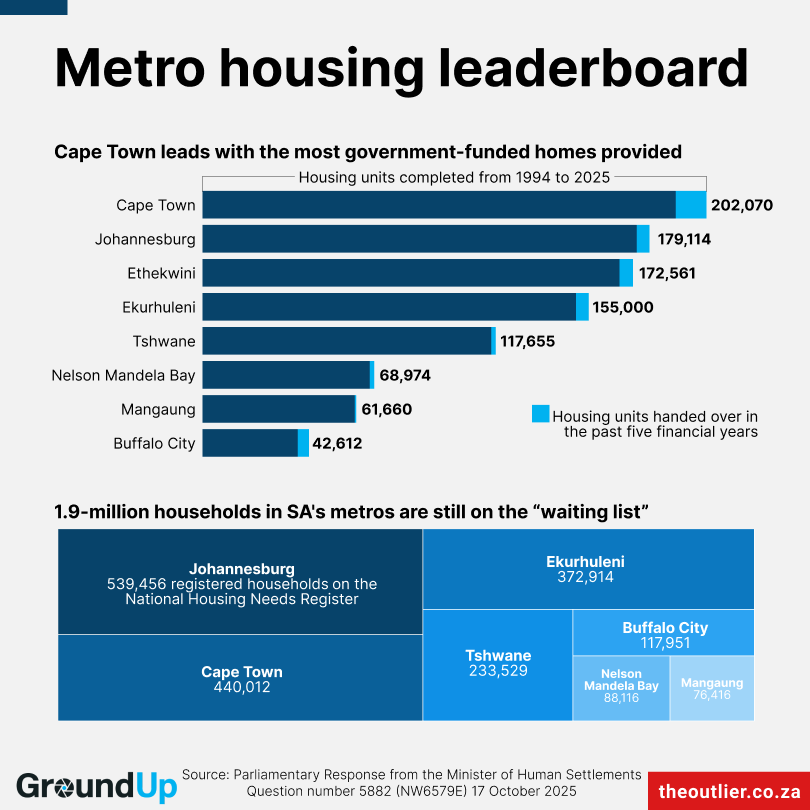
Of South Africa’s eight metropolitan municipalities, the City of Cape Town has provided the most government-funded homes since 1994, according to a parliamentary response by human settlements minister Thembisile Simelane in October last year.
Cape Town has also handed over more homes in the past five financial years (12,401) – between 2020/21 and 2024/25 – than any other metro.
However, about 1.9-million households in metro municipalities are still on the National Housing Needs Register, said Simelane. Johannesburg, Cape Town, and Ekurhuleni have the most people on this housing “waiting list”.
But this is probably not an accurate representation of the housing need. In addition to the national register, there are also provincial and municipal housing “waiting lists”, which do not necessarily correspond.
The housing lists can also be outdated and flawed. People may have died or already found alternative housing, while others have been allocated housing on the list but never actually received a house.
- Read the full GroundUp story.
Click here for a link to all references for this newsletter.