💰 Taxing times
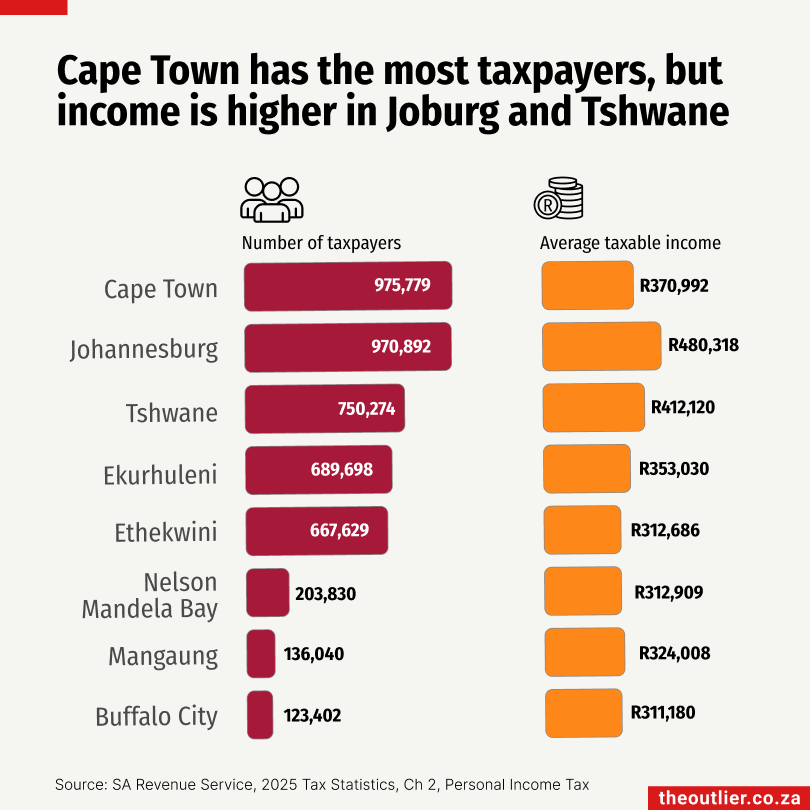
The City of Cape Town has more assessed tax payers than the City of Johannesburg. It passed Johannesburg in 2024. But tax payers in Johannesburg still have higher incomes on average than Capetonians – R408,318 compared with R370,992 – as do those living in Tshwane where average income is R412,120.
Assessed tax payers are people whose income was high enough to pay personal income tax and who submitted their tax return. Even though there are 14-million registered tax payers in South Africa, not all are expected to pay income tax.
The chart above covers only the eight metro municipalities, because they have the highest number of assessed tax payers.
The City of Johannesburg’s population is close to 6-million. The City of Cape Town’s is just over 5-million. Over the past five years their populations have grown by 9% and 8% respectively. It is unclear why Cape Town now has more assessed tax payers than the City of Johannesburg, perhaps Capetonians are more tax compliant.
 Eat. Sleep. Game. Repeat
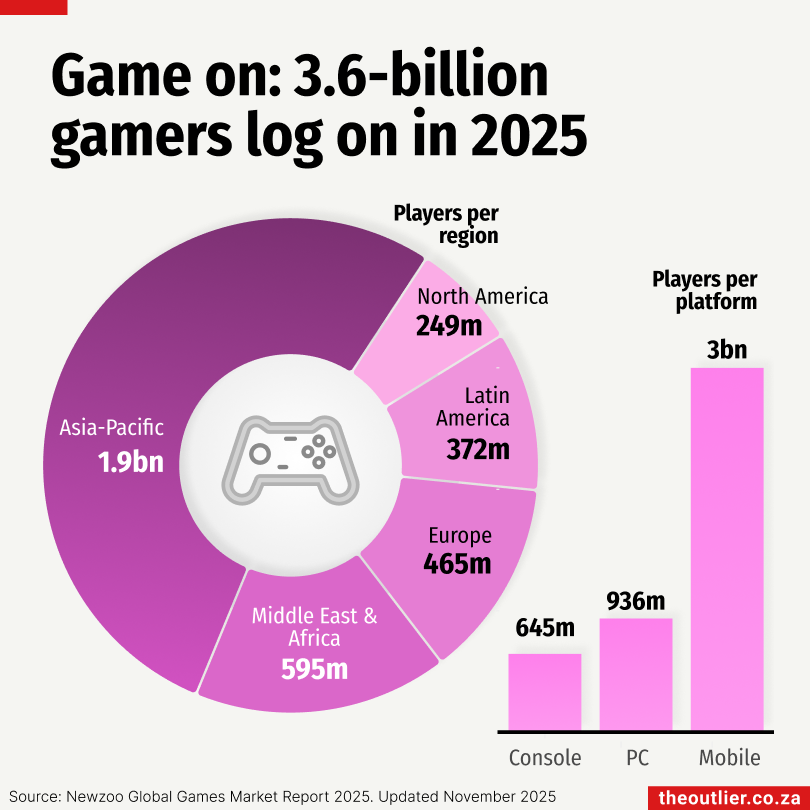
Almost 3.6-billion people played video games last year. This is roughly 4% more than 2024, which suggests the global games market is heading into a more mature phase, according to the latest Newzoo Global Games Market Report 2025.
3.6-billion players is about 60% of the world’s online population, the report says.
Mobile gaming remains dominant with 3.0-billion players, while PC gaming reached 936-million and console 645-million in 2025.
Younger player cohorts, like Gen Alpha (born 2010-2024), are a growing share of players, particularly on PC. Significant drivers of the growth are in China and Japan.
The number of console players is increasing more slowly than any of the other platforms with around 2.5% year-on-year growth for 2024-25. In comparison PC players increased 3.1% and mobile players 4.5%.
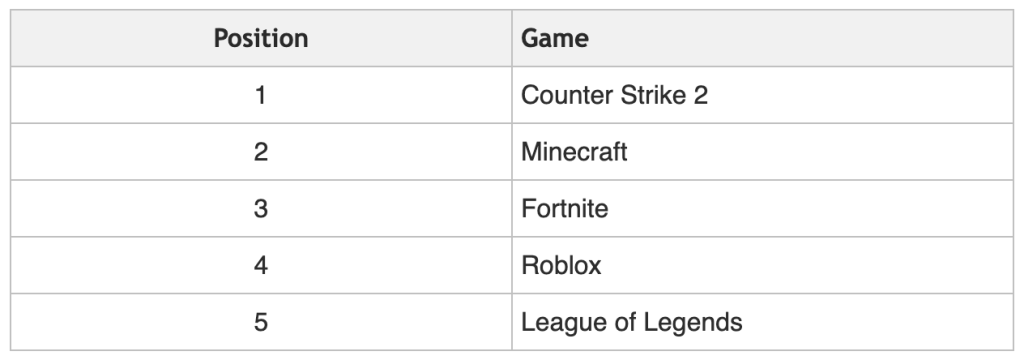
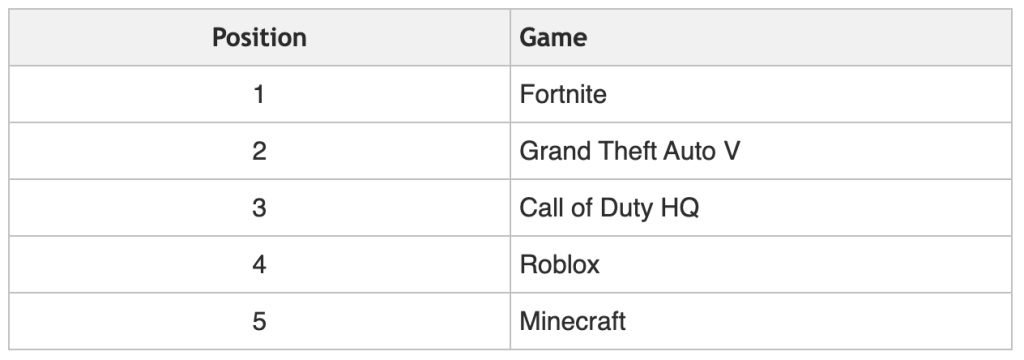
The top 5 games on PC and console in December 2025 were:
PC games
Console games
 ️ Available power
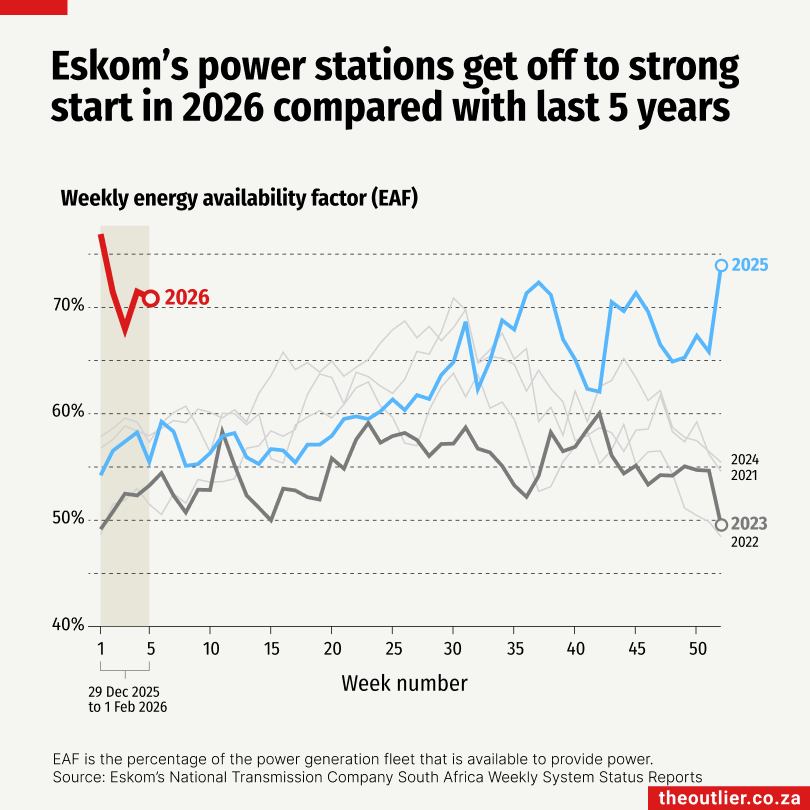
Eskom’s power stations have started off 2026 on a high. The percentage of generating capacity that is available to provide electricity to the grid – or the energy availability factor (EAF) – is the highest it has been in six years, according to Eskom’s weekly system status reports.
For the first five weeks of this year the EAF has averaged 72%. During the same period last year it was 56%.
A higher EAF is an indication that there are fewer breakdowns (or unplanned outages) at the power stations (mostly coal) that make up the bulk of Eskom’s electricity generation fleet.
Eskom uses EAF as a measure of the health of the national grid and its target is to keep it at 70% or above.
In 2023, when loadshedding was at its worst, the average EAF for the year was 55%. In 2025, it improved to 62%.
With this year’s encouraging start, perhaps we can look forward to Eskom meeting its 70% target.
The improved EAF means Eskom is using less diesel to generate electricity, which is a massive cost saving.
In fact, Eskom says it has excess capacity, with 5,854MW in “cold reserve”, which means it has that much electricity available to fire up and add to the grid if it’s needed.
 Jozi’s fibre divide
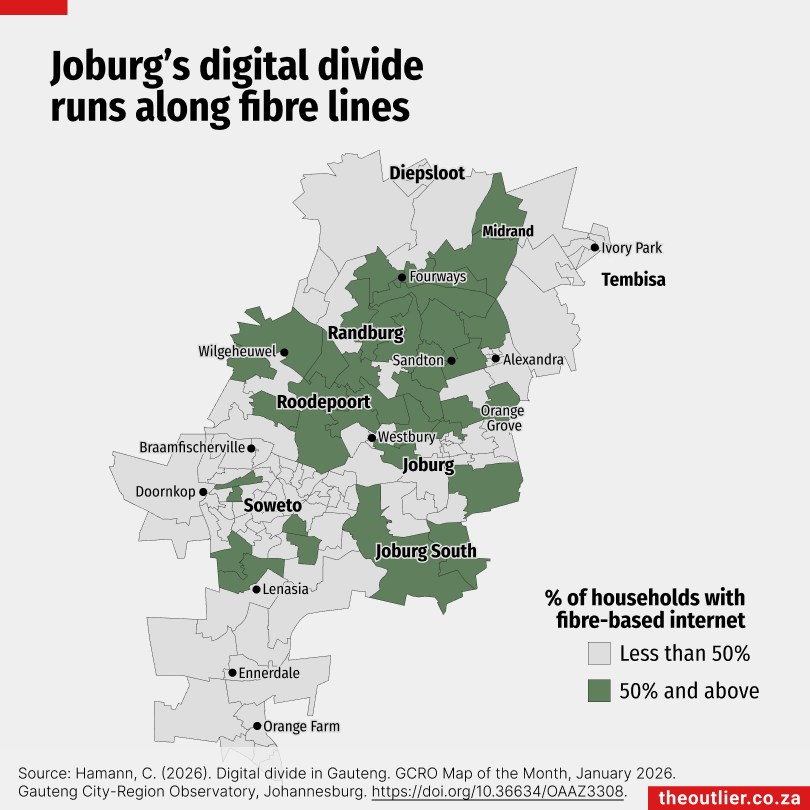
Johannesburg’s digital divide is visible ward by ward. Survey data from the Gauteng City-Region Observatory (GCRO) shows that households do not have equal access to home internet, particularly fibre-based connections.
Fibre is faster and more reliable than older copper-based connections, which are more vulnerable to weather disruptions and cable theft. It’s also more consistent than the capped and fluctuating speeds of mobile data.
But despite the perks of fibre, it is concentrated in areas such as Fourways, where 80% of households report having fibre at home. In contrast, less than 20% of households in Orange Farm and Alexandra have fibre.
The rollout of fibre lines is largely driven by the private sector, which installs fibre infrastructure along road verges, favouring areas where returns are more certain, according to the GCRO.
And the consequences stretch beyond streaming and emails. “While it is now relatively straightforward and ‘standard’ for institutions and large businesses to obtain access to the internet, it is not necessarily as easy for small businesses and all households,” the GCRO notes.
The digital divide, the GCRO explains, can limit access to education, jobs and healthcare, shaping how people live and work in the city.
- Made in partnership with Our City News.
 Back to varsity
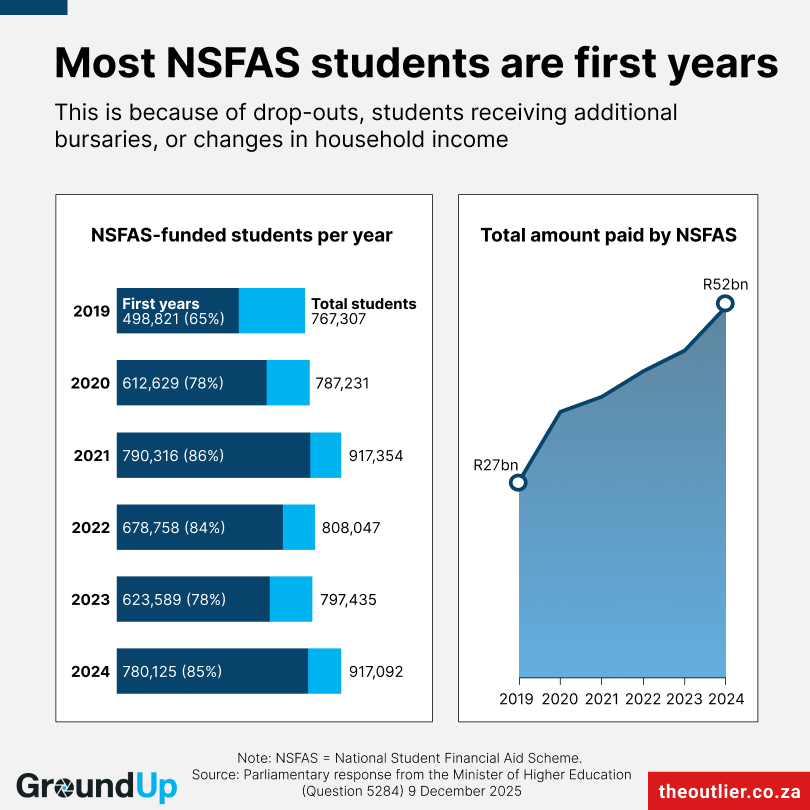
About 80% of the students funded by the National Student Financial Aid (NSFAS) scheme between 2019 and 2024 were first years.
But not all of the approximately 620,000 first-year students who received funding in 2023 continued to receive funding for their studies in 2024.
There are several reasons for this.
Many students drop out after their first year, sometimes for personal reasons or because they did not qualify for further studies. NSFAS requires students to pass their university courses with a 60% grade to continue receiving funding. TVET students need to pass a certain number of subjects to proceed with funding.
Some students may receive bursaries for the rest of their studies, which disqualifies them from receiving further funding. Others may not pass the eligibility criteria for the following years, due to increases in household income.
NSFAS provides financial aid to students at public universities and TVET colleges. Students need to be SASSA grant recipients or prove a household income of less than R350,000 per year. NSFAS funding covers tuition, accommodation, a living allowance, books, and transport.
- Read the full GroundUp story.
Click here for a link to all references for this newsletter.