 SA wine exports
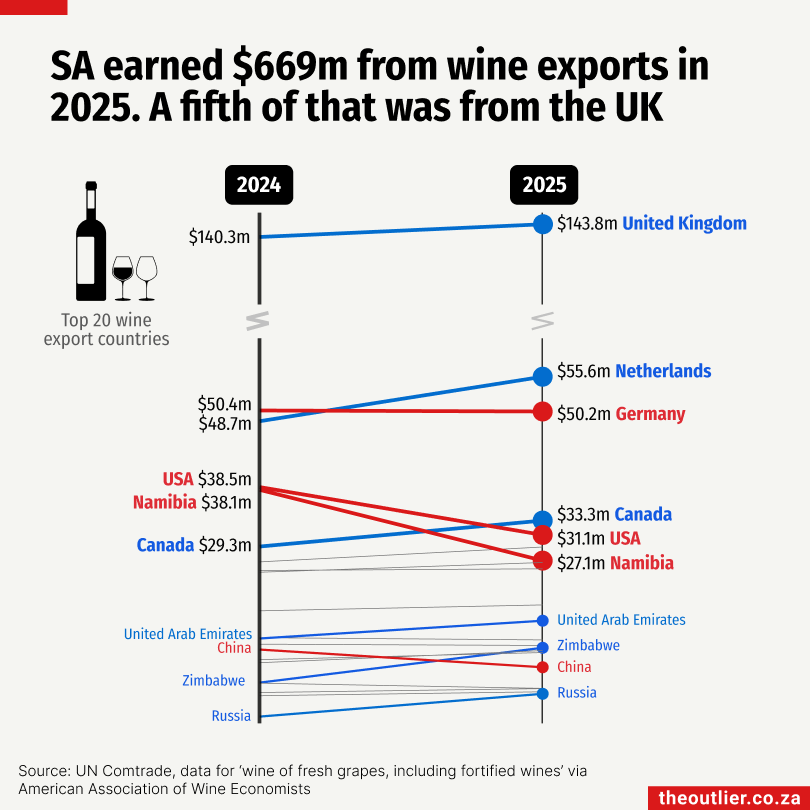
South Africa’s wine exports increased to $669-million in 2025, an increase of $21.5-million on 2024, but still $25-million short of 2022. The United Kingdom is the biggest export market for South Africa’s wine – 21% of the total value, or $143.8-million worth was shipped there.
Of the top five markets, exports to the Netherlands and Canada increased. The Netherlands overtook Germany as South Africa’s second biggest export destination. Canada jumped to fourth thanks to big decreases in exports to the United States and Namibia.
The value of wine exports to the United States has decreased every year since 2021, when they were $63.2-million. This year’s $31-million is half of that value.
Exports to China also decreased, they were $10.6-million in 2025, down from a $30.9-million in 2021.
Other notable increases in South Africa’s 20 biggest wine export markets were the United Arab Emirates, which reached $17.8-million in 2025, Zimbabwe, up to $23.6-million and Russia, which recovered to $6.5-million after falling for three years.
 Security boost
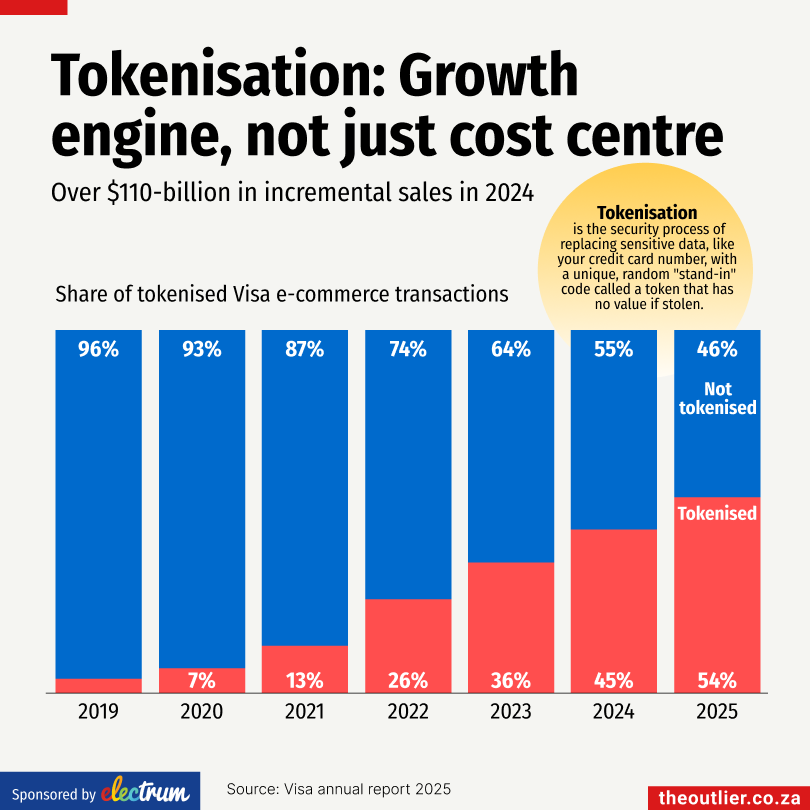
Tokenisation replaces sensitive payment credentials with non-sensitive tokens, reducing risk throughout the payment ecosystem.
For years, many banks have viewed tokenisation primarily as a defensive shield – a necessary tool to devalue sensitive data and meet compliance standards. However, leading global institutions are proving that when treated as a strategic priority rather than a technical “tick-box,” tokenisation becomes a powerful driver of top-line growth.
The scale of this opportunity is staggering. Visa recently provisioned more than 16-billion tokens as of September 2025, a move that did far more than just secure the ecosystem. This strategic shift has unlocked more than $110-billion in incremental sales in 2024 alone. By replacing static 16-digit account numbers with dynamic, context-specific tokens, banks have achieved an authorisation lift of nearly 5% for e-commerce sellers while simultaneously reducing fraud by over 35%.
Scaling for the next decade of value
As South Africa moves toward a consolidated, real-time “Red Dot” future, tokenisation is no longer just about cards. Globally, it is expanding to include bank accounts, digital wallets, and even tokenised deposits.
Electrum and Cyan EA’s new report predicts that real-time payment volumes in South Africa will explode, with separate scenarios forecasting a surge of up to 10x by 2030. To capture this growth, banks must adapt by implementing advanced authentication methods, embracing tokenisation, and strengthening cybersecurity.
Are your systems ready for the surge? Pre-register for the exclusive report to access the predictions for 2030 and a step-by-step action plan to lead the next generation of payments.
🚘 Plug-and-drive
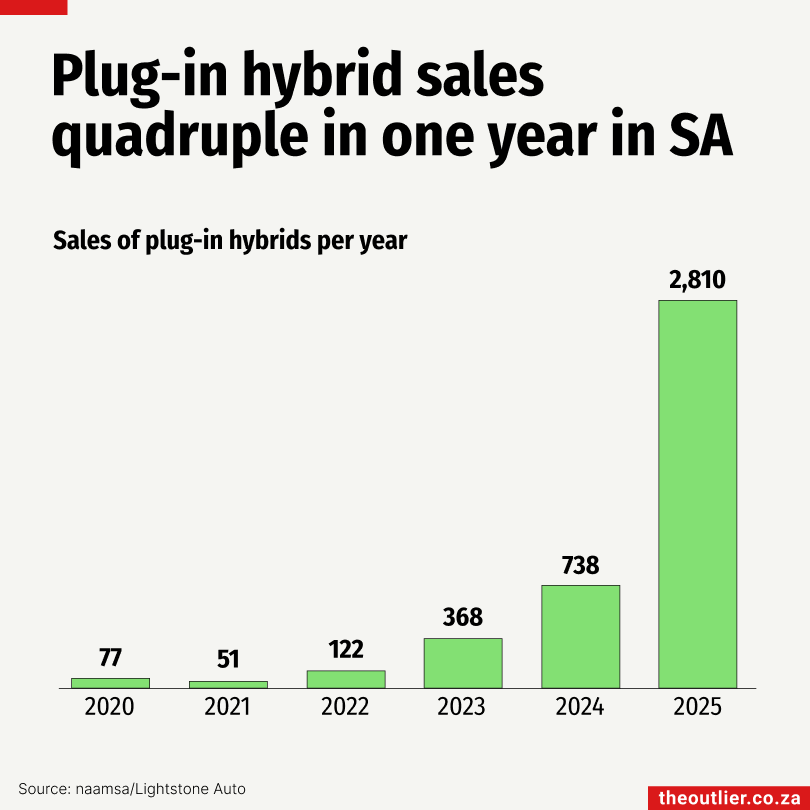
Sales of plug-in hybrids (PHEVs) nearly quadrupled in South Africa in 2025. The number of vehicles sold jumped from 738 units in 2024 to 2,810.
Unlike traditional hybrids, which rely entirely on the engine and braking to charge, PHEVs can be plugged into the grid. This allows for pure electric driving on short trips, effectively acting as an electric vehicle until the petrol engine is needed for longer hauls.
The Automotive Business Council (naamsa) says the jump in sales is because of new entrants to the market in 2025 offering more affordable plug-in models.
The Haval H6 PHEV was the best-selling plug-in hybrid, with 448 units sold at around R800,000, followed by the Chery Tiggo 7 Pro PHEV, at R600,000, according to naamsa and Lightstone.
Traditional hybrids still dominate South Africa’s new energy vehicle market, with 12,818 sold in 2025, down slightly from 13,616 in 2024.
 Horn again
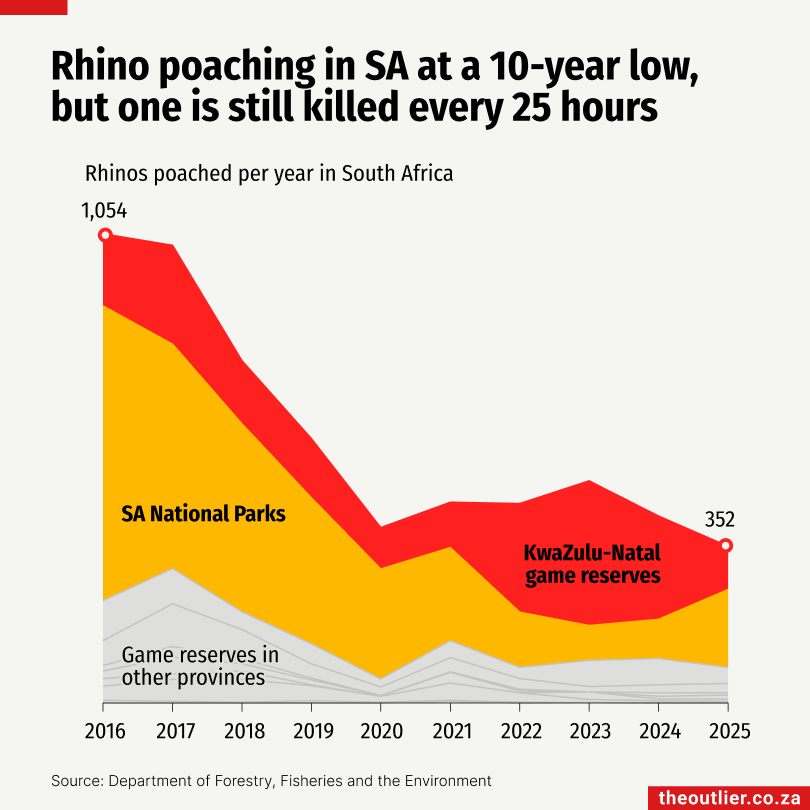
Poachers killed 352 rhinos in South Africa in 2025, according to official statistics. That’s one rhino every 25 hours. It’s a chilling number, but an improvement on a decade ago when three rhinos a day were killed by poachers.
The 2025 national poaching numbers are the lowest they’ve been since 2016 thanks to anti-poaching efforts, particularly in KwaZulu-Natal’s Hluhluwe-iMfolozi Park.
Poaching dropped by a third in the park following a massive dehorning programme which started in 2024. That year the park lost 198 rhinos to poachers. In 2025 the number dropped to 63.
Other anti-poaching measures at the park include sensors and advanced camera technologies, and “successful polygraphing of all park law-enforcement personnel”, said the Department of Forestry, Fisheries and the Environment.
Unfortunately, in 2025, poaching increased in the Kruger National Park, South African National Parks’ (SANParks’) biggest reserve, where the number of rhinos killed doubled to 175 compared with 88 in 2024. The rhino population in the Kruger Park has dropped to 2,600 in 2023 from 10,000 in 2010.
South Africa’s rhino population is estimated at 14,400, according to 2024 data from the International Rhino Foundation.
 Wrongful arrests
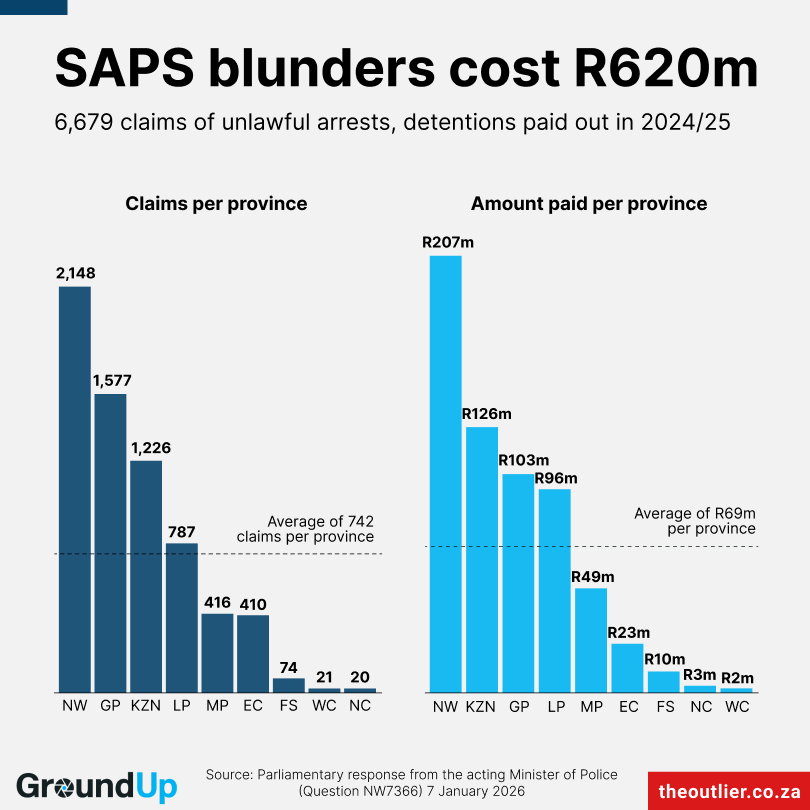
Unlawful arrests or detentions cost the South African Police Service (SAPS) over R620-million in 2024/25, according to an answer in Parliament by Acting Minister of Police Firoz Cachalia.
Claims arise when people take legal action, usually through the courts, against SAPS for detaining or arresting them without sufficient cause.
In the North West alone, 2,148 claims were settled at a cost of R207-million in 2024/25.
The reasons for the high number of cases in the North West are unclear. SAPS spokesperson Brigadier Athlenda Mathe did not respond to questions about this. However, incidents related to the Marikana strikes are likely a contributing factor.
“These claims … include … some of the payments made through the years emanating from the Marikana incidents in North West Province,” Cachalia said in his response to Parliament.
- Read the full GroundUp story.
Click here for a link to all references for this newsletter.