 Budget 2026
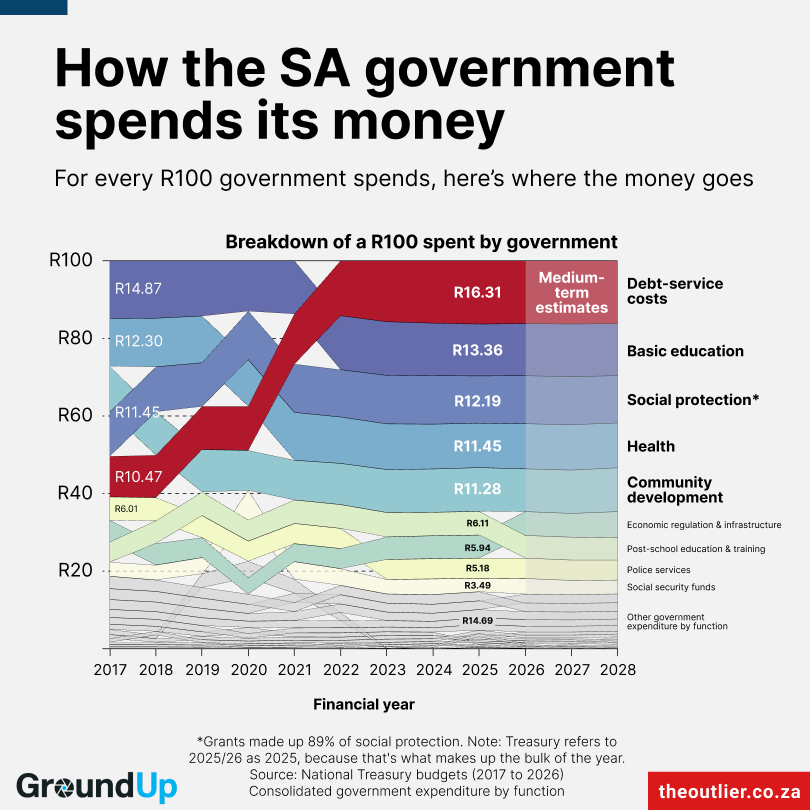
Since 2017, the proportion of South Africa’s budget spent on paying back debt and interest on debt has skyrocketed, overtaking spending on education, social grants, health, and community development. Spending in these “social wage” categories had to be cut to cover debt-servicing costs.
But finance minister Enoch Godongwana, while tabling the 2026 budget before Parliament on Wednesday, announced that South Africa has “turned a corner” and that government debt is stabilising.
In the last few years, the government has tightened its belt to find funds to repay debt and to pay interest on debt. At the same time, tax revenue is increasing as investment in electricity generation and improving export infrastructure at ports pays off and the economy grows. The economy is expected to grow by 1.6% in 2026 (taking inflation into account) and by 2% in 2028.
South Africa’s debt is still equivalent to more than 78% of its annual economic output (Gross Domestic Product or GDP). But Treasury believes this ratio will decrease from 2026 onwards.
- Read the full GroundUp story.
 Leaking water
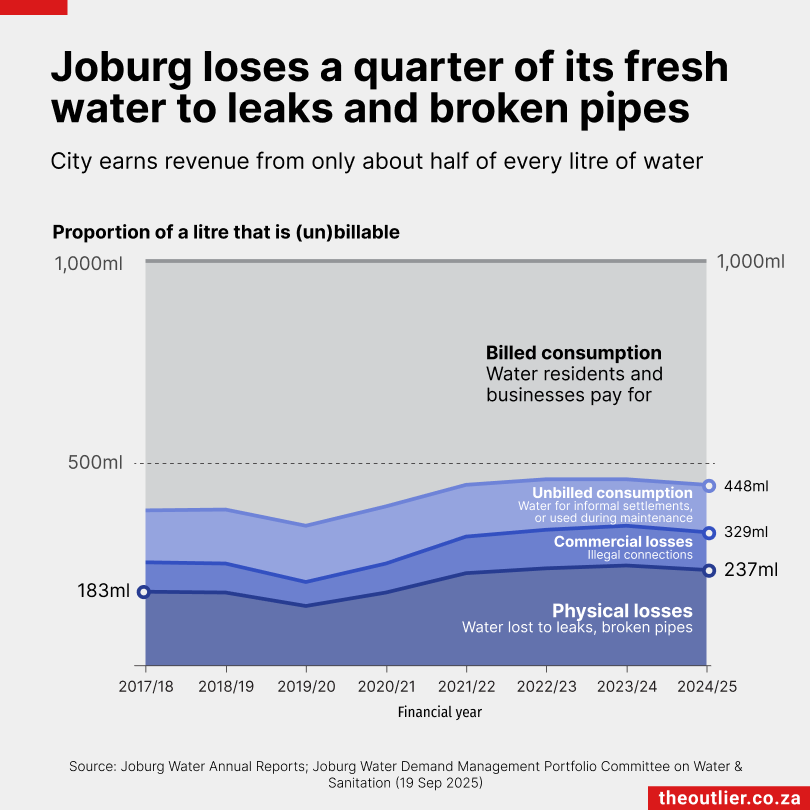
Rand Water’s decision to reduce water supply to Johannesburg and Tshwane due to “high consumption” has sparked understandable outrage among residents. For every litre of water Johannesburg Water supplies, 240ml disappears into the ground through leaks caused by crumbling old infrastructure. It’s a problem that has worsened over the last eight years, with water losses increasing from 183ml in the 2017/18 financial year.
While the city acknowledges the need for urgent repairs, progress is slow. To stabilise the network, Johannesburg Water needs to replace roughly 180km of water pipes annually, but it replaced only 17km in the 2023/24 financial year. In addition, 22 of Johannesburg’s 98 reservoirs are leaking.
Ultimately, residents are being asked to cut their water consumption when Johannesburg Water’s infrastructure is a sieve. It lost R2-billion worth of water in 2023/24 to leaks.
In total, Johannesburg Water could not bill water to the value of R3.9-billion. Other than leaks, water is consumed through unbilled, but authorised, consumption in informal settlements or lost through commercial losses like illegal water connections and metre tampering.
No flow
The long history of Joburg’s water crisis
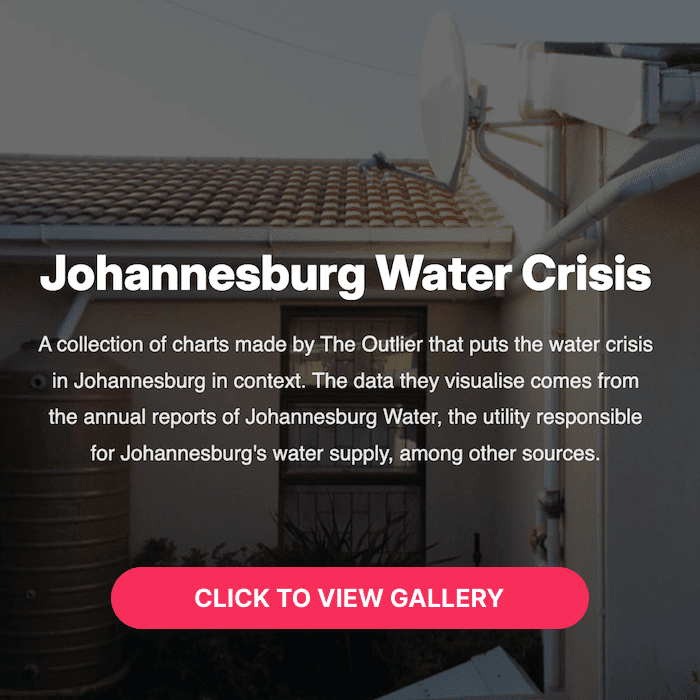
Most people could have predicted the current water crisis Johannesburg is facing. The conditions leading to the current shortages have been known and documented for many years: the lack of infrastructure maintenance, the resultant water leaks, the billing chaos and the failing water systems across the country. We take no pleasure from this but there is also no surprise. Over the past few years we’ve documented the gradual, sometimes rapid, decline in water services in the city using public data and charts.
Below is a link to a gallery of just some of those charts in the hope that it helps understand the current crisis for what it is: a long history of neglect.
 Tool updates
Consumer prices
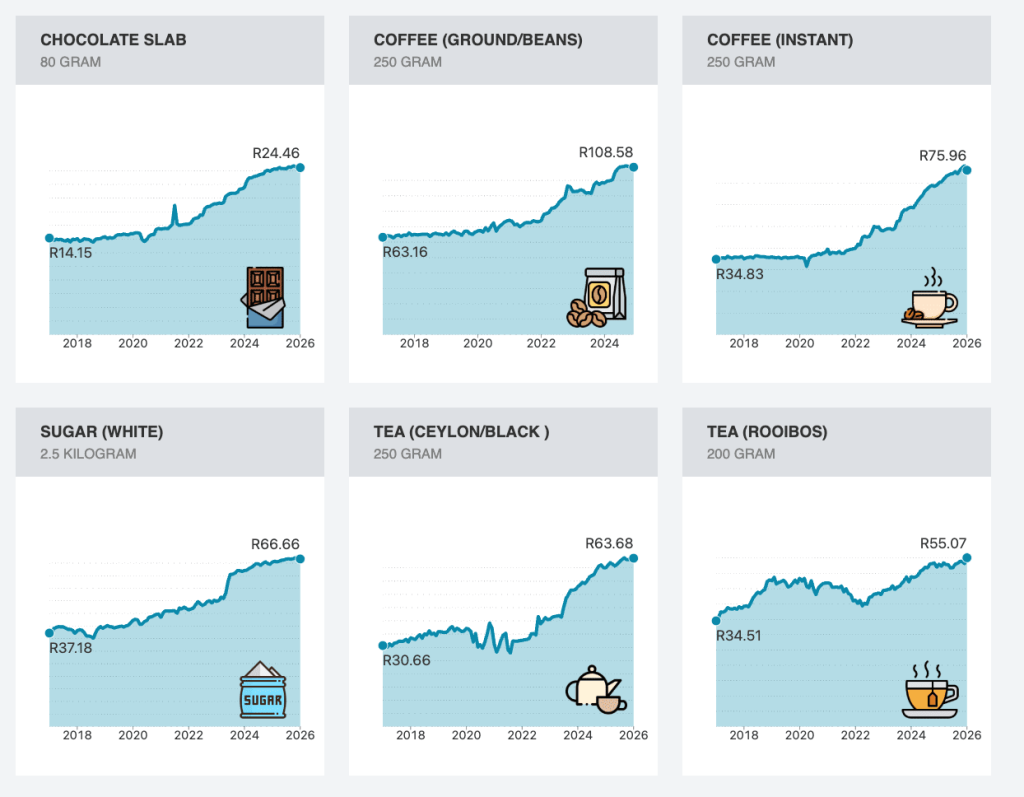
A couple of years ago we started a consumer prices dashboard to track the prices of goods over time and we’ve been updating it ever since. The data is based on Statistics South Africa’s CPI data and updated with all the prices on selected goods since 2017. If you’re a coffee and chocolate lover this might be painful to look at.
Take a look at the full dashboard here.
Energy registrations explorer
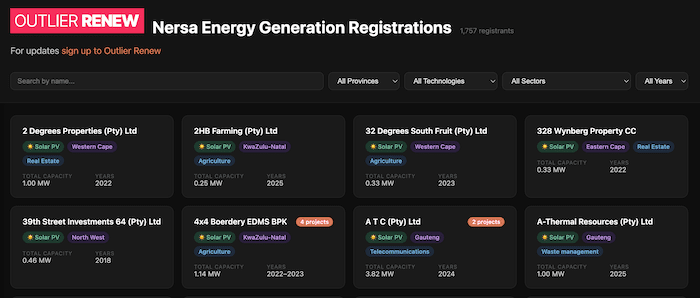
We’ve been monitoring the private power registrations with the National Energy Regulator of South Africa (Nersa) for quite a while. The data is easily available but not easily usable as it is multiple separate spreadsheets for different periods. So a couple of weeks ago Laura decided she needed a better way to search through the data and set about making something. The result: Our Outlier Renew Nersa Registrations Explorer. It’s still early days but it’s already pretty easy to use, and interesting to see which companies are doing what in the mostly renewable energy space.
Click here for a link to all references for this newsletter.