 Hard lessons
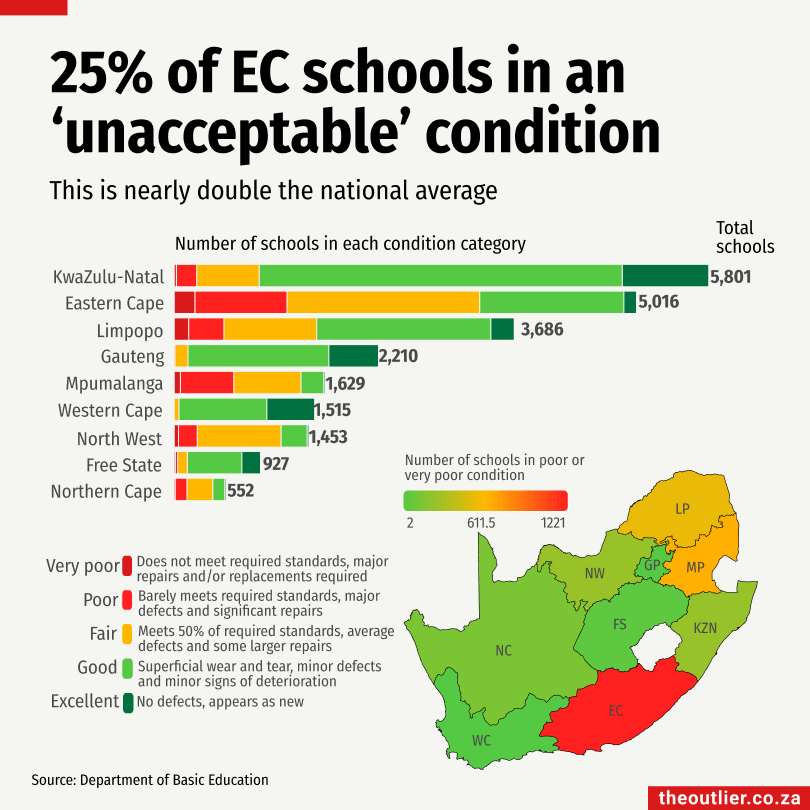
Nearly 25% of public schools in the Eastern Cape are in poor or very poor condition, according to information presented to Parliament’s Portfolio Committee on Basic Education on 3 March 2025.
What this means, in the words of the Department of Basic Education (DBE), is that those schools are either in a “totally unacceptable” condition or are “barely fulfilling their intended purpose”. They are also in need of “significant repairs” to fix “major defects” or they need “major replacements to restore functionality”.
The Eastern Cape has almost double the proportion of schools in poor or very poor condition as the national average of 13%, highlighting a major infrastructure challenge in the province.
The percentages mask the scale of the problem, however, because in raw numbers that 25% is 1,221 schools in the Eastern Cape and that 13% is 3,050 nationally.
The DBE uses a five-level condition rating system ranging from very poor to excellent. Schools classified as excellent, of which there were 2,588 across the country, have “no defects and appearance is as new”. Those classified as in good condition “perform satisfactorily but not optimally” and show “signs of superficial wear and tear and minor signs of deterioration to surface”. Most schools fall in this category (11,153 or 49%).
Schools in the richest provinces, Gauteng and the Western Cape, were more likely to be rated as excellent. In Gauteng, 24% of schools were rated as excellent and only 2 were in poor or very poor condition. In the Western Cape 34% of schools were in excellent condition and none were rated as being in poor or very poor condition.
 Banking security
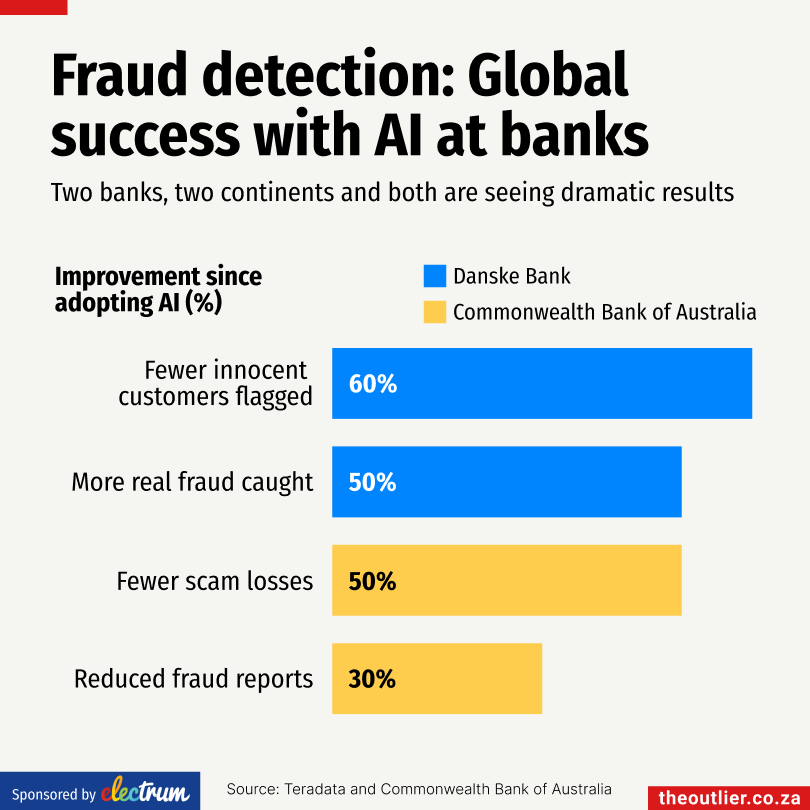
As South African banks move towards 2030, the “invisible” layers of the financial system are being rebuilt. AI and advanced analytics are no longer just experimental tools; they are now core to how banks manage risk and protect customer data. By embedding machine learning into their payments stacks, institutions are moving from reactive security to real-time, sophisticated risk simulations that stop threats before they impact the user. Both Danske Bank and The Commonwealth Bank have already seen success in using sophisticated AI models for fraud detection.
Turning Technical Capability into Practical Value
- Proactive Protection: Instead of just reacting to theft, AI now runs sophisticated, real-time risk simulations to spot “outlier” behaviour and stop fraud in its tracks.
- Conversational Finance: Banks are moving towards intuitive interfaces where you can talk to your app to get instant answers about your spending or contract terms, rather than waiting on a call centre hold.
- Faster Innovation: By using AI to handle “heavy lifting” like contract intelligence and data governance, banks are freeing up human experts to focus on creating new services that actually solve your financial problems.
- Global Safety Standards: To ensure this tech is used responsibly, banks are adopting new global standards (like ISO/IEC 42001) to balance powerful AI with “explainability” – ensuring the system is fair and transparent.
The 2030 Reality: The winners in the banking world are no longer the ones with the most branches; they are the ones who effectively combine high-tech AI with human expertise. Electrum and Cyan EA’s new report unpacks AI and Advanced Analytics as well as other key technology enablers that will determine the future of payments. To learn more, register here ahead of the report’s release.
 High steaks
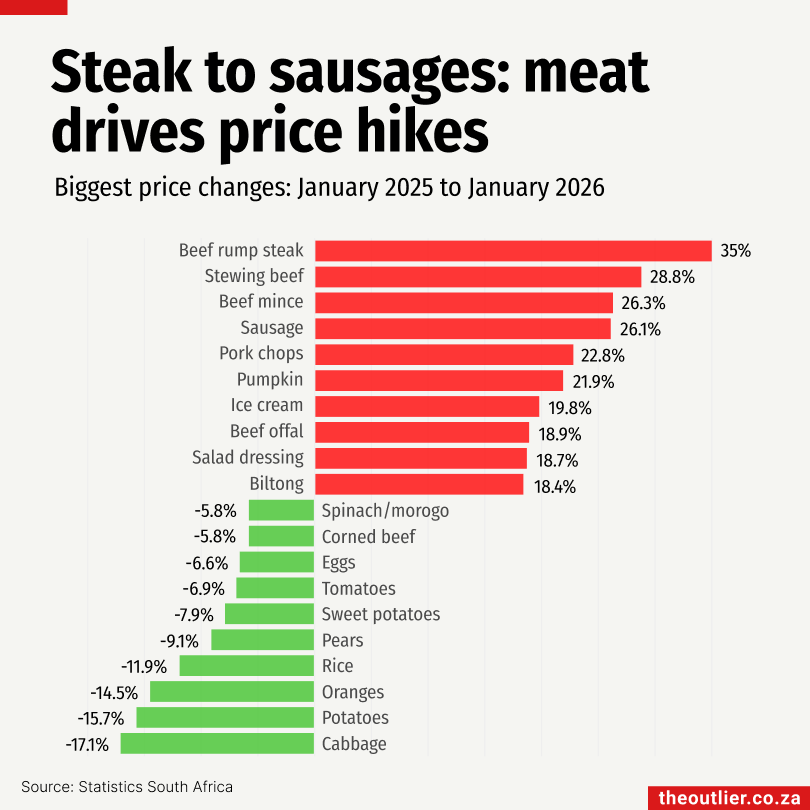
Meat is the biggest driver of food price increases in South Africa right now. Beef rump steak jumped 35% between January 2025 and January 2026. Stewing beef rose 28.8%, mince 26.3%, and sausage 26.1%. Pork chops were up 22.8%.
We calculated these prices from the monthly CPI basket released by StatsSA.
A foot and mouth disease outbreak across the country has had a huge effect on the meat industry.
For non-meat eaters the good news is that many of the starch staples and vegetables have actually reduced in price relative to last year. Cabbage fell 17.1%, potatoes 15.7%, and oranges 14.5%.
The split matters for household budgets. Protein is becoming less affordable, while many starches and vegetables are still affordable.
 Slow recovery
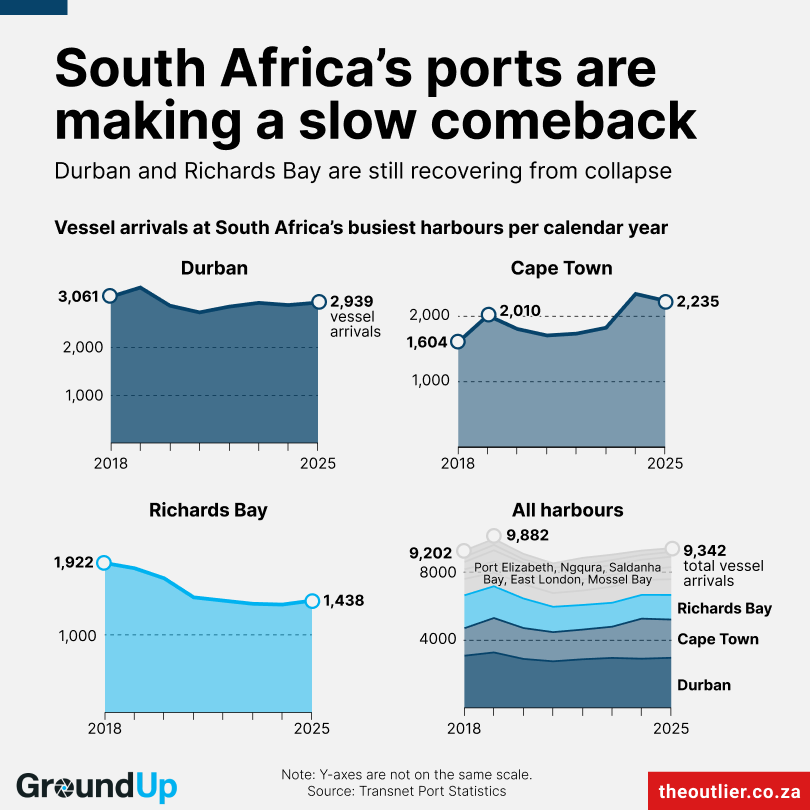
After a decrease in the number of ships docking at South African ports in 2020 and 2021, the country’s harbours appear to be making a gradual comeback.
Almost all of the country’s exported goods leave through harbours operated by state-owned Transnet.
The sharp drop in vessel arrivals – from 9,882 in 2019 to 8,453 in 2021 – was the result of the covid pandemic, compounded by ageing infrastructure and years of mismanagement and corruption at Transnet.
However, economic recovery and increased investment in South Africa’s ports, including new public-private partnerships, appear to be arresting the drop, with 9,342 vessels arriving in 2025.
Durban harbour, the country’s largest, has battled with ageing infrastructure and administrative delays, resulting in long waiting times. A new public-private partnership came into effect in January at Durban’s Pier 2 and is expected to improve throughput and ease congestion.
Cape Town harbour has been busier than ever. Since 2018, it has overtaken Richards Bay as the country’s second-busiest port, with record numbers in 2024.
- Read the full GroundUp story.
 Show’s over
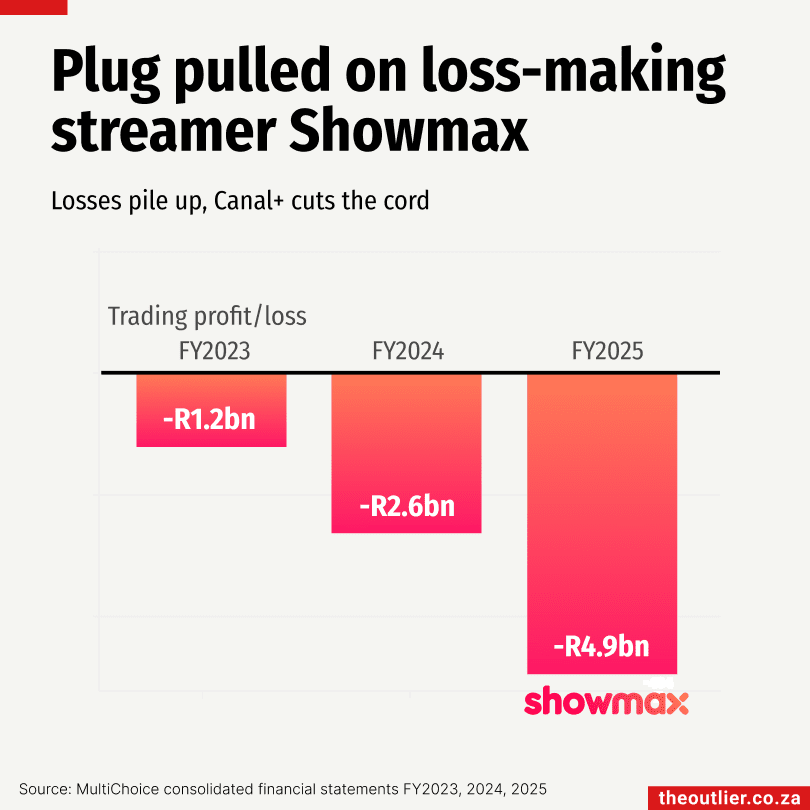
Showmax was MultiChoice’s flagship streaming service, built to compete across Africa. It attracted a decent audience by all accounts and MultiChoice reported subscriber growth of around 40% in 2025, though it doesn’t share exact numbers.
But the growth came at a cost. In financial year 2025, Showmax recorded a R4.9-billion loss.
The financial losses alone don’t fully explain the closure, though. Canal+’s acquisition of MultiChoice introduced a new complication: South African broadcast regulations limit foreign ownership of broadcast operations and resolving that legal uncertainty takes time. Faced with mounting losses and no clear resolution in sight, Canal+ appears to have decided Showmax wasn’t worth holding onto in the interim, or find another way around the limits.
For viewers, losing Showmax stings. But the deeper impact may be on South Africa’s TV and film industry. Showmax was commissioning thousands of hours of local content and local productions consistently dominated its top-10 rankings, a pipeline of work that will be hard to replace.
Click here for a link to all references for this newsletter.