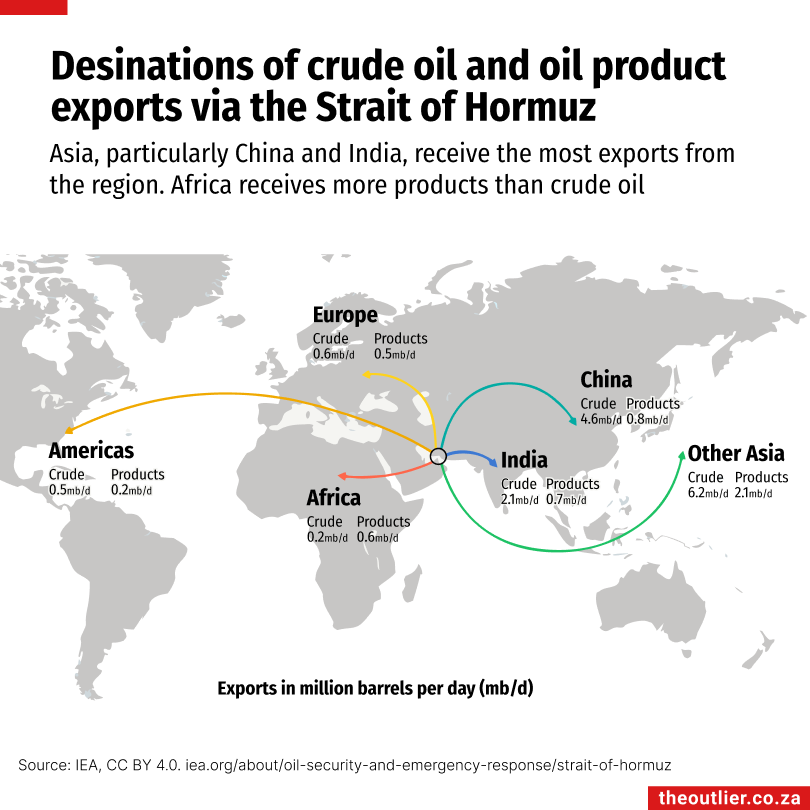

South Africa’s energy security is the focus of this week’s newsletter thanks to threats of a petrol price hike next month because of the conflict in the Middle East. Since 28 February the supply of oil coming from the Gulf countries through the Strait of Hormuz has been throttled.
About 25% of the world’s seaborne oil is shipped through the Strait of Hormuz, according to the International Energy Agency. In 2025 that was an average of 20-million barrels a day of crude oil and oil products. The Strait of Hormuz is the primary export route for oil from Saudi Arabia, the United Arab Emirates (UAE), Kuwait, Qatar, Iraq, Bahrain and Iran.
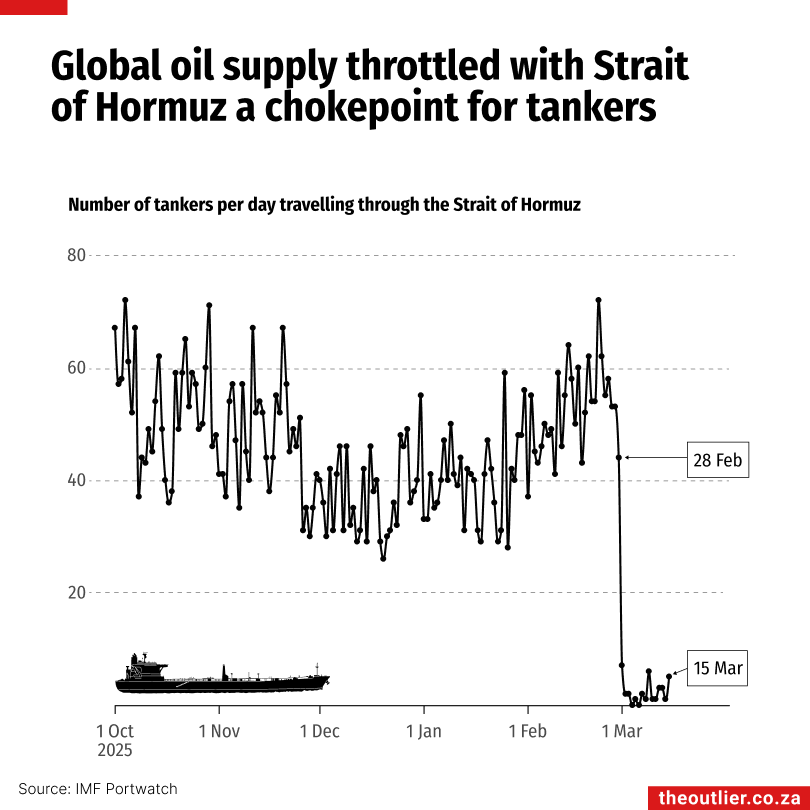
Most of that oil goes to markets in Asia (see map). Africa exports more oil products than crude oil.
Most of South Africa’s crude oil imports are from Nigeria. We also import crude from Angola and Ghana (2024 South African Energy Trade Report). But that doesn’t mean we’re sheltered from the effects of the conflict in Iran. When it comes to oil products like diesel, petrol and jet fuel, South Africa is very exposed.
For example, the Department of Electricity and Energy reports that in 2024 well over half of South Africa’s imported diesel came from Oman, the UAE and Bahrain, while another 20% came from India. About 46% of our petrol imports were from the UAE and Saudi Arabia, and the other 24% was from India. And around 95% of our jet fuel imports were from Gulf countries – hence the warnings about increases in air fares.
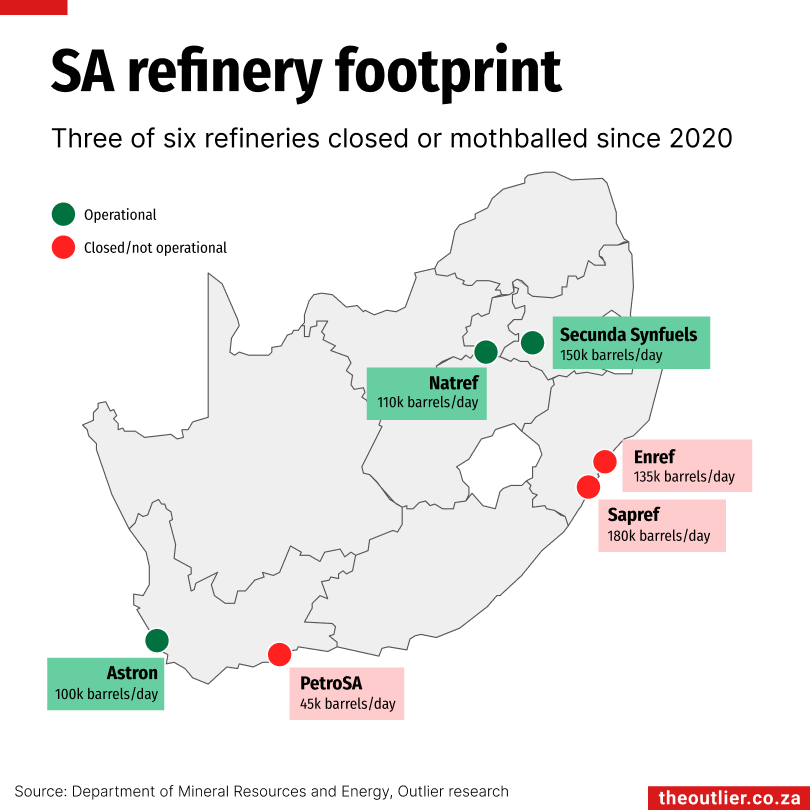
Even though South Africa imports most of its crude oil from West Africa, it has lost a chunk of its refining capacity. Three of its six refineries have closed since 2020, halving the country’s capacity from 720,000 barrels per day to 360,000. This leaves the country heavily dependent on imported diesel and petrol. South Africa reportedly imports about two-thirds of these refined fuels.
This oil crisis highlights that it’s time to speed up the move to electric vehicles in South Africa powered in large part by locally generated renewable energy.
🔌 On Tuesday, 24 March, we will host a free webinar with Joubert Roux, one of South Africa’s leading renewable energy entrepreneurs. Roux will unpack the country’s EV charging landscape, explore whether South Africa is ready for electric vehicles to go mainstream, and share how off-grid solutions are already making it possible. Register here to attend. Live attendance is free. Outlier Renew members will get access to the recording of the webinar after the event.
NEWS WRAP
🚚 Zero Carbon Charge and Zimi have announced a three-year partnership to support the rollout of electric freight operations on the N3. Zimi works with commercial fleet operators to deploy electric vehicles by bundling electric vehicles, energy and software in one unified lease. Zero Carbon Charge will launch two off-grid solar-powered EV charging stations on the N3 between Johannesburg and Durban in May. Each site will have six fast-charging connectors. Under the agreement Zimi-operated vehicles will have reserved charging capacity of up to 500kWh per station per day. The model aims to protect fleet operators from rising electricity and fuel prices.
☀️ The 240MW Mooi Plaats Solar PV project has started commercial operations. The project near Noupoort on the border of the Eastern and Northern Cape is part of the Koruson 2 cluster, a renewable energy development led by Envusa Energy. The plant has 416,324 bifacial photovoltaic modules mounted on a single axis tracker system and supported by 943 inverters. It is expected to generate 360-million kWh of electricity a year, which will be supplied to Anglo American’s South African mining operations including Anglo Platinum, Kumba Iron Ore and De Beers. Koruson 2 is a joint venture between Anglo American and EDF Renewables.
☀️ Coega Steels and Emergent Energy commissioned a 7MW solar project earlier this month at the company’s metal recycling plant in the Coega Industrial Development Zone in Nelson Mandela Bay. The project comprises 11,484 solar panels – 3.91MW rooftop and 3.17MW ground-mounted – and 23 inverters. Huawei Digital Power Sub-Saharan Africa supplied the inverters and transformers. Coega Steels now has just under 8MW of installed solar, which supplies 7% of electricity it requires to operate. It has plans to increase that to 20% by installing another 20MW of solar – The Herald (paywalled)
🔌 Ignite Energy Access has commissioned 15 mini-grids in Zambia, bringing the total in operation in the country to 30. The mini-grids supply electricity to households, small businesses and essential community services in remote or underserved communities.
💰 The Stanlib Khanyisa Energy Transition Fund announced its first close at R5-billion. The fund aims to mobilise capital to help finance South Africa’s just energy transition. So far the fund’s capital has been deployed across 14 Renewable Energy Independent Power Producer Procurement Programme projects. The fund expects to grow to R18-billion.
☀️ Independent power producer Anthem’s 475MW Notsi solar project reached financial close on 5 March. The project, which is in the Free State, reached private power off-take agreements with electricity traders Discovery Green and NOA Group. Construction is expected to take 26 months. Electricity from Notsi will be wheeled through Eskom’s national grid to customers around the country.
EVENTS and RESOURCES
🔋 Solar & Storage Live Africa returns to the Gallagher Convention Centre from 25 to 27 March. The exhibition will feature more than 650 solution providers showcasing technologies across solar generation, energy storage, power electronics and smart energy systems. Alongside the exhibition will be a three-day conference. Outlier Renew is a media partner for the event. To register to attend the exhibition and conference for free, you can register here.
📊 Webinar: Data Decisions and Disputes: Powering Energy-Intensive Users in a Liberalising Electricity Market. EE Business Intelligence is hosting a webinar on 25 March 2026 from 10am to 12.30pm. The presenters will discuss how the ability to accurately measure, forecast and optimise demand and generation will become business-critical. Attendance is free of charge. Register here.
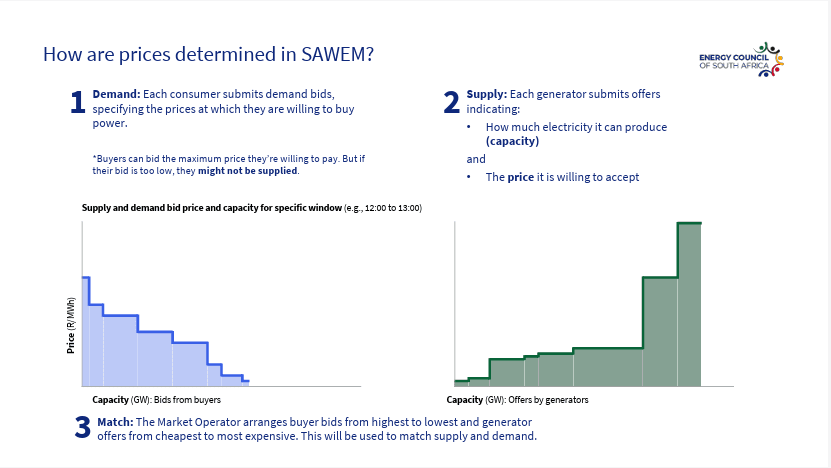
⚡️ The Energy Council of South Africa has produced a series of explainers on the South African Wholesale Energy Market, which they’ve been publishing on their LinkedIn account. You can find Chapter 1 of their Electricity Wholesale Tariff Series here and How Does and Electricity Market Work here.
🖥️ Webinar: Gas: An update on South Africa’s gas sector priorities and challenges. Creamer media is hosting this discussion on 25 March at 2pm. It will cover progress on Bid Window 1 of the Gas Independent Power Producer Procurement Programme and how gas-to-power fits into the Integrated Resource Plan 2025, among other topics. Register here.