 Industrial slump
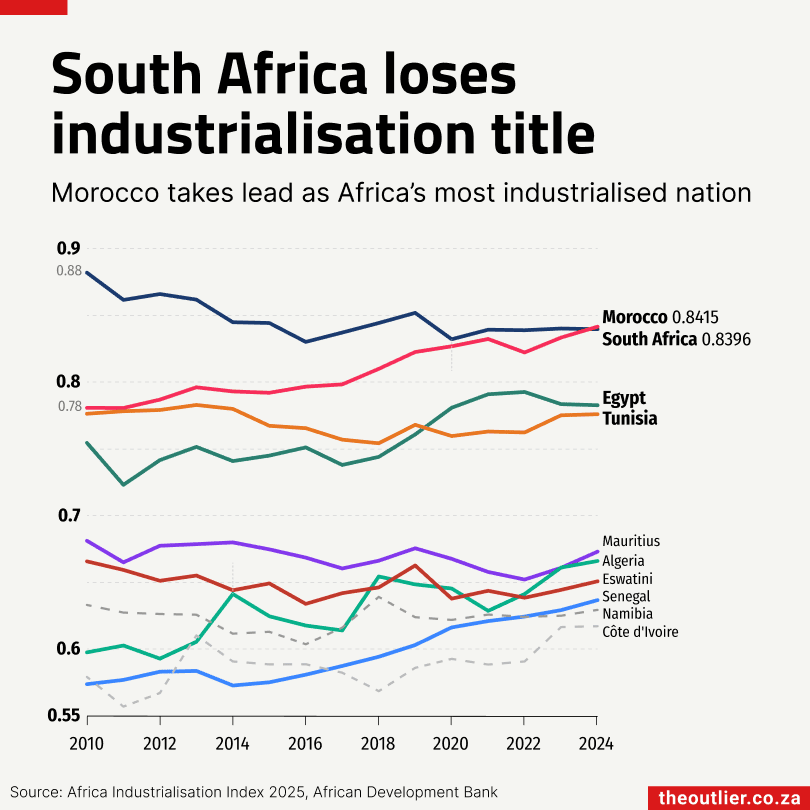
South Africa has lost its long-held position as Africa’s most industrialised economy, with Morocco overtaking it for the first time. Morocco’s 2024 score of 0.8415 edged past South Africa’s 0.8396, reflecting gains in Morocco’s manufacturing exports, diversification and industrial policy, and against a backdrop of gradual decline in South Africa since its 2010 score of 0.8819.
The index, compiled annually by the African Development Bank, is a composite measure built from 19 indicators across three categories: manufacturing performance (output, exports, employment and technological sophistication), direct determinants (investment, credit, infrastructure and skills), and indirect determinants (business environment, governance and macroeconomic stability). Each country gets a score between 0 and 1.
Egypt and Tunisia round out the top four, both well ahead of fifth-placed Mauritius.

 Shiny happy

South Africa now has more than 8GW of rooftop solar panels installed, on homes, businesses and factories, according to Eskom. We don’t have exact figures for home solar capacity, but StatsSA’s household survey shows the number of homes with solar panels jumped 86% in three years, reaching 675,000 in 2025. Gauteng and the Western Cape have two-thirds of these homes.
Most of that 8GW rooftop total isn’t on houses, though. It’s on shopping malls, warehouses and factories that switched to solar because of loadshedding and high Eskom prices.
In this week’s Outlier Renew deep dive we look at the solar panel imports and installations and ask: who is using all this power?

Out to Lunch with The Outlier will sit down with Dr Werner van Antwerpen, Head of Corporate Advisory at Growthpoint Properties, on 24 June 2026 at 1pm to unpack what electricity wheeling is and whether it cuts costs for businesses.
Attendance is free. Sign up to be an Outlier member for the recording.
 Rapid decline
Last week, we covered Cape Town’s MyCiti bus service, which hit 20-million annual passenger journeys in the 2024/25 financial year. This week, we look at Joburg’s Rea Vaya rapid bus service, which is proving to be less successful. At its peak in 2018, it was running 52,000 passenger trips per day, or just shy of 19-million trips a year.
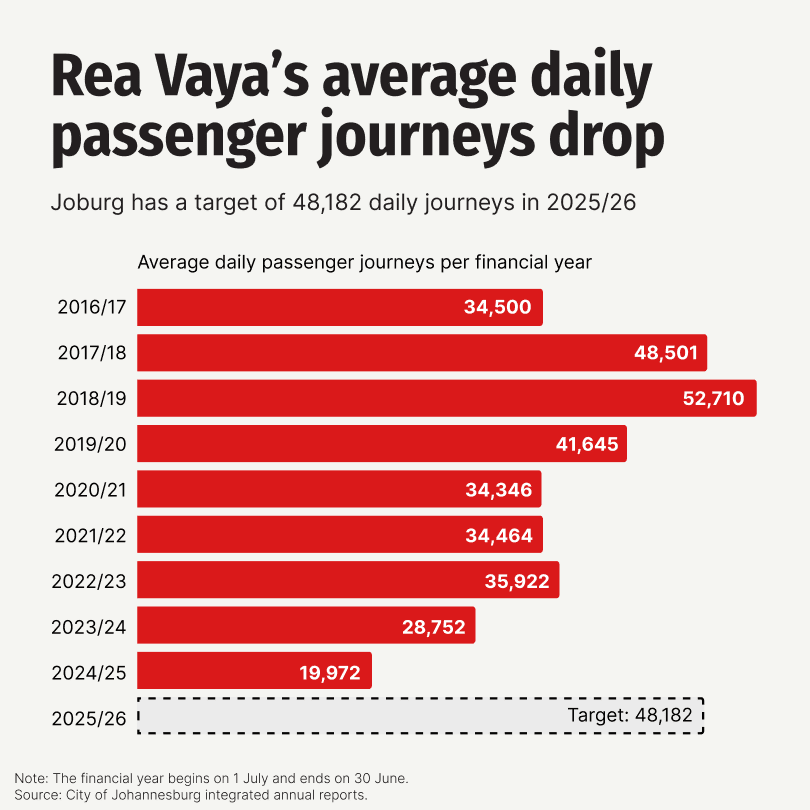
In the past financial year that has dropped to under 20,000 passenger trips per day on average leaving minibus taxis to dominate public transport.
The Rea Vaya bus service always seemed like an excellent idea but has been beset by endless challenges, both political and financial, eventually resulting in PioTrans, the company licensed to operate the Rea Vaya service, filing for business rescue in December 2023.
Despite originally being designed in partnership with the taxi industry, there have been constant disputes between the parties over lucrative taxis routes, resulting in endless delays and eventually vandalism as unused stations sat unfinished or empty.
Also, Rea Vaya feeder buses serving Soweto, introduced in November 2024, were suspended following protests from the taxi industry over registration concerns, briefly resumed, then suspended again in February 2025 after two drivers were killed.
The Rea Vaya is funded primarily by the Public Transport Network Grant, a grant funded by the national government. But in early June, Transport Minister Barbara Creecy announced her department’s plan to wind down the grant by 2028/29 after it was found that the bus rapid transit programmes were underperforming. Cape Town’s MyCiti service also faces funding uncertainty with the winding down of the grant.
Produced in partnership with Our City News.
 TVET students
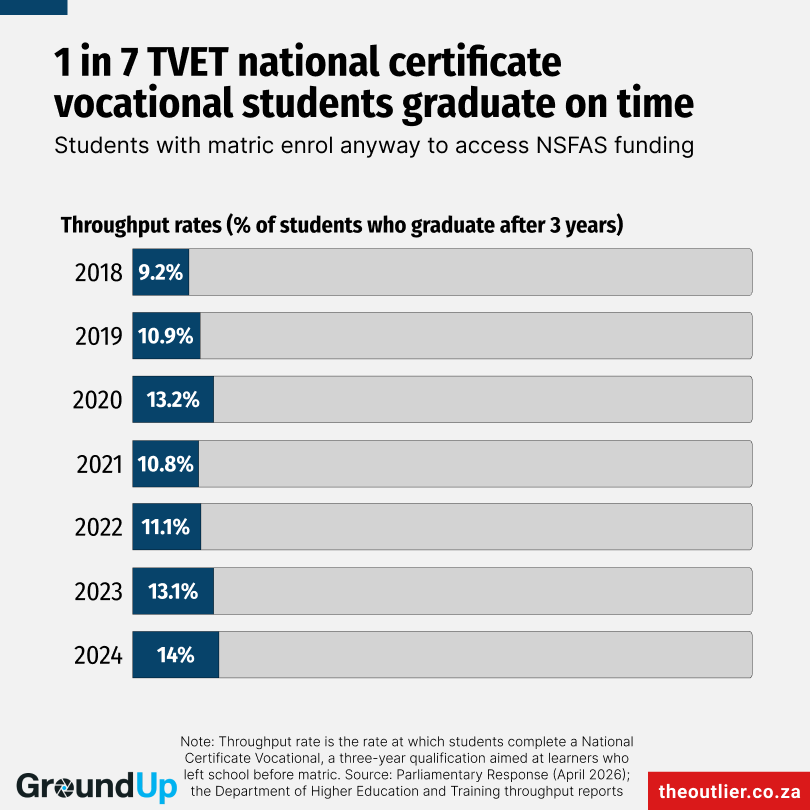
The National Certificate Vocational (NCV) qualification offered by TVET colleges is a three-year course targeted at learners who left school at grade 9, 10 or 11 with a school leaving certificate. The NCV is a vocational alternative to a matric certificate.
The government believes the low percentage of people who graduate within the prescribed three years (or “throughput”) is driven by the fact that most people who enrol in the programme already have a matric certificate, essentially “repeating” a qualification they already have.
In 2024, Nobuhle Nkabane, then higher education minister, told Parliament that matriculants, often those with low NSC results, enrol in the NCV programme so that they can receive NSFAS funding while they await other education or job opportunities.
It is not a bad thing in principle for the government to be offering a form of income to young people, together with training.
It does mean, however, that the NCV programme is under pressure, impeding its ability to do what it was intended for, which is to provide vocational training to people who do not complete matric.
Read the full GroundUp article here.
Click here for a link to all references for this newsletter.