
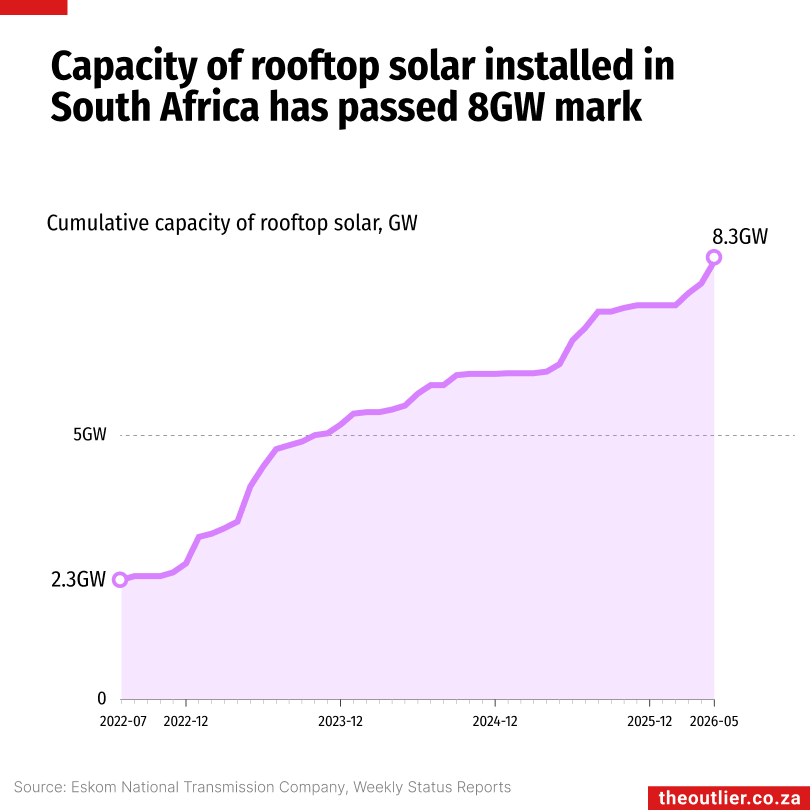
This week’s newsletter focuses on solar panels for a few reasons. Firstly, because the capacity of rooftop solar in South Africa has now passed 8GW, according to Eskom’s latest weekly status report. Those are the panels installed on commercial and industrial buildings as well as on households.
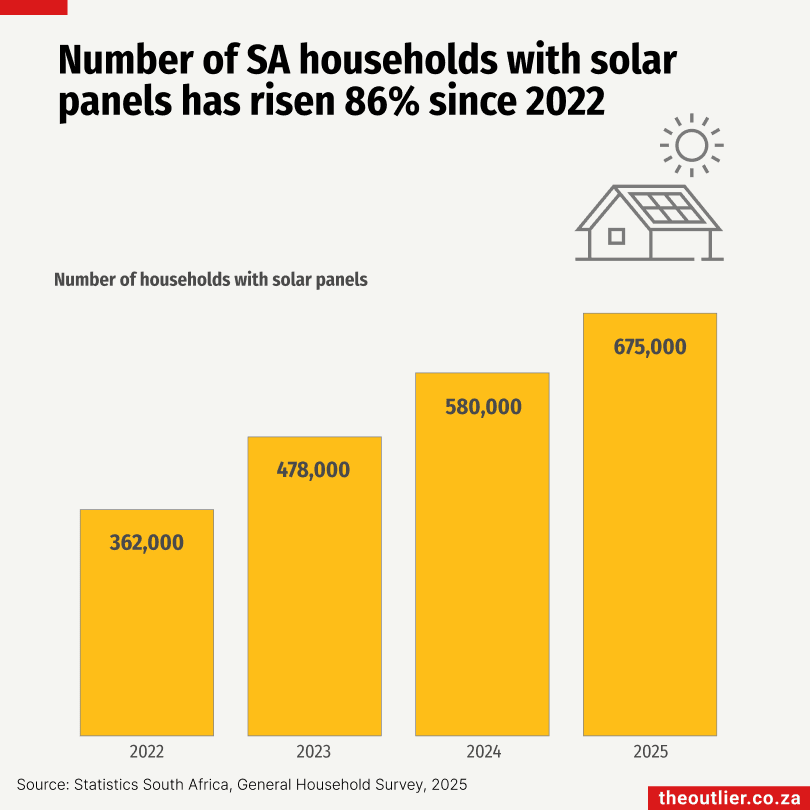
We can’t find data on the megawatts of solar that have been installed on people’s homes, but StatsSA’s annual General Household Survey recently published 2025 data on the number of households with solar panels. That number has increased by 86% in the space of three years. 675,000 households in South Africa had solar panels in 2025, according to the survey. Half (52%) of those households are in Gauteng, and another 16% are in the Western Cape, so together those two provinces have two-thirds (68%) of the households with solar panels.
But the bulk of the 8GW of rooftop solar that Eskom reports is not sitting on the roofs of people’s houses; it’s on the shopping malls, warehouses and other commercial and industrial properties that invested in solar because of loadshedding and have continued to do so because of the high cost of Eskom’s electricity.
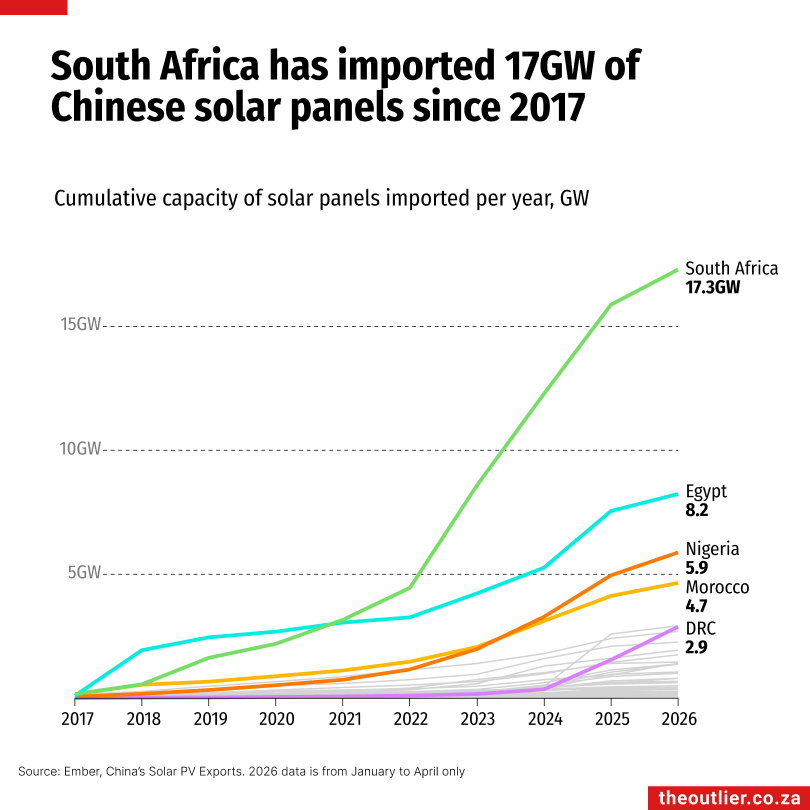
This brings me to the second reason I’m focusing on solar panels this week. Ember’s data shows that South Africa has imported 17.3GW of panels from China since 2017. This is by far the most of any African country. For context, the chart below shows South Africa’s imports compared with the other top importers on the continent.
Where are all those imported panels being used? The private solar PV generation projects registered with Nersa and the government’s renewable energy and risk mitigation independent power producer programmes (REIPPPP and RMIPPPP) can give an indication of where some of those 17GW of panels have gone.
Around 13.7GW of solar PV projects have been registered with Nersa since 2018. These are the projects that have permission to link to the national grid or a municipal distribution network, so solar installations that are for on-site use only (like the ones on your neighbour’s roof) are unlikely to be on that list.
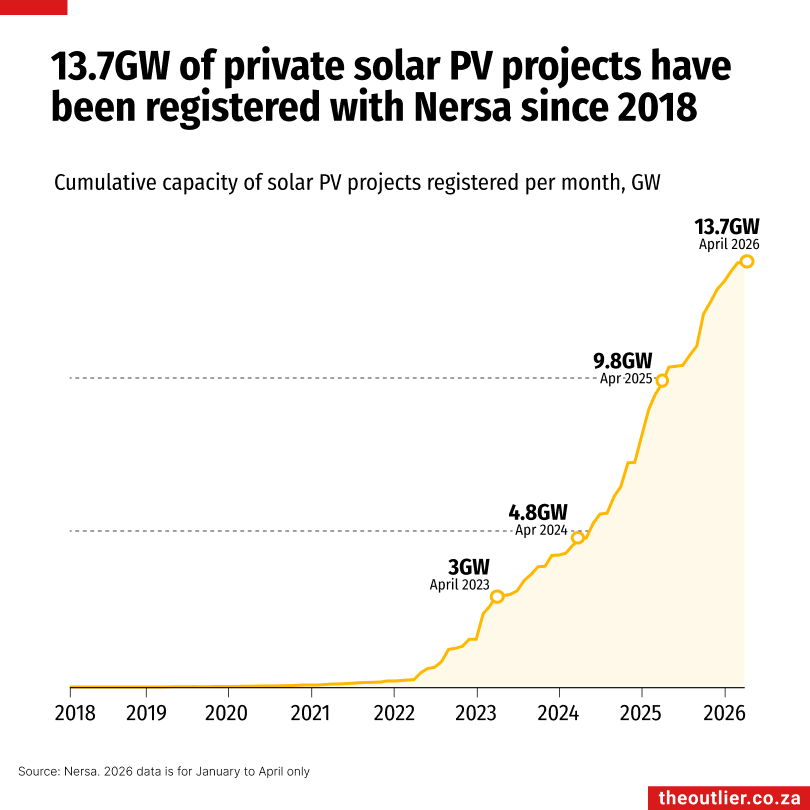
Some of the Nersa-registered projects are big utility-scale facilities whose electrons will be wheeled though the national grid to private users like mines or data centres. Others are at farms or shopping malls. There’s a wide range of developers. Not all of the projects on the register are operational and many of them may not be under construction yet. Nersa doesn’t share that information.
Then there are the big utility-scale projects that are part of REIPPPP and RMIPPPP. There is 8.1GW of solar PV under those programmes, according to our calculations. But only 2.8MW of them are built and operational. Most of the projects are working towards financial close and not yet under construction.
Which brings me back to the rooftop solar stats. Nersa registered private power projects and rooftop solar together total 22GW. And there is more rooftop solar PV installed now (ie, 8.3GW) than there is contracted by the government’s independent power producers programmes and operational – 2.8GW. So the surge in Chinese solar panel imports is being driven by private sector projects.
RENEWABLE PIN-UP
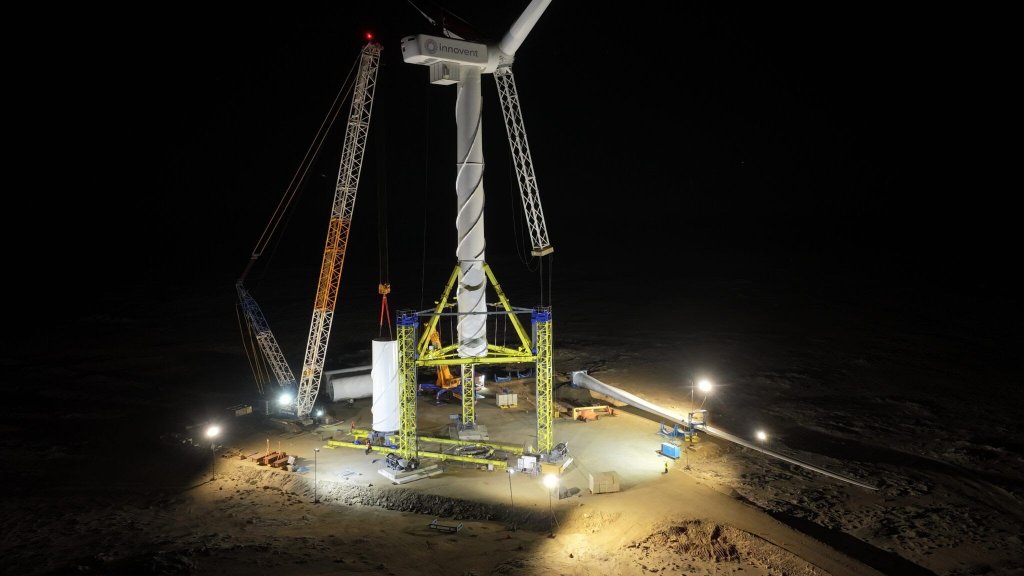
A “crane-less” system for installing wind turbines (Photo: Nabrawind)
A wind turbine in Namibia has become the first in the world to be commercially installed without a crane. The turbine is the first of seven at the InnoVent Diaz Wind Farm near Lüderitz that will be installed using Skylift, a system developed by Spanish engineering firm Nabrawind.
Standard cranes can only install turbine blades at wind speeds between 6 and 8 m/s. Skylift can operate at 15 m/s, with bursts up to 20 m/s. The system also removes the need to transport heavy cranes to remote sites with limited road access.
“The turbine essentially builds itself upward from the ground,” InnoVent executive director for Southern Africa Tom Torne told The Namibian.
Namibia currently imports 60–70% of its electricity, mainly from South Africa. The Diaz Wind Farm is expected to produce 230GWh a year, covering roughly 6% of the country’s electricity demand.
Vital statistics
Location: InnoVent Diaz Wind Farm, near Lüderitz, Namibia
Number of turbines: 11, seven of which are Goldwind GW165/6000 wind turbines. The remaining four turbines, which have already been installed, are XMEC-Darwind XE93-2000 wind turbines.
Total capacity: 44MW
Expected generation: 230GWh a year, 6% of Namibia’s electricity demand
Emission prevention: 200,000 tons of CO2 annually
Start of construction: 2023
Expected commission date:August 2026
NEWS WRAP
💨 The 110MW Impofu North wind farm in Humansdorp in the Eastern Cape has reached commercial operation, developer Enel Green Power reports. It’s the first of three wind farms that make up the 330MW Impofu Wind Power Farms Complex to reach this milestone. The complex, which comprises Impofu North, Impofu East and Impofu West, has a power purchase agreement with Air Liquide and Sasol to wheel electricity through the grid to Sasol’s Secunda operations in Mpumalanga, where Air Liquide operates an oxygen production facility.
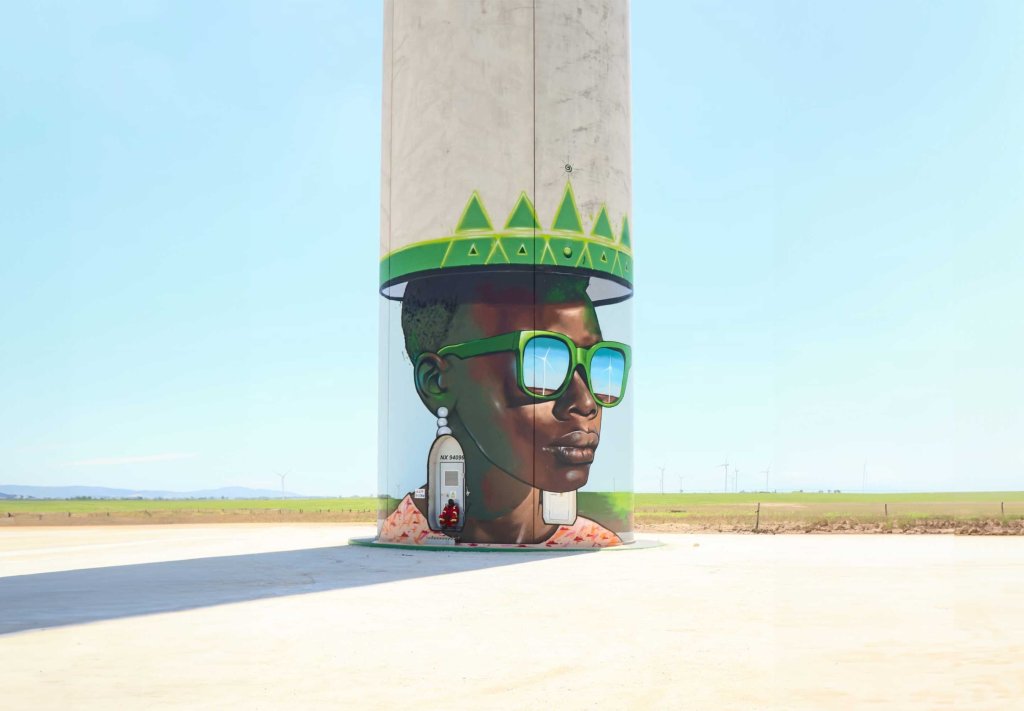
Three South African artists, Falko, Motel and Bushy, painted murals on wind turbines as part of a Blowing Art Initiative at the Impofu Wind Farm Complex in Humansdorp in the Eastern Cape. This one is painted by Falko. I love the earring door. (Photo: Enel Green Power)
💰 Revego Fund Managers is exploring a merger with HI Holdings that would create a renewable energy-focused fund with assets exceeding R13.3-billion, Bloomberg reports. Revego Africa Energy Fund’s portfolio includes the Khobab, Loeriesfontein, Noupoort and Aurora wind farms as well as Konkoonsies, Aries, Soutpan, Kathu and Springbok solar plants and Bokpoort concentrated solar plant.
⚡️ Eskom officially launched Eskom Green, its utility-scale renewable energy business, this week. The press release states that “Eskom Green will have about 6GW of carbon-free electricity available up to 2030, as a result of Eskom’s broad pipeline of renewables and storage initiatives currently under development.” It also states that at least 2GW of renewable energy and pumped storage projects are expected to advance from 2026. This includes the 75MW solar project at the Lethabo coal power station site, it says. Not mentioned in the media release, but also in the pipeline is the 1.5GW Tubatse pumped storage project in Limpopo. Eskom currently has renewable generation capacity of around 3.4GW (2.7GW of existing pumped storage, 600MW of hydro and 100MW of wind), according to its 2025 Integrated Report.
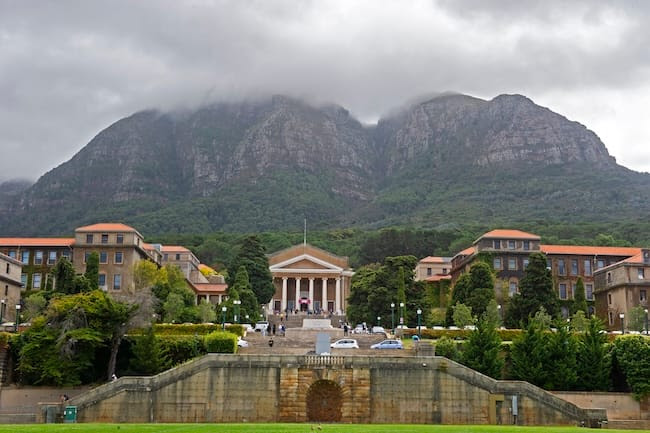
The old buildings of the main campus of the University of Cape Town. 90% of its electricity consumption will be wheeled renewable energy starting from 2027, says energy trader Discovery Green.
The University of Cape Town has signed an agreement with energy trader Discovery Green to buy renewable energy for its main and health sciences campuses. The wheeling agreement will help UCT decrease its scope 2 emissions (indirect emissions from purchasing electricity). “With the many old heritage buildings on most of its campuses, UCT has limited roof space that it can add solar PV onto, meaning that we have to look off-campus to increase our purchase of renewable energy,” says Manfred Braune, UCT’s director for environmental sustainability.
💦 Lesotho has signed a memorandum of agreement with US-based Convalt Energy to develop renewable energy projects and facilitate a large-scale data centre project. What’s proposed is the development of the Kobong Hydropower and AI Data Centre Project, Green Building Africa reports. It entails up to 1.2GW of hydro-power generation capacity, and around 4.6GW of solar generation capacity and up to 4GWh of battery storage, according to Convalt Energy. “Progression of this project remains subject to the ordinary course of development milestones, including feasibility studies, permitting, financing, regulatory approvals and definitive project agreements, says Convalt Energy in a press release.
☀️ Still in Lesotho. The Lesotho Highlands Water Project has issued a request for proposals for a feasibility study for floating solar power plants in the Katse and Mohale dams. The country imports nearly half of its electricity from South Africa and Mozambique, but has ambitions to become electricity independent by 2030. You can find the RFP document here.
☀️ The Zambian government has signed an implementation agreement for the 16MW Northrise Solar Photovoltaic Power Project in Ndola. The project is being developed by Lifesong for Orphans Zambia, which is the majority shareholder in LightCon Zambia, a solar electrical engineering and construction company. The grid-connected project is expected to be commissioned in July. The $12-million investment is phase one of a larger development. Lifesong intends to add another 35MW in phase two.
💦 British International Investment (BII), the UK’s development finance institution, has committed $20-million to Azana Electric Group to support the construction of run-of-river hydropower projects across Africa. The first project is expected to be in Zambia.
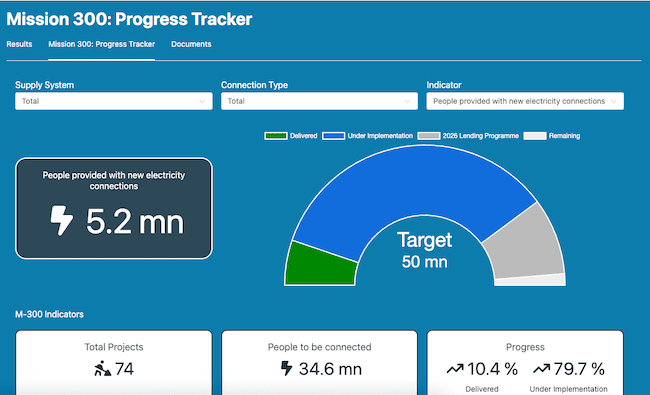
📊 The African Development Bank (AfDB) has launched a dashboard to track progress on the Mission 300 initiative, which was established with the aim to connect an additional 300-million Africans to electricity by 2030. According to the dashboard, 5.2-million people have been connected to electricity through AfDB Mission’s 300 supported operations. The tracker aims to strengthen transparency, improve monitoring and accelerate delivery of electricity access, says the AfDB.
EVENTS
⚡️ The Africa Energy Forum 2026 is being held at the Cape Town Convention Centre from 16-19 June. Find more information here.
💻 Creamer Media is hosting a webinar on embedding ESG (environmental, social and governance) in SA’s value chains on 17 June 2026. Register here.
🍃 The Bio360 conference and exhibition will take place at the Gallagher Convention Centre in Johannesburg from 17-8 June 2026. The focus will be on all bioenergy sectors, including biogas, landfill gas, bioelectricity, bioheat and more. Details and registration.
⚡️ The 44th International Energy Workshop will be held in Cape Town from 22-24 June. The event will be held at the University of Cape Town. Details and registration.
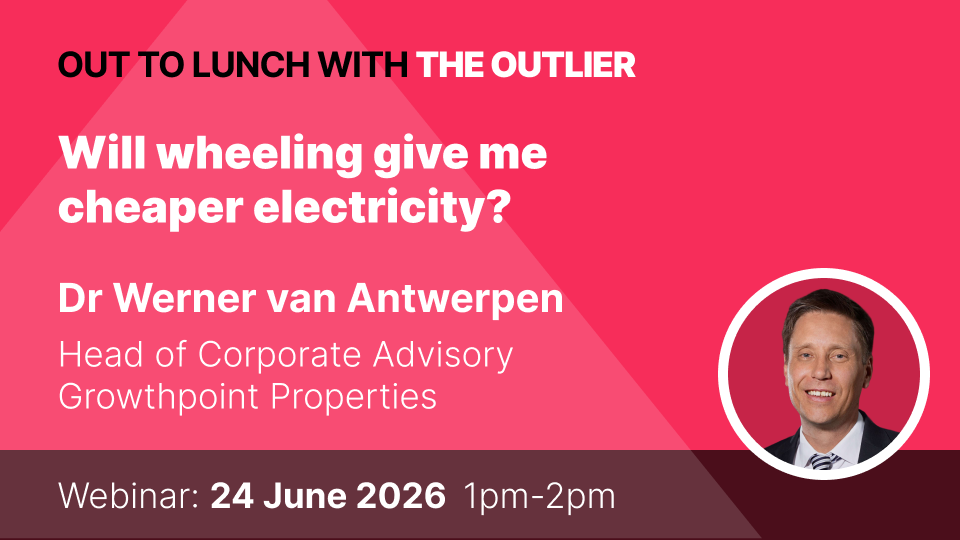
Out to Lunch with The Outlier will sit down with Dr Werner van Antwerpen, Head of Corporate Advisory at Growthpoint Properties, on 24 June 2026 at 1pm to unpack what electricity wheeling is and whether it actually puts money back in tenants’ pockets.
Attendance is free. Sign up to be an Outlier member for the recording.