🚌 Lost in transit
Last week we looked at the slowly crumbling Rea Vaya bus system in Joburg and the week before the better performing MyCiti bus service in Cape Town. This week we’ve been looking through the latest General Household Survey from Statistics South Africa and the transport data caught our attention.
The most obvious datapoint is that when it comes to getting to work, barely four percent of South Africans use any form of public transport. Train use is all but negligible while bus use accounts for just 3% of the transport used.
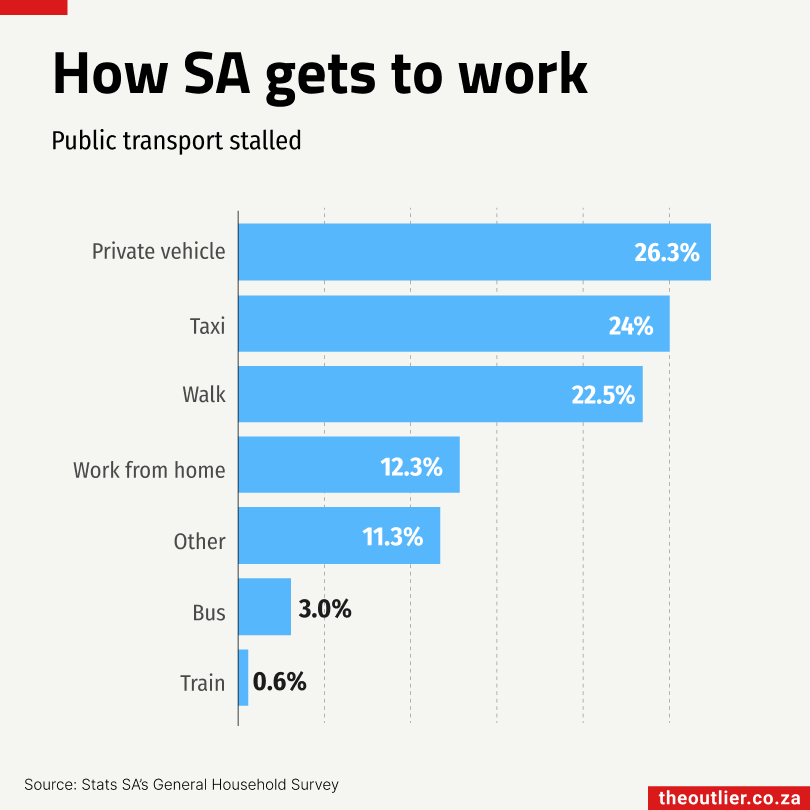
Private vehicles and taxis are the dominant forms of transport for SA workers. That is perhaps unsurprising, but as traffic congestion in cities like Johannesburg and Cape Town worsen the lack of public transport is a growing issue. Cape Town in particular regularly makes the list of most congested cities in the world, with Joburg and Pretoria close behind.
One of the most surprising numbers is not on this chart though: the number of learners who walk to school. When looking at how people get to school, more than 60% of South Africans walk. This is a national number so it covers learners walking through cities and towns to school as well as those walking in rural areas. A short, regular walk to school through safe suburbs is not a bad thing, but if it means that learners are walking long distances through dangerous areas or terrain, this ought to be more of a concern and the provision of school transport is essential.
⛏️ Digging it
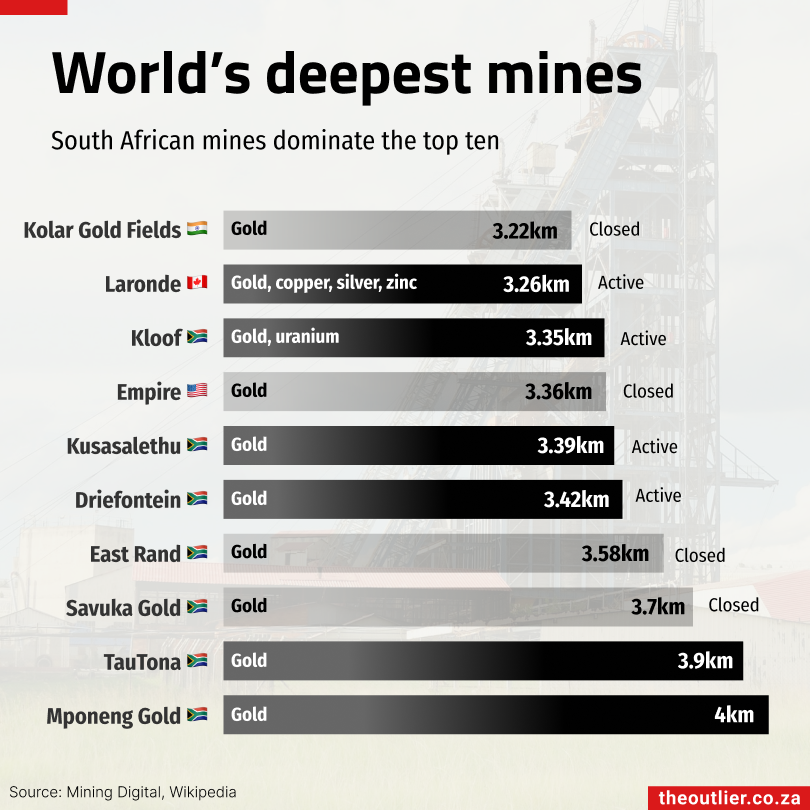
South Africa’s Witwatersrand gold basin dominates the list of the world’s deepest mines, claiming seven of the ten spots. Chasing ever-thinner reef seams buried beneath ancient rock, South African engineers have bored deeper than anywhere else on earth, with Mponeng Gold Mine in Carletonville holding the record at 4km below the surface.
The one notable new entrant is Laronde in Québec, Canada, a polymetallic mine producing gold, copper, silver and zinc that now ranks ninth at 3.26km. It’s the only non-South African active mine in the top ten, and its inclusion edges out Blyvooruitzicht, which appeared on earlier versions of this list.
Of the ten mines shown, six remain active. The closed mines tell their own stories: India’s Kolar Gold Fields, once one of the oldest and most productive in the world, shut in 2001 when falling gold prices made its depth uneconomical despite gold still sitting in the rock. California’s Empire Mine, a 19th-century gold rush relic, closed as far back as 1956.
☀️ Panel power
Solar power is booming in South Africa. There are now more than 8GW of rooftop solar panels installed, on homes, businesses and factories, according to Eskom. And according to Ember’s data, South Africa has imported 17.3GW of panels from China since 2017. This is by far the most of any African country.
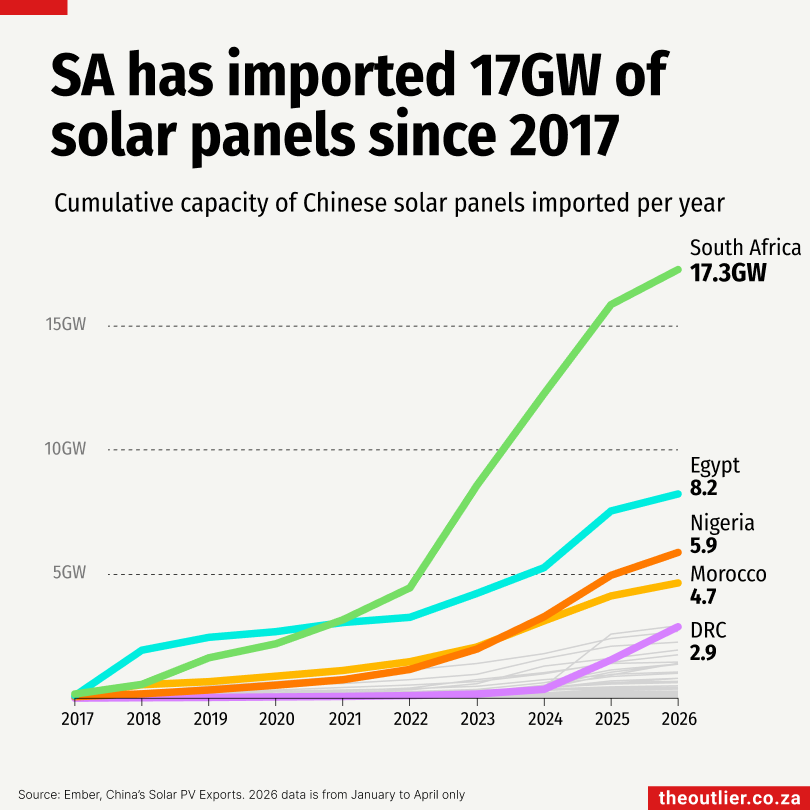
In the latest Outlier Renew deep dive we look at the solar panel imports and installations and ask: who is using all this power?
SUBSCRIBE TO OUTLIER RENEW FOR FREE
🐌 Slow justice
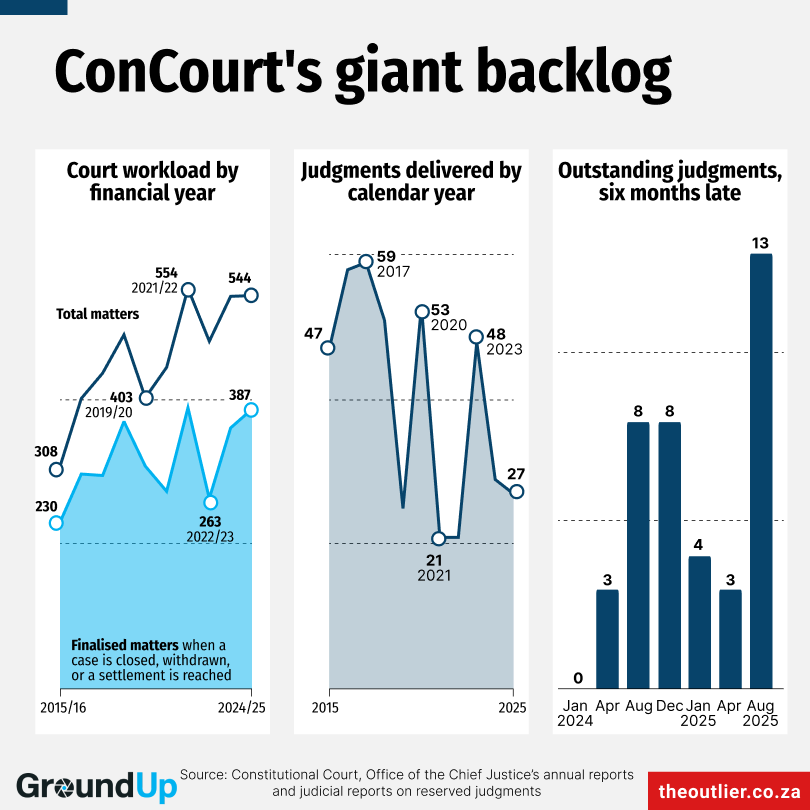
The Constitutional Court has become notoriously slow at handing down judgments. In August 2025, the latest month reported, 13 cases had been awaiting judgment for longer than six months. Yet the Judicial Norms and Standards state that judges should rule within three months of a final hearing.
It sets a poor example for lower courts when the country’s apex court takes so long to deliver.
Constitutional Court judges have at least two interns, usually top students freshly graduated from the country’s law faculties. There are also about a dozen international interns, also highly competent lawyers. The court also has the finest law library in the country, with highly proficient staff. The court’s judges have a salary package worth over R2.7-million a year.
The court is, in other words, very well-resourced, and its judges are well remunerated. That the court is unable to deliver its judgments on time strongly suggests that management of the court needs to improve and some of the judges need to work more efficiently.
Read the full GroundUp article here.