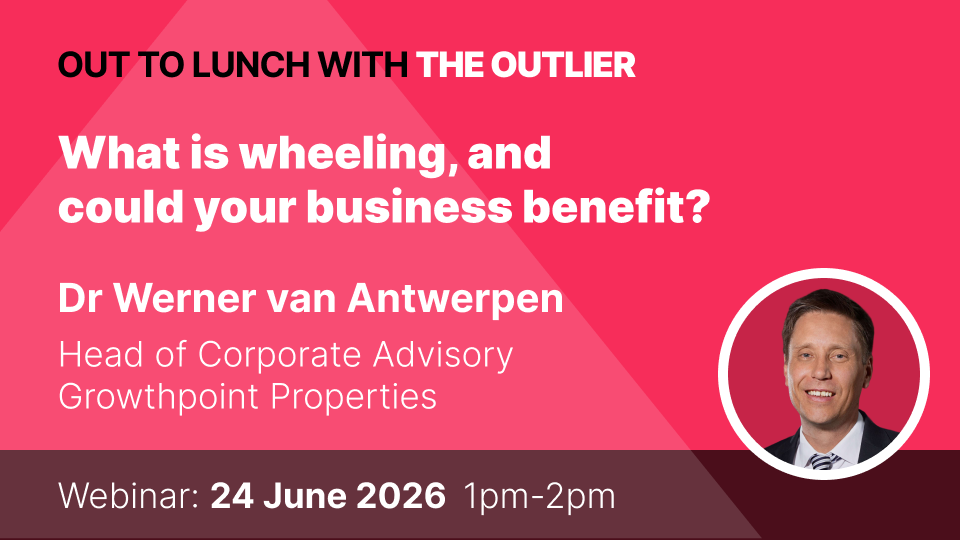
“Wheeling is not a physics thing – it’s not about an electron moving from one place to another,” explained Dr Werner van Antwerpen, head of corporate advisory at Growthpoint Properties, on The Outlier’s latest Out to Lunch webinar. “It’s more of an accounting thing. You put electricity in at a specific meter – say, R1,000 – and you allocate that R1,000 to two buildings, R500 each, and then eventually you get a credit on the two buildings that you nominated.”
Electricity traders, he said, are essentially “a massive accounting and balancing engine” that tracks what comes in and makes sure the credits land where they’re supposed to.
From a niche biogas deal to a national movement
South Africa’s first wheeling contract, by van Antwerpen’s research, was signed in 2015, when a biogas plant in Bronkhorstspruit wheeled power to BMW’s manufacturing facility. It stayed a niche arrangement – typically one generator wheeling to one or two clients – until the electricity market opened up in 2022, when new legislation let independent power producers build projects to sell directly to private off-takers instead of going through the government’s renewable energy programme.
“The landscape currently is changing dramatically, where you have several generators that need to be wheeled to several hundred buildings and endpoints,” he said. “Much more complex – so your accounting systems need to be much more advanced.”
Property owners, their tenants and wheeled electricity
Because tariffs charged to tenants are regulated by the National Energy Regulator of South Africa, a landlord can’t simply charge their tenants less because the power is wheeled. As with rooftop solar, a tenant “usually doesn’t know if their energy comes from the national grid or if there’s a wheeled component of electricity tied to that specific building”, van Antwerpen said.
To close that gap, Growthpoint built a product called e-CO2, which passes two things on to tenants: renewable energy certificates (RECs) that they can use to cut their reported scope 2 emissions, and a financial credit on their rental invoice – “almost like some of the retail banks do” with cashback.
The renewable energy certificates run on a blockchain platform that feeds the international I-REC registry in London, which prevents double counting. “If it’s been redeemed, it’s taken out of the whole blockchain circular environment,” he said – and the certificates expire after a period of time, so tenants can’t bank them across multiple reporting years.
Scope 2 emissions would come from buying power from Eskom or the municipality. “Most of your emissions in a building will be scope 2 emissions,” he said – which is exactly the category RECs are designed to offset.
The e-CO2 programme currently covers nine office buildings in Sandton, chosen as a pilot strategically to help lease vacant space. There’s no technical reason why we can’t expand it elsewhere, van Antwerpen said, it was a strategic choice, not a limitation.
Growthpoint also has a renewable energy certificate partnership with Nedbank covering retail premises it leases. Van Antwerpen says they are talking to other financial institutions. “I think the big corporates are going to probably be the first movers,” he said.
Why tenants can’t cut their own deal
Tenants can’t contract directly with a wheeling trader, van Antwerpen said, because the landlord holds the electricity supply agreement and is on the hook for the bill. Growthpoint instead contracts with trading platform Etana Energy, which aggregates generators on one side and signs customer agreements – including with Growthpoint – on the other. Any tenant benefit then flows through whatever programme the landlord chooses to offer, such as e-CO2.
Pooled wheeling: the Cape Town fix
The standard wheeling process is strikingly manual: a generator’s meter is read monthly, an allocation report is signed off at Eskom, and credits are applied to accounts – a process that gets unwieldy fast once hundreds of buildings are involved.
So Growthpoint, its trader and the City of Cape Town spent roughly 18 months building something new: “pooled wheeling.” Under the model, the municipality bills a building only for fixed connection charges, while all wheeled and non-wheeled electricity charges are pushed to the trader to administer. “The administrative burden is taken away from the municipality and put onto the trader, which is their bread and butter,” van Antwerpen said. “The municipality doesn’t need to build a massive administration team just to deal with wheeling.”
Cape Town was an early, willing partner – the city had already hosted South Africa’s first municipal wheeling deal, from Constantia Village Shopping Centre to what is now the Ninety One building on 36 Hans Strijdom. “They understood the problem. They wanted to be proactive,” van Antwerpen said. He believes the model can be copied elsewhere. Other municipalities are starting to engage with the team, said van Antwerpen.
What the new wholesale market changes
South Africa’s incoming Wholesale Electricity Market will add three trading layers on top of today’s bilateral power purchase agreements: day-ahead trading, where generators price tomorrow’s electricity in advance, and a real-time balancing market. The latter, van Antwerpen said, is where things get genuinely new: “If I’m an independent power producer, I need to vouch that I will actually generate a thousand kilowatt-hours tomorrow. And if I don’t – if I generate 950 – there needs to be some other mechanism to quickly push 50 kilowatt-hours into the network,” whether from battery storage or a fast-ramping gas turbine.
That variability – a forecast sunny day that turns to rain, a wind farm that goes still – will only grow as more renewables come online, he said: “It’s probably not as bad now as it will be in five to ten years’ time… more and more variability and risk also comes with it.”
Advice for landlords weighing wheeling
For a landlord considering wheeling for the first time, van Antwerpen frames it as one choice: contract directly with an independent power producer, or go through a trader. Growthpoint chose the latter. “The electricity trader is becoming a massive accounting machine,” he said – and unless a landlord has the scale to justify building that expertise in-house, a trader’s existing systems and lower per-unit overhead usually win out.
This story is based on The Outlier’s Out to Lunch webinar, in which journalist Gemma Ritchie interviewed Dr Werner van Antwerpen, head of corporate advisory at Growthpoint Properties.