
Get involved: Volunteer your expertise to help us cover stories better.
🚽 Many years ago we started working on stories about pit toilets in South African schools. Over the years we’ve watched as work to replace pit toilets has progressed. Nationally the SAFE Initiative was one of the primary lists of schools that needed fixing, even if it most likely wasn’t a comprehensive list. As things currently stand the SAFE backlog has been completed, which is welcome and much needed progress. But the work is not entirely over, as another 400+ schools have been identified as having pit latrines. This week we look at those.
💸 Two years ago reader David emailed me about the number of credit providers registered in the country. At the time we discussed how crazy it was that there were more than 7,500. This week I revisited the topic only to find that close to 3,000 credit providers had been added to the list in the past two years.
In today’s newsletter we look at:
- School pit toilets
- Credit providers and debt
- Spam calls in SA
- Pikitup’s hiring backlog
- Young and unemployed
The pit toilet problem isn’t over
It took seven-and-a-half years, but the job is (mostly) done. In July, Basic Education Minister Siviwe Gwarube announced that all 3,372 schools on the 2018 SAFE Initiative list (SAFE stands for Sanitation Appropriate for Education) had been given proper toilets. That’s an average of 450 schools a year.
But the SAFE list was probably never a complete record of schools with pit toilets. The minister has said so herself, repeatedly, in answers to parliamentary questions.
In January she said 448 public schools still had pit latrines as of the end of July 2025, none of them covered by SAFE. When we checked the list, one school appeared twice, so the real number is 447. And, strangely, 17 of those schools also appear on the SAFE list.
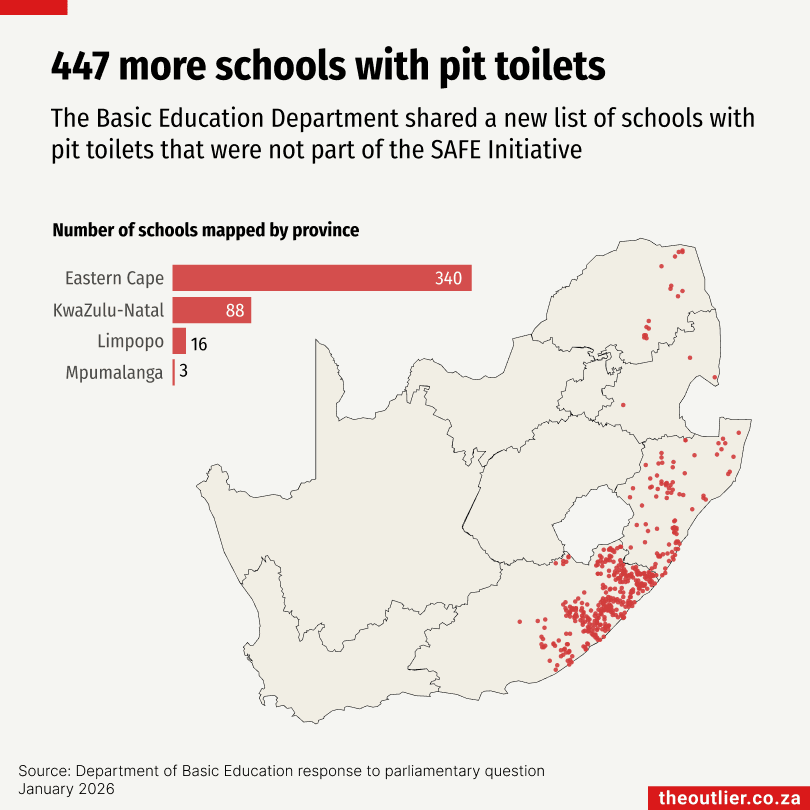
The definitions are blurry too. Some of the 447 may already have proper toilets, with the old pits simply not yet demolished.
What’s clear is that the work continues.
Read the full story and interactive map for a breakdown of the 447 schools still in need of attention.
💸 Cashing in
There are now more than 10,200 registered credit providers in South Africa. And just 1,800 debt counsellors. The number of debt counsellors is actually down 25% from the number that were registered in 2014, while credit providers have surged by 4,000 in the past four years.
If you borrow money in South Africa, whether it’s a home loan from a bank, a store account, or a small cash loan, the lender is supposed to be registered with the National Credit Regulator (NCR).
Note: This data is not a complete record. It is sourced from historical versions of the NCR webpage that are available via web archiving tools.
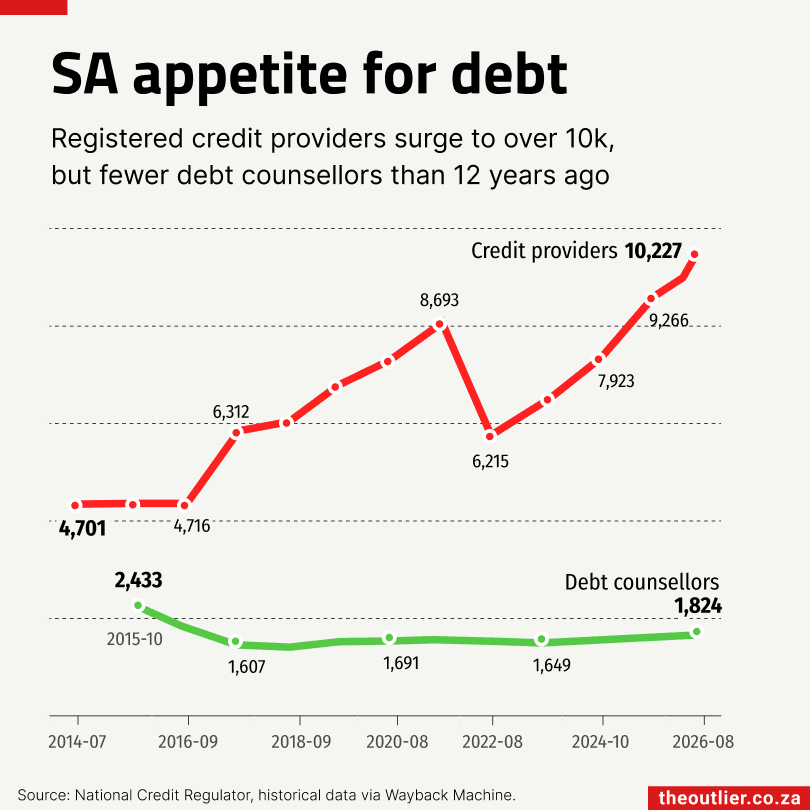
A spike in credit providers and no measurable increase in debt counsellors might be a cause for concern because more South Africans than ever are struggling with debt. According to the latest Eighty20/XDS Credit Stress Report, 35% of the country’s 56-million open loans were in arrears at the start of 2026, with 14.8-million more than three months behind on payments. In the poorest group of borrowers, which Eighty20 calls the Mass Credit Market, the figure is even higher: 52% were in default at the start of 2026. Across the country there were 56-million open loans, and 19.6-million of them were behind on payments. On average, credit-active consumers were spending 28% of their monthly take-home pay just on debt repayments.
So right now more lenders than ever are handing out credit; four in ten borrowers are falling behind, but the number of professionals helping them dig their way out hasn’t grown at all.
🗑️ Rubbish jobs
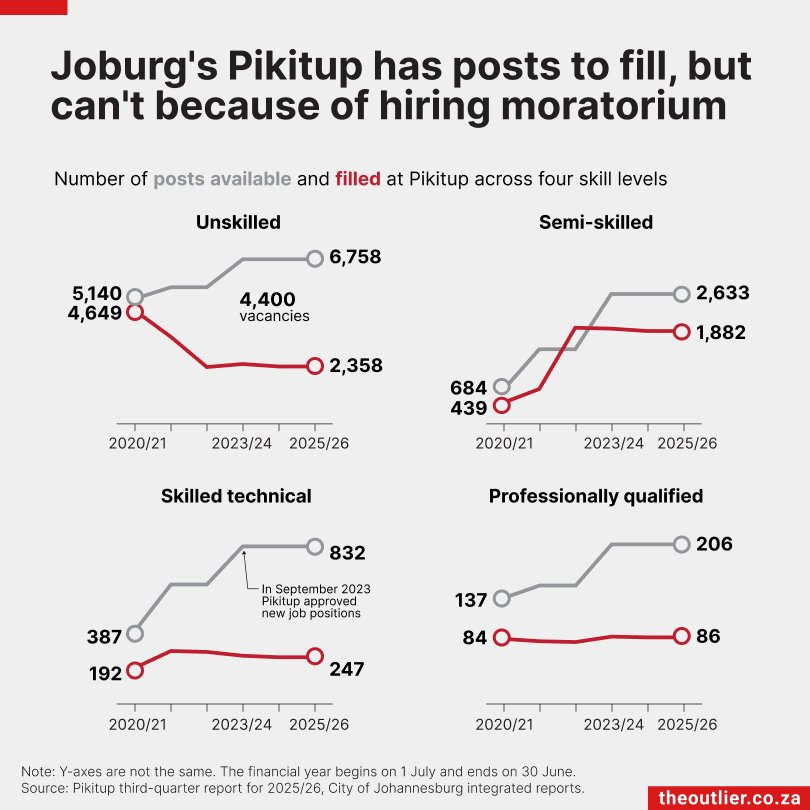
Pikitup is employing fewer people in 2025/26 than it did six years ago. On paper, the biggest drop has been among unskilled workers, whose numbers halved from 4,649 to 2,358. Meanwhile, semi-skilled staff surged from 439 to 1,882. Much of this shift is from a September 2023 restructure, which included the reclassification of unskilled roles and expanded Pikitup’s overall approved jobs from 6,348 to 10,429 across its professionally qualified, senior technical, semi-skilled and unskilled employees.
Yet in 2025/26, only 44% of those 10,429 jobs are actually filled. To cut costs, the City of Johannesburg placed a moratorium on filling vacancies, according to Pikitup’s third-quarter report for 2025/26.
But the freeze hasn’t stopped overspending. Pikitup has overspent its overtime budget by R30-million. Unbudgeted City-mandated wage increases also saw the payroll overspent by R59-million in the 2025/26 year to date. It has left Pikitup with no funds to hire staff, despite what it calls “critical vacancy levels”.
Produced in partnership with Our City News.
📌 Where are SA’s young people?
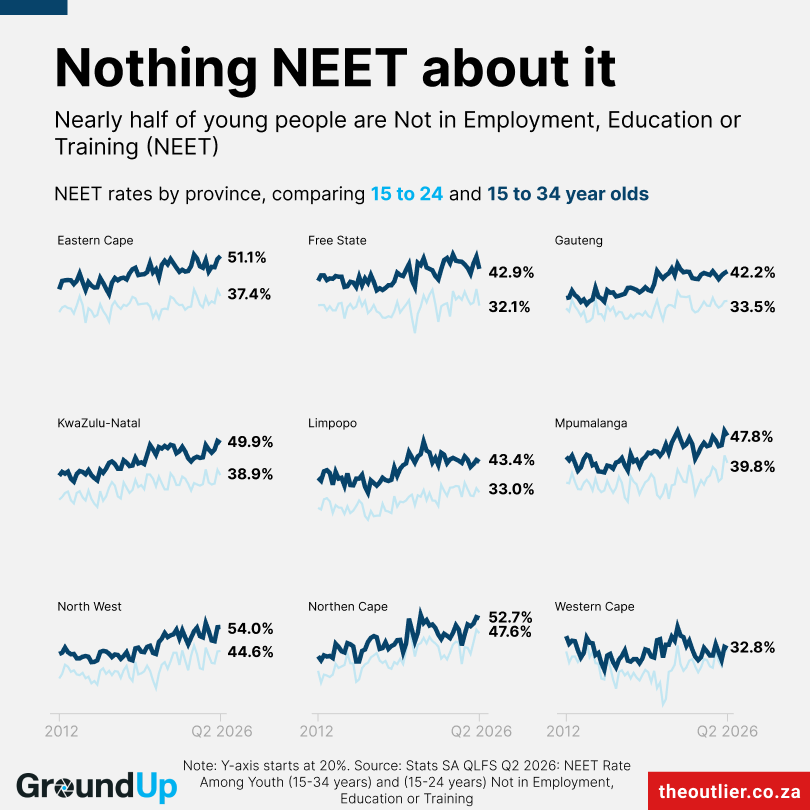
45% of people in South Africa aged 15-34 are NEET (not in employment, education or training) according to Statistics South Africa. In 2012, it was 38%.
NEET includes those who did not work in the survey reference week and are not enrolled in education or training. It also covers people who are inactive for other reasons — caring for family, illness, or disability. Anyone who did even an hour of paid work is excluded, as is anyone in education or training, whether they work or not.
In most provinces, there is a gap between the 15-24 and 15-34 brackets. This is because people aged 15-24 are more likely to still be in school or in tertiary education. As they exit education, they enter the NEET bracket because, in most provinces, there are not enough jobs.
The Western Cape shows an anomaly, though. There is almost no gap between the two age brackets. As this is the province with the lowest overall unemployment rate, young people exiting education are more likely to be absorbed into the job market.
Read the full GroundUp article here.
📱 Calling spam
South Africans were bombarded with more than 17-billion unwanted calls in the first six months of 2026. That’s a 25% jump from 14-billion in the same period last year, according to Truecaller and reported by News24.
The surge fits a global pattern the company describes in its 2025 Global Insights Report as the “machine era” of spam: automated fraud at a scale no human caller could match. Worldwide, Truecaller identified over 68-billion spam and fraud calls in 2025, up 80% from 2021.
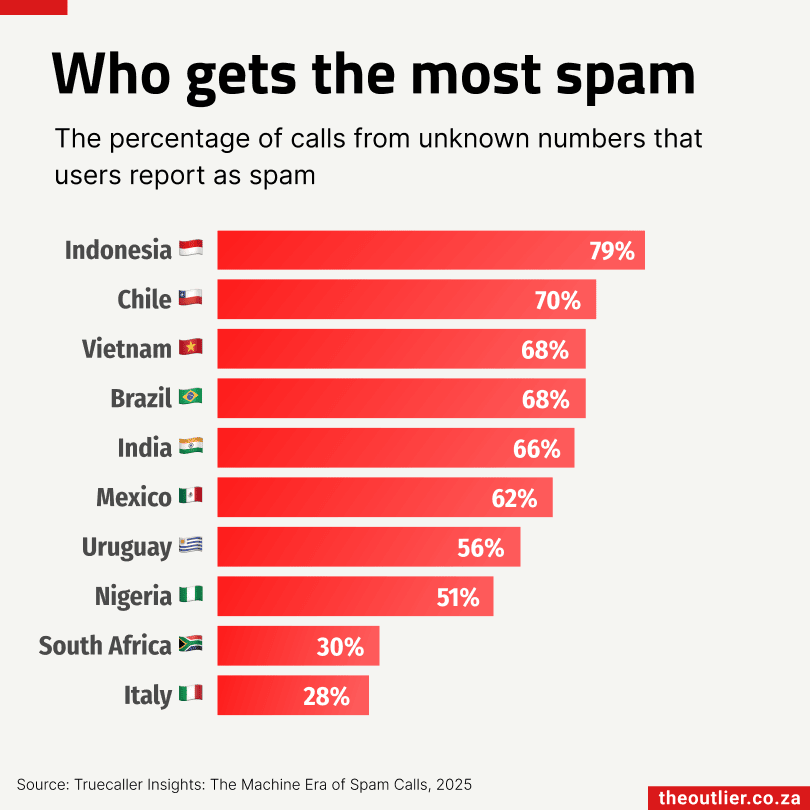
South Africa ranks ninth among the world’s most spammed countries, with 30% of unknown calls flagged as spam or fraud, second in Africa behind Nigeria (51%).
The category breakdown for South Africa is distinctive: insurance is the top reported spam category at 14%, followed by financial services (10%) and debt collection (6%).
Personally, 30% of calls identified as spam feels remarkably low. Truecaller isn’t explicit about how this is calculated, other than saying that a user that receives 10 calls and 7 are spam, then the ‘intensity’ of spam is 70%. What’s not clear is the effect of multiple repeat calls from the same number.
The full Truecaller report is available here.
Click here for a link to all references for this newsletter.